
How to identify market trends for business success
Many entrepreneurs launch products without understanding market trends, leading to preventable failures. Identifying market trends early dramatically improves your chances of building a sustainable business by revealing what customers actually want and where demand is heading. This guide walks you through practical, actionable strategies to spot emerging trends, validate opportunities, and launch your business idea with confidence in 2026. You’ll learn how to distinguish real trends from fads, gather meaningful data, and test ideas quickly before committing significant resources.
Table of Contents
Preparing To Identify Market Trends: Research And Analysis Essentials
Executing Trend Identification: Spotting Opportunities And Validating Ideas
Common Mistakes And How To Avoid Them When Identifying Market Trends
Discover Tools To Identify And Validate Your Market Trends In 2026
Key takeaways
Point | Details |
|---|---|
Trends versus fads | Market trends are fundamental shifts lasting months or years, while fads fade quickly and rarely support viable businesses. |
Data-driven preparation | Identifying trends requires analyzing consumer behavior, economic indicators, and competitive landscapes systematically over time. |
Validation through testing | Competitive analysis and direct customer feedback are essential tools for confirming trend viability before full launch. |
Hidden opportunities | Look for market inefficiencies, personal pain points, and overlapping trends to discover underserved business opportunities. |
Early testing reduces risk | Quick, low-cost experiments like MVPs help refine ideas and minimize losses before scaling. |
Understanding market trends and their impact
Before you can identify profitable opportunities, you need to understand what market trends actually are and how they differ from fleeting fads. Trends are longer-lasting shifts that build momentum over months or years, fundamentally changing how consumers behave or what they value. Think remote work tools or sustainable packaging. Fads are short, intense bursts of popularity that fade within weeks or months, like viral dance challenges or novelty products that spike on social media then disappear.
Macro shifts influence multiple industries or entire economies over years or decades, such as digital transformation or demographic aging. These create the context for numerous smaller trends and business opportunities. Understanding these distinctions helps you avoid building a business around something that will vanish before you achieve profitability. Trends provide stable ground for planning because they reflect genuine, sustained changes in customer needs and market conditions.
Why does this matter for your business decisions? Fads might generate quick revenue, but they rarely support long-term growth or justify significant investment. Trends, however, signal where customer behavior is heading, allowing you to position your business for sustained demand. Macro shifts help you understand the broader forces shaping your industry, so you can anticipate changes rather than react to them. Mastering trend identification basics gives you a competitive advantage by revealing opportunities others miss and helping you allocate resources where they’ll generate the best returns.
Recognizing these categories guides smarter entrepreneurial decisions:
Trends justify long-term investment because they represent fundamental shifts in customer priorities
Fads can supplement revenue but shouldn’t form your core business model
Macro shifts reveal the playing field where multiple trend-based opportunities will emerge
Understanding all three helps you time your market entry and scale appropriately
Preparing to identify market trends: research and analysis essentials
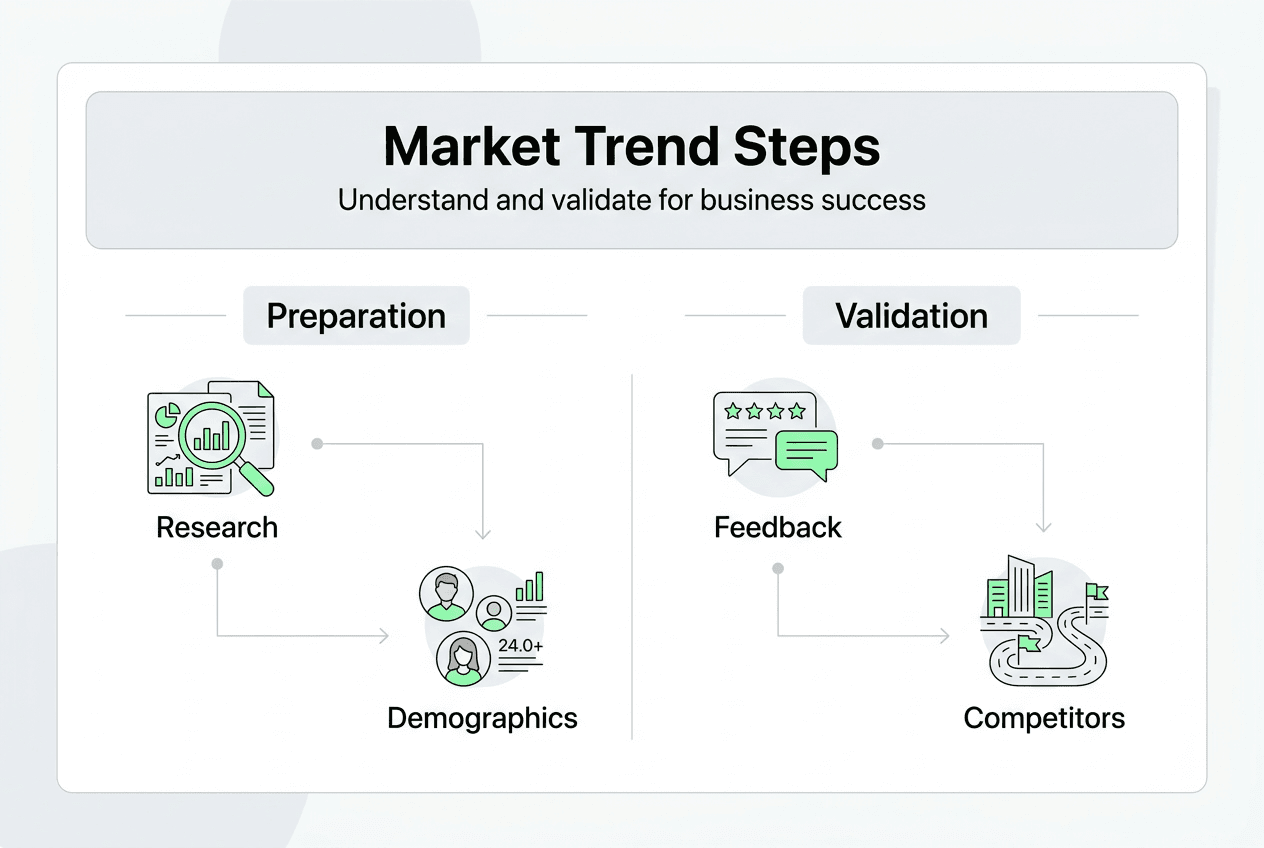
Effective trend identification starts with thorough preparation and systematic data collection. You can’t spot meaningful patterns without gathering the right information first. A 7-step data-backed guide outlines key industry trend research steps, including defining your scope, identifying data sources, analyzing competitors, tracking technology shifts, monitoring regulatory changes, gathering customer insights, and synthesizing findings into actionable intelligence.
Gathering demographic information helps you understand customer opportunities by revealing who your potential buyers are, what they value, and how their needs are evolving. Look at age ranges, income levels, geographic distribution, lifestyle preferences, and purchasing behaviors. This data shows you whether sufficient demand exists for your idea and how to position your offering to match customer expectations. Understanding market research fundamentals accelerates this process by teaching you which metrics matter most and where to find reliable information.

Competitive analysis helps you learn from businesses competing for your customers and defines your edge. Evaluate direct competitors offering similar products, indirect competitors solving the same problem differently, and potential future competitors who might enter your space. Assess their market segments, pricing strategies, strengths, weaknesses, and barriers to entry. This reveals gaps in the market where customer needs aren’t fully met and shows you what differentiation strategies actually work.
Data Type | Purpose | Sources |
|---|---|---|
Demographic data | Identify target customer characteristics and size potential market | Census data, industry reports, social media analytics |
Consumer behavior | Understand purchasing patterns and decision drivers | Surveys, focus groups, purchase history analysis |
Competitive landscape | Map existing solutions and identify market gaps | Competitor websites, industry publications, customer reviews |
Economic indicators | Assess market health and growth potential | Government statistics, financial news, trade associations |
Technology trends | Spot emerging tools changing customer expectations | Tech blogs, patent filings, startup funding news |
Pro Tip: Use multiple data sources to avoid research blind spots that could lead you to misread trends or miss critical market shifts. Cross-reference government statistics with industry reports, competitor analysis, and direct customer conversations to build a complete, accurate picture of where your market is heading.
Executing trend identification: spotting opportunities and validating ideas
Once you’ve gathered foundational data, you can actively spot opportunities by recognizing inefficiencies, pain points, and trend convergence. The best opportunities often hide in plain sight as personal inconveniences, like Airbnb’s origin story where founders couldn’t afford rent and noticed conference attendees struggled to find hotel rooms. Start by examining your own frustrations and those of people around you. What products or services are unavailable, inconvenient, or unnecessarily expensive?
Follow these steps to identify market inefficiencies and personal pain points:
Document recurring problems you encounter in daily life or work that lack satisfactory solutions
Interview potential customers about their biggest frustrations in areas you’re exploring
Analyze online reviews and social media complaints to find common pain points
Look for industries where customer satisfaction scores are consistently low
Identify services that require excessive time, cost, or effort relative to the value delivered
Spotting convergence of multiple trends creates opportunities with greater impact and defensibility. When remote work, digital payments, and flexible scheduling all accelerated simultaneously, they created space for entirely new business models like virtual coworking platforms and distributed team management tools. Watch for intersections where two or three trends amplify each other, creating demand that didn’t exist when each trend operated independently.
Testing and validating ideas cheaply is crucial before scaling. Create minimum viable products, simple prototypes, or pop-up market stalls to gauge real customer interest without massive investment. Airbnb started by renting air mattresses in the founders’ apartment and photographing cereal boxes to fund early operations. These low-cost experiments provided proof of concept before they built complex technology or raised significant capital.
Market research and consumer feedback build confidence and guide product refinement by showing you what resonates with customers and what needs adjustment before you scale.
Validation through early customer interaction accelerates learning and reduces waste. When Pip & Nut founder Pippa Murray sold her nut butter at farmers markets, direct conversations revealed which flavors customers preferred, what price points worked, and how to communicate product benefits effectively. This feedback shaped her product development and marketing strategy long before she approached retailers. Understanding product market fit validation and following proven business idea validation steps systematically increases your odds of building something customers actually want.
Pro Tip: Prioritize rapid response to market signals by building feedback loops into every experiment. The faster you can test, learn, and iterate, the more efficiently you’ll refine your offering and the less money you’ll waste pursuing ideas that won’t work.
Common mistakes and how to avoid them when identifying market trends
Even with solid preparation, entrepreneurs frequently make avoidable mistakes that undermine their trend identification efforts. Ignoring market research and unclear target audience definition can hinder startup success by causing you to build products nobody wants or market to the wrong people. Many founders skip research because they’re excited about their idea or assume their own preferences represent broader market demand. This leads to expensive pivots or outright failure when reality doesn’t match assumptions.
Neglecting market research creates blind spots about competitive dynamics, customer preferences, and market size. You might discover too late that your idea already has dominant competitors, that customers aren’t willing to pay your target price, or that your addressable market is too small to sustain growth. Invest time upfront in understanding your market landscape, even if it delays your launch. The insights you gain will save you from costly mistakes and help you position your offering more effectively.
Failing to clearly define your target audience dilutes your messaging and wastes marketing resources. When you try to appeal to everyone, you end up resonating with no one. Instead, create detailed customer profiles describing demographics, behaviors, pain points, and purchasing triggers for your ideal buyers. This focus helps you craft compelling value propositions and choose marketing channels where your audience actually spends time.
Relying solely on secondary research without competitor analysis leaves gaps in your understanding. Published reports and statistics provide valuable context, but they don’t show you how competitors are positioning themselves, what customer complaints reveal about unmet needs, or where market gaps exist. Combine secondary research with primary investigation, including competitor website analysis, customer review mining, and direct conversations with potential buyers.
Failing to adapt your product based on real customer feedback wastes the learning opportunities that early testing provides. Some entrepreneurs become so attached to their original vision that they ignore signals telling them to pivot or adjust. Customer feedback isn’t always right, but patterns in feedback reveal important truths about market readiness, product positioning, and feature priorities. Build mechanisms to collect, analyze, and act on customer input throughout your development process.
Avoid these mistakes by following risk reduction strategies that emphasize validation over assumption:
Commit to research before building by allocating time and budget for market investigation
Define your target customer precisely using demographic and psychographic criteria
Conduct both secondary research and primary competitive analysis for complete market understanding
Create feedback loops that capture customer input at every stage of development
Stay flexible and willing to pivot when data contradicts your assumptions
Discover tools to identify and validate your market trends in 2026
After learning how to identify and validate market trends manually, you might wonder how to accelerate the process and reduce guesswork. siift.ai offers an intelligent platform designed specifically to help aspiring entrepreneurs analyze market trends and validate business ideas quickly. The AI-powered Business Canvas guides you step-by-step through ideation, validation, and go-to-market planning, systematically accelerating your journey to product-market fit.
The platform provides personalized feedback, new insights, and prioritized actions to reduce the risk of building a business by filtering out biases, blind spots, distractions, and uncertainty. Instead of spending weeks gathering data from multiple sources and trying to synthesize patterns yourself, siift.ai streamlines trend analysis and validation into an intuitive workflow. This lets you focus your energy on making strategic decisions and testing ideas rather than wrestling with research logistics. Explore how the platform complements what you’ve learned here to turn your business idea into reality faster and with greater confidence.
FAQ
How can I differentiate between a market trend and a fad?
Trends build momentum gradually and last months to years, fundamentally changing consumer behavior across broad segments. They reflect deeper shifts in values, technology, or economic conditions that create sustained demand. Fads spike quickly and fade within weeks or months, driven by novelty or social contagion rather than lasting value. They rarely provide stable foundations for business planning because interest evaporates before you can build sustainable operations.
What are the best ways to validate a business idea based on an identified trend?
Use minimum viable products, simple prototypes, or market stalls to test consumer interest with minimal investment. These approaches let you gather real purchase behavior data rather than hypothetical survey responses. Collect early customer feedback through direct conversations, usage analytics, and structured interviews to refine your offering. This iterative process helps you pivot or adjust before committing significant resources to scaling.
How do market inefficiencies create new business opportunities?
Inefficiencies occur when existing products or services are unavailable, inconvenient, overpriced, or poorly designed for customer needs. These gaps frustrate customers and signal unmet demand that entrepreneurs can address. By offering better alternatives, more convenient access, or innovative solutions to persistent problems, you can capture market share from incumbents or create entirely new categories. The key is identifying inefficiencies that affect enough customers to support a viable business.
Why is it important to combine multiple data sources when researching trends?
Combining data sources gives you a more complete and accurate market picture by revealing patterns that single sources might miss or misrepresent. Different sources provide complementary perspectives: government statistics show macro patterns, customer interviews reveal motivations, and competitor analysis exposes market gaps. Relying solely on one source risks confirmation bias, outdated information, or blind spots that lead to poor decisions. Cross-referencing multiple sources helps you separate signal from noise and build confidence in your conclusions.