
TL;DR:
- A startup is a company focused on rapid, scalable growth amid high uncertainty.
- Differentiating between startups and small businesses is crucial for setting appropriate goals and strategies.
- AI tools now enable solo founders to build and grow startups more efficiently by automating tasks.
Most people assume that any new business is automatically a startup. Open a bakery, launch a consulting practice, register an LLC — startup, right? Not even close. A startup is a company designed for rapid growth, distinguished from ordinary businesses by its intent to scale quickly into something much larger. That distinction changes everything: the strategy, the funding, the risk tolerance, and the tools you’ll need. If you’re an aspiring founder trying to figure out where your idea actually fits, this guide cuts through the noise and gives you the clarity to move forward with confidence.
Table of Contents
- Defining a startup: Beyond the buzzword
- How startups differ from small businesses
- Growth, scale, and the role of AI in modern startups
- Inside the startup methodology: Lean, MVP, and beyond
- Who can launch a startup? Edge cases and expert insights
- Startup wisdom: What most new founders miss
- Ready to launch your idea? Get the right tools and support
- Frequently asked questions
Key Takeaways
| Point | Details |
|---|---|
| Startups seek rapid growth | A real startup is defined by ambitious goals for fast, scalable expansion, not just being new. |
| Not all new businesses qualify | Startups differ from small businesses by their focus on innovation, outside investment, and nationwide or global market reach. |
| Lean methods drive progress | Successful founders rely on iterative cycles—build, measure, learn—to reduce risk and maximize learning. |
| AI empowers solopreneurs | AI tools now enable individuals to launch and scale startups with smaller teams and greater efficiency. |
| Founders matter most | Ambition and adaptability are what distinguish successful startup founders, regardless of industry or tech trends. |
Defining a startup: Beyond the buzzword
The word “startup” gets thrown around so casually these days that it’s nearly lost its meaning. Every new venture is called a startup. Every side project gets the label. But the concept has a precise, important definition, and understanding it will save you from building the wrong thing entirely.
Eric Ries, author of The Lean Startup, offers one of the most widely cited definitions: a startup is a human institution designed to create a new product or service under conditions of extreme uncertainty. Notice what that definition emphasizes. Not the size of the team. Not the industry. Not whether you’re using AI. It’s about uncertainty and novelty at the institutional level.
“A startup is a company designed for rapid growth. Being newly founded does not make something a startup. Nor is it necessary to raise VC funding or have a cool new technology. The only essential thing is growth.” — Paul Graham, Y Combinator
Wikipedia adds another layer: a startup seeks to validate a scalable business model, often with innovation, rapid growth potential, and external funding. The scalability piece is critical. Your business model has to be capable of serving 10x or 100x more customers without requiring 10x or 100x more effort and cost.
So what are the real building blocks of a startup? A few essential elements stand out:
- Rapid growth intent: The goal from day one is aggressive expansion, not just sustainability.
- Scalable model: Revenue should grow faster than costs as you add customers.
- High uncertainty: You’re operating in unproven territory, testing assumptions constantly.
- Innovation orientation: You’re solving problems in new ways, not copying established formulas.
- External fundability: The model is often designed to attract investors, though not always required.
One common misconception is that startups must be tech companies. They don’t. A startup selling physical products can qualify if its model is designed for rapid, scalable growth. Conversely, many software companies are built for steady local or niche revenue, making them small businesses in practice. Learning about AI for founders can help you understand where modern tools intersect with the startup path, but the definition itself transcends any single technology.

How startups differ from small businesses
This is where a lot of aspiring founders get genuinely confused, and it matters enormously. Choosing the wrong model means building toward the wrong goal, which is a fast track to frustration. Startups seek rapid scalable growth and external funding, while small businesses focus on steady local profitability. Both are legitimate. Neither is inherently superior. But they require radically different strategies.
Here’s a side-by-side breakdown:
| Factor | Startup | Small business |
|---|---|---|
| Growth goal | Rapid, exponential | Steady, sustainable |
| Funding approach | Venture capital, angel investors, seed rounds | Personal savings, bank loans, local grants |
| Risk tolerance | High, by design | Moderate, minimized |
| Market scope | Regional, national, global | Local or niche |
| Innovation level | Core to the model | Optional, incremental |
| Team structure | Lean, fast-moving, equity-based | Stable, role-defined, salary-based |
| Revenue model | Scalable, often recurring | Linear, often transaction-based |
| Exit strategy | Acquisition, IPO | Lifestyle business, family succession |
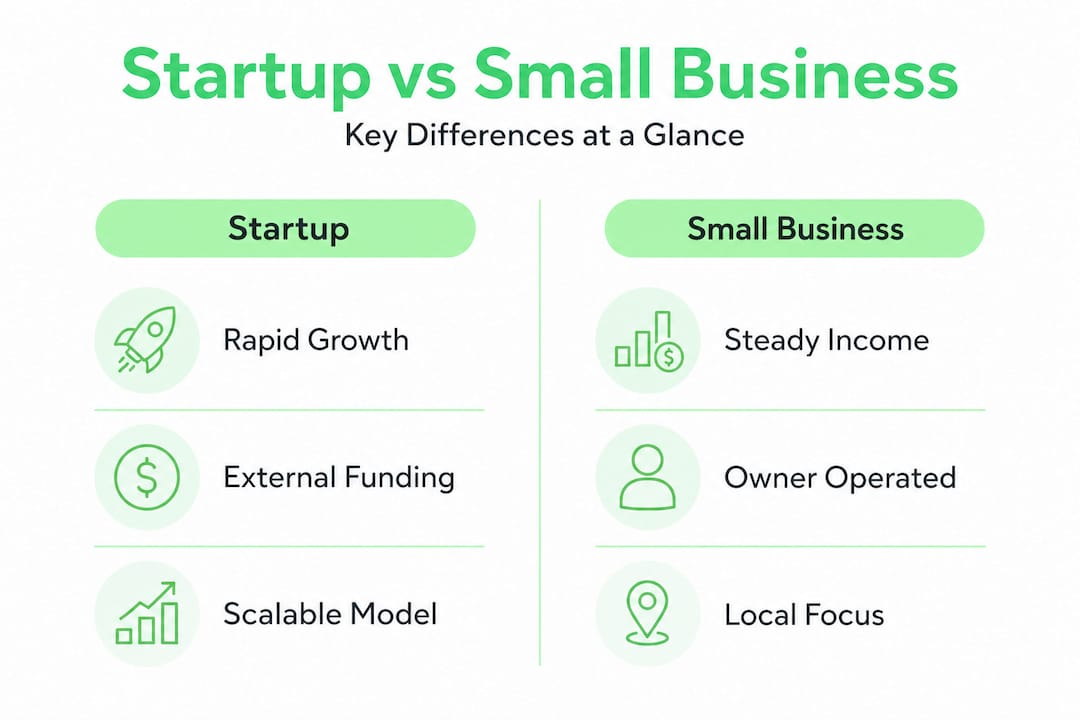
A small business thrives on consistent execution, loyal customers, and controlled margins. Think your neighborhood coffee shop, a local accounting firm, or a boutique clothing store. The founder often is the business, and that’s exactly the point. There’s real dignity and financial reward in that model.
A startup, by contrast, is designed to eventually run without the founder being central to every transaction. It’s built to grow beyond what any single person could manage. Understanding this distinction is foundational to your journey as a founder, and exploring the nuances of startup vs. small business models can sharpen your thinking before you commit to a path.
Pro Tip: Not every great idea needs to become a startup. If your vision is freedom, community, and a good income, a small business might serve your life better than the high-stakes startup track. Choose the model that fits your actual goals, not the one that sounds most impressive at dinner parties.
Growth, scale, and the role of AI in modern startups
Growth isn’t a nice-to-have for startups. It’s the whole point. Paul Graham is famously direct about this: good startups achieve 5-7% weekly growth, while exceptional ones hit 10% per week. Let those numbers sink in for a moment. At 7% weekly growth, your business more than doubles every three months. That’s not organic word-of-mouth. That’s a machine.
To put it into perspective, consider these growth benchmarks:
| Weekly growth rate | Annual growth multiple | Category |
|---|---|---|
| 1% weekly | ~1.7x per year | Small business pace |
| 5% weekly | ~12.5x per year | Good startup |
| 7% weekly | ~33x per year | Strong startup |
| 10% weekly | ~142x per year | Exceptional startup |
These numbers illustrate why startup founders obsess over growth metrics from the earliest days. A company growing at 10% per week doesn’t stay small for long.
Now here’s where the landscape has shifted dramatically for the 25-to-35-year-old founder: AI. AI-enabled startups operate with 6% fewer employees on average, because automation handles tasks that used to require full-time hires. Customer service, data analysis, content creation, code review, marketing personalization — all of it can now be partially or fully automated by a solo founder with the right stack.
How do you know if your idea has genuine startup DNA? Ask yourself these questions in order:
- Can this serve 10,000 customers without 10,000 times the effort? If yes, you have a scalable model worth exploring.
- Does solving this problem require something genuinely new or faster? If yes, you have innovation potential.
- Would customers in other cities or countries want this? If yes, you have geographic scalability.
- Can you build a first version quickly and learn from real users? If yes, you have the right mindset.
- Is there a clear path to revenue that doesn’t depend solely on your personal time? If yes, you may have a startup idea.
The rise of AI tools for solopreneurs has made steps one through five more achievable than ever. Tools that used to require teams can now be managed by a single motivated founder. Platforms that support AI for first-time founders now guide users through strategy, validation, and go-to-market execution systematically. Meanwhile, purpose-built AI product development platforms are enabling entrepreneurs to ship working prototypes in days rather than months.
Pro Tip: Use AI to do the analytical heavy lifting: customer segmentation, competitive research, demand validation, and content distribution. Focus your own energy on the founder’s irreplaceable work, which is understanding your customer’s pain at a deep, human level.
Inside the startup methodology: Lean, MVP, and beyond
So you have an idea with startup potential. How do you actually build it without burning through time and money testing assumptions that might be completely wrong? That’s where startup methodology becomes your best friend.
The most influential framework in modern startup building is the Lean Startup methodology developed by Eric Ries. At its core, it uses a three-step loop:
- Build: Create the smallest possible version of your product that can be tested with real users.
- Measure: Collect actual data on how users interact with it, what they love, and what they ignore.
- Learn: Use that data to either continue on your current path (persevere) or change direction (pivot).
Then repeat. Fast.
“The goal of a startup is to figure out the right thing to build, the thing customers want and will pay for, as quickly as possible.” — Eric Ries, The Lean Startup
The MVP, or minimum viable product, is the engine of this process. An MVP isn’t a rough draft of your final product. It’s a deliberate, stripped-down version designed to test your single most important assumption. Dropbox famously launched with just a demo video. Airbnb started by renting out air mattresses in the founders’ own apartment. Neither was a finished product. Both validated massive market demand before anyone wrote a line of complex code.
Why does this matter for you as an aspiring founder? Because the instinct to perfect something before sharing it is deeply human — and deeply dangerous in the startup context. The market will always surprise you. Users will use your product in ways you never imagined. Launching with an MVP and learning fast is not a compromise. It’s the strategy.
The pivot is another concept that separates startup thinking from traditional business planning. A pivot isn’t failure. It’s an informed course correction based on real data. Instagram started as Burbn, a location-based app. Slack began as an internal communication tool for a gaming company. YouTube was originally a video dating site. Every one of those pivots came from listening to users and following the data rather than defending the original vision.
Pro Tip: Early user feedback is worth more than months of internal planning. Get your idea in front of ten real potential customers before you build anything. Their candid reactions will save you enormous amounts of time, money, and emotional energy. Connecting with MVP development services can accelerate this process significantly if you’re building a technical product.
Who can launch a startup? Edge cases and expert insights
Here’s something that might challenge your assumptions: not every ambitious, hard-working founder should launch a startup. And not every startup needs AI, VC funding, or a Silicon Valley zip code.
Paul Graham makes this distinction plainly: a barbershop isn’t a startup, because it’s not designed for fast, scalable growth. A barbershop can be an excellent business. It can support a family and a community. But its structure, by nature, caps its growth at the number of chairs and hours in a day. That’s a feature, not a bug, for the right founder with the right goals.
The startup path demands a specific orientation. Successful startup founders tend to share certain traits:
- Obsessive customer empathy: They understand the user’s problem more deeply than the user does.
- Tolerance for ambiguity: They make confident decisions with incomplete information.
- Learning velocity: They update their beliefs quickly when new data arrives.
- Resilience without rigidity: They persist, but they don’t confuse stubbornness with conviction.
- Execution bias: They ship, test, and iterate rather than plan indefinitely.
And here’s a perspective worth internalizing: Paul Graham himself has noted that not every new company needs to be about AI. Exceptional founders in non-AI industries can build world-class startups. The founders matter more than the technology stack. AI is a catalyst, not a requirement.
What this means for you is liberating. You don’t need a computer science degree. You don’t need a co-founder from a top university. You don’t need to be building the next large language model. You need a real problem, a scalable solution, and the grit to learn faster than everyone else. Meeting exceptional founders who’ve walked this path before you can accelerate your own clarity enormously.
Startup wisdom: What most new founders miss
Here’s an honest take from our team at siift, shaped by working with hundreds of aspiring founders.
The biggest trap we see is this: founders chase growth before they’ve managed uncertainty. They assume that moving fast and building features will naturally lead to product-market fit. It doesn’t. Paul Graham emphasizes growth as the essential measure of a startup, while Eric Ries stresses that managing uncertainty through validated learning is what makes growth sustainable. Both are right, and the tension between them is where most founders stumble.
AI makes this trap both easier to fall into and easier to escape. It’s easier to fall into because AI tools let you build faster than ever — which can feel like progress even when you’re building the wrong thing. It’s easier to escape because AI can also run your customer interviews, analyze your survey data, and surface patterns in user behavior that a solo founder would take months to identify manually.
The founders who win aren’t necessarily the ones with the best ideas. They’re the ones who use AI tools with strategic intention, filtering out bias and blind spots rather than amplifying them. Your execution and your learning speed matter more than the original idea. The startup landscape is full of companies that won with a second-rate idea and a first-rate team. The inverse is far rarer.
The most underrated skill in the early startup journey? Intellectual honesty. The ability to look at your data, hear what your customers are actually saying, and update your approach even when it’s uncomfortable. That skill, combined with the right AI tools, is what separates founders who get traction from those who spin their wheels indefinitely.
Ready to launch your idea? Get the right tools and support
If this guide has given you a clearer picture of what a startup actually is and whether your idea has the DNA to become one, the next step is doing something with that clarity. Understanding the theory is just the beginning. Translating it into a validated, fundable, scalable strategy requires the right tools and a structured process.
That’s exactly what siift was built for. Our founder’s intelligence tools guide you through ideation, validation, and go-to-market execution step by step, using agentic AI to filter out biases, blind spots, and distractions that derail most early-stage founders. Unlike generic AI tools, siift is purpose-built for the founder’s journey, helping you build a holistic, validated strategy that accelerates your path to product-market fit. Whether you’re stress-testing your first idea or preparing to pitch investors, siift gives you the structure and intelligence to move faster and smarter.
Frequently asked questions
What makes a business a startup and not just a new business?
A startup is built for rapid growth and scalability, while most new businesses focus on steady, local profitability rather than exponential market expansion.
Do you need to use technology or AI to be a startup?
Technology and AI aren’t required, but they’re common because they enable the rapid scaling that startups demand. As Paul Graham notes, tech isn’t essential, but scalability is.
How fast do startups need to grow?
Good startups target 5-7% weekly growth, while exceptional ones push toward 10% per week, according to Y Combinator’s benchmarks.
What is the Lean Startup methodology in simple terms?
Lean Startup is a framework that uses fast Build-Measure-Learn cycles and MVPs for validated learning, helping founders make data-driven decisions rather than guessing.
Can solo founders build real startups with AI?
Absolutely. AI-enabled startups operate with fewer employees by automating key functions, making it more viable than ever for solo founders to build and scale competitive products.