

AI can help you organize research notes, compare audience/problem hypotheses and spot questions worth investigating. It cannot establish demand by generating a plausible niche. Start with a specific audience, a recurring situation and an existing workaround; then test whether the problem is important enough for people to act.
The ledger below is a blank research example, and the two creative-worker hypotheses are fictional. No interviews, artifact reviews or commercial results have been collected for them. Replace the blanks with dated observations and use the comparison to choose your next test.
Table of Contents
Quick Summary
| Action | Purpose |
|---|---|
| Define audience, situation and problem | Make the niche specific enough to investigate and to distinguish from neighboring audiences. |
| Inventory skills and access | Use relevant experience and practical access as constraints, not evidence of demand. |
| Record evidence and contrary explanations | Keep observations separate from interpretations and untested possibilities. |
| Compare two provisional hypotheses | Choose a test that could change which problem you investigate next. |
| Decide from observed behavior | Record results and limitations before revising the hypothesis or investing further. |
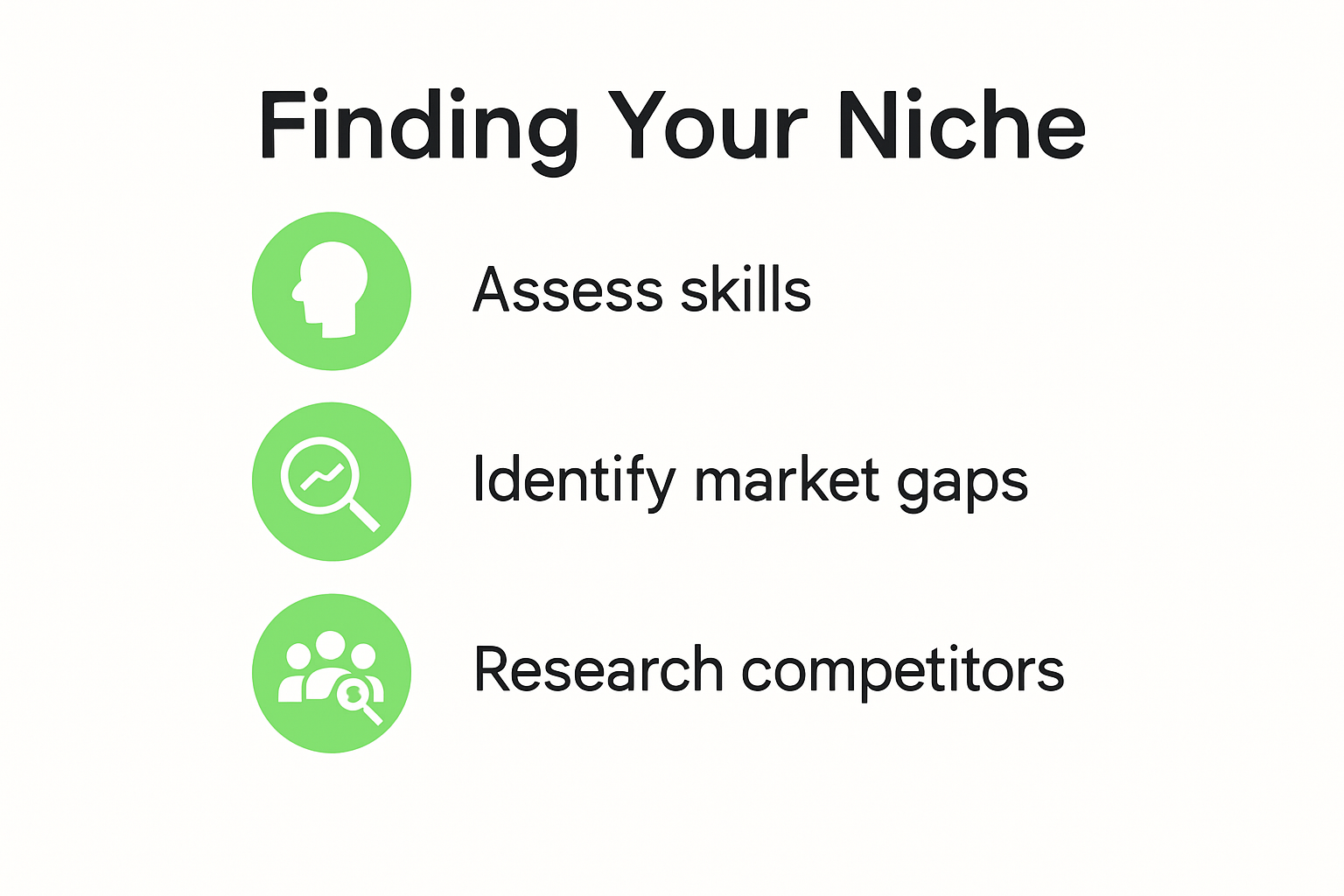
Understanding What a Niche Really Means
A business niche is a defined audience with a particular problem or need in a recognizable situation. It is more useful than a broad label when it helps you choose whom to learn from, what alternative to compare and what offer to test.
Skills, interest and access can help you choose where to begin. They do not prove that a market is underserved or that people will pay. Treat a promising overlap as a hypothesis until you have evidence.
The Anatomy of a True Niche
Define the situation and problem as well as the audience. The U.S. Small Business Administration market-research guide is a useful starting reference; your own investigation must establish whether existing alternatives leave an important need unmet.
For example, “working mothers seeking 20-minute home workout options that fit unpredictable schedules” is more specific than “fitness enthusiasts.” Investigate how often that situation occurs and what people already do before developing an offer.
Why Precision Matters in Niche Selection
A narrower audience can make recruitment and an offer easier to specify. It does not guarantee lower competition, higher margins or stronger loyalty. A focused niche can also be too small, difficult to reach or already well served.
Ask which relevant skills and experiences you bring, who you can reach responsibly, and what people already do when the problem occurs. Write the strongest reason your preferred niche might be wrong.
| Approach | Working scope | Possible advantage | Question to test |
|---|---|---|---|
| Broad market | A wide audience with varied situations | More potential situations to investigate | Can you identify a common problem without diluting the offer? |
| Provisional niche | A specific audience, situation and problem | More focused recruitment and comparison | Is the problem recurring, important and reachable enough to support an offer? |
Steps to Discover Your Ideal Niche
Start with two plausible hypotheses rather than asking AI for one winning niche. Use it to organize supplied evidence, then check every interpretation yourself. Use this blank ledger to plan what to collect and keep observations separate from explanations.
| Source and date | Observed statement or behavior | Interpretation | Counterevidence or alternative explanation | Remaining question |
|---|---|---|---|---|
| Prospective interview notes; not collected | No interview observations yet. | No conclusion about problem frequency or importance is justified. | An interviewee may describe an aspiration rather than a recent problem. | Can they describe a specific recent incident and their actual workaround? |
| Prospective workaround or artifact review; not collected | No artifact or behavior has been reviewed. | No conclusion about effort, cost or adoption is justified. | A missing tool may reflect low priority, not an unmet need. | What did they use, change, abandon or spend time on? |
| Provider pages; date to record if reviewed | No provider observation is added in this example. | A dated offering description could identify an alternative to investigate. | A provider website demonstrates an offering, not customer demand or comparative superiority. | Do people use that alternative for this situation, and what remains difficult? |
For each new record, keep the exact source/date and observation, your interpretation, a contrary explanation and the next unanswered question. Use customer details only with appropriate permission. An AI summary must not silently become the original observation.
Mapping Your Unique Value Proposition
Begin with an inventory of relevant skills, experience and access. OpenStax’s Entrepreneurship textbook provides background on researching opportunities.
List professional skills, personal talents, hobby expertise and perspectives that may help you understand a problem. Ask trusted colleagues for concrete examples of where you have helped. Then note whom you can reach for research and which capabilities you would still need. Keep that inventory separate from evidence of demand.
Connecting Personal Skills to Market Needs
After the skills inventory, define two audience/problem hypotheses that fit your experience or access. The Market Opportunity Navigator offers a framework for comparing opportunities.
Compare two different situations among independent creative workers:
| Provisional hypothesis | Audience and situation | Problem to investigate | Existing alternative to ask about | Contrary explanation |
|---|---|---|---|---|
| A: client preparation | Independent portrait photographers preparing a booked client for a session | Important preparation details may be missing or repeatedly clarified. | Ask about the actual emails, forms or conversations used. | Their current process may already work, or exceptions may be too rare to justify change. |
| B: referral follow-through | Independent brand designers following up a warm referral | A useful referral may stall before the next concrete step. | Ask how the most recent referral progressed. | Delays may reflect fit, budget or timing rather than a follow-up problem. |
Use the same evidence questions for both: when did it last happen, what was done, what consequence followed, and what would have made a difference? Keep the hypotheses separate until evidence supports changing them.

Leveraging Social Networks and External Knowledge
Professional groups and personal networks can help you find people with relevant recent experience. Recruit beyond friends who want to encourage you, and record how each participant was found so you can recognize selection limits.
For historical context, see a 2010 opportunity-recognition study using 2007 data from Spain, uploaded to arXiv in 2024. Its setting and age limit its relevance; it does not establish either example niche.
Plan a distinguishing test: use a small, deliberately balanced exploratory sample, such as three people fitting A and three fitting B, recruited through comparable routes. This is a learning exercise, not a representative survey or a basis for statistical claims.
Before recruitment, write the same questions and decision rule for both groups. Ask about a recent incident, the actual workaround and a concrete consequence. Avoid pitching your proposed solution first.
With permission, ask each person to walk through a relevant artifact or sequence of actions. Record what was shown separately from what was said and from your interpretation.
Advance a hypothesis only if at least two participants in that group can show a recent recurring problem and agree to a concrete follow-up involving their own workflow. This is a provisional decision rule chosen for the example, not a validated threshold or proof of demand.
If only one group meets the rule, investigate that group further. If both do, compare consequences and practical access before planning a pilot. If neither does, revise the hypotheses. Record contradictory cases rather than discarding them.
A later pilot should test a specific offer against the existing workaround; agreeing to another conversation is only an early signal.
Mistakes to Avoid When Finding Your Niche
Choosing a niche means investigating an opportunity while checking for reasons it may not work. The following pitfalls help you decide which evidence to collect before committing more effort.
The Danger of Insufficient Market Research
Business Wales provides further reading on common startup mistakes. For your own investigation, begin with recent incidents rather than asking whether someone likes a hypothetical idea.
Ask what happened, what the person did and what consequence followed. Compare interview accounts with artifacts or observed behavior where appropriate. Surveys can help organize responses, but stated enthusiasm is not the same as adoption or payment. Keep this problem investigation distinct from a later offer test.
Misunderstanding Competitive Landscape
Compare existing alternatives by the audience, situation and problem they address rather than assuming that every visible competitor serves the same need.
Record the date and exact page for any offering or pricing claim you inspect. Customer reviews can suggest questions, but they may be selective or outdated. Ask research participants about the alternatives they actually considered and used; do not assume that a gap in a website proves an unmet need.
Avoiding Oversaturated Markets
The Canadian Institute of International Business offers niche-selection context. The number of visible competitors alone cannot tell you whether a market is attractive: few providers may signal an overlooked problem or insufficient demand, while many may serve different situations.
Record alternatives by the job they help someone do, including doing nothing or using a manual workaround. Compare dated offerings only on observed facts. Do not convert a provider list into a demand estimate or an AI-generated ranking.
Before committing, check whether you can reach the audience, what constraints make delivery difficult and which contrary evidence would change your mind. Revise the niche when evidence conflicts with your initial story.
Turning Your Niche Into a Real Business
Turn the problem you have investigated into a specific offer: who it serves, what it helps them do and how you would deliver it. The next sections connect that offer to a test, an operating plan and documented costs.
Developing a Robust Business Framework
The U.S. Small Business Administration’s general business support can help you find planning guidance. Specify the proposed offer, target audience, delivery requirements and revenue and cost assumptions. Keep estimates labeled until evidence supports them.
Turn the next assumptions into milestones and choose measures appropriate to the stage. Early measures might describe problem frequency, completion of a concrete next step or behavior in a pilot. Later, acquisition costs, conversion and retention may matter. Do not invent a forecast merely to make a plan look complete.
Validating Your Business Model
Use the distinguishing test above to decide what to investigate next. It does not replace validation of an offer or business model. Before building a product, state the next assumption you need to test and choose the least costly method that can answer it responsibly.
A concept walkthrough, manual trial or prototype may be appropriate depending on the question. Define the expected behavior and what would make you stop or revise before running the test. Record the result only afterward, including people who declined or found no problem. A positive interview is not proof of willingness to pay.
Building Your Initial Infrastructure
Plan only the infrastructure the next stage requires: a way to deliver the proposed service or product, handle customer interactions responsibly and keep basic operational records. Resolve applicable legal and administrative requirements with appropriate local guidance.
Choose tools that support the actual workflow and avoid adding complexity before it is needed. Record dependencies and constraints so a promising problem hypothesis is not confused with a feasible delivery model.
Keep a separate list of expected startup costs, funding constraints and pricing assumptions. Replace estimates with documented amounts when available.
After each test, record what happened, what contradicted your expectations and which decision follows. Persistence and a clear niche do not guarantee success; continuing should depend on what you learn.
Frequently Asked Questions
What is a business niche?
A business niche is a defined audience with a particular problem or need in a recognizable situation. This focus helps you choose whom to learn from, which alternatives to compare and what offer to test.
How can I find my niche as a new entrepreneur?
Inventory relevant skills and access, define two provisional audience/problem hypotheses and record dated evidence with contrary explanations. Compare them using a small test before choosing the next investigation.
Can AI help me find a niche?
Yes. AI can organize research notes, compare audience and problem hypotheses, and identify questions to test. Check its interpretations against your sources; a plausible answer does not establish demand.
What mistakes should I avoid when selecting a niche?
Avoid treating enthusiasm, provider offerings, a confident AI answer or a small favorable interview sample as proof of demand. Investigate real workarounds, contradictory cases, practical access and delivery constraints.
How do I turn my niche idea into a viable business?
Move from evidence about a problem to a specific offer and a proportionate test. Then develop the business framework, delivery process and financial assumptions. Record outcomes and limits before scaling investment.
Choose a Small Next Test
Your next useful output is a clear hypothesis, a short evidence ledger and a test that could change your mind. Keep unanswered questions visible rather than asking any tool to fill them with certainty.
If you use siift to structure the work, review its suggestions against your sources and save the version you intend to use. Explore a next step when you have a specific question to investigate.
Recommended
Tendencias de marketing 2025 para impulsar el crecimiento digital