
Validating a new business idea often hits a wall when you are forced to cobble together strategy docs, competitor checks, and market signals from separate apps that were never meant for founders. Most traditional validation workflows either gate key features behind pricey subscriptions or require manual research, slowing your first test launches to a crawl. This comparison highlights six business idea validation platforms with transparent workflows and audience fit so you can pick one that matches your pace, technical level, and launch style.
Table of Contents
- siift.ai
- Dais-E
- Fluenta
- Algowim
- Seer Platform
- MakerAI
- Comparative Analysis of Business Idea Validation Tools
siift.ai
At a Glance
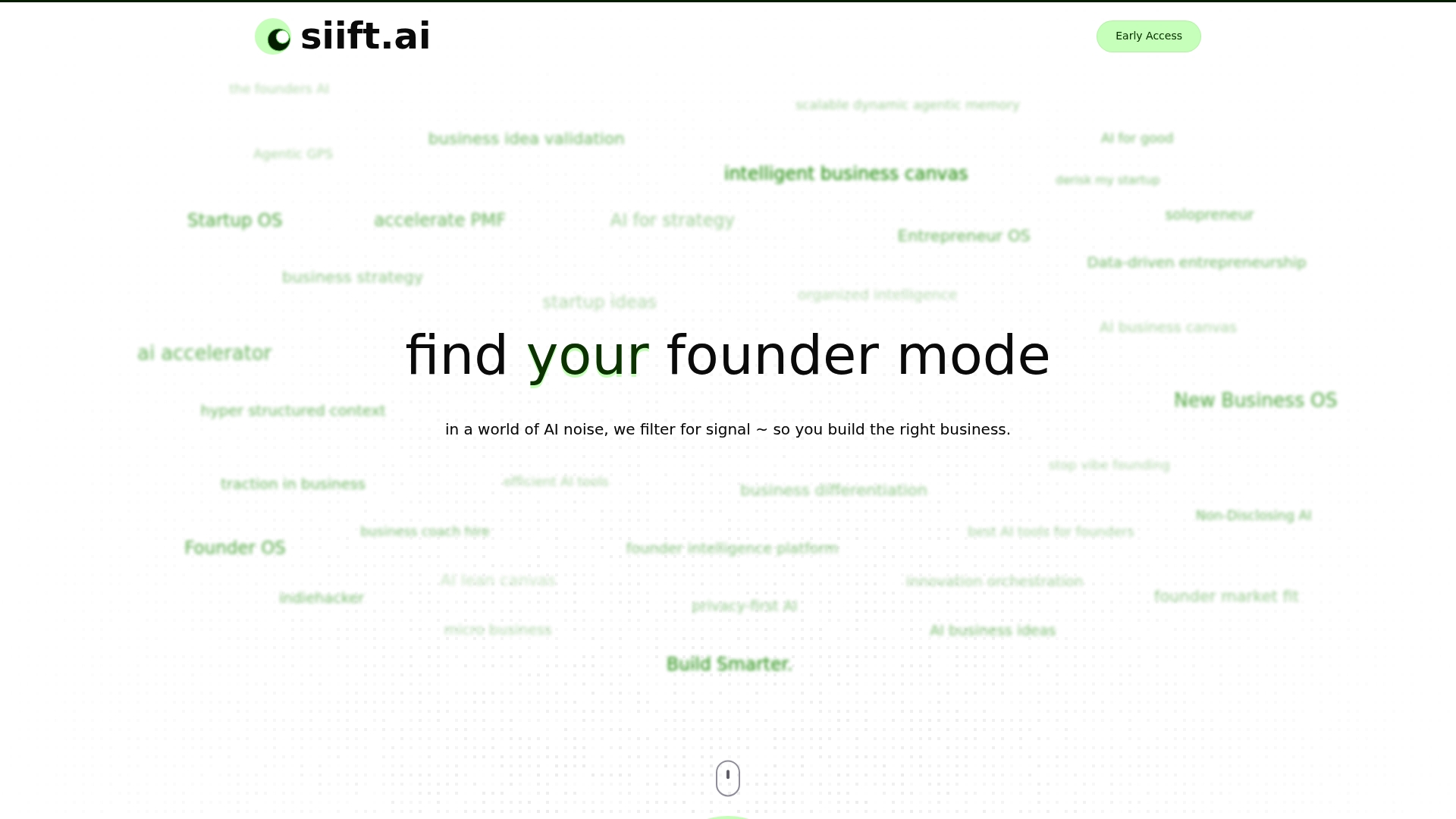
A founder’s OS that walks you step-by-step from ideation through validation to go-to-market while prioritizing privacy and focused inputs. Siift’s marketing positions it as an agentic AI tool that accelerates progress to Product-Market-Fit more efficiently than generic tools like Claude or Openclaw.
Core Features
- AI-powered business canvas and strategy tools that translate prompts into a structured plan.
- Proactive guided sessions with context hierarchies so conversations stay linked to prior research and decisions.
- Structured validation workflows designed to surface and quantify risk rather than just produce ideas.
- Micro-business and solopreneur focus with templates tuned to one-person teams and tiny budgets.
- Market problem and audience mapping modules that synthesize AI insights into segmentable hypotheses.
Key Differentiator
A structured, privacy-first approach that converts strategy, validation, and risk analysis into a single guided workflow for solo founders. That focus on clarity and practical results tilts the product away from broad chat tools and toward an operational playbook you can follow.
Pros
- Provides step-by-step guidance tailored for solo entrepreneurs, so you get a repeatable process instead of ad hoc prompts.
- Emphasis on de-risking early-stage ventures with structured validation reduces guesswork when you articulate hypotheses and test them.
- Strong privacy posture attracts founders who work with sensitive customer data or early-stage research and do not want promiscuous data sharing.
- The integrated business OS merges strategy, planning, and validation into one workspace, cutting down the number of disconnected docs and notes.
- Visible partnerships and media coverage make it easier to find case studies and third-party perspectives during evaluation.
Cons
- Some features remain in early or locked status per external reviews, so certain modules may not be production-ready for immediate launch workflows.
Who It’s For
Solo founders, micro-business owners, and very early-stage teams that want a guided, evidence-first way to validate ideas and structure a go-to-market plan. If you prefer a single workflow over stitching many tools together, Siift is aimed at you.
Unique Value Proposition
The founder’s OS combines market mapping, structured validation, and explicit risk scoring into one guided sequence, so you leave with a defensible roadmap rather than scattered outputs. For founders juggling product, research, and limited time, that workflow reduces context switching and accelerates decision clarity.
Real World Use Case
A solo founder with an untested niche idea runs the guided validation track, maps three customer segments, and executes two prioritized experiments. Within weeks they have tested hypotheses, captured feedback as structured evidence, and a clear next-step plan for a minimum viable launch.
Pricing
Pricing is not publicly listed. The vendor appears to offer early access or custom arrangements typical of incubator-style products. Contact Siift for pilot options, onboarding details, and any available trial or pricing tiers.
Website: https://siift.ai
Dais-E
At a Glance
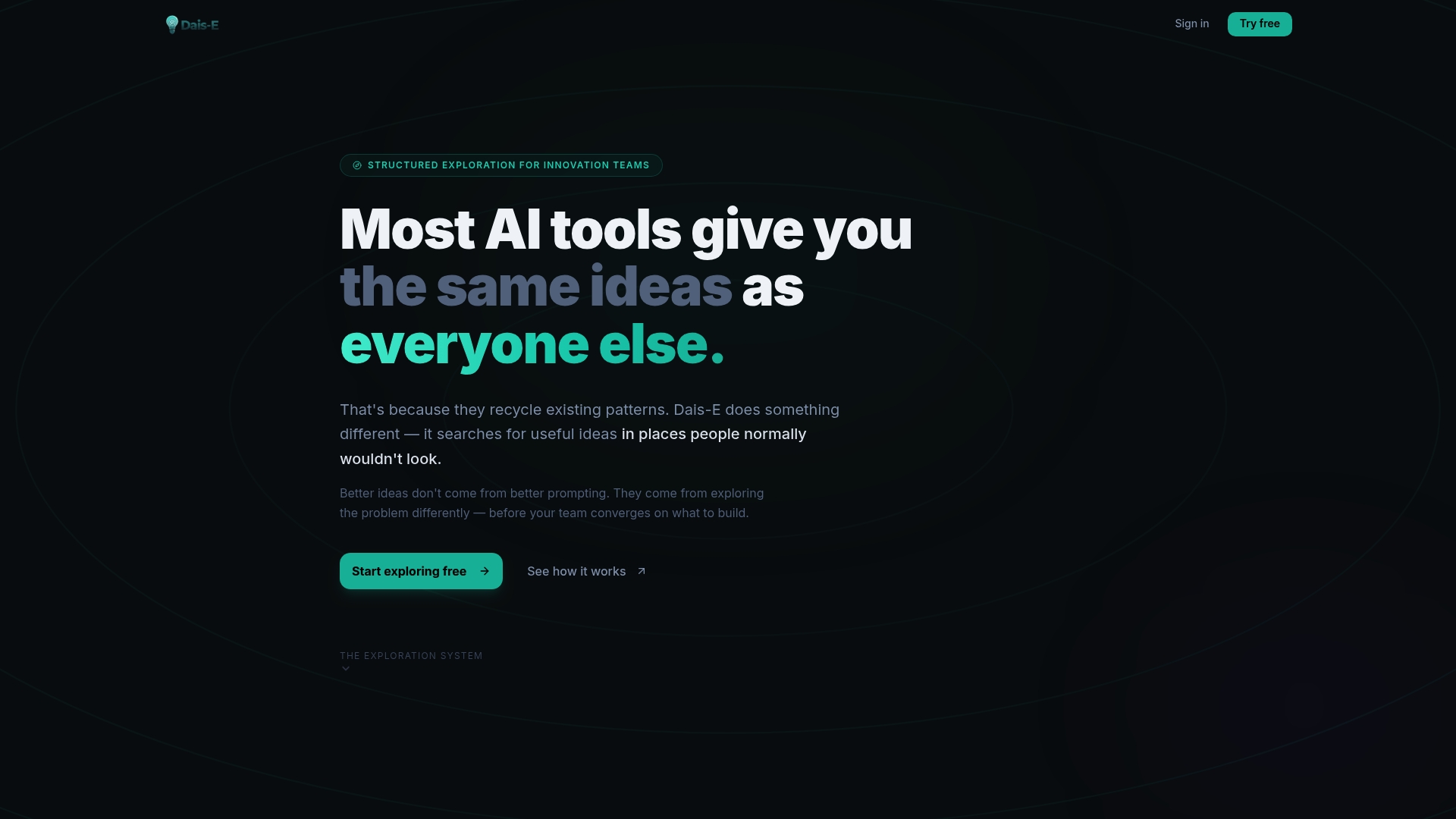
Real-time patent and prior art filtering is embedded into Dais-E’s exploration flow, and the app layers that with an organizational memory that records what worked and what failed in past sessions. That combo lets teams judge novelty while they expand possibility space.
Core Features
Divergence is guided by a structured divergence for cross-domain analogy search that forces teams to look outside their category before narrowing options.
Collaborative refinement uses digital twin expert personas so teams can simulate specialist feedback without booking dozens of interviews.
The platform scores ideas on novelty, feasibility, and defensibility, and stores session outputs in a searchable memory for reuse.
Key Differentiator
Dais-E focuses on structuring the full early-stage journey from broad exploration to filtered, feasible concepts, with memory baked in. That emphasis on process and repeatable institutional learning separates it from broader idea tools and makes it narrower in scope than Siift.
Pros
-
Helps teams surface non-obvious directions beyond typical AI completions, which is useful when your brief needs lateral jumps instead of iterative tweaks.
-
The structured process reduces ideation drift during workshops, keeping sessions measurable and repeatable for leadership reviews.
-
Patent analysis integrated into the flow makes defensibility checks immediate, helping teams avoid obvious dead ends before resource commitments.
-
The memory feature raises the signal-to-noise of future explorations by preventing repetition of poor lines of inquiry.
-
Appeals to product, R&D, and IP teams that need a disciplined way to expand then converge.
Cons
-
Multiple reports cite login and access issues, including account problems and unexpected charges, which undermines trust during procurement.
-
App glitches and crashes are documented by users and can interrupt live workshops, reducing reliability when momentum matters.
-
Customer support response is often slow or insufficient, with booking and refund processes described as inflexible.
-
Negative reviews point to recurring technical and support problems rather than a single isolated incident.
When It May Not Fit
If you need a rock-solid, always-on tool for client workshops, the reliability concerns above are a real constraint. Similarly, teams that lack internal process discipline will find the structured approach heavy and may prefer lighter, faster whiteboard tools. Siift users looking for broader go-to-market guidance will find Dais-E more narrowly focused on early discovery and defensibility.
Who It’s For
Innovation and R&D teams, IP strategists, and product managers who want a repeatable process to expand problem framing, test analogies, and check patent space before committing engineering resources. Best when you have someone to manage sessions and interpret the memory outputs.
Real World Use Case
A technology startup runs a series of divergence sessions in Dais-E to map cross-industry analogies for a new hardware feature. The team uses the built-in prior art checks to rule out routes that lack defensibility before any prototyping budget is spent.
Pricing
Free for innovation teams. No credit card required. The vendor lists the product as free for qualifying innovation teams, which makes early evaluation low friction for small groups.
Website: https://daise.io
Fluenta

At a Glance
Fluenta’s marketing materials claim it scans over 200+ sources daily to generate a Launch Readiness Score that rates ideas from 0 to 100. That score breaks signals across demand, pain, competition, monetization, funding, and urgency to give an instant signal for further research.
Core Features
- Live aggregation from sources such as VC firms, media, Reddit, GitHub, and more for continuous market signal collection.
- Integration with roughly 25 data feeds including Google Trends, Product Hunt, Crunchbase, job boards, funding databases, and YouTube.
- A quantifiable Launch Readiness Score and a six-dimension signal breakdown to compare ideas quickly.
- X-Ray validation runs that produce structured reports with risks, business model variants, and customer playbooks.
- Exportable validation reports tied back to original sources so you can cite evidence in pitches.
Key Differentiator
Fluenta ties each numeric signal back to the original source so you can trace a score to the evidence that created it. That source-linked scoring makes it easier to argue for or against an idea during investor conversations or internal prioritization meetings.
Pros
- Data-first approach reduces guesswork. The platform pulls live signals so you rarely rely solely on memory or forum anecdotes.
- Transparent sourcing. Each signal links back to a feed, which helps you document assumptions for investors or cofounders.
- Flexible access levels, including a free tier and paid plans, make it practical for solo founders testing multiple concepts.
- The structured reports accelerate prep for investor conversations by packaging risks, monetization options, and go/no-go recommendations.
- Built-in AI research helps synthesize signals into readable narratives instead of dumping raw exports you must parse manually.
Cons
- Each X-Ray run takes about 20 minutes, which slows very rapid iteration workflows that need sub-5-minute checks.
- Some signals are weak or cold, so interpreting moderate indicators requires domain judgment rather than blind trust in the numeric score.
- Heavy quantitative focus means deep qualitative user insights can be underemphasized unless you supplement with interviews.
- Coverage favors English and markets with abundant public data; niche local markets may return sparse results.
When It May Not Fit
If you need instant micro-tests several times per hour, the roughly 20-minute runtime per analysis will feel slow. If your idea targets a niche language or a small local market with little public data, Fluenta’s signal coverage will likely be thin.
Notable Integrations
- Google Trends
- Quora
- Crunchbase
- Product Hunt
- Job Boards
- Funding Databases
- YouTube
Who It’s For
You if you are a solo founder, early-stage product manager, or an innovation lead who prefers evidence before engineering. Fluenta fits teams that value defensible, source-linked validation over purely speculative brainstorming.
Real World Use Case
A solo founder tests an app idea for pet grooming. Fluenta runs an X-Ray, surfaces high demand signals and low competition in the report, and provides a playbook that lets the founder proceed with a minimum viable experiment and an investor-ready one-page summary.
Pricing
Offers a free tier with 1,000 credits and limited features. Paid plans start at $9/month and add more X-Ray runs, additional credits, and team features. Credits are also available as separate purchases.
Website: https://fluenta.space
Algowim

At a Glance
Algowim’s marketing materials include an example where a designer converted a raw concept into a detailed product blueprint in under an hour, then listed it on the platform for early feedback. That rapid turnaround is the clearest demonstration of its focus on speed and outputs like WIMfiles.
The platform presents a guided visual workflow that walks an idea through generation, refinement, validation, and optional marketplace listing. It targets creators who want tangible, execution-ready concept artifacts rather than vague roadmaps.
Core Features
- Guided visual workflow for product concept creation that enforces structure at each step and reduces decision friction.
- A proprietary algorithm named MANIA that the vendor says sources and harmonizes idea inputs to produce refined concepts.
- Built-in marketplace called WIMshop where creators can trade or validate concepts with early buyers and peers.
- Exportable WIMfiles which act as comprehensive blueprints for execution and market launch.
- Multiple ideation tools including universe calibration, concept visualization, and live feedback driven by a module called Piffany.
Key Differentiator
Algowim centers its process on MANIA. The vendor describes this algorithm as the mechanism that harmonizes disparate idea signals into a single, prioritized concept blueprint. That automated harmonization reduces the manual curation founders normally do between brainstorm and prototype.
Pros
- Speeds the front end of product development by enforcing a repeatable visual workflow that replaces scattered notes and whiteboards.
- Generates exportable deliverables. WIMfiles give you a tangible package to hand to designers or developers, shortening handoff time.
- Marketplace integration. Listing in WIMshop lets you gather early market signals and potential buyers without running separate outreach campaigns.
- Versatile audience fit. The tool is presented for solo entrepreneurs, corporate R&D teams, and community innovation programs, which makes onboarding diverse contributors easier.
- Collaboration baked in. Live feedback tools help teams converge on a single concept faster than asynchronous doc exchanges.
Cons
- Independent user reviews are scarce. The vendor’s own materials provide most of the evidence for claims, so external validation is limited.
- Core features like WIMkeys and WIMpods are marked as upcoming, which means some promised workflows are not yet available to test in production.
- Pricing details are not published clearly, which complicates budgeting for organizations used to transparent tiers or fixed per-seat models.
When It May Not Fit
If you need a tool with broad, independently verified adoption or public case studies, this early-stage product may feel risky. Teams that require mature enterprise integrations or immediate access to every promised module will find gaps until WIMkeys and WIMpods ship.
Who It’s For
Solo founders, product designers, innovation leads, and community organizers who value quick, visual concept development and a marketplace channel for early testing. It suits groups willing to accept an evolving feature set in exchange for a structured ideation pipeline.
Real World Use Case
A designer used Algowim to move from a sketch to a market-ready blueprint in the example above, then listed the concept on WIMshop to collect early feedback and a small validation sale. That workflow removed weeks of back-and-forth and produced a deliverable the team could act on immediately.
Pricing
Pricing is not explicitly published. The vendor references purchasable bundles and bulk options such as sets of 50, 100, or 1000 WIMpods, which suggests a credit or package model rather than a simple per-user subscription. Contacting Algowim is required to get specific pricing for organizational needs.
Website: https://algowim.com
Seer Platform
At a Glance
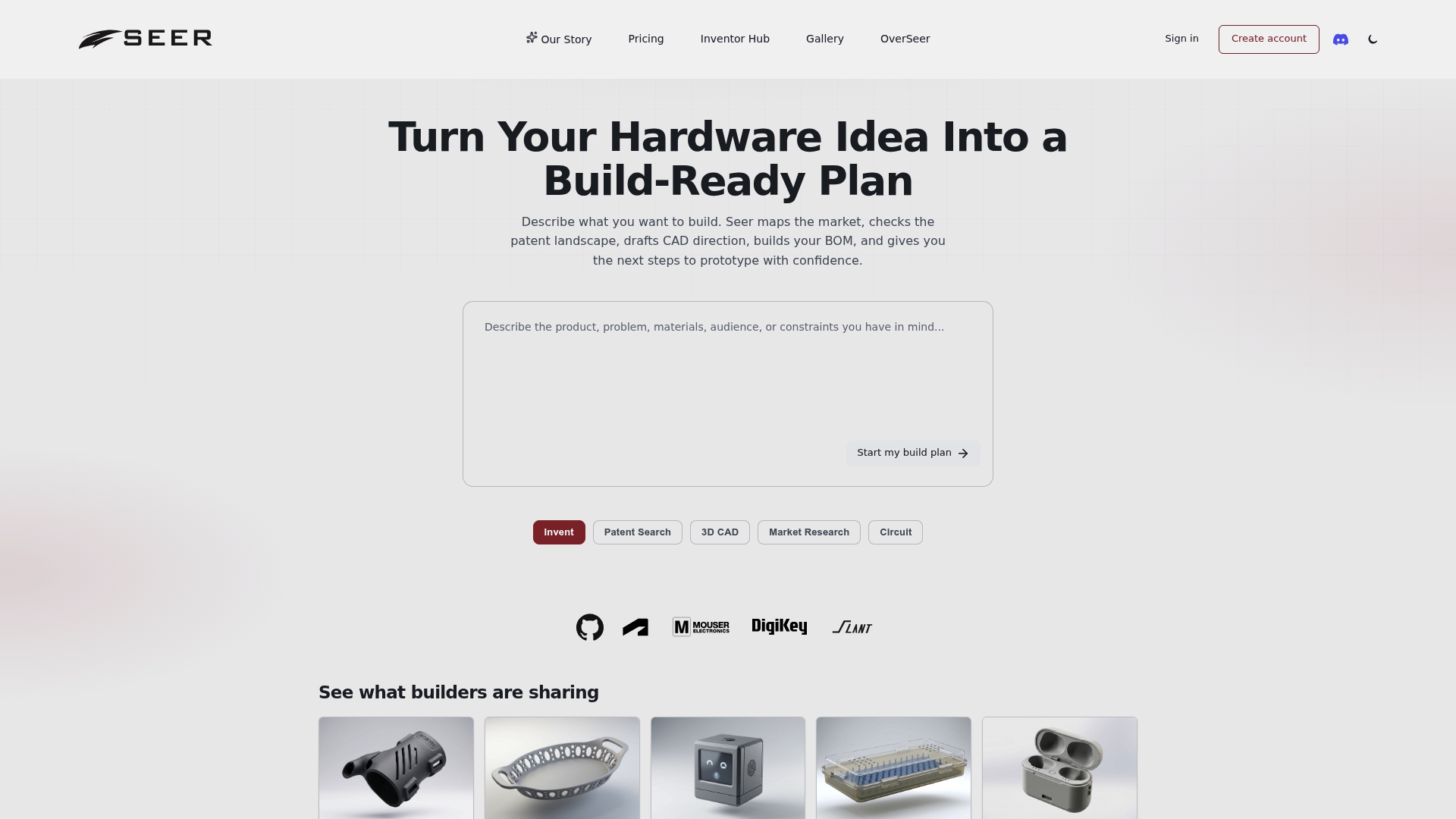
Generates 3D CAD models from sketches and written descriptions while producing a Bill of Materials and sourcing guidance in the same workflow. That coupling of CAD output with market research and patent checks is uncommon for hobbyist-friendly tools.
Core Features
AI-driven product planning and design tools that translate sketches and prompts into editable 3D geometry. Market research and validation modules help you check demand signals and competitor products during early ideation.
Bill of materials creation and vendor sourcing guidance reduce guesswork before you contact manufacturers. Patent landscape analysis runs inside the ideation flow via the OverSeer AI agent mode to flag prior art during concepting.
Key Differentiator
Seer Platform stitches design, research, and sourcing into a single sequence so you move from idea to build-ready files without jumping between five services. The platform emphasizes hardware output: CAD models, BOMs, and prototyping next steps rather than just notes or sketches.
Pros
- Broad toolkit for inventors. Research, CAD generation, BOM drafting, and patent checks live in one place so you spend less time moving files between apps.
- AI assistance speeds early design iterations. The system turns a rough sketch or a short prompt into a usable 3D model you can refine in standard CAD software.
- Low-friction entry. A Free tier lets solo inventors experiment before committing to paid plans, which helps control early costs.
- Community features let you share prototypes and get feedback from other makers, shortening the feedback loop compared with private experiments.
- Pricing tiers and add-on packs give teams predictable scaling paths instead of one-size-fits-all contracts.
Cons
- Independent user reviews or case studies are sparse, so assessing long-term reliability relies on limited vendor information.
- AI-generated CAD and BOM outputs may contain inaccuracies that require manual validation and engineering review before manufacturing.
- The platform’s real-world success stories and measurable outcomes are not widely documented, which raises due-diligence work for buyers.
When It May Not Fit
If you need audited CAD deliverables with guaranteed tolerances for production, Seer Platform’s AI outputs will still need professional validation. Large enterprises seeking vendor references or lengthy implementation support may find the available public proof points limited.
Who It’s For
Solo inventors, small hardware startups, and educators teaching product development who want an integrated, AI-assisted toolchain. Best for teams that can review AI drafts and convert them into validated engineering files.
Real World Use Case
A solo inventor researches a new consumer gadget, runs patent scans, generates an initial 3D model from a pencil sketch, and produces a BOM to quote parts. The result is a prioritized list of next steps for prototype sourcing and fabrication.
Pricing
Free tier plus paid plans. Hobby at $10/month and Inventor at $30/month, with additional packs and annual discounts available. The structure supports incremental investment as prototypes mature.
Website: https://seerplatform.dev
MakerAI
At a Glance
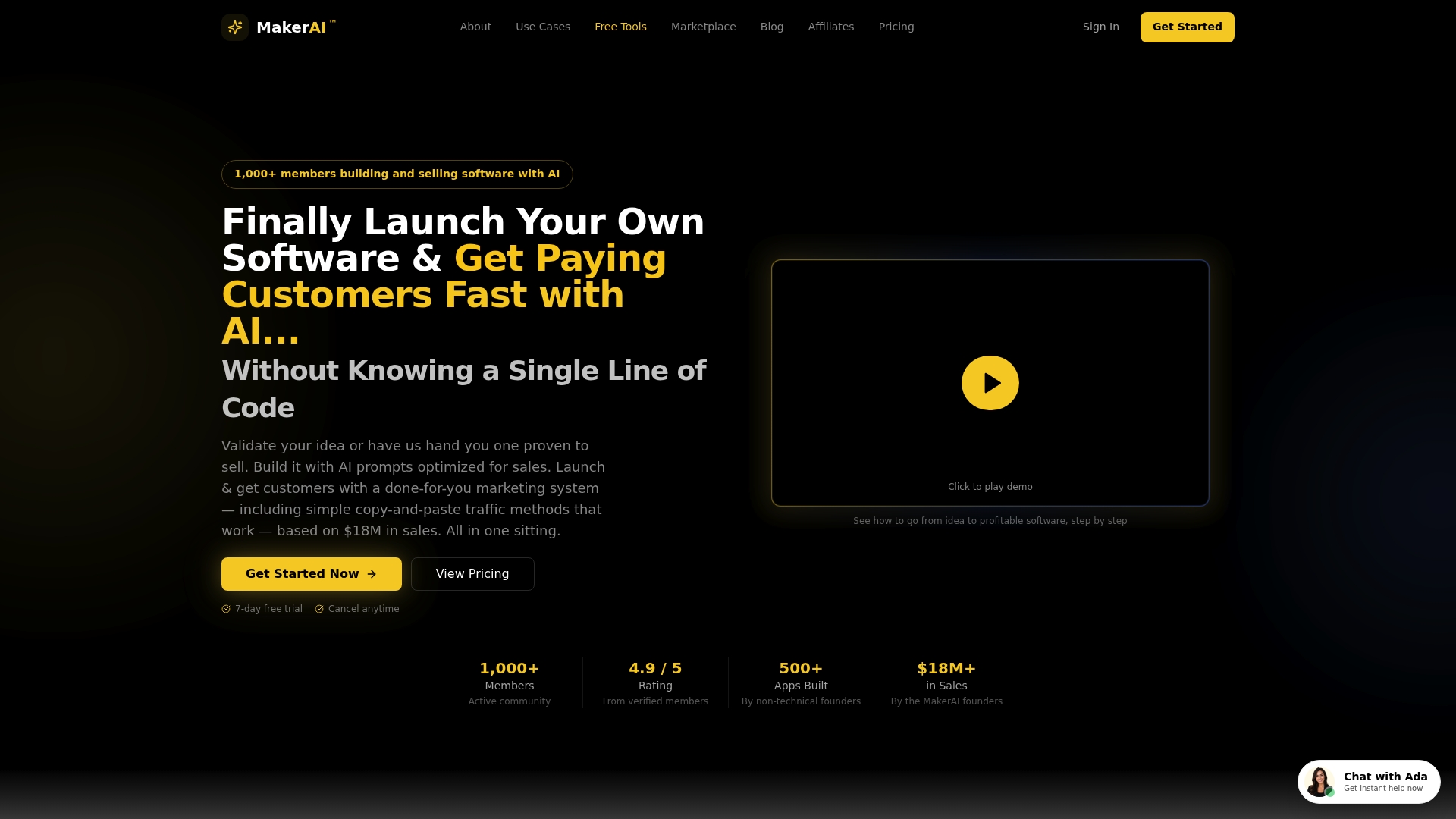
A lifetime access option at $1,497 is MakerAI’s most specific price signal — a one-time route for non-technical founders who want ongoing app-building and marketing tooling without monthly churn. The platform pairs validated idea discovery with build prompts and a marketplace for distribution.
Core Features
MakerAI combines a handful of practical capabilities aimed at getting an idea to paying customers quickly.
- AI-powered idea discovery and validation that narrows promising niches and app categories.
- Step-by-step AI build prompts that guide no-code app creation and configuration.
- A full marketing stack with landing pages, email sequences, and social content templates.
- Built-in marketplace for listing launched apps and tapping buyer traffic.
- Community access for peer feedback and troubleshooting.
Key Differentiator
MakerAI’s claim is a validated, data-backed system that unites AI-guided app building with marketing execution so founders can ship without coding. Compared with Siift, MakerAI serves a narrower crowd: hands-on, non-technical builders who want repeatable prompts and go-to-market assets rather than a broader, strategy-first Founder’s OS.
Pros
- The end-to-end sequence removes a lot of guesswork. You move from idea validation to launch templates in a single workflow.
- No coding requirement opens product creation to marketers, coaches, and agency owners who do not hire developers.
- Community features mean prompt templates and launch checklists get vetted by peers before you spend ad budget.
- Integrations with automation tools let you plug launches into existing workflows rather than rebuilding pipelines.
- The marketplace offers a distribution channel that can cut discovery time for newly launched apps.
Cons
- Most public reviews originate from MakerAI’s own community, which limits independent verification of outcomes.
- Pricing targets serious creators and agencies, so small experiments on a shoestring budget may feel expensive.
- Success depends on active user effort; MakerAI provides the system but not guaranteed sales or automation of growth.
When It May Not Fit
If you need full-service product strategy with advisory oversight, MakerAI’s do-it-yourself prompt approach will feel hands-on. Enterprises needing custom engineering, complex security certifications, or guaranteed performance SLAs should look elsewhere. If you want purely passive income without execution work, this is a poor match.
Notable Integrations
- ChatGPT
- Claude
- Cursor
- Zapier
- n8n
- Make.com
These connections let you automate build steps and tie launches into marketing and backend tooling without custom code.
Who Should Use It
Non-technical entrepreneurs, solopreneurs, marketing agencies, coaches, and creators who want a repeatable playbook for launching software products without hiring developers. Ideal for people comfortable executing templates, running ads, and iterating quickly.
Real World Example
MakerAI’s materials describe a non-technical founder who used the step-by-step prompts to validate a SaaS idea, build the app in a few hours, and launch a campaign that produced a first paying customer in under a week. That example illustrates the speed the system aims for, but it relies on the founder executing the marketing plan.
Pricing
Monthly plans start at $87/month, annual plans at $797/year, and a lifetime access option at $1,497. The pricing tiers reflect the platform’s all-in-one positioning rather than a collection of single-purpose tools.
Website: https://getmakerai.com
Comparative Analysis of Business Idea Validation Tools
When engaging with tools designed for validating business ideas, seeking a platform attuned to the specific needs of startups and innovation-driven teams becomes. This analysis highlights the comparative strengths and targeted utility of seven key platforms reviewed above.
Balancing Depth and Breadth of Validation Features
Siift.ai emphasizes a guided and nuanced process tailored for solo founders and micro-businesses, offering structured modules for market mapping and hypothesis validation. In contrast, Dais-E excels in prompting lateral ideation through structured divergence while actively integrating defensibility checks in its workflow. For users prioritizing rapid aggregation and evaluation across diverse sources, Fluenta showcases its real-time signal coupling with its expansive Launch Readiness Score, albeit with noted runtime requirements for signal digestion. Algowim, uniquely distinct in its visual-first guided structure, facilitates tangible WIMfiles aimed at execution. Meanwhile, MakerAI breaks context with its integrated no-code app-building combined with modular marketing tools, targeting entrepreneurs eager to transition rapidly from ideation to execution. Each presents unique focal points and user engagement dynamics.
Real-World Implementation Constraints
For early-stage teams managing workshop environments, reliability becomes crucial, a category where Dais-E could face challenges with technical stability as reported. Conversely, Seer Platform’s suite integrating CAD, BOM, and patent checking resonates remarkably with hardware-centric projects but requires careful validation of AI outputs. Siift.ai, with fewer arguments around technical interruptions, optimizes for process continuity under privacy-centric measures. The variance in pricing strategies and transparency additionally separates free models like Dais-E’s introduction from premium subscription pivots such as MakerAI’s positioning.
Best Fit
-
Siift.ai is for solo founders navigating privacy concerns and needing thorough hypothesis validations in entrepreneurial endeavors.
-
Dais-E bridges innovation teams searching for cross-industry insights with particular strengths in idea defensibility evaluations via patents conveniently.
-
Fluenta’s aggregation prowess benefits market strategy personnel needing quantifiable results tied back to evidenced threads systematically.
-
Seer’s combination suits prototype-heavy building-centered creators within a single suite combining sourcing deliverables concurrently.
Siift.ai: Designed for Founders
Siift.ai’s synthesized validation framework caters distinctively to creators mapping ideas methodologically aligned to scalable ventures avid about maintaining data discretion. However, users requiring tangible deliverables like CAD files may alternatively consider Seer for domain achievements tactile.
Business Idea Validation Software Comparison
Choosing the right platform for business idea validation is crucial to optimize the ideation, market testing, and launch preparation process efficiently. Here’s a comparison of leading platforms to help you decide:
| Product | Core Feature | Key Differentiator | Best For | Pricing | Notable Limitation |
|---|---|---|---|---|---|
| Siift | AI-driven business planning tools | Structured risk analysis integrated into workflow | Solo entrepreneurs | Not disclosed | Certain modules are still in progress |
| Dais-E | Contextual novelty and feasibility scoring | Integrated patent filtering in ideation sessions | Innovation teams | Free | Reports cite login and technical reliability issues |
| Fluenta | Market signal aggregation and live scoring | Traceable validation metrics linked to sources | Evidence-driven users | $9/month and up | Longer runtimes limit rapid iteration |
| Algowim | Agility-focused concept creation | Comprehensive WIMfiles for blueprint clarity | Designers and planners | Not disclosed | Certain features not yet publicly available |
| Seer Platform | CAD and prototype development assistance | Integrated design-to-sourcing workflows | Inventors | $10/month and up | AI outputs require manual validation |
Make sure to evaluate each platform based on your specific requirements, such as budget, team size, and the stage of idea development to find the best match for your project.
Turn Ideas for Digital Products into a Validated Business Strategy with Siift
Feeling overwhelmed by the sea of ideas for digital products and unsure which one to bet on? This article highlights the challenge of moving beyond brainstorming and guessing, toward building a validated, structured plan that actually leads to market traction. You need more than generic AI chat tools — you need a Founder’s OS designed specifically to guide solo founders step-by-step through ideation, validation, and go-to-market strategies.
Siift helps you cut through noise and uncertainty by providing a privacy-first, evidence-based workflow that surfaces risks and clarifies your business approach. Stop second-guessing your digital product concepts and gain a defensible roadmap today. Visit siift.ai to explore how you can validate your core ideas and map your path to product-market fit in weeks, not months.
Frequently Asked Questions
How does Siift help solo founders with validating business ideas?
Siift guides solo founders through idea validation using structured workflows. Its structured validation workflows are designed to surface and quantify risk rather than just produce ideas. Solo founders can expect a repeatable process to define and test their business hypotheses more effectively.
What is the difference between Siift and Dais-E for early-stage teams?
Dais-E excels by focusing on structured divergence and cross-domain analogy searches, giving teams a rigorously guided exploration process. Siift stands out for its clear step-by-step guidance through the entire ideation to validation process aimed specifically at solo entrepreneurs. Teams should consider their specific needs: Siift for comprehensive governance or Dais-E for a more exploratory framework.
Which platform offers a user-friendly approach to business validation for one-person teams?
Siift provides a user-friendly interface tailored for one-person teams, making complex business processes manageable. The emphasis on micro-business and solopreneur focus with templates tuned for small budgets makes it a solid choice for busy founders. Users can efficiently orchestrate their ideas and market testing in one cohesive package.
Can I use Fluenta if my idea targets a niche market with limited data?
Fluenta may not deliver robust insights for niche markets lacking abundant public data. The platform favors markets with rich data sources, which may result in sparse results for smaller or more localized concepts. If your market is niche, you might find Siift’s structured validation workflows a more effective starting point to develop ideas without heavy data reliance.
How does Siift support privacy for founders dealing with sensitive customer data?
Siift emphasizes a strong privacy posture, making it attractive for founders managing sensitive data. The platform’s commitment to privacy-first methodologies ensures that user inputs are handled with care. Founders concerned about data sharing can engage with Siift knowing their information remains secure while they validate their ideas.