

TL;DR:
- Market segmentation involves dividing a broad market into smaller, targeted groups based on shared traits to optimize marketing efforts. It encompasses demographic, geographic, psychographic, and behavioral types, with the most effective strategies layering data for accurate customer profiles. Proper segmentation drives core business decisions, including pricing, messaging, and product development, rather than being a static or superficial task.
Market segmentation is the strategic process of dividing a broad market into smaller, distinct groups based on shared characteristics so you can target and engage the right customers with the right message. Without it, you are essentially shouting into a crowd and hoping someone turns around. The four foundational types — demographic, geographic, psychographic, and behavioral — form the backbone of every effective segmentation strategy. Founders who fail to segment end up with average positioning and wasted ad spend, two outcomes no lean startup can afford.
What is market segmentation explained in plain terms?
Market segmentation is defined as the practice of grouping potential customers by shared traits so your marketing speaks directly to each group rather than nobody in particular. Think of it as drawing a map before you start driving. The map does not tell you where to go. It shows you all the roads so you can choose the best one.
Segmentation precedes targeting. You first divide the market into groups, then decide which groups to pursue, then tailor your messaging and product to fit. Skipping the first step means your targeting is guesswork. For a small business with a limited budget, guesswork is expensive.
The concept is not new, but its application has sharpened considerably. In 2026, founders have access to behavioral data, AI-driven customer profiling, and real-time analytics that make segmentation more precise than ever. The strategic logic, however, remains the same: focus where you have an advantage, and stop wasting resources everywhere else.
What are the four types of market segmentation?
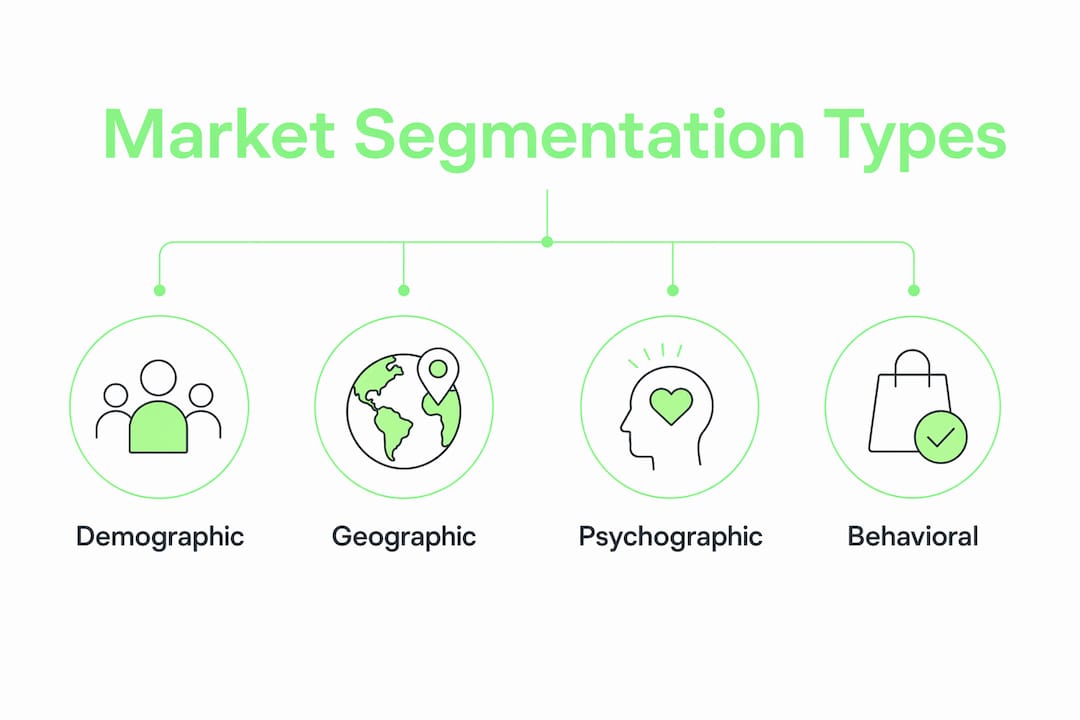
The four segmentation variables are demographic, geographic, psychographic, and behavioral. Each one captures a different dimension of your customer. Used alone, each has real limitations. Used together, they build a picture that actually resembles a human being.
-
Demographic segmentation groups customers by age, income, gender, education, or occupation. It is the most widely used type because the data is easy to collect. The downside is that two people with identical demographics can have completely different buying behaviors. A 35-year-old software engineer in Austin and a 35-year-old teacher in rural Ohio share a demographic profile but almost nothing else.
-
Geographic segmentation divides customers by location: country, city, region, or even neighborhood. A local bakery in Chicago cares about foot traffic within a five-mile radius. A SaaS company selling globally cares about time zones, language, and regional compliance. Geography shapes context, and context shapes buying decisions.
-
Psychographic segmentation groups customers by values, lifestyle, personality, and attitudes. This is where you start understanding why people buy, not just who they are. A fitness brand targeting “health-conscious professionals” is using psychographics. It is harder to measure than demographics, but far more predictive of behavior.
-
Behavioral segmentation groups customers by their actual actions: purchase history, product usage, brand loyalty, and engagement patterns. Behavioral segmentation is most commercially valuable because it is grounded in observed reality, not assumed traits. A customer who has bought from you three times in six months is a fundamentally different segment than someone who browsed once and left.
Pro Tip: Never build a segment on demographics alone. A 45-year-old suburban parent who buys organic food and a 45-year-old suburban parent who buys fast food are not the same customer. Layer behavioral or psychographic data on top of demographics to get segments that actually drive decisions.
The real power comes from combining types. A SaaS startup might segment by company size (demographic), industry (geographic or demographic), growth stage (psychographic), and trial-to-paid conversion behavior (behavioral). That combination produces a segment you can actually build a product and a pitch around.
How does segmentation differ from targeting and positioning?
These three terms travel together so often that founders treat them as synonyms. They are not. Each one does a distinct job in your go-to-market strategy.
| Concept | Definition | Purpose |
|---|---|---|
| Segmentation | Dividing the market into distinct groups | Creates the map of who exists in your market |
| Targeting | Choosing which segments to pursue | Makes the strategic decision of where to compete |
| Positioning | Crafting how you want to be perceived by a segment | Shapes messaging, product, and brand identity |
Segmentation is the mapping step. It is descriptive. Targeting is the decision step. It is strategic. Positioning is the execution step. It is creative. You cannot do the second without the first, and the third without the second.
Where founders go wrong is treating segmentation as the finish line. They do the research, identify three or four customer groups, and then file the findings away. That is like drawing a map and never leaving the house. Segmentation must inform your value proposition, your pricing, your channel strategy, and your product roadmap before a single marketing dollar is spent.
A practical example: a local fitness studio segments its market and identifies two groups. The first is young professionals aged 25–35 who value convenience and use fitness apps. The second is parents aged 35–50 who prioritize stress relief and community. Targeting both with the same message is a waste. Targeting the first with a “book in 60 seconds” app-based offer and the second with a “your tribe, your pace” community campaign is segmentation doing its actual job.
Pro Tip: Treat your segmentation work as a functional map, not an academic exercise. Every segment you identify should answer one question: what do we do differently for this group? If the answer is “nothing,” the segment is not useful.
How do you create segments that actually drive results?
A segment is only useful if it meets four criteria. Measurability, accessibility, substantiality, and differentiability are the tests every segment must pass before you invest in it.

Measurable means you can quantify the segment. How many people are in it? What is their average spend? If you cannot measure it, you cannot track whether your strategy is working.
Accessible means you can actually reach the segment through your available channels. A segment of ultra-high-net-worth retirees sounds appealing until you realize your only channel is Instagram.
Substantial means the segment is large enough to be worth pursuing. A hyper-specific niche can be powerful, but if it contains 200 people globally, the economics rarely work for a small business.
Differentiable means the segment responds differently to your marketing than other segments do. If two groups react identically to the same message, they are one segment, not two.
Here is a practical process for building segments that hold up:
- Gather raw data. Use customer surveys, Google Analytics, CRM records, social media insights, and sales call notes. You need both quantitative and qualitative inputs.
- Identify patterns. Look for clusters of shared behavior, not just shared demographics. Who buys most often? Who churns fastest? Who refers others?
- Layer behavioral with psychographic data. Combining these two types gives you a commercially valid view that demographics alone cannot provide.
- Apply the four criteria. Run each candidate segment through measurability, accessibility, substantiality, and differentiability. Cut the ones that fail.
- Assign a value proposition to each segment. If you cannot write a distinct one-sentence pitch for a segment, it is not differentiated enough to act on.
- Test and refine. Run small campaigns to each segment, measure response rates, and adjust. Segmentation is not a one-time event. It evolves as your customers do.
The most common mistake founders make is creating too many segments or relying entirely on demographic data. Both errors produce noise instead of signal. Three to five well-defined segments are more useful than twelve fuzzy ones.
What do real segmentation strategies look like for small businesses?
Abstract frameworks only go so far. Here is what segmentation looks like when it is actually working.
A local coffee shop in Denver segments its customers into three groups: remote workers who stay for three-plus hours and need reliable Wi-Fi, morning commuters who want speed and consistency, and weekend brunch seekers who prioritize atmosphere and food quality. Each group gets a different experience. The remote workers get a loyalty program tied to hourly stays. The commuters get a mobile pre-order option. The brunch crowd gets curated weekend specials and a warm, social environment. Same business, three distinct strategies, all driven by behavioral and psychographic segmentation.
A SaaS startup selling project management tools segments by company size (1–10 employees vs. 11–50 employees), industry (creative agencies vs. construction firms), and usage behavior (daily active users vs. monthly check-ins). The daily active users in creative agencies get onboarding focused on speed and integrations. The monthly check-in users in construction get case studies showing ROI over time. The messaging, the trial length, and even the pricing page are tailored to each segment. That is segmentation driving real product and marketing decisions, not just sitting in a spreadsheet.
A freelance consultant offering brand strategy services segments by client stage: pre-revenue founders, early-stage startups with product-market fit questions, and growth-stage companies needing repositioning. Each stage has different urgency, different budgets, and different definitions of success. Treating them identically would mean underpricing for growth-stage clients and overcomplicating the pitch for early-stage ones.
The thread connecting all three examples is the same. Segmentation shapes pricing, channels, messaging, and product decisions. It is not a marketing exercise. It is a business strategy tool that determines where you focus your limited time and money.
Key Takeaways
Effective market segmentation is the foundation of every profitable marketing strategy, requiring measurable, accessible, substantial, and differentiable segments built from layered behavioral and psychographic data.
| Point | Details |
|---|---|
| Four core types | Demographic, geographic, psychographic, and behavioral segmentation each capture a different customer dimension. |
| Layering is critical | Combining behavioral with psychographic data produces more accurate, commercially useful segments than demographics alone. |
| Segmentation precedes targeting | You must map the market before deciding where to compete and how to position your offer. |
| Four criteria test | Every segment must be measurable, accessible, substantial, and differentiable to justify investment. |
| Segmentation drives strategy | Segments should directly shape pricing, channels, messaging, and product decisions, not just sit in a document. |
Why most founders get segmentation backwards
I have worked with dozens of founders who treat segmentation as a box to check during the business planning phase. They identify a few customer types, label them, and move on to building the product. That is exactly backwards.
The founders who grow fastest use segmentation as a living input, not a static output. They revisit their segments every quarter as new behavioral data comes in. They let segmentation kill bad ideas early, before those ideas cost real money. I have seen a single segmentation insight, specifically discovering that a startup’s most profitable customers were a behavioral subset nobody had consciously targeted, redirect an entire go-to-market strategy and cut customer acquisition costs significantly.
The other trap I see constantly is over-segmenting. More segments feel like more precision, but they usually just mean more complexity and more diluted focus. Pick your best two or three segments, go deep on each one, and resist the urge to serve everyone. The go-to-market strategy that wins is almost always the one with the sharpest focus, not the widest net.
Segmentation is not glamorous work. It does not feel like building. But it is the difference between a marketing strategy that compounds over time and one that burns budget without traction. Do it early, do it honestly, and let it challenge your assumptions. That is where the real value lives.
— Samim
How Siift helps you put segmentation to work
Understanding segmentation is one thing. Applying it systematically before you burn through your runway is another. Siift is built specifically for founders who want to move from idea to validated strategy without the guesswork. The platform guides you step by step through ideation, customer profiling, and go-to-market planning, so your segmentation work directly shapes your value proposition and your first marketing moves. No generic templates, no vague advice. Just a structured process that helps you validate your strategy before you spend a dollar on ads. If you are serious about reaching the right customers with the right message, Siift gives you the clarity and confidence to do it.
FAQ
What is market segmentation in simple terms?
Market segmentation is the process of dividing a broad market into smaller groups of customers who share common characteristics. It allows businesses to tailor their marketing to each group rather than using a one-size-fits-all approach.
What are the four main types of market segmentation?
The four main types are demographic, geographic, psychographic, and behavioral segmentation. Effective strategies integrate at least two types to avoid generic messaging and build more accurate customer profiles.
Why is behavioral segmentation considered the most valuable?
Behavioral segmentation is based on observed customer actions rather than assumed traits, making it directly tied to revenue outcomes. Layering it with psychographic data produces the most commercially accurate customer profiles.
How many segments should a small business target?
Most small businesses perform best with two to four well-defined segments. Too many segments dilute focus and increase marketing complexity without proportional returns.
When should a founder start segmentation work?
Segmentation should happen upstream, before marketing materials are developed or product features are prioritized. It shapes your value proposition and ideal customer profile from the start.