
TL;DR:
- Customer segmentation involves dividing customers into meaningful groups to tailor communication effectively. It is an ongoing process that benefits from automation, combining various data types to refine targeting and improve growth. Poorly managed, over-segmentation and outdated data can harm marketing effort and ethical standards.
Customer segmentation gets talked about constantly and practiced poorly almost as often. Ask most founders or marketing managers to define it, and you’ll get a vague answer about “grouping customers.” That’s not wrong, but it misses the point by miles. What is customer segmentation, really? It’s the practice of dividing your customer base into distinct groups that share meaningful characteristics, so you can speak to each group in ways that actually resonate. Done right, it’s one of the highest-leverage things a business can do. Done once and forgotten, it’s just busywork.
Table of Contents
- Key Takeaways
- What customer segmentation really means
- Types of customer segmentation
- Modern tools and automation for segmentation
- Pitfalls and ethical considerations
- My take on what most people get wrong
- How Siift helps you segment and scale smarter
- FAQ
Key Takeaways
| Point | Details |
|---|---|
| Segmentation is ongoing | Customer behaviors evolve, so your segments must be continuously refreshed, not set and forgotten. |
| Five core segment types | Demographic, geographic, psychographic, behavioral, and transactional segmentation each serve distinct strategic purposes. |
| Automation changes the game | Dynamic, CRM-integrated segmentation outperforms static lists by keeping targeting current in real time. |
| Over-segmentation is a real trap | Too many micro-segments become unmanageable; start simple with models like RFM before adding complexity. |
| Ethics and privacy are non-negotiable | Respecting data privacy laws and consumer consent protects your brand and your customers equally. |
What customer segmentation really means
At its core, the customer segmentation definition is straightforward: you identify subgroups within your broader customer base and treat each group as having distinct needs, motivations, and behaviors. The purpose is not to label people. It’s to communicate more precisely, allocate resources smarter, and build offers that actually fit the people you’re selling to.
The benefits of customer segmentation compound quickly once you get them working:
- Personalized marketing that speaks to real needs instead of broadcasting generic messages
- Higher engagement rates because your content and offers feel relevant
- Better retention by recognizing where different customers are in their lifecycle
- Smarter budget allocation by focusing spend on your highest-value segments
- Revenue growth through targeted upsells and cross-sells that match purchase patterns
A clean segmentation model is also how you build customer profile development that scales. You start to understand not just who is buying, but why they’re buying and what keeps them coming back.
Pro Tip: Before building your first segment, write down the specific business goal it serves. “Better targeting” is not a goal. “Reduce churn among first-year subscribers by 20%” is. Segmentation without a clear purpose produces noise, not insight.
Types of customer segmentation
Not all segments are created equal, and not every type works for every business model. Here’s a breakdown of the five major categories and what they’re actually good for.
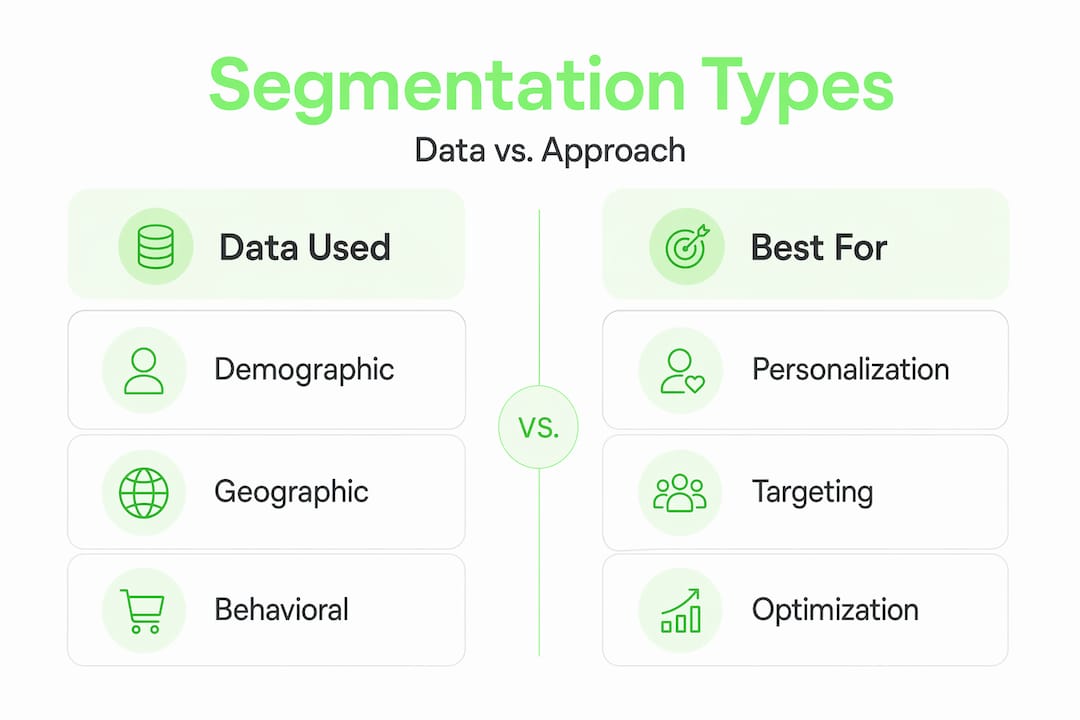
| Type | Primary Data Used | Best For | Example |
|---|---|---|---|
| Demographic | Age, income, gender, education | Broad market positioning | Targeting 25-40-year-old urban professionals |
| Geographic | Location, region, climate | Local or regional campaigns | Promoting winter gear in colder states |
| Psychographic | Values, lifestyle, personality | Brand storytelling and positioning | Eco-conscious buyers who prioritize sustainability |
| Behavioral | Purchase history, usage patterns | Retention and upsell campaigns | Rewarding high-frequency buyers with loyalty perks |
| Transactional | Spend level, order frequency, recency | Lifetime value optimization | Identifying customers approaching churn |
Amazon’s multi-dimensional segmentation system demonstrates what happens when you layer these types intelligently. Amazon uses RFM (Recency, Frequency, Monetary), behavioral, and psychographic profiles simultaneously to optimize pricing, logistics, and personalization across hundreds of millions of customers. The result? Prime members average 8.4 orders per year and a customer lifetime value of $80,640, compared to 2.1 orders and $3,717 for non-Prime customers. That gap is not luck. It’s segmentation done with precision.

When you’re deciding how to segment customers, the type you choose should follow your data availability and your goal. B2B businesses typically lean on firmographics (company size, industry, revenue), while B2C segmentation leans harder on behavioral and psychographic data. There’s no universal right answer. There is a right answer for your specific model.
A few principles to keep in mind:
- Combine types where you have the data quality to support it. Layering behavioral data on top of demographics sharpens targeting considerably.
- Market research platforms enable targeting using over 200 profiling attributes, from age and income to employment status. But depth of data is only useful when your team can act on it.
- Always prioritize data quality over quantity. Dirty data creates false segments that waste money.
Pro Tip: Run a simple RFM analysis (Recency, Frequency, Monetary value) before investing in complex segmentation models. RFM as a practical framework helps you prioritize your most valuable customers without needing sophisticated tooling upfront.
Modern tools and automation for segmentation
Static segmentation lists are a liability. Customer behavior shifts constantly, and a segment built on last quarter’s data may be describing people who have already moved on. This is where automation fundamentally changes how customer segmentation strategies work in practice.
The shift from manual to automated segmentation looks like this:
- CRM integration: Your CRM captures customer interactions in real time. Segments update automatically as customers hit new thresholds, like crossing a spend level or going 60 days without a purchase.
- Behavioral triggers: CRM data with marketing automation enables dynamic segmentation that adjusts based on lifecycle stage. A customer who just made their third purchase enters a different workflow than one who’s gone quiet.
- Automated email workflows: A welcome series launches when someone joins. It shifts tracks based on what they engage with. Dynamic lists exclude inactive customers who haven’t purchased in 90 days, keeping your active segments clean and relevant.
- AI-driven personalization: Machine learning models predict which segment a new customer belongs to based on early behavioral signals, letting you personalize from the very first interaction.
The practical benefits of this approach over spreadsheet-based segmentation are significant:
- Segments stay current without manual intervention
- Marketing actions fire at the right moment in the customer lifecycle
- You reduce the lag between a customer changing behavior and your business responding to it
- Teams save hours of manual list management each week
For founders and marketers who want to explore AI tools for segmentation, the barrier to entry has dropped considerably. Platforms that once required a data science team are now accessible to small businesses with lean marketing operations.
The importance of customer segmentation in a world of automated tools isn’t diminishing. It’s growing. Because automation amplifies your strategy. If your strategy is weak, automation just sends the wrong message faster.
Pitfalls and ethical considerations
Segmentation can do real harm when it’s done carelessly. That’s not hyperbole. It’s a pattern worth taking seriously.
The most common pitfalls are:
- Over-segmentation: Creating dozens of micro-segments feels thorough. In practice, it produces groups too small to be statistically meaningful and too many for your team to manage well. Starting with manageable models like a five-segment RFM structure keeps you grounded.
- Stale data: Segmentation requires continuous refinement as customer behaviors evolve. Experts from Salesforce and Mailchimp both emphasize this. A segment you built 18 months ago may no longer describe anyone accurately.
- Siloed data sources: When your CRM, email platform, and ad accounts don’t talk to each other, your segments describe different versions of the same customer. Unified data is the foundation of effective segmentation.
- Discriminatory targeting: Segmentation that excludes certain groups from offers based on protected characteristics is not just unethical. It’s a legal exposure.
“The ethical terrain of segmentation is complex and requires balancing personalization with consumer privacy and fairness to avoid discriminatory practices.” Customer segmentation ethical considerations
On the privacy front, advanced segmentation must respect data privacy laws like GDPR and, increasingly, regulations like India’s DPDP Act. Techniques like on-device inference and differential privacy are becoming standard practice for businesses that handle customer data at scale. Consumer trust, once lost through a data misuse incident, is extraordinarily difficult to rebuild. Treat data stewardship as part of your brand promise, not just a compliance checkbox.
My take on what most people get wrong
I’ve watched a lot of founders and marketers treat segmentation as a project with a finish line. They spend weeks building a model, launch a campaign, see decent results, and then move on. Six months later, the same segments are running on autopilot while the actual customer base has shifted underneath them.
The misconception that segmentation is a one-time task is the most expensive mistake I see. Markets move. Customer needs evolve. The cohort that loved your original product may not be the same people who love version three. Staying locked into early segments while your market matures is how you end up sending perfectly crafted messages to the wrong people.
What I’ve found actually works is treating segmentation like a living system, not a deliverable. Build it, use it, measure it, and revisit it on a quarterly cadence at minimum. That rhythm forces you to confront whether your segments still reflect reality or whether you’ve been marketing to ghosts.
There’s also a tendency to conflate sophistication with effectiveness. More segments, more attributes, more complexity. But the businesses I’ve seen get the most traction from segmentation are the ones who started simple. Define your top three customer archetypes. Build one campaign for each. Measure the difference. Then add nuance. Getting early customers validated through tight segmentation beats a beautifully complex model that never ships.
Segmentation gives you permission to be specific. And specific is what actually converts.
— Samim
How Siift helps you segment and scale smarter
Understanding customer segmentation principles is one thing. Building a strategy around them, testing it, and refining it without burning through runway is another challenge entirely. That’s exactly where Siift comes in.
Siift’s AI-powered Business OS guides founders and marketers through the customer definition and validation process step by step. Instead of guessing which segments to target, you work through a structured framework that surfaces the segments most aligned with your business model and growth goals. It’s the kind of rigorous, bias-filtering process that normally costs a consulting firm’s day rate.
If you’re ready to move from generic marketing to precision targeting, explore Siift’s platform and see how agentic AI can accelerate your path to product-market fit.
FAQ
What is the customer segmentation definition?
Customer segmentation is the process of dividing a customer base into distinct groups based on shared characteristics like demographics, behavior, or purchasing patterns, so businesses can market to each group more precisely.
What are the main types of customer segmentation?
The five core types are demographic, geographic, psychographic, behavioral, and transactional segmentation. Most effective strategies combine two or more types based on available data and business goals.
How often should you update customer segments?
Segmentation is an ongoing process, not a one-time task. Reviewing and refreshing segments quarterly is a strong baseline, with automated systems providing continuous updates in real time.
What is the risk of over-segmentation?
Over-segmentation creates too many micro-groups that lack statistical significance and become unmanageable for marketing teams. Starting with a simpler model like five RFM segments and expanding gradually is the smarter approach.
Why does customer segmentation matter for small businesses?
Segmentation helps small businesses compete by focusing limited resources on the customers most likely to convert, retain, and advocate. It turns a broad market into a manageable set of people you can actually serve well.