
Launching your own side business might feel overwhelming at first. Most people think it starts with a single brilliant idea, but that is not how successful entrepreneurs really do it. The real magic begins the moment you discover that nearly every skill you already have can be flipped into a business with actual demand waiting out there.
Table of Contents
- Step 1: Identify Your Skills And Markatable Ideas
- Step 2: Conduct Market Research For Viability
- Step 3: Create A Business Plan For Your Side Hustle
- Step 4: Set Up Your Business Structure And Finances
- Step 5: Launch Your Business And Start Marketing
Quick Summary
| Key Point | Explanation |
|---|---|
| 1. Identify your skills thoroughly | Conduct a skills audit to list all talents, including professional and personal skills, without self-censoring. |
| 2. Conduct targeted market research | Use free platforms to identify real customer needs and assess potential demand for your services. |
| 3. Create a simple business plan | Develop a lean document outlining your business concept, target market, offerings, and financial projections. |
| 4. Choose the right business structure | Select a business structure like sole proprietorship or LLC for legal protection and tax efficiency. |
| 5. Develop a strategic marketing approach | Focus on initial networking and content marketing to build credibility and attract your first customers. |
Step 1: Identify Your Skills and Marketable Ideas
Identifying your skills and transforming them into marketable business ideas is the critical first step in your self employment journey. Most aspiring entrepreneurs get stuck because they fail to recognize the unique value they can offer the marketplace. Your existing skills, professional experiences, and personal passions are potential goldmines waiting to be explored.
Start by conducting a comprehensive personal skills audit. Grab a notebook or open a digital document and spend 45 minutes documenting every skill you possess. This includes professional capabilities, technical expertise, soft skills, hobby-related talents, and even niche knowledge you might have overlooked. Don’t self-censor during this process. Write down everything from “graphic design” to “expert home baker” to “multilingual communication skills.”
Next, evaluate these skills through a market validation lens. Which of your skills solve real problems for specific groups of people? Learn how to transform your skills into viable business opportunities by understanding market demand. For instance, if you’re an excellent writer with technical knowledge, you might offer technical writing services for software companies. If you’re great at organizing and have project management experience, you could provide virtual assistant services for small businesses.
Consider creating a matrix that maps your skills against potential market needs. This strategic approach helps you identify intersection points between your abilities and market gaps.
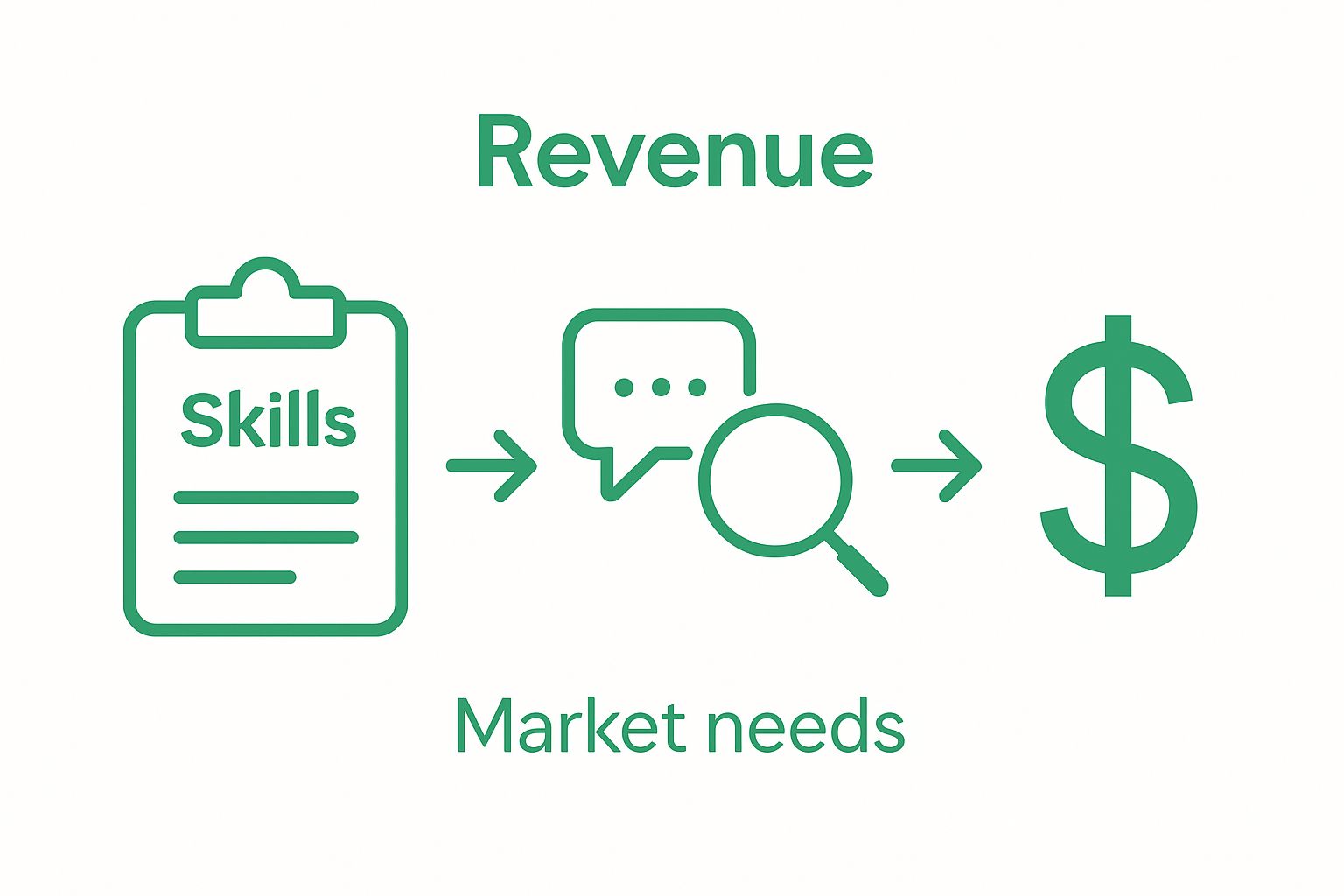 Research online marketplaces like Upwork, Fiverr, and LinkedIn to understand how professionals monetize skills similar to yours. Pay attention to pricing, service descriptions, and client reviews to gain insights into market expectations.
Remember that your first business idea doesn’t need to be perfect. What matters is starting with something manageable that leverages your existing strengths. Many successful entrepreneurs begin with side projects that gradually evolve into full-time businesses. Your initial offering can be a service, digital product, or consulting package that requires minimal upfront investment but maximizes your current skill set.
To verify you’ve completed this step successfully, you should have:
- A comprehensive list of your professional and personal skills
- 2-3 potential business ideas that align with your capabilities
- Initial market research indicating demand for your proposed services
- A basic understanding of how your skills translate into potential revenue streams
By methodically working through this process, you transform abstract abilities into concrete business opportunities, setting a strong foundation for your self employment journey.
Below is a checklist table summarizing the key completion criteria after Step 1, helping you verify your readiness before moving forward.
| Checklist Item | Description | Status (Check/Review) |
|---|---|---|
| Comprehensive Skills List | Documented all professional and personal skills | Check |
| 2-3 Business Ideas | Brainstormed potential businesses aligned with your skills | Check |
| Market Research Evidence | Noted initial market demand for services or products | Check |
| Revenue Stream Insights | Outlined how your skills can generate income | Check |
Step 2: Conduct Market Research for Viability
Market research is the critical bridge between your skills and a potential successful business venture. Without understanding market demand, you risk investing time and resources into an idea that might never gain traction. This step transforms your skills audit into a strategic business opportunity by validating real customer needs and potential revenue streams.
Begin your market research by leveraging free and accessible digital platforms. Google Trends, social media groups, Reddit forums, and industry-specific online communities are treasure troves of consumer insights. Pay close attention to recurring pain points, questions, and discussions that hint at unmet market needs. For example, if you notice multiple professionals in a LinkedIn group complaining about a specific workflow challenge, that could be your potential service niche.
Master the art of business opportunity analysis by conducting targeted research. Develop a systematic approach to gathering market intelligence. Create a spreadsheet to track potential competitors, their pricing models, service offerings, and customer reviews. Look for gaps in their services or areas where you could provide a more personalized, efficient solution. Tools like SEMrush, Google Keyword Planner, and industry reports can provide valuable data on search volumes, customer interests, and market trends.
Engaging directly with potential customers is crucial. Conduct informal interviews or surveys with 10-15 individuals who match your target market profile. These conversations are more valuable than generic market reports. Ask specific questions about their challenges, current solutions, and what they would pay for a service that solves their problems. Platforms like SurveyMonkey or Google Forms can help you structure these research efforts efficiently.
Calculate the potential market size and economic viability of your business idea. Estimate the total addressable market, your potential customer base, and realistic pricing models. Consider factors like customer acquisition costs, potential competition, and scalability. A promising side business should offer a balance between your passion, skills, and market demand.
To verify you’ve completed this step successfully, ensure you have:
- A detailed market research document
- Identified 3-5 specific customer pain points
- Preliminary competitive analysis
- Initial pricing and market size estimates
- At least 10 direct customer insights from interviews or surveys
Your market research transforms an abstract business idea into a data-driven opportunity with genuine potential for success.
Step 3: Create a Business Plan for Your Side Hustle
A business plan transforms your market research and skills into a strategic roadmap for success. While many entrepreneurs view business plans as intimidating corporate documents, they are actually powerful tools for clarity and focus. Your side hustle business plan doesn’t need to be complex but must provide a clear vision of your entrepreneurial direction.
Start by creating a lean, actionable document that captures the essence of your business opportunity. Explore the essentials of crafting a beginner-friendly business plan that aligns with your side hustle goals. Begin with an executive summary that succinctly describes your business concept, target market, unique value proposition, and initial revenue model. Think of this section as your elevator pitch condensed into one powerful paragraph.
Structure your business plan to include key sections that provide a comprehensive yet practical overview. Outline your service or product offerings, detailing exactly what problems you solve for customers. Define your target market segments with precision, explaining why your solution is uniquely positioned to address their needs. Include a competitive analysis that demonstrates your understanding of the marketplace and highlights your differentiation strategy.
Develop realistic financial projections that ground your side hustle in economic feasibility. According to research from the Small Business Administration, your financial section should include startup costs, potential revenue streams, and a basic profit and loss forecast. Use conservative estimates and factor in potential challenges. Create a spreadsheet tracking your expected monthly expenses, potential income, and break-even point. Tools like Google Sheets or Excel can help you build these financial models without requiring advanced accounting skills.
Incorporate a marketing strategy that outlines how you will attract and retain customers. Describe your promotional channels, pricing strategy, and initial customer acquisition approach. Consider low-cost digital marketing tactics like social media, content marketing, and networking that can help you build initial momentum without significant financial investment.
To verify you’ve completed this step successfully, ensure your business plan includes:
- A clear and concise executive summary
- Detailed description of your service or product
- Defined target market and customer segments
- Competitive analysis
- Basic financial projections
- Initial marketing strategy
- Realistic timeline for launch and initial growth
Your business plan is a living document that will evolve as your side hustle grows.
Treat it as a strategic compass, not a rigid contract, allowing flexibility and continuous refinement.
Step 4: Set Up Your Business Structure and Finances
Structuring your side business correctly is crucial for legal protection, tax efficiency, and long-term growth. This step transforms your business idea from a concept into a legitimate operational entity. The right business structure shields your personal assets and sets a professional foundation for your entrepreneurial journey.
Explore the nuanced process of choosing your business structure with careful consideration. For most side hustlers, a sole proprietorship or Limited Liability Company (LLC) offers the best balance between simplicity and protection. Sole proprietorships are easiest to set up and ideal for low-risk businesses with minimal startup costs. LLCs provide personal asset protection and potential tax advantages, making them attractive for businesses with higher potential liability.
According to IRS guidelines, selecting your business structure impacts your tax obligations and legal responsibilities. Consult with a local tax professional or small business advisor to understand the specific implications for your unique situation. Many entrepreneurs start with a sole proprietorship and transition to an LLC as their business grows and income increases.
This table compares common side business structures mentioned in the article, highlighting their advantages and best use cases for new entrepreneurs.
| Structure Type | Key Advantages | Best For | Setup Complexity |
|---|---|---|---|
| Sole Proprietorship | Easiest to set up, low cost, total control | Low-risk, simple businesses | Low |
| LLC | Personal asset protection, tax flexibility | Businesses with higher liability or growth plans | Moderate |
Establish a dedicated financial infrastructure for your side business. Open a separate business checking account to keep personal and professional finances distinct. Online banks like Novo, Mercury, or Chase Business Banking offer low-cost options specifically designed for small businesses and side hustlers. Consider obtaining a business credit card to track expenses, build business credit, and simplify accounting. Platforms like QuickBooks Self-Employed or Freshbooks can help you manage invoicing, expense tracking, and basic bookkeeping with minimal effort.
Develop a robust financial tracking system from the start. Create spreadsheets or use accounting software to monitor income, expenses, and potential tax deductions. Maintain meticulous records of all business-related transactions, including receipts, invoices, and financial statements. This practice not only simplifies tax preparation but also provides insights into your business’s financial health.
To verify you’ve completed this step successfully, ensure you have:
- Selected an appropriate business structure
- Obtained necessary business registrations or licenses
- Opened a dedicated business bank account
- Established a basic bookkeeping and expense tracking system
- Consulted with a tax professional about your specific business setup
- Created a system for managing business finances separately from personal funds
By methodically setting up your business structure and financial systems, you create a professional framework that supports sustainable growth and minimizes potential legal and financial risks.

Step 5: Launch Your Business and Start Marketing
Launching your side business requires strategic planning and a thoughtful approach to marketing that maximizes your limited resources. Your initial marketing efforts should focus on building credibility and attracting your first customers through targeted, low-cost strategies that leverage your existing network and skills.
Discover how to validate and refine your business marketing approach by starting with your immediate professional and personal network. Craft a compelling narrative about your business that explains the unique problem you solve. Develop a clear, concise elevator pitch that communicates your value proposition in less than 30 seconds. Reach out to former colleagues, LinkedIn connections, and professional acquaintances who might be interested in your services or can provide referrals.
Create a minimal viable online presence that showcases your expertise and makes it easy for potential clients to understand and contact you. Build a simple website using platforms like Squarespace, Wix, or WordPress that highlights your services, professional background, and contact information. Develop a professional LinkedIn profile that tells your business story and demonstrates your expertise. Choose 1-2 social media platforms where your target customers are most active and create consistent, value-driven content that demonstrates your knowledge and skills.
Implement a targeted outreach strategy that combines digital marketing with personal networking. Use platforms like LinkedIn, Twitter, and industry-specific online communities to share insights, answer questions, and subtly promote your services. Cold email potential clients with personalized, value-driven messages that solve specific problems. Offer initial consultations or small-scale projects at competitive rates to build your portfolio and generate initial testimonials. Focus on delivering exceptional value in these first interactions to generate word-of-mouth referrals.
Develop a basic content marketing strategy that positions you as an expert in your field. Start a blog, create short-form videos, or develop a podcast that addresses common challenges in your industry. Share these resources on social media and professional networks to demonstrate your expertise and attract potential clients. Consider guest posting on relevant industry blogs or participating in online forums to expand your visibility.
To verify you’ve completed this step successfully, ensure you have:
- A clear, concise business narrative and elevator pitch
- Basic online presence (website and professional social profiles)
- Initial marketing outreach plan
- First set of potential client contacts
- Strategy for generating initial client testimonials
- Content marketing approach that showcases your expertise
Remember that your first marketing efforts are about building relationships and demonstrating value, not aggressive selling. Patience, consistency, and genuine value are your most powerful marketing tools.
Make Your 2025 Side Business Unstoppable With siift
Building a side business is exciting but the journey can feel overwhelming. Common struggles highlighted in Master Self Employment: Build Your Side Business in 2025 include transforming your raw skills into real business opportunities, validating your ideas through research, and setting up the right structure with confidence. You might worry about missing a critical step or spending time on the wrong priorities. That fear of making a costly mistake can hold you back even after you pour hours into planning and research.
siift gives you clarity and confidence at every stage. Our intuitive AI platform acts as your personal founder’s compass. siift helps you:
- Turn a skills audit into a focused business idea
- Prioritize the right actions based on real-time feedback
- Validate your market research and competitive positioning
- De-risk your journey no matter where you start
There is no better time to get expert-level guidance tailored to your journey. Start your self employment roadmap now and see how personalized insights and next actions from siift can help you launch smarter, move faster, and grow with confidence. Take your first step to a successful side business today.
Frequently Asked Questions
How can I identify my skills to build a side business in 2025?
Start by doing a personal skills audit; write down all your skills, including professional abilities, hobbies, and soft skills. Dedicate at least 45 minutes to this process to uncover unique strengths that you can turn into a business idea.
What steps should I take for market research before launching my side business?
Conduct thorough market research by analyzing consumer needs through online platforms and social media discussions. Identify 3-5 specific pain points faced by potential customers and gather insights through informal interviews or surveys to validate your business idea.
How can I create a simple business plan for my side hustle?
Begin with an executive summary that includes your business concept and target market, then outline your services and marketing strategy. Ensure your plan has clear financial projections and a timeline for launch—keep it concise and focused.
What type of business structure is best for my side business in 2025?
For most new side hustlers, a sole proprietorship or LLC is recommended due to their balance of simplicity and personal asset protection. Research the advantages of each option and consult with a professional if needed before making your choice.
How do I effectively market my side business after launching?
Utilize your personal and professional network to generate initial interest and testimonials. Focus on building an online presence with a simple website and engaging on 1-2 social media platforms relevant to your target audience to attract clients.
What financial practices should I implement from the start?
Open a dedicated business bank account to separate your personal and professional finances. Establish a simple bookkeeping system to track your income and expenses, ensuring you maintain accurate records for easier tax preparation and financial analysis.
Recommended
- blog | siift | Work From Home Tips for Future Entrepreneurs and Solopreneurs
- blog | siift | When to Register a Business: A 2025 Guide for Side Hustlers and New Founders
- blog | siift | Building Entrepreneurial Mindset: Steps for Beginners in 2025
- blog | siift | How to Identify Trends for Your Side Business in 2025
- Set Your Personal Development Goals and Achieve Real Growth
- Master Financial Planning for Freelancers in 2025 - Finblog