
TL;DR:
A growth mindset alone is not enough for entrepreneurial success; it requires real structure, feedback, and effort.
Building intentional environments and clear habits enhances mindset effectiveness, enabling progress despite setbacks.
You’ve got the drive, the late nights, and a real idea. Yet somehow, you still feel stuck. This is one of the most common and least talked about realities of early-stage entrepreneurship: motivation alone doesn’t move the needle. Growth mindset has become a buzzword that promises to bridge that gap, but for most founders, the concept stays abstract until someone shows them exactly how to use it. This guide cuts through the noise, offering evidence-backed techniques, honest limitations, and a practical framework that turns the growth mindset from an inspirational concept into a genuine engine for entrepreneurial progress.
Table of Contents
Key Takeaways
Point | Details |
|---|---|
Mindset needs structure | Growth mindset techniques work best when combined with feedback, clear goals, and practical opportunities for improvement. |
Context is critical | Results vary depending on environment, starting point, and real support—not just positive thinking. |
Progress beats perfection | Tracking small wins and learning from setbacks helps entrepreneurs maintain motivation and sustain growth. |
Pitfalls can be avoided | Watch for plateaus and stay adaptable—changing techniques or adding support can revive stalled progress. |
Understanding growth mindset: What it is and isn’t
Before diving into the techniques, let’s clarify what a growth mindset truly means in the entrepreneurial arena, and why it’s not a magic bullet.
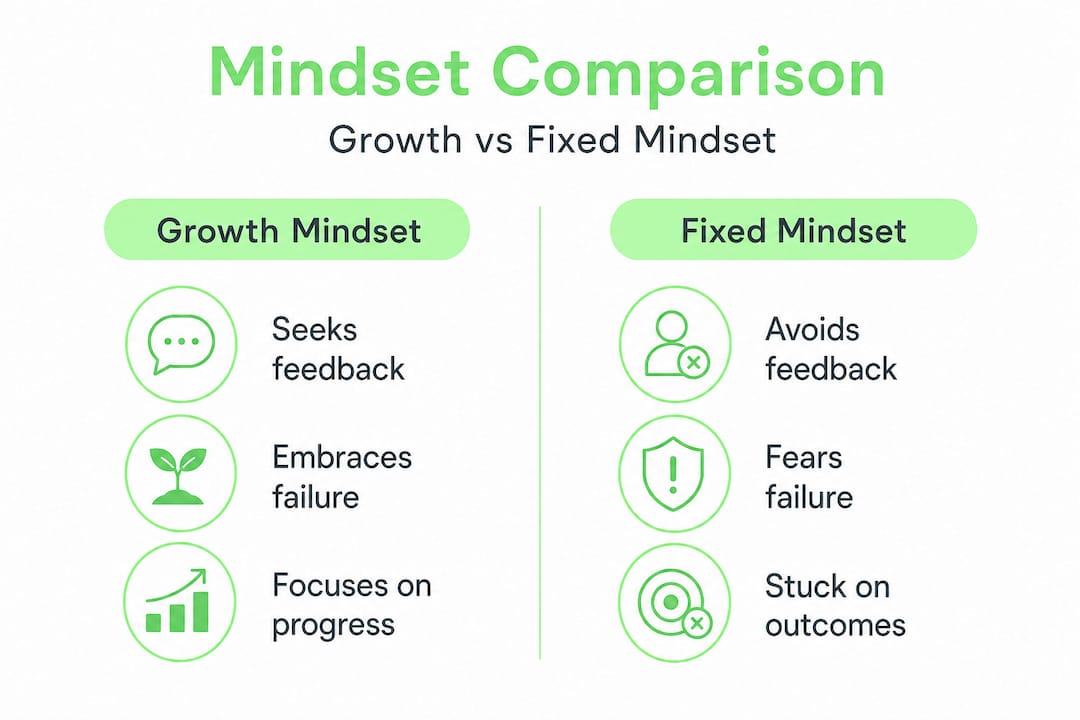
At its core, a growth mindset is the belief that your abilities, intelligence, and skills can improve through effort, feedback, and learning. Psychologist Carol Dweck popularized the concept, and it resonated loudly with founders who face constant uncertainty. In contrast, a fixed mindset assumes your talents are largely set at birth. For entrepreneurs, the stakes of that distinction feel very real. Can you learn to sell? Can you figure out product development? A growth mindset says yes, consistently.
But here’s where many aspiring founders get misled. The idea that believing in growth automatically produces growth is a dangerous oversimplification. Research on growth mindset in real-world settings consistently shows that belief alone is not the catalyst. Context, structure, and real feedback loops matter just as much.
Consider the research: mindset effects on performance are not linear, showing diminishing returns and even U-shaped outcomes over time. That means some people who adopt growth mindset messaging see initial gains, then plateau or even regress if the underlying method doesn’t evolve with them. And a structured review found that mindset interventions produce little or very modest achievement gains with possible bias in the way outcomes are reported.
“A growth mindset is the frame around the painting, not the painting itself.”
That’s a useful way to think about it. The frame matters. It orients how you see challenges and setbacks. But the actual art, the strategy, the learning, the iteration, still needs to be built deliberately. Understanding growth mindset for entrepreneurs means accepting both its power and its limits.
Dimension | Growth mindset | Fixed mindset |
|---|---|---|
Response to failure | Sees it as data and direction | Sees it as proof of inability |
View of effort | Effort builds capability | Effort signals weakness |
Reaction to feedback | Seeks and applies it | Avoids or deflects it |
Long-term pattern | Iterates and improves | Stays in comfort zones |
The key takeaway here is that growth mindset works best as a lens, not a lever. It shapes how you interpret your journey, which in turn influences the quality of your decisions. But interpretation without action, structure, and honest feedback is simply wishful thinking in disguise.
Laying the groundwork: Essential habits and tools
With the real limits and possibilities of mindset in mind, the next step is to build a foundation that allows these techniques to stick and actually move you forward.

One of the clearest findings from large-scale research is that mindset benefits are strongest when paired with real opportunities and clear structures. Translated into startup language: your environment either amplifies or dampens your mindset’s effectiveness. If you’re working in isolation with no feedback, no mentorship, and no measurable goals, even the most growth-oriented thinking won’t generate traction.
Start by designing your environment intentionally. This means choosing co-founders, advisors, or community members who will challenge your assumptions rather than validate them. It means creating a physical or digital workspace that signals serious work. And it means building in structured feedback moments, not occasional ones. Feedback shouldn’t only arrive during crises. It should be a routine, like checking your analytics or reviewing your weekly budget.
Foundational habits that support a growth mindset:
Set specific, time-bound milestones (not vague intentions like “grow revenue”)
Build a weekly reflection habit around what worked, what didn’t, and why
Track visible progress with simple tools like a progress board, journal, or app
Identify one skill gap per quarter and pursue deliberate improvement in that area
Seek at least one challenging, honest conversation with a mentor or peer each month
Good business goal setting is itself a mindset practice. Vague goals produce vague effort. When you set clear checkpoints, you give your growth mindset something concrete to work with. You can celebrate a small win, diagnose a shortfall, and adjust your strategy. That cycle is where real entrepreneurial development happens.
Foundation element | Why it matters | Practical tool |
|---|---|---|
Clear milestones | Converts belief into measurable direction | OKR framework, weekly sprint goals |
Feedback loops | Reveals blind spots early | Peer review sessions, user interviews |
Visible progress | Builds momentum and motivation | Kanban boards, habit trackers |
Mentorship access | Provides context-aware challenge | Advisory circles, founder communities |
Skill targeting | Builds actual capacity, not just confidence | Online courses, deliberate practice sprints |
Your startup growth strategies need this infrastructure beneath them. Without it, mindset becomes a performance rather than a practice.
Pro Tip: Before adopting any growth mindset technique, spend 30 minutes auditing your current environment. Ask yourself honestly: where does useful, challenging feedback actually reach me right now? If you can’t name two or three consistent sources, that’s your first project, not a new mindset hack.
Actionable growth mindset techniques for entrepreneurs
Once your foundation is built, you’re ready to implement concrete techniques that foster, test, and strengthen a growth-focused approach.
The following methods are grounded in evidence and designed for the messy, nonlinear reality of early-stage startup life. They won’t always feel comfortable. That’s the point.
Step-by-step growth mindset technique system:
Set challenge goals, not comfort goals. Research supports progress checkpoints, clear goals, and small achievable wins as the architecture of real perseverance. Your goal should stretch you without snapping your motivation. A useful test: does this goal require you to learn something new, or just do more of what you already know?
Map your milestones visually. Create a roadmap that shows where you are and where you’re going. Physical visibility changes behavior. Founders who can see their journey are far more likely to stay on track when the inevitable setbacks arrive. Use a whiteboard, a Notion page, or a dedicated planning tool.
Run weekly reflection logs. Every Friday, spend 15 minutes writing answers to three questions: What did I attempt? What did I learn? What will I change? This isn’t journaling for its own sake. It’s deliberate practice through structured reflection, which builds the metacognitive (self-aware thinking about your own thinking) skills that separate founders who grow from those who repeat the same mistakes.
Seek feedback on specific skills. General feedback is hard to act on. Targeted feedback is actionable. Instead of asking “What do you think of my startup?” ask “What’s the one thing in my pitch that felt unclear or unconvincing?” The mindset as a lens, not a substitute for real deliberate practice means you need to pair your belief in improvement with specific, honest input from others.
Use accountability partners deliberately. Find someone whose opinion you respect, who has no reason to protect your feelings. Set a bi-weekly check-in where you share your goals, report on progress, and discuss what’s stuck. This creates external accountability that reinforces internal drive.
Additional practices to layer in over time:
Audit your reaction to criticism: do you get defensive or curious? Work to shift toward curiosity.
Celebrate process wins (finishing a user interview series) as enthusiastically as outcome wins (landing a customer).
Rotate your challenges regularly to avoid the plateau that comes from repetition without novelty.
Use visual progress maps to show your momentum and motivation strategies drawn from behavioral science.
Building an entrepreneurial mindset is a practice you return to daily, not a destination you arrive at once. And exploring practical startup growth steps alongside these mindset tools creates a powerful synergy that generic motivation alone never could.
Pro Tip: Record one voice memo per week summarizing your biggest learning of that week. Listening back to these memos one month later is one of the most powerful ways to observe your own growth. You will be surprised by how much you’ve moved, even when daily progress feels invisible.
Avoiding common pitfalls: When growth mindset techniques stall
Even well-equipped entrepreneurs can get stuck. Let’s address why growth mindset techniques sometimes lose power and how to avoid common traps.
The first trap is confusing belief with capability. You can believe wholeheartedly in your ability to improve and still lack the skills, resources, or access needed to actually improve. Research notes that effects on resiliency and growth show diminishing or even non-monotonic (non-straightforward, going up and then down) effects in certain populations, especially when the mindset message isn’t aligned with real constraints. In other words, telling yourself “I can figure this out” without also building the actual skills to figure it out is a recipe for frustration, not growth.
The second trap is over-indexing on positivity. Growth mindset is not toxic positivity wearing a startup hoodie. Real growth requires honest acknowledgment of what isn’t working. Founders who reframe every failure as a “learning opportunity” without actually extracting and applying the lesson aren’t practicing growth mindset. They’re performing it.
Warning signs that your growth mindset approach is stalling:
You’re reflecting without changing any behaviors or strategies
Feedback feels threatening rather than useful
Your goals haven’t evolved even though your environment has
You’re celebrating effort but not honest about results
You feel like you’re growing in theory but can’t point to specific skill improvements
“Context, baseline, and alignment with real constraints matter just as much as the belief itself.”
This is the uncomfortable truth that much of the mindset industry glosses over. If you’re operating in an environment with no real mentorship, no capital access, and no network, a growth mindset alone cannot compensate for those structural gaps. Addressing them directly is part of the work. Exploring startup idea success tips and inclusive learning environments can help you close some of those structural gaps.
The third trap is staying too long in a strategy that isn’t working. The fix is variation. Change the level of challenge. Introduce a new type of feedback source. Try a different format for reflection. The goal is progressive difficulty combined with ongoing support, not repetition with diminishing returns.
A founder’s lens: Mindset isn’t magic—context is everything
Having explored the pitfalls, let’s step back and see what the research and lived entrepreneurial experience really teach us about using growth mindset to move the business needle.
Here’s an uncomfortable perspective we’ve arrived at after studying this closely: most growth mindset content in the entrepreneurship world is written to inspire, not to instruct. It cherry-picks success stories and skips over the messy middle. That creates a dangerous gap between how founders think growth mindset works and how it actually performs under pressure.
Method always trumps messaging. A founder who tracks every customer conversation, iterates their pitch weekly, and builds honest feedback loops into their process will outperform a founder who simply believes in their growth potential every single time. The research backs this up. The modest, context-dependent gains from mindset interventions don’t become powerful until they’re paired with real structure.
What we believe most strongly is this: mindset is the frame, not the engine. It determines whether you stay in the game long enough to learn and whether you face challenges with curiosity or defensiveness. Those qualities matter enormously. But they only produce results when the engine, the goals, the skills, the feedback, and the opportunities, is running.
We also think there’s a more nuanced insight worth naming. Some founders are so convinced of the importance of growth mindset that they become resistant to legitimate strategic pivots, thinking that pushing harder reflects the right mindset. Sometimes the right move is to stop, reassess, and redirect. Intellectual honesty and strategic flexibility are as much a part of a healthy growth mindset as perseverance. Exploring ideas around curiosity and startup success reinforces this point well.
Think of your mindset like the operating system on your phone. If the OS is glitchy or outdated, even the best apps won’t run properly. Keeping it updated through reflection, feedback, and honest self-assessment keeps everything else running smoother and faster.
Take your growth journey further with siift.ai
Ready to put these strategies into action? Here’s a resource designed for founders like you.
Growth mindset is most powerful when embedded in a structured, systematic workflow, not practiced in isolation between motivational podcasts. The siift.ai intelligence platform is built specifically to help founders like you turn ideas into viable businesses by combining goal-setting, validation, and go-to-market strategy in one intuitive system. It filters out the biases, blind spots, and distractions that undermine even the most growth-oriented founders, and it replaces guesswork with evidence-backed guidance at every stage. If you want to pair your growth mindset with the real structure that makes it work, dive deeper into more growth strategies and see how siift.ai accelerates the founder journey from idea to traction.
Frequently asked questions
Do growth mindset techniques guarantee entrepreneurial success?
No, growth mindset techniques can help, but their effectiveness depends on context, real opportunities, and structured feedback. Mindset interventions show variable effects and require real structural support to produce consistent results.
What’s the most important habit to pair with a growth mindset?
Setting clear goals and visible progress checkpoints is key to making a growth mindset effective in entrepreneurial settings. Research supports using visual progress maps and checkpoints to guide sustained effort over time.
Why do growth mindset strategies sometimes stop working?
Their effectiveness can stall if not paired with real skills training, feedback, or challenging but achievable tasks. The OECD PISA findings show benefits are strongest when paired with opportunity and structure, not belief alone.
Can fixed mindset traits ever help founders?
Some research suggests even strong fixed mindsets can outperform moderate ones in certain situations, showing that both traits have situational strengths depending on context and the specific challenge involved.