
TL;DR:
- Most small businesses underestimate the value of intellectual property protection. IP boosts revenue, credibility, investment, and negotiation power for startups. AI tools now enhance IP strategy by automating searches, infringement monitoring, and invention capturing, giving entrepreneurs a competitive edge.
Most founders believe intellectual property protection is a luxury reserved for Silicon Valley giants or pharmaceutical conglomerates. That belief is quietly costing small businesses millions. 93% of SMEs with registered IP rights report a positive business impact, yet the majority of early-stage founders still treat IP as an afterthought. The reality is that your brand name, your software, your process, your secret formula — these are assets. And unprotected assets are just opportunities waiting to be taken. In this guide, we’ll walk through what to protect, how to protect it, the traps to avoid, and how AI is now giving entrepreneurs a genuine edge in the IP game.
Table of Contents
- Why intellectual property matters for small businesses
- The four pillars of IP protection: What you need to know
- Common mistakes and how to safeguard your IP
- How AI transforms intellectual property protection and growth
- The uncomfortable truth: Why most IP strategies fail and how to win
- Level up your IP protection with smarter tools
- Frequently asked questions
Key Takeaways
| Point | Details |
|---|---|
| IP boosts business value | Registered IP increases your reputation, revenue, and chances of securing investment. |
| Know what and how to protect | Match each business asset to the right protection—trademarks, patents, copyrights, or trade secrets. |
| Avoid common pitfalls | Mistakes like public disclosure or skipping filings can cost you future growth and legal leverage. |
| AI multiplies your impact | Modern AI tools automate IP tasks, speed up discovery, and reveal new growth opportunities. |
| Strategy beats paperwork | Prioritize assets, update your approach regularly, and combine technology with expert advice for lasting protection. |
Why intellectual property matters for small businesses
Let’s challenge something right away. IP protection isn’t a legal formality. It’s a business strategy. When you register your intellectual property, you’re not just filing paperwork — you’re building a moat around your most valuable assets, signaling credibility to investors, and creating leverage in negotiations.
The numbers make a compelling case. IP-intensive SMEs generate 68% more revenue per employee than their non-IP counterparts. That’s not a marginal difference. That’s a structural advantage baked into how the business operates and how the market perceives it.
Here’s what strong IP protection actually does for your business:
- Reputation and brand trust: A registered trademark signals legitimacy. Customers, partners, and press treat you differently.
- Revenue leverage: Licensed IP can become a standalone income stream, separate from your core product.
- Investment attraction: Investors want defensibility. IP portfolios are one of the clearest signals that your business has durable competitive advantage. Around 45% of IP owners report attracting more funding after formalizing their rights.
- Negotiation power: In partnerships, acquisitions, or licensing deals, IP ownership shifts the balance in your favor.
- Employee productivity: Teams working in IP-protected environments tend to innovate more, knowing their work is valued and defended.
Think about the founders who built a product, grew a loyal audience, then watched a better-funded competitor copy their brand identity or core feature set. Without IP protection, there’s often little recourse. That’s not just a legal problem — it’s an existential one.
“Intellectual property is the currency of the knowledge economy. For small businesses, it’s not optional — it’s the foundation of sustainable growth.”
If you’re serious about de-risking your startup, IP strategy belongs in your earliest planning conversations, not your Series A checklist. And if you want a solid foundation before diving deeper, the IP basics for founders resource is a great place to start. When you’re ready to raise capital, a well-documented IP portfolio can also transform your pitch deck IP value and make investors take notice.
The SME IP impact report is clear: IP isn’t just for tech giants. It’s for every founder who wants to build something worth protecting.
The four pillars of IP protection: What you need to know
Not all intellectual property is the same, and not every type fits every business. Understanding the differences helps you prioritize where to invest your time and money. There are four main types of IP protection that matter most for entrepreneurs: trademarks, patents, copyrights, and trade secrets.
Here’s a side-by-side breakdown:
| Type | What it protects | How to obtain | Estimated cost | Duration |
|---|---|---|---|---|
| Trademark | Brand names, logos, slogans | Register with USPTO | $250–$350 per class | 10 years, renewable |
| Patent | Inventions, processes, designs | File with USPTO | $5,000–$15,000+ | 20 years |
| Copyright | Creative works, software, content | Automatic; register to enforce | $45–$65 | Life + 70 years |
| Trade secret | Formulas, processes, data | Confidentiality agreements | Minimal | Indefinite |
Each type serves a distinct purpose. A trademark protects your identity in the marketplace. The USPTO trademark guide is an excellent starting point for understanding registration requirements and timelines. Patents protect your inventions from being copied, though the process is expensive and slow. Copyright kicks in automatically when you create original work, but copyright registration is what gives you real enforcement power in court. Trade secrets, like Coca-Cola’s formula or your proprietary algorithm, can last forever as long as you keep them confidential.
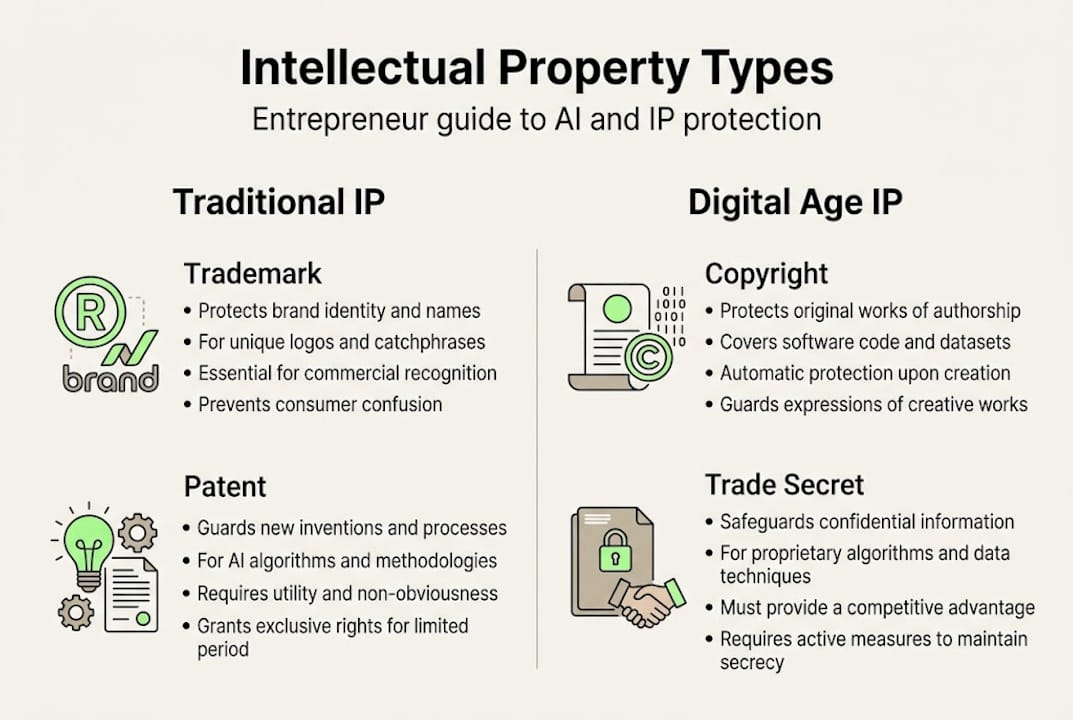
For most early-stage founders, trademarks and copyrights offer the best return on investment. They’re faster, cheaper, and often more immediately relevant than patents. Patents make sense when your core innovation is genuinely novel and your business model depends on exclusivity.
Here’s a quick decision guide:
- Launching a brand? Register your trademark first.
- Building software or content? Register your copyright.
- Invented a novel process? Explore a provisional patent to establish your filing date while you refine the product.
- Protecting a formula or algorithm? Treat it as a trade secret with robust NDAs and access controls.
For more on reducing business risk through smart IP strategy, it’s worth reading up on how asset identification connects to overall business resilience.
Pro Tip: Before you file anything, run an IP audit. List every asset your business depends on — your name, your logo, your code, your processes — and rank them by business value and vulnerability. That list becomes your IP roadmap.
Common mistakes and how to safeguard your IP
Knowing what to protect is only half the battle. The other half is avoiding the mistakes that quietly erode your IP position before you even realize it. WIPO identifies skipping prior art searches and poor documentation as two of the most common and costly IP errors entrepreneurs make.
Here are the six mistakes we see most often, and how to avoid them:
- Disclosing before filing. Publicly sharing your invention before filing a patent application can invalidate your rights in many jurisdictions. File first, talk later.
- Skipping prior art searches. Before investing in a patent, search existing patents and publications. Filing without this step wastes money and time.
- Relying on informal agreements. Handshake deals and verbal understandings don’t hold up. Use written NDAs and IP assignment clauses in every contractor and employee agreement.
- Ignoring monitoring. Registration is not a set-and-forget solution. You need to actively watch for infringement, especially online.
- Poor documentation. Keep dated records of your creative process, invention development, and business decisions. This evidence is critical in disputes.
- Neglecting international protection. If you plan to operate globally, WIPO international protection tools let you file in multiple countries through a single application, dramatically reducing complexity and cost.
“The biggest IP mistake isn’t failing to file. It’s failing to think about IP as an ongoing business practice rather than a one-time legal task.”
Enforcement is where many founders freeze up. If you discover infringement, start with a cease-and-desist letter. It’s often enough to resolve the issue without litigation. Document everything, consult an IP attorney, and escalate only if necessary.
For founders in the early stages, startup validation and IP strategy should move in parallel. As your business evolves, so do your most valuable assets. What matters at launch may be very different from what matters at scale.

Pro Tip: Schedule a quarterly IP review. As you add products, enter new markets, or hire contractors, new assets and vulnerabilities emerge. Staying current is far cheaper than catching up after a breach.
The founder best practices that separate thriving startups from struggling ones almost always include a proactive, documented IP approach.
How AI transforms intellectual property protection and growth
Here’s where the landscape is shifting fast. AI isn’t just a productivity tool anymore. It’s becoming a genuine force multiplier for IP strategy, and entrepreneurs who embrace it early are gaining a measurable edge.
AI tools like IP8 and IP Copilot automate prior art searches, infringement detection, and invention harvesting, cutting costs and saving significant analyst time. What used to take a legal team weeks can now be accomplished in hours.
Let’s look at the before-and-after picture:
| Task | Traditional approach | AI-powered approach |
|---|---|---|
| Prior art search | 20–40 hours, $2,000–$5,000 | 2–4 hours, fraction of the cost |
| Infringement monitoring | Manual, periodic checks | Continuous, automated alerts |
| Invention harvesting | Quarterly interviews | Ongoing AI-assisted capture |
| Licensing opportunity ID | Ad hoc, relationship-driven | Data-driven, systematic |
SMEs using AI-assisted IP tools have reported saving up to 70% of analyst time on prior art research alone. That’s not just efficiency. That’s capital freed up for product development, marketing, and growth.
Here’s what modern AI tools can realistically do for your IP strategy:
- Prior art searches: Scan millions of patents and publications to assess novelty before you file.
- Infringement alerts: Monitor the web, patent databases, and trademark registries for potential violations.
- Claim charting: Map your IP claims against competitor patents to identify overlap or opportunity.
- Invention harvesting: Capture and document innovations as they emerge within your team, reducing the risk of losing undocumented IP.
Platforms like IP8 specialize in AI-driven patent analytics, while IP Copilot excels at collaborative prior art research and claim management. Both are worth exploring, especially if you’re working with limited legal budgets.
That said, AI is a tool, not a replacement for legal counsel. It accelerates research and surfaces insights, but nuanced legal judgment still requires a human expert. Use AI to inform your strategy, then validate with a qualified IP attorney.
For founders looking to sharpen their overall edge, AI for productivity extends well beyond IP into every dimension of business operations.
The uncomfortable truth: Why most IP strategies fail and how to win
We’ve worked with enough founders to see a clear pattern. Most IP strategies don’t fail because of bad legal advice. They fail because of misplaced priorities and magical thinking.
The biggest myth? That a patent equals protection. It doesn’t. A patent is a right to sue, not a guarantee of exclusivity. Enforcing it costs money, time, and energy that most early-stage startups simply don’t have. Meanwhile, the trademark and copyright strategies that could have built real brand equity and revenue leverage get deprioritized.
Here’s the contrarian truth: for most startups, trademark and copyright deliver better ROI than patents, faster. They’re cheaper to obtain, easier to enforce, and directly tied to the assets customers actually interact with — your name, your content, your brand.
Another pattern we see constantly is the DIY filing trap. Founders use online tools to file their own patents or trademarks, make procedural errors, and end up with weaker protection than they realize. AI tools boost efficiency but still need human review for legal nuance. The same applies to DIY filings. Speed without accuracy is expensive.
The winning approach is iterative and business-first. Start with an IP audit. Register what matters most right now. Use AI to monitor and expand your portfolio systematically. Reassess every quarter as your business evolves. And treat IP as a living strategy, not a one-time checkbox. That’s how you build a defensible, valuable business. Your exit strategy and IP are more connected than most founders realize — buyers pay premiums for clean, well-documented IP portfolios.
Level up your IP protection with smarter tools
Protecting your intellectual property is one of the highest-leverage moves you can make as a founder. And now, with AI in your corner, you don’t need a big legal budget to do it well. You need the right strategy, the right tools, and a system that keeps you moving forward.
That’s exactly what siift.ai is built for. siift’s Intelligent Business Canvas guides you step-by-step through the decisions that matter most — from ideation and validation to go-to-market and beyond — helping you build a defensible, scalable business with clarity and confidence. If you want to go deeper on IP fundamentals, our in-depth IP guide is a practical next step. Your ideas are worth protecting. Let’s build something that lasts.
Frequently asked questions
What is the easiest form of IP for a small business to protect?
Trademarks are cost-effective and provide significant protection for your business identity, making them the most accessible starting point for most small businesses. Registration is affordable and immediately strengthens your legal standing.
How can AI help protect my startup’s IP?
AI tools cut costs and save time by automating prior art searches and infringement monitoring, but they still require human legal review to catch nuance and avoid costly errors.
Does copyright protect my software automatically?
Copyright registration enables stronger enforcement, even though copyright itself is automatic from the moment you create original software or content. You need formal registration to pursue legal action in court.
What’s the best first step for protecting my IP?
Start with an IP audit to identify your most valuable and vulnerable assets, then prioritize registering what your business depends on most. Entrepreneurs should integrate IP audits early and revisit them regularly as the business grows.
How long do patents and trade secrets last?
Patents are limited term at roughly 20 years, while trade secrets can be protected indefinitely as long as confidentiality is actively maintained through agreements and access controls.