
Launching a socially impactful startup can feel overwhelming when you want to do good but are unsure where purpose meets strategy. Many ambitious founders in Canada and the United States face real challenges turning bold social ideas into sustainable, revenue-generating ventures. This guide walks you through social entrepreneurship, demystifying how innovative businesses can create meaningful change, what models exist, and the practical steps to move from inspiration to measurable impact.
Table of Contents
- Defining Social Entrepreneurship And Its Purpose
- Categories Of Social Entrepreneurship Models
- Core Traits And How Social Ventures Work
- Essential Steps For Launching Social Startups
- Common Obstacles And Legal Requirements
Key Takeaways
| Point | Details |
|---|---|
| Social Entrepreneurship Focuses on Social Impact | Social entrepreneurship aims to solve critical societal issues through innovative business strategies, prioritizing social change over profit. |
| Diverse Organizational Models Exist | Models include nonprofit, for-profit, and hybrid structures, all committed to sustainable social impact alongside financial viability. |
| Core Traits of Successful Ventures | Successful social entrepreneurs exhibit mission-driven leadership, radical innovation, and robust stakeholder engagement to drive measurable change. |
| Strategic Planning Is Essential for Launch | A clear understanding of the community challenge and a sustainable business model are vital steps before launching a social startup. |
Defining Social Entrepreneurship and its Purpose
Social entrepreneurship represents a transformative approach to solving global challenges through innovative business strategies. Unlike traditional entrepreneurship focused solely on financial returns, social entrepreneurs design ventures explicitly aimed at generating meaningful social change. Social entrepreneurship involves developing solutions to critical societal problems like poverty, healthcare access, environmental sustainability, and economic inequality.
At its core, social entrepreneurship blends the innovative spirit of business with a profound commitment to addressing systemic social issues. These entrepreneurs recognize that traditional nonprofit models and government interventions often fall short in creating sustainable, scalable solutions. By applying entrepreneurial principles to social challenges, they create mission-driven organizations that can generate revenue while simultaneously driving positive community impact. Their approaches range from nonprofit structures to hybrid models that balance financial sustainability with social mission.
The fundamental purpose of social entrepreneurship extends beyond profit generation. These mission-driven founders seek to create systemic, sustainable transformations in areas where traditional systems have failed. They leverage business creativity, technological innovation, and strategic thinking to develop groundbreaking approaches to complex social challenges. Innovative ventures directly generate social change by addressing root causes rather than merely treating symptoms, whether through educational programs, healthcare solutions, environmental conservation efforts, or economic empowerment initiatives.
Pro tip: When considering a social entrepreneurship venture, focus first on deeply understanding the specific community challenge you want to solve, not just the potential business model.
Categories of Social Entrepreneurship Models
Social entrepreneurship encompasses diverse organizational models that strategically address societal challenges through innovative approaches. Social entrepreneurship models range from nonprofit organizations applying business methodologies to for-profit ventures pursuing explicit social missions. These models share a fundamental commitment to generating meaningful social impact while maintaining financial sustainability.
The primary categories of social entrepreneurship models include nonprofit social enterprises, for-profit social enterprises, and hybrid organizational structures. Nonprofit social enterprises typically reinvest all generated revenues into their social mission, focusing on areas like education, healthcare, and community development. For-profit social enterprises generate financial returns while intentionally creating measurable social value, often attracting impact investors who prioritize both economic and social returns. Hybrid models combine elements from both approaches, strategically balancing revenue generation with social impact objectives.
Organizational forms differ in their stakeholder engagement and approaches to creating social capital. Some models emphasize direct community involvement, while others leverage technology and scalable solutions to address systemic challenges. Common domains include sustainable agriculture, renewable energy, affordable healthcare, educational technology, and economic empowerment programs for marginalized communities. The key distinguishing factor across all models remains their unwavering commitment to solving critical social problems through entrepreneurial strategies.
Pro tip: When exploring social entrepreneurship models, assess your specific social impact goals and choose an organizational structure that aligns with your mission and resource capabilities.
Here’s a summary of primary social entrepreneurship models:
| Model Type | Revenue Approach | Social Impact Focus | Example Activities |
|---|---|---|---|
| Nonprofit Social Enterprise | Reinvests all revenue | Social mission only | Community education, clinics |
| For-profit Social Enterprise | Profitable with impact goals | Social and financial returns | Fair trade, green businesses |
| Hybrid Model | Mix of profit and grants | Equal priority to both goals | Tech for underserved groups |
Core Traits and How Social Ventures Work
Social entrepreneurs are unique changemakers who blend business acumen with deep social mission commitment. Social ventures work by addressing challenges through innovative strategies that simultaneously create economic and social value. These ventures are distinguished by their ability to identify systemic problems and develop sustainable solutions that traditional business or nonprofit models cannot effectively address.
The core traits of successful social ventures include mission-driven leadership, radical innovation, adaptive strategic planning, and robust stakeholder engagement. Mission-driven leadership means founders are fundamentally motivated by creating social impact rather than pure financial gain. Radical innovation involves developing unconventional approaches to solving entrenched social problems, often leveraging technology or reimagining existing systems. These ventures prioritize sustainable management practices that balance financial sustainability with meaningful social transformation.

Successful social ventures typically operate through a strategic framework that includes comprehensive impact measurement, continuous learning, and flexible organizational structures. They often employ techniques like discovery-driven planning, which allows them to test and refine their models dynamically. Common domains include educational access, healthcare innovation, environmental sustainability, economic empowerment, and community development. The key differentiator is their commitment to creating measurable, scalable social change while maintaining operational and financial resilience.
Pro tip: Develop a clear theory of change that explicitly maps how your venture’s activities will translate into meaningful social impact, and build metrics to track progress systematically.
Essential Steps for Launching Social Startups
Launching a social startup requires a strategic blend of passion, innovation, and systematic planning. Social entrepreneurs must identify critical issues to address, develop innovative solutions, and create a sustainable business model that balances social impact with financial viability. This journey demands more than just a good intention - it requires a comprehensive approach that transforms bold ideas into tangible, scalable solutions.
The essential steps for launching a social startup begin with thorough market research and mission definition. Founders must conduct deep investigations into the specific social challenge they aim to solve, understanding its root causes, existing solutions, and potential impact. Developing a sustainable business plan involves exploring different organizational models - nonprofit, for-profit, or hybrid - and determining the most effective structure for achieving both social and financial objectives. This process includes identifying potential funding sources, building strategic stakeholder partnerships, and establishing clear metrics for measuring social impact.
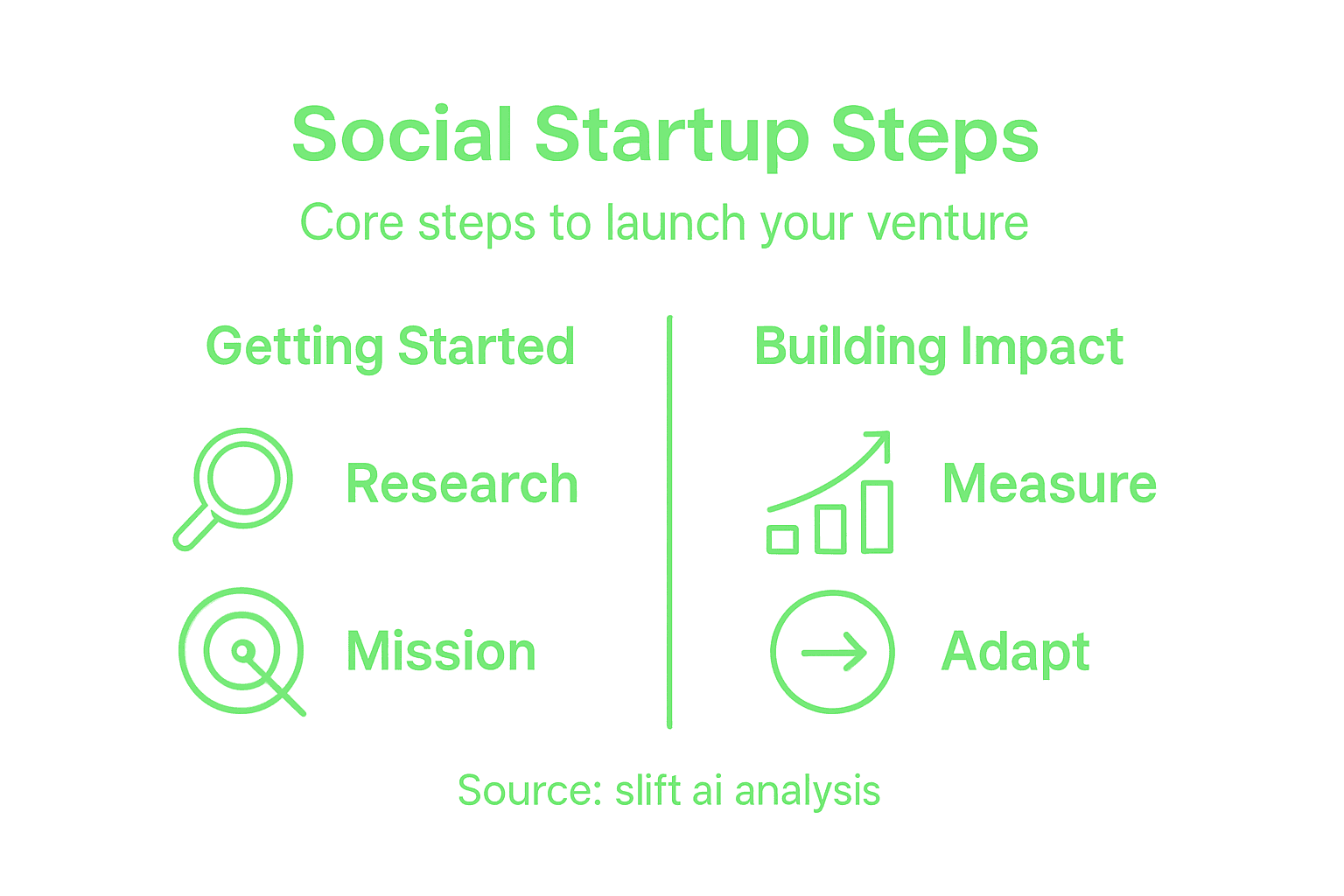
Successful social startups also require continuous adaptation and robust operational strategies. This means developing a flexible organizational framework that can pivot quickly, creating strong networks of support, and maintaining a rigorous approach to impact measurement. Key focus areas include building a diverse and committed team, establishing legal and financial foundations, developing scalable technologies or interventions, and creating robust feedback mechanisms that allow for constant learning and improvement. The most effective social ventures are those that can demonstrate clear, measurable social value while maintaining financial sustainability and operational excellence.
Pro tip: Before launching, create a detailed impact measurement framework that clearly defines your social objectives, key performance indicators, and methods for tracking and communicating your venture’s tangible social contributions.
Common Obstacles and Legal Requirements
Social entrepreneurs navigate a complex landscape of challenges that extend far beyond traditional business hurdles. Common obstacles include ethical dilemmas that demand careful balance between financial sustainability and social impact. These challenges require founders to develop nuanced strategies that maintain integrity while driving meaningful change, often requiring them to make difficult decisions that prioritize social value over immediate financial returns.
The legal requirements for social ventures are intricate and vary significantly depending on the chosen organizational structure. Organizational classification plays a critical role in determining tax obligations, reporting standards, and governance frameworks. Social ventures face complex legal considerations that demand thorough understanding of nonprofit, for-profit, and hybrid enterprise regulations. Entrepreneurs must carefully navigate registration processes, compliance requirements, and accountability standards that differ across jurisdictions. Key legal considerations include establishing proper corporate structures, maintaining transparent financial reporting, ensuring stakeholder protection, and developing governance mechanisms that align with the venture’s social mission.
Beyond legal technicalities, social entrepreneurs must manage several persistent obstacles. These include securing sustainable funding, managing potential unintended consequences of interventions, building credible stakeholder relationships, and maintaining public trust. Successful ventures develop robust risk mitigation strategies, create clear impact measurement frameworks, and maintain exceptional transparency. The most resilient social startups anticipate challenges, build adaptive organizational cultures, and remain committed to their core social objectives even when facing significant operational pressures.
Key legal and operational obstacles for social startups are summarized below:
| Challenge | Description | Potential Solution |
|---|---|---|
| Legal Complexity | Navigating nonprofit or hybrid rules | Legal counsel, compliance plans |
| Impact Measurement | Proving real social value | Use data-driven metrics |
| Funding Sustainability | Maintaining steady revenue | Diversify funding sources |
| Stakeholder Trust | Gaining credibility and transparency | Regular updates, audits |
Pro tip: Consult both legal and social impact specialists early in your venture’s development to create a comprehensive strategy that balances regulatory compliance with mission-driven objectives.
Transform Your Social Entrepreneurship Vision Into Reality
If you are inspired by the powerful mission-driven goals discussed in the article “Social Entrepreneurship Turning Ideas Into Impact” you already know how challenging it can be to balance creating measurable social change with building a sustainable business. Common obstacles such as legal complexity, impact measurement, and funding sustainability demand clear strategies and ongoing adaptation. This is where having a structured, insightful approach makes all the difference.
siift.ai Intelligent Business Canvas offers a modern founder’s strategy platform designed to guide social entrepreneurs through every step from ideation to go-to-market. Using intuitive AI, you receive personalized feedback and new insights that focus on de-risking your venture and prioritizing actions tailored to your unique social mission. You no longer have to worry about blind spots or pressure because this platform supports your mission-driven leadership and radical innovation.
Ready to turn your passion into scalable impact? Explore how the Intelligent Business Canvas supports social entrepreneurs like you. Take your next step with confidence by visiting siift.ai and start building a truly sustainable social venture that thrives financially while creating positive change.
Frequently Asked Questions
What is social entrepreneurship?
Social entrepreneurship is a transformative approach to solving global challenges by creating ventures that generate social change and impact, blending business strategies with a commitment to addressing societal problems.
What are the different models of social entrepreneurship?
Social entrepreneurship models include nonprofit social enterprises that reinvest all profits into their mission, for-profit social enterprises that seek financial returns while creating social value, and hybrid models that balance both goals.
What traits make social entrepreneurs successful?
Successful social entrepreneurs typically exhibit mission-driven leadership, radical innovation, adaptive strategic planning, and strong stakeholder engagement, focusing on creating both social and economic value.
What are the essential steps to launch a social startup?
Key steps include conducting thorough market research to define the social challenge, developing a sustainable business plan, building stakeholder partnerships, and implementing a robust impact measurement framework.
Recommended
- blog | siift | Understanding What is Entrepreneurship: A Complete Guide
- blog | siift | Understanding Idea vs Opportunity: Key Insights Explained
- blog | siift | Purpose Driven Business: A Simple Guide for Beginners
- 7 Practical Idea Generation Techniques for Aspiring Founders | siift
- 10 Best Books for Nonprofit Leaders to Thrive | Colossus Systems