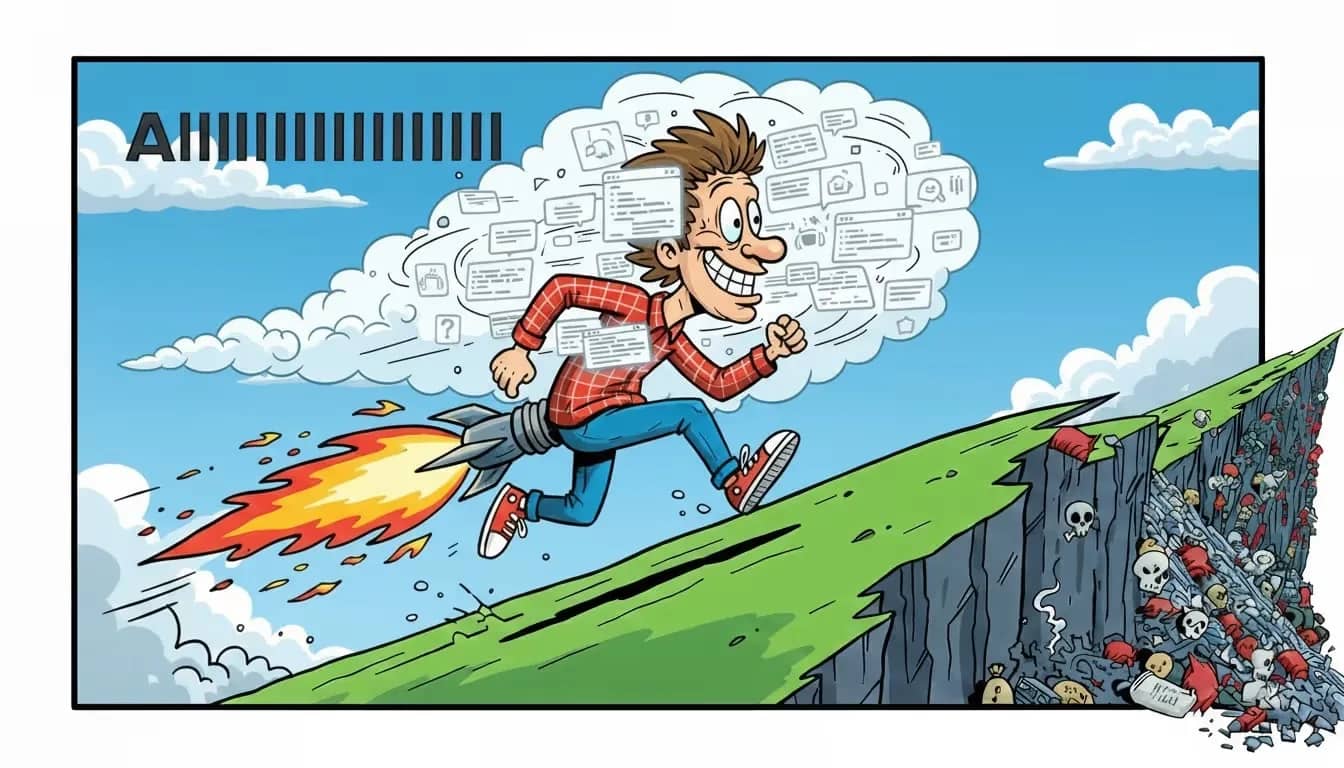
AI is flooding entrepreneurship with Vibe-founding. People are now starting more projects and easier than ever, with just a little help from their friend, AI. Thanks to digital tools like ChatGPT or Gemini, anyone can now build out a business with a fraction of the time and money it used to take, lowering barriers and unlocking opportunities. Sounds great right? Well it turns out it may be too good to be true - as serious trade-offs expose Vibe-founders to massive liability and “business debt, that just isn’t worth it. Don't let AI trick you into going down dead-ends - learn why a structured, disciplined approach to AI helps you get the best of both worlds.
Table of Contents
Summary
What is Vibe Founding?
Vibe Founding Isn’t New
The Good in Vibe-Founding
The Digital Democratization of Startup Creation
The Importance of Vibe in Starting a Business
Psychological Foundations of Business Vibe
Strategic Implications of Vibe Optimization
The Pitfalls of Vibe-Founding
The Double-Edged Sword of Convenience
Vibe Founding removes important filters for Founder-Market Fit
Vibe Founding will make you(r Brain) Soft
Generic AI Chatbots create Promiscuous Founders
AI Chatbots make it easier than ever to trick yourself into a Business Trap
Ie. AI-fueled Vibe Founding only inflates your “Business Debt”
How to avoid Vibe-Founding in the AI Age
Frequently Asked Questions
What is vibe founding?
How does technology influence vibe founding?
What are the trade-offs of vibe founding compared to traditional entrepreneurship?
What is the solution to modern, AI-fuelled Vibe-founding?
Recommended
Summary
Vibe founding enables you to build a business almost on auto-pilot. Entrepreneurs can quickly brainstorm, research or plan business ideas or generate content and code using accessible digital tools and AI technologies. This is great for turning passion and ideas into more opportunity for more people, and lowering the barrier of entry for entrepreneurship. But it can expose founders to massive risks as well, since they are not as involved in building the foundation of the company and spread thin by trying to do too much at once (maybe even building multiple businesses at once, ie. Multi-founders). Relying on AI tools without any structure and a bias to please their users is a dangerous combination that leads more and more founders to failure. It also compromises the very behaviors that are integral to building a successful business, such as hard-work, objectivity and focus. But what choice do we have? Very few tools offer the structured, objective guidance founders need, to filter out biases, blindspots and distractions - but good news, that’s where siift comes in. The Founder Intelligence Platform works with users to turn their ideas into a viable business, step-by-step.
What is Vibe Founding?
Vibe founding is when one builds a business mainly on emotions. While passion and intuition can be differentiators that define great businesses, it is not the foundation. Vibe-founding is as old as time, but AI chatbots have amplified it in modern times, making it much harder to notice, filter out and prevent. Modern AI-flooded forms of entrepreneurship, where people use ad-hoc, casual chats with AI’s like chatGPT, Gemini, Claude or Perplexity to try to build a business. It’s the mother of vibe-coding, they are related, often seen together and sometimes mixed up but make no mistake - while vibe coding may be the sexy term of the day, vibe-founding was there first and is even more influential.
Examples of vibe-founding at play include asking ‘Chat’ leading questions if -insert vague fetus of an idea- is a good business to start, or to do “deep research” for a market, or for a perfect, said-and-done 90 day business plan. It is often done in highly biased phrasing, which gets yes-man answers, and gives super dense and presumptive advice that then gets buried in chat history never to be used as intended. It’s easy, it’s convenient, it feels good, and it gives people the illusion of progress or thinking… when, in reality it’s nothing more than half-baked, scattered attempts at professional work with generic chatbot tools (at best), and at its worst it is an echo-chamber of highly-misleading noise that can doom one’s Founder’s Journey.
Modern Vibe-founding with AI is infact the most dangerous, as superficial, yes-man “expertise” really just masks the underlying emotional drivers of the user, ie. it covers their bias, blindspots and distractions well, to the point that others find it hard to filter what is valuable or sound, from the noise.
Vibe Founding Isn’t New
Vibe-founding is as old as entrepreneurship itself… but modern AI chatbots are amplifying by making it easier than ever for people into tricking themselves into thinking they have a sound business idea or plan, when in reality its just a disguise for underlying emotional drivers.
Founders must be passionate about building the next big thing, solving a real problem, and driving real-world change - otherwise they wouldn’t go through the hardships of building something new. Don’t get things wrong, emotion is an important piece of the entrepreneurial puzzle but must be balanced with reason and evidence… otherwise it becomes an unchecked liability rather than leveraged as an asset.
The Good in Vibe-Founding
The Digital Democratization of Startup Creation
Vibe founding is deeply rooted in human nature, and can be a good force for technological democratization. According to AWS research on startup ecosystems, 500 modern entrepreneurs can now access an unprecedented array of tools that dramatically reduce entry barriers:
AI-powered business plan generators
No-code website builders
Instant landing page creation platforms
Automated market research tools
Generative design and branding services
These technologies enable founders to conceptualize and visualize business ideas within hours or days, a process that traditionally required months of meticulous planning and significant financial resources or education and expertise.
The Importance of Vibe in Starting a Business
Make no mistake, "vibes have value"; in the entrepreneurial landscape, the concept of “vibe” transcends mere aesthetic appeal and represents a fundamental psychological and strategic dimension that can significantly influence a startup’s trajectory. But its more than just a trendy fuzzy term, a robust business vibe encompasses the foundational energy, cultural alignment, and intuition or hunches that drives founders and attracts potential collaborators, investors, and customers. Emotions are intrinsic drivers that overpower logic or reasoning, as core traits of human nature. If you aren't excited and deeply interested in a particular business, that should be a warning sign that challenges any presumptions of Founder Market fit.
Psychological Foundations of Business Vibe
Research from Columbia Business School reveals that founder personality traits are critical determinants of startup success. And According to research from Northumbria University, entrepreneurial success is deeply interconnected with founders’ psychological assets. Vibe founding recognizes that a founder’s intrinsic qualities significantly influence venture outcomes. Key psychological components include:
Authentic passion for solving a specific problem
Genuine commitment to the venture’s mission
Consistent emotional resilience
Clear communication of core values
Alignment between personal and professional goals
Founders who cultivate a compelling vibe demonstrate an intangible yet powerful quality that communicates trustworthiness, competence, and potential to external stakeholders. This psychological resonance can be the differentiating factor between a forgettable startup and a memorable brand.
Strategic Implications of Vibe Optimization
Beyond personal psychology, a well-crafted vibe serves strategic purposes. It functions as an unspoken narrative that attracts talent, signals credibility, and creates an emotional connection with potential customers. Learn more about essential habits that contribute to entrepreneurial success.
Successful founders understand that vibe is not about manufacturing a persona but authentically expressing the core ethos of their venture. I.e. vibes directly shape your brand, which countless authorities including Forbes have written the importance of in business.
Cultivating a suitable vibe can involve creating a consistent, transparent representation of the startup’s purpose, values, and potential impact. This authenticity resonates with investors, team members, and customers who seek meaningful connections beyond transactional relationships.
Vibe-founding means well, and it does lower the barrier for entrepreneurship, enabling easier business ideation, validation and planning - giving (so-called) expertise to many people who wouldn’t have had it otherwise. It unlocks passions and opportunities for more entrepreneurs, democratizing business acumen. But what she offers in convenience, access and information she takes away in reliable, sound thinking. She amplifies biases, blindspots and distractions, which run rampant entrepreneurship and doom many people to failure at business.
vibe-founding is like vibe-coding - its fast, fun and reduces friction... but at the end of the day its a shortcut that can get you in trouble. Similar to how Vibe-Coding seems super helpful but in reality is recklessly building up technical debt (ie. complex, high-maintenance and highly buggy code that takes more time to fix than just coding it properly in the first place). Vibe-founding similarly takes people down slippery, winding and ultimately dead-end business paths.
https://youtu.be/Tw18-4U7mts?si=509ltm5P46LwdAJl
The Pitfalls of Vibe-Founding
The Double-Edged Sword of Convenience
While vibe founding presents exciting opportunities, it simultaneously introduces significant if not bigger risks - and the rise of generic AI chatbots makes things much worse. The ease of startup creation with AI does not guarantee meaningful business validation or long-term sustainability, in fact it usually means the opposite. Many vibe-founders suffer from:
Superficial market understanding, a lack of Founder-market Fit
Lack of deep problem-solving skills or critical thinking
Reduced commitment or distractions from a venture
Sunken cost fallacies and business traps
Successful founders recognize that while AI chatbot tools can provide valuable information, they cannot replace fundamental domain expertise, entrepreneurial skills or personal characteristics like strategic thinking, resilience, continuous learning, or focus.
This table presents a side-by-side comparison of traditional entrepreneurship and vibe founding, highlighting the main differences outlined throughout the article.
Vibe Founding removes important filters for Founder-Market Fit
As a founder, confidence and ambition are critical assets that help you succeed, but as with anything a balance is needed - where self-awareness can help founders avoid getting into too much trouble.
While a bit of danger is inherent in the Founder Journey, today AI tools make it very easy for anyone to feel like they can start a business about anything. For example, without knowing anything about submarines, I can easily do some Vibe-founding AI ‘research’ that will develop me a passable yet short-sighted business plan for a submarine inventory app, which may truly be a great idea (or maybe not…) but is not really a domain where I can stand out and win, personally.
Think about it - why would someone who works with or in a submarine trust me to deliver this app? Do I have a plausible claim to be the messiah of submarine toilet paper shortages or critical engine parts?? Unfortunately AI tools simply make it easier than ever for Founders to trick themselves (and maybe even a few others) into building a dead-end business - not because the idea is bad, but because they are using un-earned or limited insights that will eventually be outshined by someone who is a true domain expert or authority, and has the ever-important “Founder-Market Fit”.
Vibe Founding will make you(r Brain) Soft
A recent study from MIT suggest that AI tools like ChatGPT can induce “Brain-Rot”, or in other words, it erodes people’s critical thinking skills, which, are central to being a successful entrepreneur. If you agree that entrepreneurship or business is largely about continuous learning - then MIT’s results should concern you. Although it may seem that you are thinking more or doing more research and preparation by using AI, the reality is you are substituting quality thinking for a larger quantity of information.
Instead of showing some deep, logical insight that is unique to your business, Vibe-founding is instead pointing to a generic, web search or info dump based on unclear and even unvetted sources. It is tempting, maybe you’re busy or just don’t have the patience to go do thorough research yourself, but using AI to augment yourself is a slippery slope which should be done in a structured and disciplined way, with checks and balances - to ensure you avoid blindspots, bias and distraction.
An over-reliance on AI tools for critical thinking in your business is a recipe for disaster. Just like any machine, it creates a dependency for its users - and catch-all AI tools that are driven to constantly engage you are no exception. In fact letting AI steer your business may be one of the riskiest things you can do, as not only does it start diluting your understanding of where the business is going, but can openly you up to massive liabilities as a result.
It is important not to blindly ask or listen to AI too much for business advice, just like you may not want to listen to your grandma or a competitor. Maintaining a deep understanding and insight into how your business runs is one of the few differentiators and truly un-delegatable practices that a founder should maintain.
Generic AI Chatbots create Promiscuous Founders
Another study from Harvard shows that AI chatbots like ChatGPT can make you seem more productive, but actually less motivated. If you agree that successful entrepreneurship comes in large part from hard work and discipline to execute, then you’d be wise to reflect on how AI may commodify your Founder’s Journey.
Put another way - Easy come, easy go. Just as quickly as you can brainstorm a new business idea, you can be distracted by a new one - a bad one, a deceptive one, or simply a sub-optimial one. As AI lowers the barriers for entrepreneurship it also opens us up to a flood of noise.
The grit and tenacity that are scaffolded by the hard earned insights, progress and market position of a founder become paper mache in the AI age, where it often seems easier to just go start a new business, instead of dealing with whatever challenges you’re facing with the current one. Maybe you convince yourself that this business is flawed and another is better (despite every business has its challenges, simply due to the game theory of nash equilibrium), or maybe you start multiple business from the get go (and never commit yourself fully to one, which makes you a master of none). While being a multi-founder is not always a bad thing… experienced entrepreneurs know that the moment you start dedicating yourself fully is when you see an inflection point. You only have so much bandwidth in a day, and despite any unique talent or insight you may have, hard work beats talent.
AI Chatbots make it easier than ever to trick yourself into a Business Trap
Similarly, listening to AI too much about one business can be a slippery slope that quickly builds up obligations and liability on you that is hard to get out of. For example, maybe you do pursue your submarine inventory app idea, just in spite of this article, and end up getting a few customers in almost no time - Chat helped you brainstorm a name, website copy, business plan, and sales emails and even a professional contract. In a month, you now got some clients paying you five or six figures for a friggin glorified table checklist app you vibe-coded a prototype of on a weekend - amazing. Your margin is 99% and you just brute-force cold-email everyone and close new leads ASAP. You Baller.
But psst. you didn’t read your own fine print; and after one client had an incident in the field on one of their ships and your app crashed when its needed the most, this client is suing for damages (you didn’t maintain you own guaranteed uptime). You can settle with them and give up all your revenue, or wait can you? Turns out your other clients depend on you now too, as per your multi-year contract… oh and turns out there was a security vulnerability in your app which some hack exploited and is now black-mailing you with… plus you just signed a lease on a new office for you a few buddies you convinced to quit their jobs to help you to work out for 1 year… ps. Didn’t you know that your website lays out exactly how Sg. John Doe, a decorated veteran who just finished his MBA and got accepted into YC can basically copy your idea and make it even better with his deep expertise and reputation?? Fast forward 3 years, a lot of lost hair, business (and personal) bankruptcy later… you wish you just took your time and picked which business to build more carefully. If you tolerated spinning your wheels a bit more early on and reflected on what is the “right” business for you personally to build, with your own unique background and interests, you may have had a more modest but sustainable and durable business blossoming now.
Why didn’t Chat warn you of these risks!?
“Excellent point…” (because it’s goal is to make you feel good & keep coming back for more dopamine)
Ie. AI-fueled Vibe Founding only inflates your “Business Debt”
All of the above can be grouped as “business debt” - the various liabilities, financial, legal, social or otherwise that you obligate yourself in a venture. While some business debt is unavoidable, vibe-founding recklessly gets you in over your head, much like how vibe-coding makes it easier than ever to accumulate technical debt, by taking engineering shortcuts on a product.
What does “business debt” or vibe-founding look like?
-Asking leading questions of AI or people, like “do you think XYZ is a good idea?”
-rushing the ideation or validation processes in the early days of your business
-Skimming and not fully digesting any long, detailed AI answers or any content about say your business plan
-Manual or AI chat’s about any specific important topic, never to be used again (ie. they are forgotten, rejected, or just a quick checking of a box rather than integration into your business)
-Hitting a foreseeable wall in your business, without any idea of what to do next or where to start (maybe traction or engagement is down, or you have manufacturing troubles, or real competition)
-Or even the growing feeling of dread as you slowly realize no-one is buying what you’re selling (the art of selling and storytelling are understandable, but this particular feeling of dread comes from over-selling, over-extending and no real back-up plan or idea of how to actually adapt to a rejection).
Feel attacked yet? Relax, this is more of a confession than an accusation.
We’re as guilty of vibe-founding as anyone, having 15+ years of experience vibe-founding to one degree or another… its human nature and very hard to filter out. Infact its very common among founders, especially younger or newer ones -navigating one’s own biases, fears, uncertainty and building self-awareness are life-long journey that overshadow a Founder's Journey... Heck you could argue epistemology (the study of knowledge itself) is in practice here - that entrepreneurs are some of the most robust operators of this science and it is deeply wrought with (self)deception and misunderstanding…
But let’s digress.
How to avoid Vibe-Founding in the AI Age
Don’t get us wrong - AI can be a powerful tool for founders, but only if it follows the structure that is characteristic of a focused, disciplined business leader. The problem isn’t AI information or your ideas - its how to systematically build a business around them, and build the true value in the AI production line, as Sequoia capital calls it.
This is where siift.ai changes the game - our Founder Intelligence Platform nurtures your vibe while organizing its outputs into all the key considerations need to build a viable business. It helps you slow down just enough to pick the right idea (for you!), objectively validate all your assumptions (big and small), and take that idea to market in a systematic way that helps your engineer your way to Product-Market-Fit. Sign up below to see for yourself.
Frequently Asked Questions
What is vibe founding?
Vibe founding is the age-old practice of building a business mostly on feelings, rather than rationality. It has trade-offs that parallel those of vibe-coding, but predates that - it is as old as entrepreneurship itself. It is often done unknowingly, by a founder who has unchecked blindspots, bias or distractions. Overall it is considered a short-sighted, dangerous practice done by insufficiently experienced founders.
How does technology influence vibe founding?
Modern technology, primarily generic AI chatbots (like ChatGPT) enable vibe-founding drastically. Current AI tools make it dangerously easy to be a vibe-founder, because they are ubiquitous and convenient yet provide services that are superficial, unorganized, yes-man-y (sycophantic) in nature.
What are the trade-offs of vibe founding compared to traditional entrepreneurship?
Vibe-founding especially with AI lowers the barriers to entry for entrepreneurship and can be quick, convenient help for very preliminary thinking or work. However it is wrought with more downsides than upsides - vibe-founding amplifies biases, blindspots, distractions and generally dilutes the core characteristics of successful entrepreneurs, with a flood of dead-end, inaccurate or incomplete info.
What is the solution to modern, AI-fuelled Vibe-founding?
Using AI in more structured, systematic way towards building a business that actively filters out blindspots, bias and distractions for a founder is the solution. This can be done manually, but is best down with the Founder Intelligence Platform from siift.ai.