
TL;DR:
- Intentionally structured volunteering develops startup-relevant skills and measurable outcomes.
- Skills-based volunteering creates lasting capacity and credible proof of entrepreneurial competence.
- Choosing roles with clear deliverables and success metrics maximizes volunteer impact for founders.
Most aspiring founders think volunteering is about giving back. Noble, sure. But that framing quietly leaves one of the most powerful entrepreneurial training tools sitting unused. Volunteering, done with intention, is a low-risk laboratory where you can pressure-test real business skills, build a portfolio of provable outcomes, and create the kind of professional credibility that no online course can manufacture. If you’re building a side hustle or chasing a startup idea, the strategic question isn’t whether to volunteer. It’s how to volunteer in a way that actually moves your founder journey forward.
Table of Contents
- What does ‘volunteering for experience’ really mean today?
- Skills-based volunteering: The entrepreneur’s shortcut
- Making your volunteer work matter: From hope to proof
- Packaging your impact: Showcasing volunteer experience professionally
- Why most advice on volunteering for experience falls short
- Turn your volunteering experience into real startup traction
- Frequently asked questions
Key Takeaways
| Point | Details |
|---|---|
| Focus on outcomes | Volunteering only builds your entrepreneurial portfolio if you achieve and track real, relevant results. |
| Choose skills-based roles | Prioritize volunteering opportunities where you contribute business-critical expertise like strategy, marketing, or operations. |
| Document and showcase | Translate volunteer accomplishments into concrete, outcome-driven resume or portfolio entries. |
| Be proactive | Don’t hope volunteering leads to opportunity—negotiate deliverables and feedback upfront. |
What does ‘volunteering for experience’ really mean today?
Traditional volunteering looked like this: show up Saturday morning, sort canned goods, feel good, go home. The world still needs that kind of generosity. But for an aspiring entrepreneur, equating all volunteering with that model is a missed opportunity of serious proportions.
Today’s most forward-thinking founders treat volunteering as a strategic proving ground. The shift is from time-based contribution to outcomes-based engagement. You’re not measuring how many hours you logged. You’re measuring what you built, what you changed, and what you can point to afterward.
“Volunteering should focus on transferable skills and measurable outcomes, not just ‘having volunteered.’” Indeed’s resume guide captures this shift precisely. The documentation you create matters as much as the work itself.
This is the engine behind skills-based volunteering, a growing movement where professionals deploy real expertise, not just extra hands. For an entrepreneur, that means approaching a nonprofit, community organization, or early-stage project with the same mindset you’d bring to a client engagement.
What entrepreneurial skills can you actually build through this kind of volunteering? Quite a few that matter at the early stage:
- Project leadership: Owning a deliverable from kickoff to completion
- Market research: Surveying communities, identifying pain points, synthesizing data
- Communication: Pitching ideas to boards, writing reports, facilitating workshops
- Financial modeling: Building basic budgets or grant projections for nonprofits
- Team coordination: Managing volunteers, freelancers, or partner organizations
The resume and career impact of any volunteer role depends entirely on how clearly it connects to startup-relevant competencies. Pair this kind of intentional work with peer mentorship for startups and you accelerate your growth considerably. The context has changed. Volunteering for experience isn’t charity work with a side benefit. It’s real-world training with a purpose.
Skills-based volunteering: The entrepreneur’s shortcut
Skills-based volunteering (SBV) is exactly what it sounds like: you apply a specific professional skill, whether that’s marketing, operations, financial analysis, or product strategy, to help an organization achieve a defined goal. The critical distinction is that SBV builds capacity, not just labor. You’re not filling a gap temporarily. You’re creating something that outlasts your involvement.
For founders, this is where the leverage lives. Consider the difference between traditional volunteering and SBV in concrete terms:
| Traditional volunteer task | SBV equivalent | Startup skill developed |
|---|---|---|
| Handing out flyers | Designing a campaign strategy | Digital marketing |
| Helping at events | Managing event logistics end-to-end | Operations management |
| Answering phones | Mapping the customer journey | Customer experience |
| Filing documents | Building a data tracking system | Process improvement |
| General support | Leading a strategic planning session | Executive leadership |
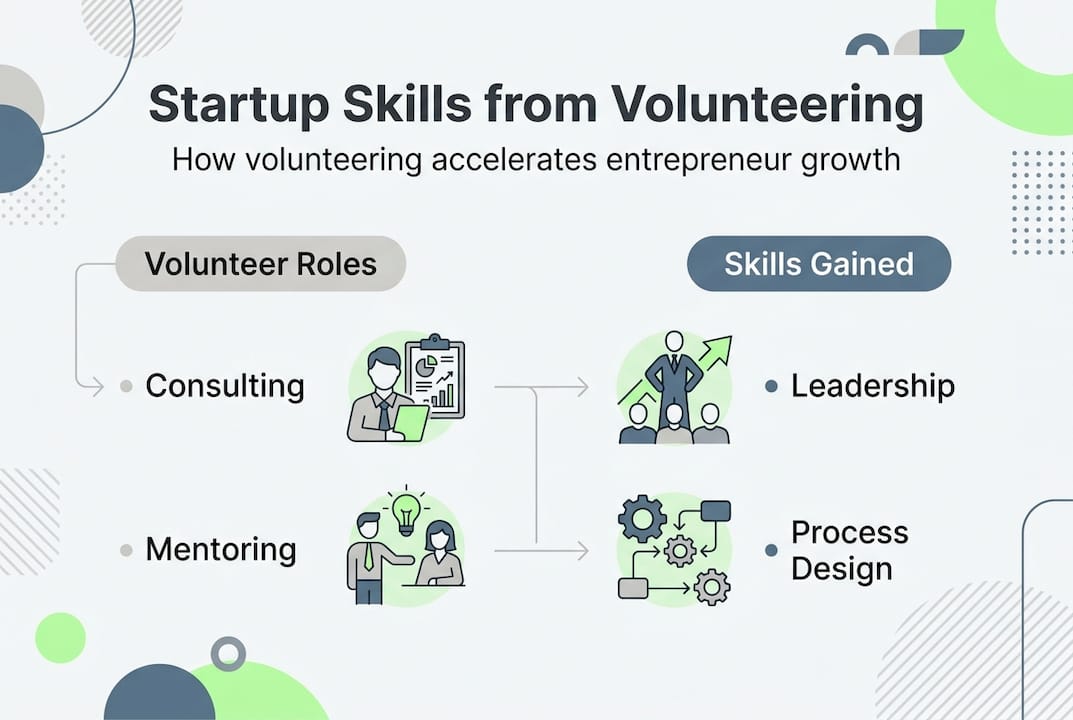
The roles that deliver the most founder value tend to involve consulting, process improvement, mentoring, or strategic planning. These mirror the exact challenges you’ll face when launching your own venture. Think of SBV as a low-stakes consulting sprint: you get a real client (the organization), a real problem, and a real deadline. The only difference is that your compensation is experience and proof.

If you’re curious how this compares to structured programs, startup accelerators follow a similar model of compressed, outcome-focused learning. SBV is something you can access right now, without an application or cohort cycle.
Pro Tip: Before you commit to any volunteer role, negotiate one specific deliverable that you’ll own completely. A campaign strategy, a financial model, a user research report. That single artifact becomes your portfolio piece and your proof of capability.
For founders who can’t yet afford business coaching alternatives, SBV is one of the most credible substitutes available. You’re doing real work, with real stakes, for a real organization.
Making your volunteer work matter: From hope to proof
Here’s the uncomfortable reality. Most people who volunteer “for experience” don’t get much of it. Not because the opportunity wasn’t there, but because they showed up without a plan and left without documentation. Volunteering is not an automatic path to business credibility. It’s a raw material that requires intentional processing.
“Effectiveness of volunteering depends on explicitly aligning tasks with skills you need to prove. A vague hope for a job is weak.” This perspective applies equally to entrepreneurial ambitions. Hope is not a strategy. Structure is.
So how do you turn a volunteer engagement into genuine proof of competency? Follow these steps before you start:
- Define your learning objective: What specific skill or outcome do you want to demonstrate? Be precise. “Improve my marketing” is too vague. “Build and execute a social media campaign that grows the organization’s following by 20%” is testable.
- Clarify your deliverable upfront: Agree with the organization on what you’ll produce. A written report, a system, a campaign, a plan. If there’s no deliverable, there’s no proof.
- Establish success metrics: How will you and the organization know you did a good job? Tie your work to numbers wherever possible.
- Schedule a mid-point check-in: Don’t wait until the end to discover you’ve drifted off course. A brief review halfway through keeps you aligned.
- Request a written reference: Ask for feedback tied to your specific contributions, not generic praise. “She led our digital outreach campaign, which increased email open rates by 34%” is gold compared to “She was a wonderful volunteer.”
This framework turns volunteering into something far more valuable. It also helps you build the founder habit of finding co-founders and partners who share your bias toward outcomes over effort. The mindset is the same: show your work, make it measurable, own the result.
Packaging your impact: Showcasing volunteer experience professionally
You’ve done the work. You’ve produced a deliverable and gathered feedback. Now comes the part that most aspiring founders skip entirely: translating that experience into language that signals entrepreneurial capability to anyone reviewing your background.
Skills-based volunteering added to resumes as professional proof of competency is now actively encouraged by career development programs, and for good reason. Done right, volunteer work communicates drive, initiative, and real-world application. Done lazily, it looks like filler.
Here’s what to document during and immediately after each project:
- Specific metrics and results (percentage changes, dollar amounts, user counts)
- Deliverables you produced (links, files, reports, systems built)
- Testimonials or quotes from organizational leaders
- Reference contacts who can speak to your specific contribution
Now let’s look at how outcome-driven language transforms a resume entry:
| Weak entry | Strong entry |
|---|---|
| Volunteered with local nonprofit | Led digital marketing strategy for 8-week campaign; grew social reach by 40% |
| Helped with fundraising | Built donor segmentation model; contributed to $12,000 fundraising goal |
| Supported community events | Managed event logistics for 200-person conference; delivered under budget |
The skills that resonate most with early-stage startups when they see volunteer experience include:
- Customer insight and user interview facilitation
- Market validation and competitive research
- Digital marketing execution and analytics
- Financial modeling and budget management
- Product or service launch coordination
These are also exactly the capabilities you need to get your early customers and prove your startup concept in the real world.
Pro Tip: Even if your project was for a nonprofit with no revenue, you can still quantify impact. Engagement rates, hours saved, attendance numbers, adoption rates. Numbers make outcomes real, regardless of the sector.
For additional guidance on formatting these entries correctly, Indeed’s volunteer resume tips offer concrete examples that translate across industries.
Why most advice on volunteering for experience falls short
Most content on this topic tells you that volunteering builds character, expands your network, and looks good on a resume. True on all counts. But for a founder or side hustler, that advice is about as actionable as “work hard and believe in yourself.”
The problem is that most advice focuses on intent, not architecture. It tells you why to volunteer without telling you how to design the engagement as a mini-consulting sprint with a beginning, middle, end, and deliverable. Without that structure, you’re just logging time.
What we’ve seen time and again: founders who treat volunteer roles like real client projects, complete with scope, milestones, and a retrospective review, extract dramatically more value than those who drift through with good intentions. The skill isn’t in showing up. It’s in owning the outcome.
Our unconventional advice? If you can’t identify a specific deliverable you’ll own, or if the organization can’t articulate what success looks like for your contribution, walk away and find a different opportunity. Choosing the right engagement is a skill too. And if you want to pair your field experience with structured startup thinking, explore AI startup ideas for beginners to see where your newly built skills might create real business traction.
Turn your volunteering experience into real startup traction
Volunteering with intention is one piece of your founder puzzle. But turning those experiences into a real, viable business strategy requires more than a strong resume entry. That’s exactly where siift’s Intelligent Business Canvas becomes your most powerful asset. siift is an agentic AI platform built specifically for entrepreneurs who are ready to move from skills and ideas to validated business strategy. It guides you step-by-step through ideation, validation, and go-to-market planning, filtering out the noise and blind spots that slow most founders down. If you want to accelerate that journey, explore what an AI startup accelerator can do for your momentum. Your next move starts here.
Frequently asked questions
What is the most valuable form of volunteering for entrepreneurs?
Skills-based volunteering is the most valuable form, since it builds portfolio-ready, startup-relevant expertise by applying real professional skills to meaningful organizational challenges.
How should I document volunteer work for a startup-focused resume?
List concrete deliverables and quantify your results, because connecting resume content to measurable skills and outcomes is what turns volunteer entries into credible proof of entrepreneurial capability.
Can volunteering really help me launch a side hustle?
Yes, absolutely. If you design your volunteer role to mirror key entrepreneurial tasks and take ownership of measurable project outcomes, you’ll build the exact skills a side hustle demands.
What should I avoid when volunteering for experience?
Avoid roles with vague tasks or undefined success criteria. Outcome-focused work with clear responsibilities is what separates transformative volunteer experience from time spent with little to show for it.