
TL;DR:
- Early adopters are visionaries who take calculated risks and influence broader market adoption.
- They typically have specific problems, prior tried solutions, and influence within their communities.
- Founders must balance early adopter feedback with mainstream needs to achieve scalable growth.
Most founders assume that winning over a crowd means winning in the market. But here’s the reality: early adopters represent just 13.5% of any given population, yet their decisions, feedback, and word-of-mouth can make or break a new product entirely. This small but mighty group sits at the intersection of vision and practicality, and most entrepreneurs either chase them blindly or ignore them completely. Both mistakes are costly. In this guide, we’ll unpack exactly what an early adopter is, what makes them tick, the real risks involved, and how you can find and leverage them to build genuine traction for your startup.
Table of Contents
- What is an early adopter?
- Key characteristics of early adopters
- Risks and rewards: The early adopter dilemma
- How founders can spot and leverage early adopters
- Our take: The real value (and danger) of early adopters for startups
- Next steps: Turn insights into startup traction
- Frequently asked questions
Key Takeaways
| Point | Details |
|---|---|
| Early adopters defined | Early adopters are visionaries who validate and promote new products, making up just 13.5% of any market. |
| Founder strategies | Effective founders qualify genuine early adopters to gain valuable feedback and drive traction. |
| Risks and pitfalls | Over-relying on early adopters can stall broader growth; always plan for the jump to mainstream buyers. |
| Practical frameworks | Use online communities, checklists, and onboarding tactics to spot and leverage ideal early adopters. |
What is an early adopter?
Let’s start with the definition. An early adopter is an early customer of a given product or technology, typically the second group to engage in Everett Rogers’ Diffusion of Innovations theory. They come after the innovators, but well before the mainstream crowd. Think of them as the bridge between a raw, unpolished idea and a product that the broader market actually wants to use.
Rogers’ model breaks the population into five distinct groups based on how quickly they adopt new technologies:
| Adopter group | Market share | Key trait |
|---|---|---|
| Innovators | 2.5% | Risk-loving tech enthusiasts |
| Early adopters | 13.5% | Visionary, calculated risk-takers |
| Early majority | 34% | Pragmatic, wait-and-see |
| Late majority | 34% | Skeptical, adopt under pressure |
| Laggards | 16% | Resistant to change |
The distinction between innovators and early adopters is subtle but critical. Innovators are pure tech enthusiasts with high risk tolerance who will try almost anything new. Early adopters, by contrast, are visionaries who take calculated risks. They’re not just experimenting for the thrill of it. They’re looking for a strategic edge, a competitive advantage, or a solution to a problem that existing products simply don’t address.
This distinction matters enormously for founders. Innovators will give you feedback on your technology. Early adopters will give you feedback on your business. They ask whether your product solves a real problem, whether it fits into their workflow, and whether it’s worth the friction of switching from what they already use. That’s the kind of signal you actually need when you’re trying to build something that scales.
As you work through your startup validation guide, understanding which group you’re actually talking to will sharpen your strategy considerably. Many founders confuse enthusiastic innovators for early adopters, then wonder why their product stalls after the initial buzz fades.
“The early adopter is not just a customer. They are a co-creator of your market narrative.”
Key characteristics of early adopters
Now that we know what early adopters are, let’s dig deeper into the defining traits that set them apart from general consumers. Recognizing these traits in the wild is a skill every founder needs.
According to research, early adopters tend to share a specific profile. They typically have higher social status, financial liquidity, and advanced education, and they operate as opinion leaders within their communities. Unlike innovators, they’re more discreet about their experimentation. They’re not posting every new tool they try on social media. They’re quietly testing, evaluating, and then influencing the people around them.

Here’s a quick comparison to help you spot the difference:
| Trait | Innovator | Early adopter |
|---|---|---|
| Risk tolerance | Very high | Moderate to high |
| Motivation | Novelty and curiosity | Strategic advantage |
| Social influence | Limited | High |
| Feedback quality | Technical | Business-oriented |
| Adoption speed | Immediate | Deliberate |
Key characteristics to look for when finding your audience:
- They have a specific, painful problem your product addresses directly
- They’ve already tried alternatives and found them lacking
- They’re willing to invest time in learning a new solution
- They have influence over others in their field or community
- They think in terms of outcomes, not just features
The motivation piece is especially important. Early adopters aren’t adopting your product because it’s shiny and new. They’re adopting it because they believe it gives them a competitive edge. That’s a fundamentally different mindset from an innovator who just wants to play with the latest tech.
Pro Tip: Before you label someone an early adopter, run them through a quick qualification checklist. Do they have a real, pressing problem? Have they actively searched for solutions? Are they willing to give structured feedback? If the answer to all three is yes, you’ve likely found a genuine early adopter worth investing in.
This distinction directly shapes how you should market, onboard, and communicate with them. Early adopters respond to ROI-driven messaging, not hype. They want to know what problem you solve and how fast. When you’re working on startup traction steps, targeting this group with precision will accelerate your momentum far more than casting a wide net.
Risks and rewards: The early adopter dilemma
But why do early adopters take risks, and what do founders need to watch out for when targeting them? This is where things get genuinely interesting, and where most startup advice glosses over the hard parts.
For early adopters themselves, the risks are real. Higher costs, product bugs, and the threat of obsolescence are constant companions. They’re paying premium prices for unfinished products, sometimes investing significant time into tools that never reach maturity. In edge cases, products fail entirely after the early adoption phase, leaving these users stranded.
The rewards, though, are compelling:
- Competitive advantage by using tools competitors haven’t discovered yet
- Direct influence over the product’s direction and features
- Exclusive access to pricing, communities, and support that later adopters won’t get
- Status as a recognized voice in their industry or niche
For founders, the risks are equally real, just different in nature. Here are the top pitfalls to avoid:
- Over-reliance on early adopter feedback. Their needs are often more advanced or niche than the mainstream market’s. Building exclusively for them can take you further from product-market fit, not closer.
- Visionary bias. Early adopters often have a high tolerance for friction and complexity. If your product requires a manual to use, they might be fine with it. The early majority won’t be.
- Failure to pivot. When early adopters love your product but growth stalls, founders sometimes double down instead of recognizing the signal to adapt.
“The chasm between early adopters and the early majority is where most startups go to die.”
Pro Tip: Use your early adopters as a signal, not a blueprint. Their feedback tells you what’s possible. The early majority tells you what’s necessary. You need both perspectives to build something that truly scales.
When validating early products, always ask yourself: is this feedback coming from someone who represents my target market, or someone who’s unusually tolerant of rough edges? That question alone can save you months of misaligned development. And when you’re deep in startup idea validation, separating signal from noise is the whole game.
How founders can spot and leverage early adopters
So how can you actually find and work with early adopters like a pro? The good news is that genuine early adopters tend to self-identify if you know where to look and how to create the right conditions.
Here’s a step-by-step approach:
- Hunt in competitor forums and Reddit threads. Frustrated users of existing solutions are gold. They’ve already identified the problem, tried the alternatives, and found them lacking. That’s your early adopter profile in real time.
- Require detailed applications for beta access. A simple sign-up form attracts curiosity-seekers. A thoughtful application asking about their specific problem, current workarounds, and expected outcomes filters for people who are genuinely invested.
- Use concierge onboarding. Walk your first users through the product personally. You’ll learn more from ten deeply onboarded users than from a hundred who signed up and ghosted.
- Offer charter pricing. A discounted rate for early customers creates commitment and filters out people who aren’t serious about using the product.
- Activate word-of-mouth deliberately. Satisfied early adopters drive word-of-mouth that helps you reach the early majority. Make it easy for them to refer others by giving them language, tools, and incentives to share.
The mechanics matter here. Early adopters provide feedback for product refinement and help you cross the chasm to the early majority, but only if you engage them intentionally. Passive feedback loops produce noise. Active, structured feedback sessions produce insight.
For getting early customers, prioritize users with real pain points over enthusiasts who are just excited about new technology. Enthusiasm fades. Pain is persistent. And when you’re mapping out your step-by-step traction plan, early adopters with genuine problems become your most powerful growth catalyst.
Key things to look for when qualifying early adopters:
- They describe their problem in specific, emotional terms
- They’ve already spent money or time trying to solve it
- They can articulate what a successful solution looks like
- They’re connected to others who share the same problem
Prioritizing true early adopters with real pain points over enthusiasts is the single most important filtering decision you’ll make in your early go-to-market phase.
Our take: The real value (and danger) of early adopters for startups
As we’ve seen, founders have powerful tools for identifying early adopters. But here’s what most advice leaves out: the very qualities that make early adopters so valuable can also lead you astray.
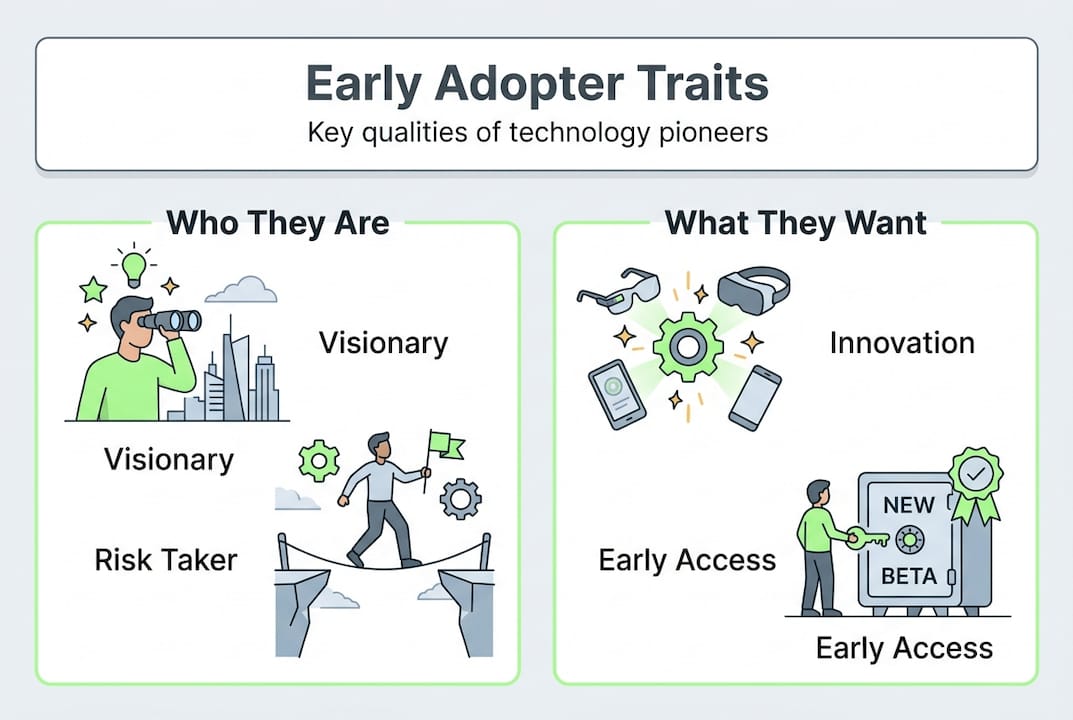
Early adopters are visionaries. They see what your product could be, not just what it is. That’s energizing. But it also means their feedback is often aspirational rather than representative. They’ll ask for features that the early majority will never use. They’ll tolerate complexity that will drive mainstream users away. And they’ll validate a product direction that works beautifully for 13.5% of the market and fails for everyone else.
Over-reliance on early adopters’ visionary needs is one of the most common reasons startups stall after a promising launch. The signs are subtle at first. Growth slows. Referrals dry up. Your most enthusiastic users love the product, but new users churn quickly. That’s the chasm showing up in your metrics.
The antidote isn’t to ignore early adopters. It’s to hold their feedback with appropriate weight. Use them to validate the problem and the core value proposition. Then use the early majority to validate the product experience. The founders who navigate this balance are the ones who build companies that last. When you’re focused on getting real traction, knowing which voice to amplify at which stage is the real skill.
Next steps: Turn insights into startup traction
With a clearer perspective on early adopters, here’s how you can put this knowledge to practical use. Finding, qualifying, and engaging the right early adopters is one of the highest-leverage activities in your early startup journey, but it’s also one of the easiest to get wrong without a structured approach.
That’s exactly where siift’s Intelligent Business Canvas comes in. siift guides you step-by-step through ideation, validation, and go-to-market, helping you identify who your true early adopters are, how to reach them, and how to turn their feedback into a validated strategy. It’s built for founders who want to move fast without drifting off course. For deeper guidance on converting early interest into paying customers, explore our early customer strategies and start building traction with intention.
Frequently asked questions
What’s the difference between innovators and early adopters?
Innovators are risk-loving tech enthusiasts representing just 2.5% of the market, while early adopters (13.5%) are visionaries who take calculated risks and bridge new innovations to the mainstream market.
Why do founders need early adopters?
Early adopters provide feedback for product refinement and generate word-of-mouth that helps new products cross the chasm into mainstream adoption, making them essential for startup growth.
What are the main risks of targeting early adopters?
Startups risk building for a niche audience that doesn’t represent the broader market. Higher costs, bugs, and obsolescence affect early adopters, and over-relying on their feedback can prevent you from appealing to the pragmatic early majority.
How can I find early adopters for my startup?
Look for users with pressing, specific problems in competitor forums and Reddit, require detailed beta applications, and prioritize people who give structured, actionable feedback over those who are simply enthusiastic about new technology.