

TL;DR:
- A customer persona is a research-based profile that humanizes data and guides marketing and product strategies. Most companies work with three to five primary personas to ensure clarity and effective storytelling. Building and actively socializing personas across teams improves decision-making and aligns efforts around real customer insights.
A customer persona is a semi-fictional profile of your ideal customer, built from real data, interviews, and behavioral research rather than guesswork. You may also hear it called a “buyer persona” — the terms are used interchangeably across most marketing teams, though subtle differences exist. The core idea is the same: go beyond age and job title to capture what actually drives someone to buy. Companies that exceed revenue goals are 71% more likely to have documented personas that capture motivations and decision drivers. That number alone tells you this is not a nice-to-have. It is the foundation of every marketing decision worth making.
What is a customer persona, exactly?
A customer persona is a research-based archetype that represents a real segment of your audience. Think of it as a character sketch written by a data analyst and a novelist working together. It names a fictional person, describes their daily pressures, maps their goals, and explains why they would choose your product over anything else.
The industry term you will encounter most often is “buyer persona,” popularized by HubSpot and widely adopted across B2B and B2C marketing. The customer persona definition is functionally identical: a detailed profile that goes beyond demographics to include psychographics, motivations, and pain points. Demographics tell you who someone is. Psychographics tell you why they act.
Most organizations work with 3–5 primary personas. That number is not arbitrary. Acquia recommends this range specifically to prevent complexity from killing adoption. A persona no one uses is just a PDF collecting digital dust.
How do personas compare to ideal customer profiles and user personas?
This is where most founders and marketers get tangled. Three related concepts exist, and confusing them leads to wasted research and misaligned teams.
| Concept | Focus | Primary Use Case |
|---|---|---|
| Customer persona | Individual motivations, behaviors, goals | Marketing messaging, content strategy |
| Ideal customer profile (ICP) | Company-level attributes, firmographics | B2B sales targeting, account selection |
| User persona | Product experience, feature usage | UX design, product development |
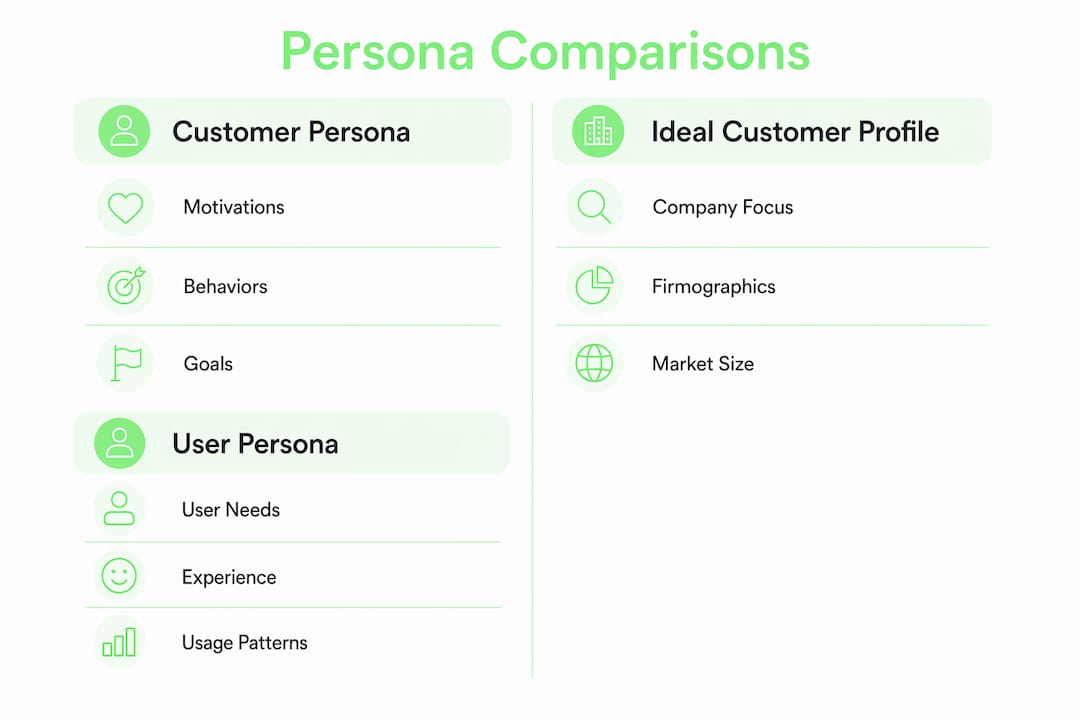
Customer personas differ from ICPs by zooming in on the individual rather than the organization. An ICP tells a B2B sales team which companies to pursue. A customer persona tells the marketing team what the actual decision-maker inside that company cares about at 9 PM when they are worried about hitting their quarterly number.
User personas are a separate animal entirely. In B2B contexts especially, buyer personas focus on purchasing authority and budget decisions, while user personas focus on the day-to-day product experience. The person who signs the contract and the person who uses the software every day are often not the same person. If you are building a SaaS product, you need both. For a deeper look at how this plays out across different business models, the B2B vs. B2C distinction shapes which persona type deserves more of your attention.
Why are customer personas important for marketing and product success?
The importance of customer personas is not philosophical. It is measurable. When your team has a shared, documented picture of who they are building for, every decision gets faster and sharper.
“Personas humanize data, activate teams internally, and ensure solutions reflect real audience needs.” — YouGov
Here is what well-built personas actually do for your business:
- Sharpen messaging. When you know your persona’s specific fear (missing a product launch deadline, not “being inefficient”), you write copy that lands.
- Align cross-functional teams. Sales, marketing, and product stop arguing about who the customer is because they share the same reference point.
- Improve ROI on content. You stop creating content for everyone and start creating content for someone. That specificity drives engagement.
- Accelerate product decisions. Feature prioritization becomes clearer when you ask “would our primary persona actually use this?”
Personas bridge data and empathy, transforming raw research into characters your team can rally around. That is the real unlock. Data informs. Characters motivate.
Pro Tip: Print your top two personas and post them in your team’s shared workspace, physical or digital. Teams that see personas daily make better decisions than teams that reference a document once a quarter.
How to create a customer persona step by step
Building a persona that actually gets used requires discipline at the research stage and creativity at the synthesis stage. Here is the process that works.
-
Collect real data first. Run 5–10 customer interviews. Send surveys to your existing users. Pull behavioral data from Google Analytics, your CRM, or tools like Hotjar. Assumptions are the enemy of good personas.
-
Go deep on psychographics. True persona power lies in psychographics: motivations, fears, aspirations, and the emotional triggers behind purchase decisions. Ask interviewees what keeps them up at night, not just what their job title is.
-
Map the buying journey. Understand how your persona discovers solutions, evaluates options, and makes final decisions. Note which channels they trust, which formats they prefer, and who influences them.
-
Limit yourself to 3–5 archetypes. Limiting primary personas to this range prevents “persona bloating,” where you end up with 12 profiles that nobody can remember or activate. Pick the segments that drive the most revenue or strategic value.
-
Name and visualize each persona. Give them a real name, a stock photo, and a one-line summary. “Startup Sarah, 34, SaaS founder, terrified of burning runway before finding product-market fit” is more memorable than “Segment B: early-stage tech founders.”
-
Write a narrative, not a checklist. A narrative story capturing daily life and pressures is more effective than a bulleted list of attributes. Describe a Tuesday morning in their life. What are they stressed about? What would make their day better?
-
Socialize across teams. Personas must be shared across marketing, sales, and product to generate real business value. Schedule a persona walkthrough with each team. Make it a living document, not a one-time deliverable.
Pro Tip: Use a customer persona template to structure your first draft, but resist filling every field just to fill it. A persona with five deeply researched attributes beats one with twenty shallow ones every time.
For a practical framework on the research phase, the customer development guide at Siift walks through the interview and validation process in detail.

What are the common types of customer personas?
Not all personas serve the same purpose. Four classification types appear consistently across marketing practice, each suited to different messaging and product strategies.
- Goal-directed personas focus on what the customer is trying to accomplish. They are the most common type and work well for product teams deciding which features to build next.
- Role-based personas center on professional identity and organizational context. They are especially useful in B2B, where job function shapes buying criteria more than personal preference.
- Competitive personas describe customers who are actively evaluating alternatives. These are gold for sales teams crafting objection-handling scripts and differentiation messaging.
- Spontaneous personas capture impulsive or low-consideration buyers. They matter most in e-commerce and consumer goods, where emotional triggers drive fast decisions.
Here are three quick examples to make these concrete:
“Bootstrapped Ben” is a 38-year-old solo founder building a B2B SaaS tool. He is goal-directed, obsessed with getting to his first $10,000 in monthly recurring revenue, and makes every purchase decision based on whether it saves him time or directly generates revenue. He ignores anything that feels like overhead.
“Marketing Manager Maya” is a 29-year-old at a 50-person tech company. She is role-based, accountable to a CMO, and needs tools that produce reports she can share upward. She values social proof and case studies over feature lists.
“Deal-Hunter Dana” is a spontaneous buyer who responds to limited-time offers and peer recommendations. She rarely reads documentation but leaves detailed reviews after purchase. She is the persona you optimize your referral program for.
Each of these archetypes demands a different message, a different channel, and a different call to action. One-size-fits-all marketing is just noise.
Key takeaways
A customer persona is only as valuable as the research behind it and the activation across your team.
| Point | Details |
|---|---|
| Definition matters | A persona captures motivations and behaviors, not just demographics or job titles. |
| Revenue impact is real | Companies exceeding revenue goals are 71% more likely to use documented personas. |
| Limit your archetypes | Stick to 3–5 primary personas to keep them usable and memorable across teams. |
| Narrative beats checklist | Write a story about your persona’s daily life, not just a list of attributes. |
| Activation is the goal | Personas stored in a folder deliver zero value. Socialize them across every team. |
Why most personas fail before they even launch
I have seen this pattern repeat itself across dozens of founder conversations: a team spends three weeks building beautiful persona documents, presents them in a kickoff meeting, and then never references them again. Six months later, the product roadmap looks nothing like what those personas would have asked for.
The failure is almost never in the research. It is in the handoff. Personas fail because they are treated as a project deliverable rather than a shared operating language. The moment a persona lives only in a slide deck, it is already dead.
What actually works is making personas part of your team’s vocabulary. When a product decision comes up, someone should be able to say “would Bootstrapped Ben pay for this?” and have everyone in the room know exactly who that is. That level of internalization takes repetition, not just documentation.
I also think the industry overcomplicates the format. The best persona I have ever seen was a single page: a name, a photo, three goals, three fears, and a quote that sounded like something the real person would actually say. That is it. The teams that obsess over 20-field templates are usually the same teams whose personas collect dust.
The other mistake worth calling out: building personas from assumptions instead of interviews. Founders especially fall into this trap. You think you know your customer because you are solving your own problem. You probably do not. Get out of the building. Talk to ten real people before you write a single persona field. The surprises in those conversations are where the real insight lives.
— Samim
Build your go-to-market strategy around real customer insight
Understanding your customer persona is step one. Turning that insight into a validated go-to-market strategy is where most founders stall. Siift is built specifically for this moment. The platform guides you through ideation, customer validation, and go-to-market planning in a structured, step-by-step process that keeps your personas at the center of every decision. Instead of bouncing between generic AI tools and blank documents, you get a system that connects your customer research directly to your business strategy. If you are ready to move from “I think I know my customer” to “I have validated exactly who I am building for,” start with Siift and see how fast clarity follows.
FAQ
What is a customer persona in simple terms?
A customer persona is a detailed, semi-fictional profile of your ideal customer built from real research. It captures their goals, challenges, behaviors, and motivations to guide marketing and product decisions.
How many customer personas should a business have?
Most businesses should maintain 3–5 primary personas. Acquia recommends this range to prevent complexity and keep personas usable across marketing, sales, and product teams.
What is the difference between a customer persona and a buyer persona?
The terms are used interchangeably in most marketing contexts. Both describe a research-based profile of an ideal customer that goes beyond demographics to include motivations and decision drivers.
How do I start creating a customer persona?
Start with 5–10 customer interviews and combine findings with survey data and behavioral analytics. Focus on psychographics, goals, and pain points rather than demographic attributes alone.
What is the difference between a user persona and a customer persona?
A customer persona focuses on the buyer and purchase decision, while a user persona focuses on the product experience. In B2B, these are often two different people. See the user persona guide at Siift for a full breakdown.