

TL;DR:
- A user persona is a research-based, semi-fictional profile representing a specific user segment, guiding product and marketing strategies. It synthesizes real data to foster team empathy, clarify decision-making, and avoid false assumptions about diverse users. Continuous updates and accurate research methods are essential for effective, living personas that drive user-centered product development.
A user persona is a research-backed, semi-fictional profile representing a distinct segment of real users, capturing their goals, behaviors, frustrations, and daily context to guide product design and marketing decisions. Think of it as your most important team member who never shows up to meetings but influences every decision you make. For entrepreneurs, marketers, and product managers, understanding what a user persona is and how to build one correctly separates products that resonate from products that collect digital dust. Done right, personas align your entire team around a shared picture of who you are actually building for.
What is a user persona and why does it matter?
A user persona is a composite character built from real research data, not a guess, not a gut feeling, and definitely not “someone like my cousin Sarah.” Each persona synthesizes patterns from interviews, observations, and behavioral data into a named, detailed profile that represents a meaningful user segment. The profile typically includes goals, pain points, technical comfort level, and the context in which someone uses your product.
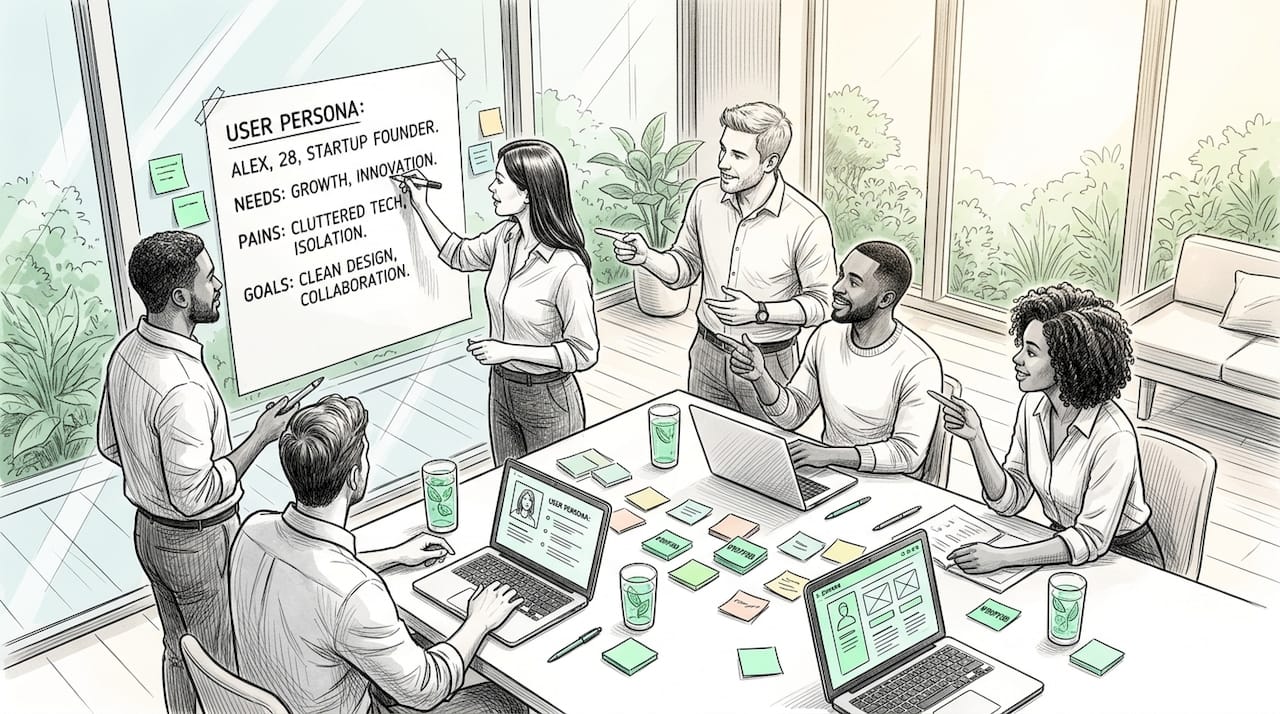
The benefits are concrete. Personas build empathy across teams who never talk directly to users. They focus product decisions by giving everyone a shared reference point. They sharpen marketing messages by replacing vague audience descriptions with specific human motivations. When a developer asks “should we add this feature?” the answer becomes “would Marcus, the time-strapped solopreneur, actually use this at 11pm on his phone?” That question cuts through opinion fast.
Poorly built personas do real damage. Generic stereotypes like “millennial tech user, age 25-35, likes social media” tell you nothing useful. They create false confidence while masking the actual diversity of your users. Teams that build on assumptions rather than research end up designing for a fictional average person who does not exist in the real world.
- Goals and motivations: What the user is trying to accomplish, not just what they say they want
- Frustrations and blockers: Where current solutions fail them, expressed in their own language
- Behavioral patterns: How they actually use tools, not how they report using them
- Context of use: Device, environment, time of day, and competing demands on their attention
- Decision triggers: What prompts them to seek a solution in the first place
Pro Tip: Write your persona’s frustrations in the first person, using language pulled directly from interview transcripts. “I waste an hour every morning just figuring out what to prioritize” lands harder in a design review than “user experiences time management challenges.”
How do user personas differ from buyer personas and customer personas?
These three terms get used interchangeably in most startup conversations, and that confusion costs teams real money. Each type serves a different purpose, tracks different metrics, and informs different decisions.
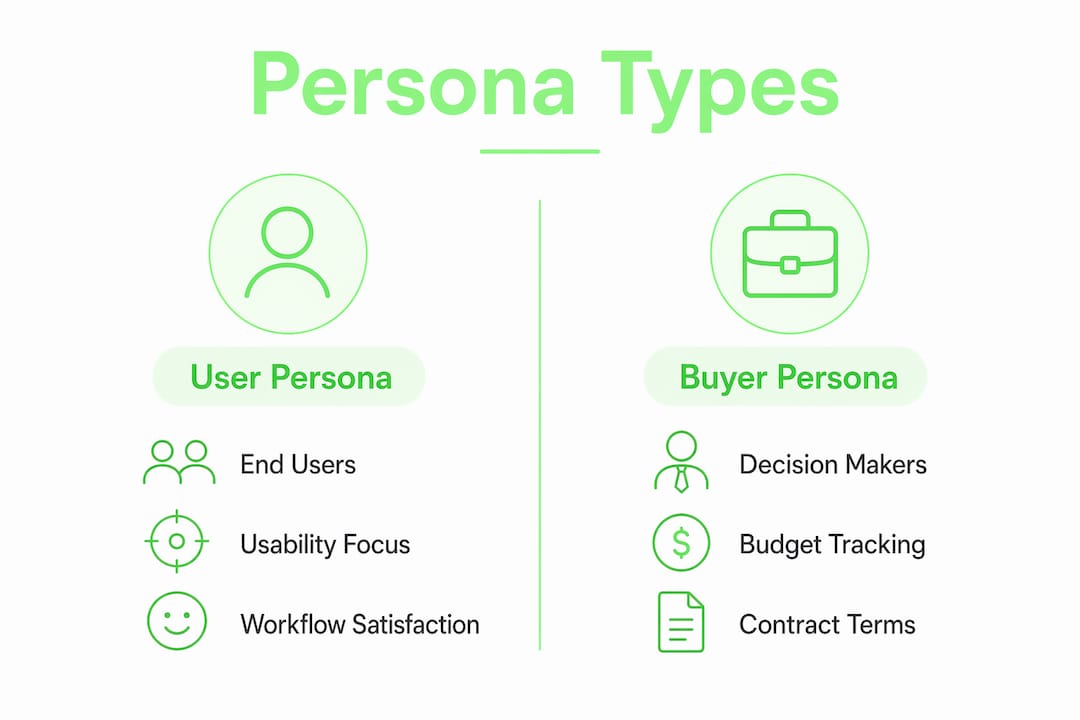
A buyer persona focuses on decision-makers tracking budget, ROI, and contract terms, while a user persona focuses on end-users tracking usability and day-to-day workflow satisfaction. In a B2B SaaS context, the buyer persona might be a VP of Operations who approves the purchase but never logs in. The user persona is the project manager who lives inside the tool every day. Conflating these two creates messaging that speaks to neither audience effectively.
A customer persona sits between the two. It combines purchase behavior with usage patterns, making it most useful for e-commerce and direct-to-consumer brands where the buyer and the user are the same person. Meanwhile, brand archetypes define how to communicate emotionally with your audience, not who that audience is. Mixing archetypes with personas is a common mistake that muddies both your product strategy and your brand voice.
| Persona type | Primary focus | Key metrics | Best used by |
|---|---|---|---|
| User persona | End-user experience | Usability, task completion, satisfaction | Product, UX, design teams |
| Buyer persona | Purchase decision | ROI, budget authority, contract terms | Sales, demand generation |
| Customer persona | Combined purchase and use | Retention, lifetime value, behavior | Marketing, e-commerce |
| Brand archetype | Emotional communication style | Brand perception, voice consistency | Brand strategy, content teams |
The practical rule: if you are designing a feature, use a user persona. If you are writing a sales deck, use a buyer persona. If you are crafting a brand campaign, reference your archetype. Keep them separate and your decisions get sharper across every function.
What are the most effective research methods for building user personas?
Building accurate personas in 2026 requires triangulation. That means combining interviews, direct observations, and behavioral data rather than relying on any single source. Triangulation reduces self-reporting bias and produces insights that actually predict behavior instead of just describing attitudes.
Here is a step-by-step process that works:
- Define your research questions. Before you talk to anyone, write down the three to five things you genuinely do not know about your users. Vague curiosity produces vague data.
- Recruit from your actual user base. Pull participants from real sign-ups, support tickets, or referrals. Recruiting from general panels introduces people who have never experienced your problem space.
- Conduct 15 to 30 interviews per segment. Qualitative research targeting 15-30 interviews per persona segment captures genuine behavioral patterns and outperforms analytics-only segmentation. Fewer interviews and you are pattern-matching on noise.
- Observe, do not just ask. Watch users complete real tasks. What they do and what they say they do are often completely different things.
- Cluster behavioral fingerprints. Group participants by what they actually do, not by demographics. Age and job title predict behavior far less reliably than workflow habits and decision triggers.
- Synthesize into two to four distinct profiles. Averaging data creates generic personas no real user resembles. Clustering identifies the two to four distinct recurring patterns that actually exist in your data.
- Validate with your team. Share raw quotes and behavioral evidence alongside the persona summary. Teams adopt personas they trust, and trust comes from seeing the receipts.
AI now plays a meaningful role in this process. AI-assisted transcript coding preserves researcher bandwidth for deep analysis and sensemaking, improving the entire persona-building workflow. Tools that auto-tag themes across dozens of interview transcripts let you spend your time on interpretation rather than data wrangling. You can also use synthetic AI-generated personas as augmentation layers to narrow hypotheses and test assumptions before committing to costly human research. They are a starting point, not a substitute.
Pro Tip: Never average your interview data to find the “typical” user. If you have ten interviews and five users love automation while five hate it, you do not have one ambivalent user. You have two distinct segments, and each deserves its own persona.
For founders using AI-assisted customer discovery, the research phase becomes faster and more structured, but the human judgment required to interpret what you find remains irreplaceable.
How can user personas be applied in marketing and product design?
Personas are not documents you create once and file away. They are living tools that should show up in sprint planning, campaign briefs, roadmap reviews, and onboarding flows. The moment a persona gets laminated and hung on a wall, it starts dying.
In product design, personas drive feature prioritization by forcing the question: which user segment does this serve, and how central is that segment to our growth? A persona named “Deadline-Driven Dana” who manages five client projects simultaneously tells your engineering team far more about notification design than any analytics dashboard will.
In marketing, personas translate directly into message architecture. Each persona gets its own pain point hierarchy, preferred channel, and language register. A campaign targeting a technically fluent developer persona reads completely differently from one targeting a first-time founder with no coding background. Both might use your product, but the message that converts one will confuse the other.
Here are the most common and highest-value applications:
- UX and interface design: Prioritize navigation, information hierarchy, and feature placement based on how your primary persona actually thinks and works
- Content marketing: Match blog topics, formats, and depth to the questions your persona is actively searching for at each stage of awareness
- Email sequences: Segment by persona to deliver onboarding flows that match each user’s goals and technical comfort level
- Paid advertising: Use persona pain points as ad copy frameworks, testing which frustration resonates most with each segment
- Product roadmap decisions: Score feature requests against persona priorities to cut through the noise of competing stakeholder opinions
- Sales enablement: Give sales teams persona-specific objection maps so they can address concerns before they surface
The most forward-thinking teams integrate personas directly into their AI workflows. When you feed a well-researched persona into a content generation or product strategy tool, the output quality improves dramatically because the context is specific rather than generic.
Common mistakes that undermine persona effectiveness
Most persona failures happen before the research even starts. Teams skip the interviews, pull demographic data from Google Analytics, and call the result a persona. What they actually have is a market segment dressed up in a fictional name.
Personas designed to be entertaining over credible lose team adoption fast. Cartoonish illustrations, quirky hobbies unrelated to product use, and pop culture references make personas memorable for the wrong reasons. Memorability matters, but usefulness comes first.
The other persistent failure is treating personas as static. Users change. Markets shift. A persona built in 2023 may be actively misleading your team in 2026. Quarterly reviews tied to new user research keep personas calibrated to reality.
- Skipping research entirely: Building personas from assumptions produces confident-sounding fiction, not strategy
- Over-relying on self-reported data: Customers are unreliable narrators of their own behavior; behavioral data tells a more honest story
- Creating too many personas: More than four personas for a single product usually signals over-segmentation; focus on the two or three that drive the majority of your decisions
- Ignoring negative personas: Defining who your product is not for saves as much time as defining who it is for
- Locking personas in a document: Personas that do not live inside your team’s daily tools and conversations do not influence decisions
Pro Tip: Schedule a persona audit every quarter. Pull five recent support tickets or user interviews and ask: does our current persona still reflect what we are hearing? If the answer is no, update it before the next planning cycle.
Key takeaways
A user persona is only as useful as the research behind it and the frequency with which your team actually references it in decisions.
| Point | Details |
|---|---|
| Definition matters | A user persona is a research-backed composite profile, not a demographic assumption or marketing stereotype. |
| Distinguish persona types | User, buyer, and customer personas serve different teams and decisions; conflating them creates costly misalignment. |
| Research quality drives accuracy | Target 15 to 30 interviews per segment and cluster behavioral patterns rather than averaging responses. |
| AI augments, not replaces | AI tools accelerate transcript analysis and hypothesis testing but cannot substitute for direct human research. |
| Personas must stay current | Quarterly reviews tied to fresh user data keep personas accurate and prevent teams from building on outdated assumptions. |
Why I think most teams are still getting personas wrong
Here is the uncomfortable truth I have observed working with founders and product teams: most personas are written to satisfy a process, not to drive a decision. They get created during a discovery sprint, presented in a slide deck, and then quietly forgotten while the team ships features based on whoever complained loudest in the last customer call.
The real power of a persona is not in the document. It is in the shared mental model it creates. When every person on your team can answer “what would Marcus do?” without opening a file, you have actually built something useful. That takes repetition, reinforcement, and a willingness to update the persona when the evidence changes.
I am also skeptical of the AI persona hype right now. Synthetic personas generated from large language models are genuinely useful for stress-testing assumptions early, but they inherit the biases of their training data. They reflect what has been written about users, not what users actually do. Use them to sharpen your research questions, not to skip the interviews.
The teams I see winning with personas in 2026 are the ones treating them as living infrastructure, not deliverables. They reference personas in stand-ups. They attach persona tags to feature requests. They update them when the data says something has changed. That discipline is rare, and it is exactly what separates user-centered teams from teams that just say they are user-centered.
— Samim
Build smarter with Siift’s founder intelligence platform
Understanding your users is the foundation of every good product and marketing decision, and Siift is built to help founders get there faster. Siift’s New Business OS guides you through customer discovery, persona research, and go-to-market strategy using agentic AI that filters out bias and blindspots from the start. Instead of guessing who your user is, you build a validated picture grounded in real behavioral insights. Explore Siift’s founder platform to accelerate your path from idea to product-market fit, with the clarity that comes from knowing exactly who you are building for.
FAQ
What is the user persona definition in UX design?
A user persona in UX design is a research-based, semi-fictional profile representing a distinct segment of real users, including their goals, behaviors, frustrations, and usage context. It guides design decisions by giving teams a concrete human reference point instead of abstract user statistics.
How many user personas should a product have?
Most products benefit from two to four personas. More than four typically signals over-segmentation and dilutes focus; fewer than two may miss meaningful differences between distinct user groups that affect design and messaging decisions.
What is the difference between a user persona and a buyer persona?
A user persona focuses on end-user experience, tracking usability and workflow satisfaction, while a buyer persona focuses on decision-makers tracking budget authority and ROI. In B2B contexts, these are often different people entirely.
How do you create a user persona from research data?
Conduct 15 to 30 interviews per user segment, observe actual behavior rather than relying solely on self-reports, cluster participants by behavioral patterns rather than demographics, and synthesize two to four distinct profiles from the recurring patterns you find.
Can AI replace human research in persona building?
No. AI-generated synthetic personas are useful for testing hypotheses and narrowing focus before research begins, but they augment rather than replace direct human interviews and observation, which remain the most reliable source of behavioral insight.