

TL;DR:
- Venture capital involves equity financing where investors gain ownership and expect high returns from startups’ growth.
- It comes with staged funding rounds, governance rights, and risk of significant ownership dilution for founders.
Venture capital sounds like a golden ticket. You pitch a brilliant idea, a partner in a tailored suit hands you millions, and suddenly you’re the next Zuckerberg. The reality is far messier and far more interesting. What is venture capital, really? It’s equity financing provided to young companies with high growth potential, and it comes with strings attached: ownership, governance, and relentless pressure to scale. Understanding how it actually works, who the players are, and whether it fits your startup is one of the most strategic decisions you’ll ever make as a founder.
Table of Contents
- Key takeaways
- What venture capital is and how it works
- Who’s involved and how VC funds are structured
- The venture capital investment process
- Weighing the pros and cons of VC funding
- My honest take on venture capital
- Build your startup strategy before you pitch
- FAQ
Key takeaways
| Point | Details |
|---|---|
| VC is equity, not a loan | Investors receive ownership in your company, not repayment with interest. |
| Few winners carry the portfolio | VCs expect most bets to fail; one breakout success funds the rest. |
| Staged funding rounds serve milestones | Each round from seed to Series C proves specific growth checkpoints. |
| Founders trade control for capital | Board seats, governance rights, and dilution are standard negotiating terms. |
| VC is not always the right path | Bootstrapping, SBICs, and other options may suit your startup better. |
What venture capital is and how it works
Venture capital is equity financing given to early-stage or growth-stage companies in exchange for ownership stakes. No repayment schedule. No interest rate. Instead, the investor owns a slice of your company and gets paid when that slice becomes worth significantly more than what they put in.
Here’s how the mechanics work at a high level:
- The fund is pooled. VC firms raise money from outside investors (called limited partners) and bundle it into a fund with a specific thesis, maybe enterprise software, biotech, or climate tech.
- General partners deploy capital. The partners at the VC firm select which startups to back, negotiate terms, and actively manage those relationships over time.
- Most startups fail. This is by design, not accident. VC portfolios balance many high-risk bets with the understanding that a handful of massive wins will more than cover the losses.
- Exit events create liquidity. When a portfolio company gets acquired or goes public, investors convert their equity into cash. Venture-backed exits totaled $217.1B across 1,463 deals in 2025 alone.
What makes VC different from a bank loan is the risk profile. A bank wants collateral and predictable repayment. A VC wants a 10x or 100x return on a bet that most people would consider reckless. That asymmetry changes everything about the relationship.
For founders, the tradeoff is real. You get capital without debt, but you give up equity. Every new round dilutes your ownership further. If things go well, that diluted slice is still worth a fortune. If things go sideways, you’ve handed ownership to investors without the outcome either side wanted.
Pro Tip: Before you ever walk into a VC meeting, calculate your post-money dilution across two or three hypothetical rounds. Seeing your ownership percentage on paper early prevents nasty surprises later.
Who’s involved and how VC funds are structured
Venture capital is not a solo sport. The ecosystem involves multiple investor types whose incentives, timelines, and governance expectations all intersect in ways that shape your startup’s trajectory.
Here’s a breakdown of the key players:
- Limited partners (LPs). These are the capital providers: university endowments, pension funds, family offices, and high-net-worth individuals. They commit money to a VC fund and expect returns over a 10-year fund lifecycle.
- General partners (GPs). These are the fund managers who source deals, conduct due diligence, negotiate term sheets, and sit on boards. They earn a management fee (typically 2% of fund size) plus carried interest (usually 20% of profits).
- The startup and its founding team. You’re not just receiving capital. You’re entering a long-term relationship with people who now have legal rights in your company.
- Strategic investors and corporate VCs. Large companies sometimes invest directly in startups for strategic reasons, not just financial returns. Their incentives can differ sharply from traditional VCs.
- Government-adjacent programs like SBICs. Small Business Investment Companies use SBA-backed debt alongside their own capital to finance qualifying businesses, offering an alternative model that blends equity and debt with regulatory oversight.
The VC-as-portfolio-manager concept is worth sitting with. VCs provide guidance, introductions, and strategy to their portfolio companies, not just checks. Board seats come with opinions. Some of those opinions are gold. Some are not. The quality of the partnership matters enormously.
Pro Tip: Research a VC’s portfolio companies before you pitch. If they’ve backed three of your direct competitors, that’s a conflict. If they’ve backed complementary businesses, that’s a potential network.
The venture capital investment process
VC funding follows staged rounds, each designed to prove a specific milestone before unlocking more capital. Understanding this progression helps founders match their growth strategy to investor expectations.
| Stage | Typical Use | What You’re Proving |
|---|---|---|
| Pre-Seed | MVP, early team | The idea is worth building |
| Seed | Product development, first customers | The product solves a real problem |
| Series A | Go-to-market, revenue growth | You have a repeatable sales model |
| Series B | Scale, team expansion | The model works at scale |
| Series C+ | Market expansion, pre-IPO | You’re a category leader |
When a VC evaluates your startup, due diligence focuses on market size, team strength, and technology. They’re asking: Is this market large enough to produce a billion-dollar outcome? Is this team capable of building and selling? Is the product defensible?
Beyond the business fundamentals, here’s what gets negotiated in term sheets:
- Valuation. Pre-money and post-money valuations determine how much of your company you’re selling at what price.
- Board composition. VCs often take one or more board seats, which gives them real governance power.
- Pro-rata rights. VCs negotiate pro-rata participation rights to maintain their ownership percentage in future rounds.
- Liquidation preferences. These determine who gets paid first if the company is sold at a loss.
The exit event ties everything together. When your company gets acquired or goes public, that’s when equity converts to cash proceeds for both you and your investors. Planning your path toward exit isn’t premature. It’s the whole game. If you want a sharper view of what that looks like, the startup exit strategies guide at Siift breaks down how to maximize your value when that moment arrives.
Weighing the pros and cons of VC funding
Venture capital can be a catalyst for building something enormous. It can also be the thing that strips you of control and pushes you toward growth you weren’t ready for. Here’s an honest look at both sides.
Benefits of venture capital:
- Access to significant capital without taking on debt
- Strategic support from experienced operators and investors
- Network access: customers, hires, and future investors
- Credibility signal to the market that serious people believe in your vision
- Runway to experiment, iterate, and scale faster than self-funded peers
Drawbacks of venture capital:
- Equity dilution across rounds can leave founders with a surprisingly small ownership stake by Series C
- Governance pressure increases with each institutional investor added to the cap table
- Founders exchange equity and sometimes control for capital, affecting future strategic options
- VCs have a fund timeline. They need exits within 7 to 10 years, which can conflict with a founder’s long-term vision
- VC is simply not suitable for most businesses. The model demands a massive addressable market and the potential for exponential growth
The comparison with other paths is worth making explicitly.
| Funding Path | Capital Returned | Control Retained | Growth Pressure |
|---|---|---|---|
| Venture capital | High | Low to medium | Very high |
| Bootstrapping | None | Full | Self-determined |
| SBIC program | Medium | High | Moderate |
| Bank loan | None (debt) | Full | Low |
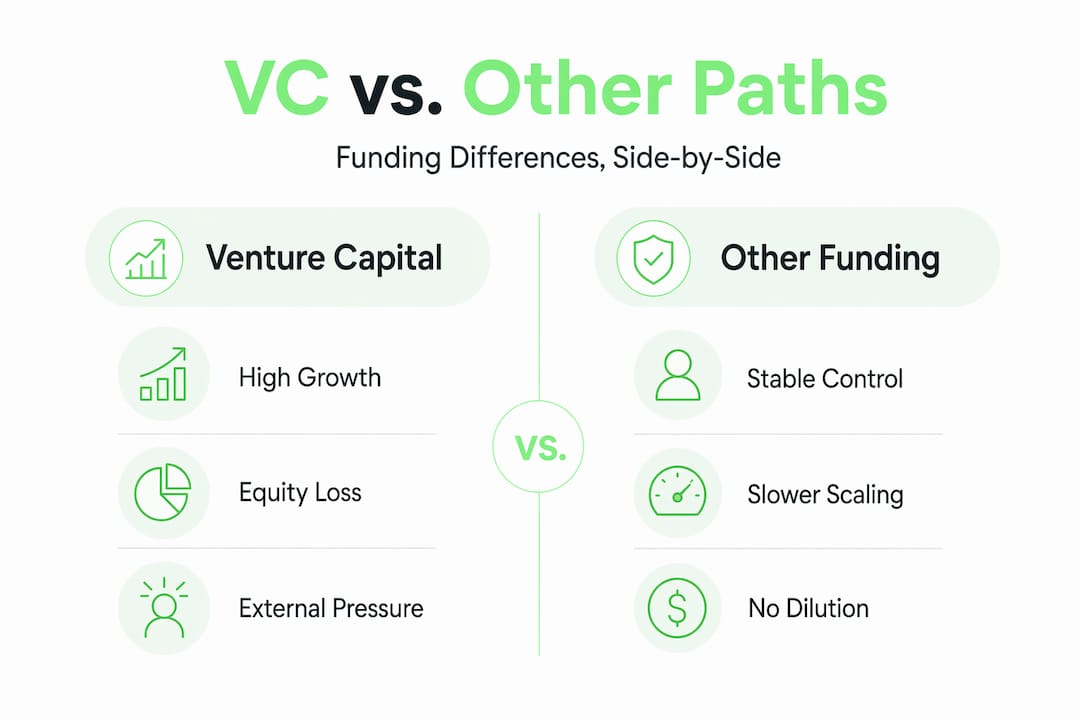
The decision should start with a simple question: does your business model require rapid, capital-intensive scaling to win? If yes, VC is worth exploring. If you’re building a profitable niche business with steady margins, taking VC money might be the wrong fit entirely. Knowing how to de-risk your startup idea before you seek any funding is the smartest first move you can make.
My honest take on venture capital
I’ve watched founders walk into VC conversations with stars in their eyes and walk out with term sheets they didn’t fully understand. The excitement is real. The complexity is also very real.
Here’s what I’ve learned: the relationship between a founder and a VC is more like a marriage than a transaction. You’re not just getting a check. You’re getting a partner who has legal rights in your company, opinions about your strategy, and a very specific timeline for when they want to get out. Misaligned expectations on any of those fronts create friction that compounds over time.

What most founders miss is that VC conversations are two-way evaluations. You should be assessing the VC as hard as they’re assessing you. What’s their reputation with founders at companies that didn’t work out? How do they behave when things get hard? A VC who ghosted their last struggling portfolio company is not someone you want on your board.
My other observation: too many founders default to “raise VC” as if it’s the natural next step after having an idea. It’s not. VC is one tool in a toolkit. The venture capital funding sources available today include government-backed programs, angels, revenue-based financing, and strategic investors. Each carries a different cost and a different relationship. Founders who understand the full spectrum make smarter, more confident decisions about which door to knock on.
Build your story, know your numbers, and never sign a term sheet without understanding every single line.
— Samim
Build your startup strategy before you pitch
Understanding venture capital is the foundation. Knowing how to position your startup to attract it, or deciding you don’t need it at all, is where the real work begins. Siift’s AI platform is built specifically for founders navigating exactly this stage. It guides you through ideation, validation, and go-to-market planning in a structured, systematic way that filters out the noise and sharpens your strategy.
Whether you’re preparing for your first VC conversation or evaluating whether funding is the right path at all, Siift helps you build a defensible plan grounded in real market thinking. Explore how Siift’s founder platform can help you de-risk your path and accelerate your journey to product-market fit before you need to impress anyone in a pitch room.
FAQ
What is venture capital in simple terms?
Venture capital is funding that investors provide to early-stage companies in exchange for equity ownership. Unlike a loan, there’s no repayment. Investors profit when the company is acquired or goes public.
How does venture capital work for startups?
Startups pitch to VC firms, negotiate a valuation and equity stake, and receive capital in staged rounds from seed through Series A and beyond. Each round funds specific milestones and typically brings new governance rights for investors.
What does a venture capitalist do beyond writing checks?
VCs often take board seats, provide strategic advice, make introductions to customers and hires, and help portfolio companies prepare for future fundraising or exit events.
What is the difference between venture capital and private equity?
Venture capital targets early-stage, high-growth startups. Private equity typically buys mature, established companies, often using debt, and focuses on operational improvement rather than early-stage risk.
Is venture capital right for every startup?
No. VC works best for startups targeting massive markets with the potential for exponential growth. Businesses with steady, profitable margins and no need for rapid scaling are often better served by bootstrapping, SBICs, or other funding models.