
Launching your first tech startup feels exhilarating, but the journey is packed with hidden obstacles that can catch even the most determined founder off guard. For recent graduates ready to transform bold ideas into thriving businesses, understanding founder risks—from operational and legal challenges to unexpected leadership pitfalls—is vital for building resilient companies. Discover how recognizing and addressing common startup misconceptions early on can help set a foundation for smarter, safer entrepreneurial decisions.
Table of Contents
- Founder Risks Defined And Key Misconceptions
- Major Categories Of Risks For Founders
- How Founder Risks Impact Startups
- Financial And Legal Consequences For Founders
- Strategy To Mitigate Common Founder Risks
- Avoiding Blindspots In Founder Decision-Making
Key Takeaways
| Point | Details |
|---|---|
| Understanding Founder Risks | Founders face various risks including operational, financial, legal, and strategic challenges that require comprehensive management strategies. |
| Misconceptions About Risks | Many entrepreneurs mistakenly believe their passion suffices for success and overlook the complexity of team dynamics and legal challenges. |
| Proactive Risk Mitigation | Establishing a clear risk assessment framework can help founders systematically identify and address potential issues before they escalate. |
| Cognitive Bias Awareness | Founders should recognize and combat common cognitive biases to make informed, objective decisions that enhance startup resilience. |
Founder risks defined and key misconceptions
Startup founders navigate a complex landscape of potential pitfalls that can make or break their entrepreneurial journey. Founder risks are multifaceted challenges encompassing operational, financial, legal, and leadership dimensions that emerge uniquely in entrepreneurial contexts. Understanding these risks isn’t just about survival - it’s about strategic navigation.
Research reveals several critical misconceptions about startup risks. Many entrepreneurs mistakenly believe that founder-led startups inherently take less risk, when in reality they often shoulder higher operational and leadership risks. The Harvard Business School highlights that early decisions around team dynamics, equity splits, and leadership control are particularly consequential.
Key Founder Risk Categories:
- Operational risks related to business infrastructure
- Financial risks involving capital allocation and funding
- Legal risks surrounding compliance and potential litigation
- Leadership risks connected to team dynamics and decision-making
- Strategic risks involving market positioning and competitive landscape
Founders frequently underestimate how personal decisions can cascade into systemic business challenges. Entrepreneurial risks extend far beyond financial metrics, touching on psychological, interpersonal, and strategic domains that require nuanced understanding.
Common Founder Risk Misconceptions:
- Believing passion alone guarantees success
- Assuming all risks are predictable and manageable
- Undervaluing the importance of team chemistry
- Overlooking potential legal and regulatory complexities
- Thinking financial resources solve all startup challenges
Successful founders don’t eliminate risks - they learn to systematically identify, assess, and mitigate them strategically.
Pro tip: Develop a comprehensive risk assessment framework that goes beyond financial metrics and incorporates leadership, operational, and strategic dimensions.
Major categories of risks for founders
Founders face a complex landscape of risks that can significantly impact their startup’s trajectory. Entrepreneurial risks span multiple critical domains, each presenting unique challenges that require strategic understanding and proactive management.
Primary Risk Categories for Founders:
- Operational Risks: Challenges related to day-to-day business processes and infrastructure
- Financial Risks: Potential monetary losses and capital allocation challenges
- Legal Risks: Litigation potential and regulatory compliance issues
- Strategic Risks: Market positioning and competitive landscape uncertainties
- Leadership Risks: Team dynamics, decision-making, and organizational effectiveness
Each risk category demands specific attention and mitigation strategies. Operational risks involve potential disruptions in business processes, ranging from supply chain vulnerabilities to technological infrastructure challenges. These risks can emerge from inefficient systems, lack of scalable procedures, or unexpected market shifts.

Deeper Risk Analysis:
Here’s how common founder risk categories differ in their primary threats and potential outcomes:
| Risk Category | Main Threat | Example Outcome |
|---|---|---|
| Operational | Process interruptions | Delayed product launches |
| Financial | Capital mismanagement | Cash flow crises |
| Legal | Regulatory non-compliance | Costly lawsuits |
| Leadership | Poor team cohesion | High turnover rates |
| Strategic | Weak market positioning | Lost competitive advantage |
- Operational risks threaten business continuity
- Financial risks impact funding and resource allocation
- Legal risks can result in significant financial and reputational damage
- Strategic risks challenge long-term business viability
- Leadership risks affect team performance and organizational culture
Successful founders don’t just identify risks - they develop comprehensive strategies to anticipate, manage, and transform potential challenges into opportunities.
Pro tip: Create a dynamic risk assessment matrix that continuously monitors and updates potential threats across all identified risk categories.
How founder risks impact startups
Startup success hinges critically on how founders navigate and manage inherent risks. Founder decisions dramatically influence startup outcomes, with potential consequences that extend far beyond initial expectations.
Key Impact Areas of Founder Risks:
- Team cohesion and internal dynamics
- Equity distribution and ownership structure
- Strategic decision-making capabilities
- Financial resource allocation
- Long-term organizational stability
Founder-related challenges can transform promising ventures into potential failures. Startup survival depends not just on market opportunities, but on the founders’ ability to manage internal complexities, resolve conflicts, and maintain strategic alignment.
Potential Negative Consequences:
- Unresolved founder disputes leading to organizational breakdown
- Loss of critical leadership control
- Misalignment of strategic vision
- Ineffective risk management
- Reduced investor confidence
The most successful startups treat founder risks as dynamic challenges to be continuously monitored and strategically addressed, not static problems to be ignored.
Interestingly, founder-led startups demonstrate complex risk profiles, exhibiting higher operational risks but potentially lower litigation risks. This nuanced landscape requires founders to develop sophisticated, adaptive risk management approaches.
Pro tip: Implement quarterly founder alignment sessions to proactively identify, discuss, and mitigate potential internal risks before they escalate.
Financial and legal consequences for founders
Startup founders navigate a minefield of potential financial and legal risks that can devastate both personal and professional landscapes. Founders face significant financial and legal challenges that extend far beyond simple business setbacks.
Critical Financial Consequences:
- Personal wealth reduction
- Potential complete capital loss
- Equity dilution risks
- Reduced future investment opportunities
- Personal credit score implications
Legal risks represent another complex dimension of startup challenges. Founder liability can manifest through multiple channels, including stakeholder litigation, regulatory non-compliance, and intellectual property disputes. These risks transform entrepreneurship from an exciting venture into a potentially high-stakes legal battleground.
Potential Legal and Financial Risk Scenarios:
- Shareholder lawsuits challenging management decisions
- Regulatory fines for non-compliance
- Breach of contract penalties
- Intellectual property infringement claims
- Personal asset seizure in worst-case scenarios
Successful founders don’t just manage risks - they anticipate and strategically mitigate potential legal and financial landmines before they detonate.
The financial exposure can be particularly brutal. Founders might find themselves personally responsible for business debts, facing potential bankruptcy or long-term credit damage. This underscores the critical importance of understanding and proactively managing both financial structures and legal frameworks.
Pro tip: Consult with both a startup-experienced lawyer and financial advisor before finalizing any significant business agreements or equity structures.
Strategy to mitigate common founder risks
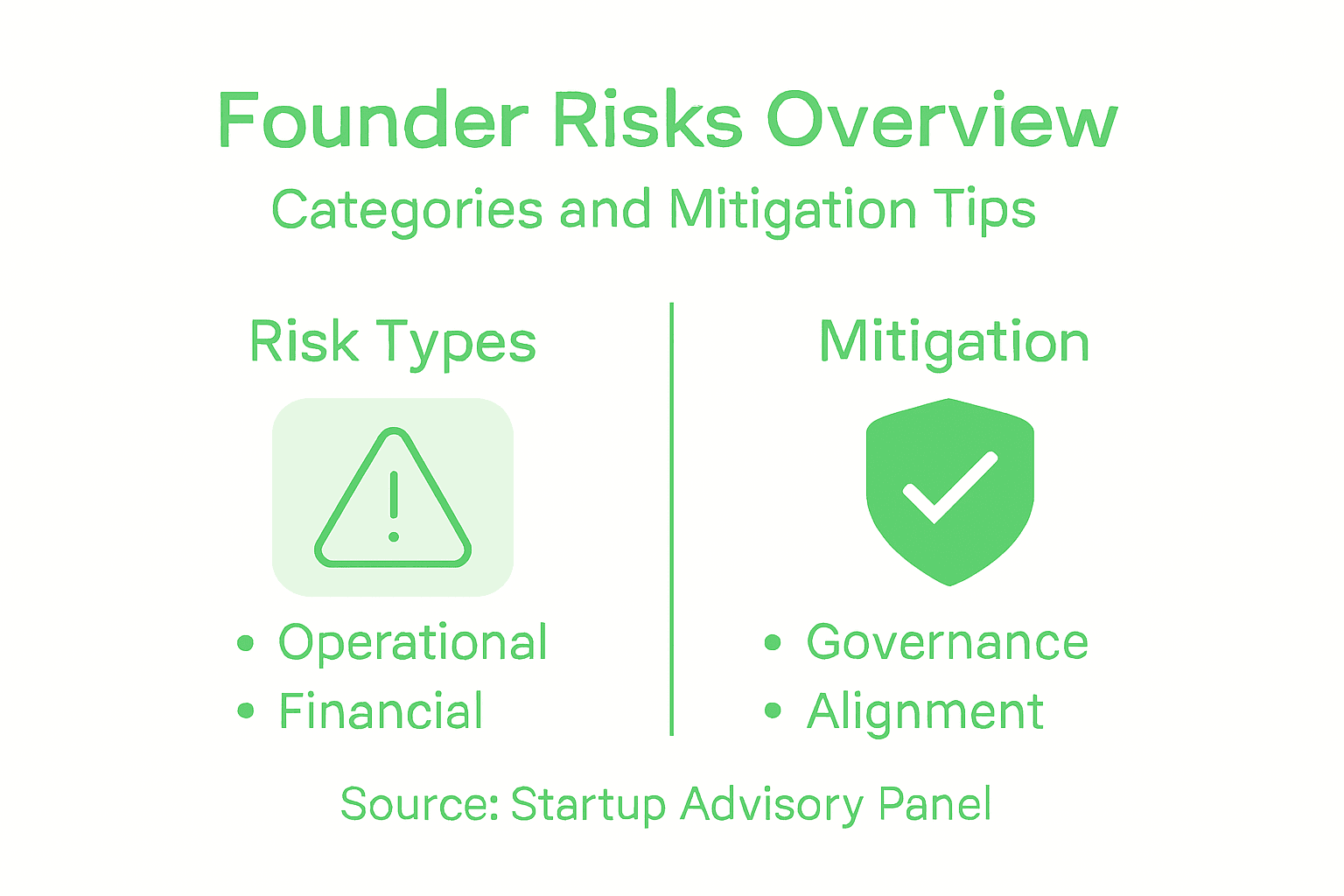
Founders must develop strategic frameworks to systematically address potential risks before they become critical challenges. Structured decision-making around leadership and governance provides the foundation for effective risk mitigation.
Key Risk Mitigation Strategies:
- Establish clear communication protocols
- Define explicit roles and responsibilities
- Create transparent equity distribution mechanisms
- Develop comprehensive conflict resolution processes
- Build flexible organizational structures
Foundational Risk Management Approach:
- Conduct comprehensive founder compatibility assessments
- Draft detailed partnership agreements
- Implement regular performance and alignment reviews
- Create exit strategies for potential founder departures
- Maintain open and honest communication channels
Founders often underestimate the importance of proactive planning. Anticipatory risk management means developing strategies that address potential challenges before they emerge, rather than reacting when problems become unavoidable.
Successful risk mitigation is not about eliminating all potential issues, but creating robust systems that can adapt and respond effectively to unexpected challenges.
Establishing clear governance structures helps prevent misunderstandings and potential conflicts. This includes defining decision-making processes, setting performance expectations, and creating mechanisms for ongoing dialogue and accountability.
Pro tip: Develop a founder’s agreement that explicitly outlines roles, responsibilities, equity distribution, and potential conflict resolution mechanisms before launching your startup.
Avoiding blindspots in founder decision-making
Founders often fall victim to cognitive traps that can derail their startup’s potential. Recognizing and mitigating cognitive biases becomes a critical skill for sustainable entrepreneurial success.
Common Decision-Making Blindspots:
- Overconfidence in personal abilities
- Confirmation bias in market research
- Emotional attachment to initial ideas
- Underestimating potential risks
- Ignoring contradictory evidence
Strategies to Combat Cognitive Biases:
- Seek diverse external perspectives
- Encourage team members to challenge assumptions
- Implement structured decision-making frameworks
- Regularly conduct independent market validations
- Practice systematic scenario planning
Psychological Barriers in Founder Thinking
The following table summarizes psychological pitfalls founders face and their long-term impact on startups:
| Cognitive Bias or Trap | How It Appears | Potential Impact |
|---|---|---|
| Overconfidence | Ignoring advice | Riskier business decisions |
| Confirmation bias | Selective information use | Missed warning signals |
| Emotional attachment | Reluctance to pivot | Stalled growth |
| Risk underestimation | Ignoring threats | Sudden setbacks |
| Ignoring evidence | Dismissing dissenting views | Weak market fit |
Founders frequently suffer from confirmation bias, unconsciously seeking information that validates their existing beliefs while dismissing contradictory data. This selective perception can create dangerous blindspots that prevent objective assessment of business challenges.
True entrepreneurial wisdom lies not in being right, but in the willingness to be proven wrong and adapt quickly.
Building a culture of psychological safety within the founding team allows for open dialogue and constructive criticism. This means creating environments where team members feel comfortable challenging ideas without fear of retribution or dismissal.
Pro tip: Establish a quarterly external advisory review where independent experts systematically assess your startup’s strategy and potential blindspots.
Turn Founder Risks Into Strategic Advantages with siift.ai
The article highlights the critical challenges founders face including operational, financial, legal, and leadership risks that can threaten startup success. If you are overwhelmed by managing these complex founder risks or worried about blindspots like confirmation bias and equity misalignment siift.ai’s Intelligent Business Canvas is designed exactly for you. It guides you step-by-step through ideation, validation, and go-to-market strategies while delivering personalized feedback that helps you identify and mitigate these risks early.
Start transforming uncertainty into clarity by using an AI-powered platform that filters out distractions, cognitive biases, and potential conflicts so you can focus on building a strong foundation for your startup. Take control of your founder journey with siift.ai today and access powerful insights to accelerate your path to product-market fit. Don’t let hidden founder risks hold you back. Explore how Intelligent Business Canvas can systematically de-risk your startup and empower you to make confident and informed decisions.
Frequently Asked Questions
What are founder risks in startups?
Founder risks refer to the multifaceted challenges that entrepreneurs face, including operational, financial, legal, and leadership risks. These risks can arise from decisions related to team dynamics, equity splits, and overall management of the startup.
How can founders effectively mitigate financial risks?
Founders can mitigate financial risks by developing a comprehensive financial plan, monitoring cash flow regularly, and consulting with financial advisors to ensure sound capital allocation and avoid potential pitfalls in funding.
What are common misconceptions about founder risks?
Common misconceptions include the belief that passion alone guarantees success, underestimating the importance of team chemistry, assuming all risks are predictable, and overlooking legal and regulatory complexities.
How do leadership risks impact a startup’s success?
Leadership risks can impact a startup’s success by affecting team dynamics, decision-making effectiveness, and overall organizational culture. Poor leadership can lead to high turnover rates and misalignment of strategic vision, ultimately jeopardizing the startup’s viability.
Recommended
- Startup Risk: How to Protect Your Founder Journey | siift
- New Business Risk: What Every Modern Founder Faces | siift
- Riskiest Part of a Startup: How to Navigate Failure | siift
- blog | siift | What Is Business Risk? A Simple Guide for New Entrepreneurs 2025
- Redefining Risks: The Future of Crowdfunding and Investment - Stratgetic IT Consultants for Accountants
- Growth Hacking Fundamentals: Boost Results for Marketers
- 💰 How to Make Your First $: Sales Plan for a Startup | Sales Mates Podcast #85 - Sales Label IT Consulting