
Launching an AI-driven startup in Canada or the United States means stepping into a world where unpredictability is the rule, not the exception. For many Millennial founders, the challenge lies in mastering risk before it controls your venture’s future. Understanding the nuances of financial, market, and team risks is crucial, especially when every decision shapes your company’s path to survival and success. This guide unpacks practical strategies and research-backed insights to help you navigate the complexities of startup risk with confidence.
Table of Contents
- Defining Startup Risk and Its Impact
- Types of Startup Risk: Market, Money, Team
- Why Product-Market Fit Is Essential
- Common Founder Mistakes and Oversights
- Financial and Legal Pitfalls to Avoid
- AI-Driven Tactics for De-Risking Startups
Key Takeaways
| Point | Details |
|---|---|
| Understanding Startup Risk | Startups face various risks, including financial, market, operational, and strategic, necessitating comprehensive risk management strategies. |
| Emphasizing Product-Market Fit | Achieving product-market fit is crucial for success, as it aligns the startup’s offering with genuine market needs. |
| Proactive Financial Management | Founders must maintain financial discipline, including cash flow management and diversified funding sources, to ensure sustainability. |
| Leveraging AI for Risk Management | Utilizing AI tools enhances predictive analysis and strategic decision-making, enabling startups to better navigate uncertainties and optimize operations. |
Defining Startup Risk and Its Impact
Startup risk represents the complex landscape of potential challenges and uncertainties that new ventures encounter during their early development stages. Entrepreneurial ventures inherently operate in environments characterized by high unpredictability, where strategic decisions can dramatically impact long-term survival and success. Analyzing startup risk management frameworks reveals multiple dimensions of potential threats that founders must systematically anticipate and mitigate.
The primary risks confronting startups typically encompass financial, market, operational, and strategic vulnerabilities. Financial risks often emerge from limited capital reserves and inconsistent revenue streams. Market risks involve competitive dynamics, customer adoption challenges, and rapidly shifting technological landscapes. Operational risks include team dynamics, scalability constraints, and execution capabilities. Strategic risks relate to foundational decisions about business model design, market positioning, and growth trajectories.
New venture risk management research emphasizes that startups face distinctive challenges compared to established enterprises. Their small size, innovative nature, and accelerated growth patterns create unique risk profiles that demand adaptive and proactive management strategies. Successful founders recognize that risk is not merely something to minimize but a dynamic process requiring continuous assessment, learning, and strategic recalibration.
Effective startup risk management involves developing comprehensive frameworks that integrate multiple perspectives. These frameworks should include robust financial planning, agile organizational structures, continuous market validation, and flexible strategic approaches that enable quick pivots when necessary. Understanding and anticipating potential risks allows founders to design more resilient business models that can withstand unexpected challenges.
Here’s a summary comparing the main types of startup risk:
| Risk Type | Main Challenge | Example Business Impact |
|---|---|---|
| Market | Gaining customer traction | Slow sales, missed growth opportunities |
| Financial | Managing cash flow and funding | Runway depletion, stalled operations |
| Team | Building and aligning the team | Culture problems, high turnover |
| Strategic | Choosing business direction | Wrong market fit, wasted resources |
Pro tip: Develop a monthly risk assessment protocol that systematically reviews your startup’s key vulnerabilities across financial, market, operational, and strategic domains to proactively identify and mitigate potential threats.
Types of Startup Risk: Market, Money, Team
Startup risks are multifaceted challenges that manifest across three critical domains: market, financial, and team dynamics. Comprehensive risk management research reveals that these risk categories are deeply interconnected, requiring founders to develop holistic strategies for navigating potential obstacles.
Market risks represent the external challenges startups face in gaining customer acceptance and establishing competitive positioning. These risks include product-market fit uncertainties, shifting consumer preferences, technological disruptions, and intense competitive landscapes. Founders must continuously validate their value proposition, monitor market trends, and remain agile enough to adapt their strategies quickly. Successful startups develop robust market intelligence systems that help them anticipate and respond to emerging challenges before they become existential threats.
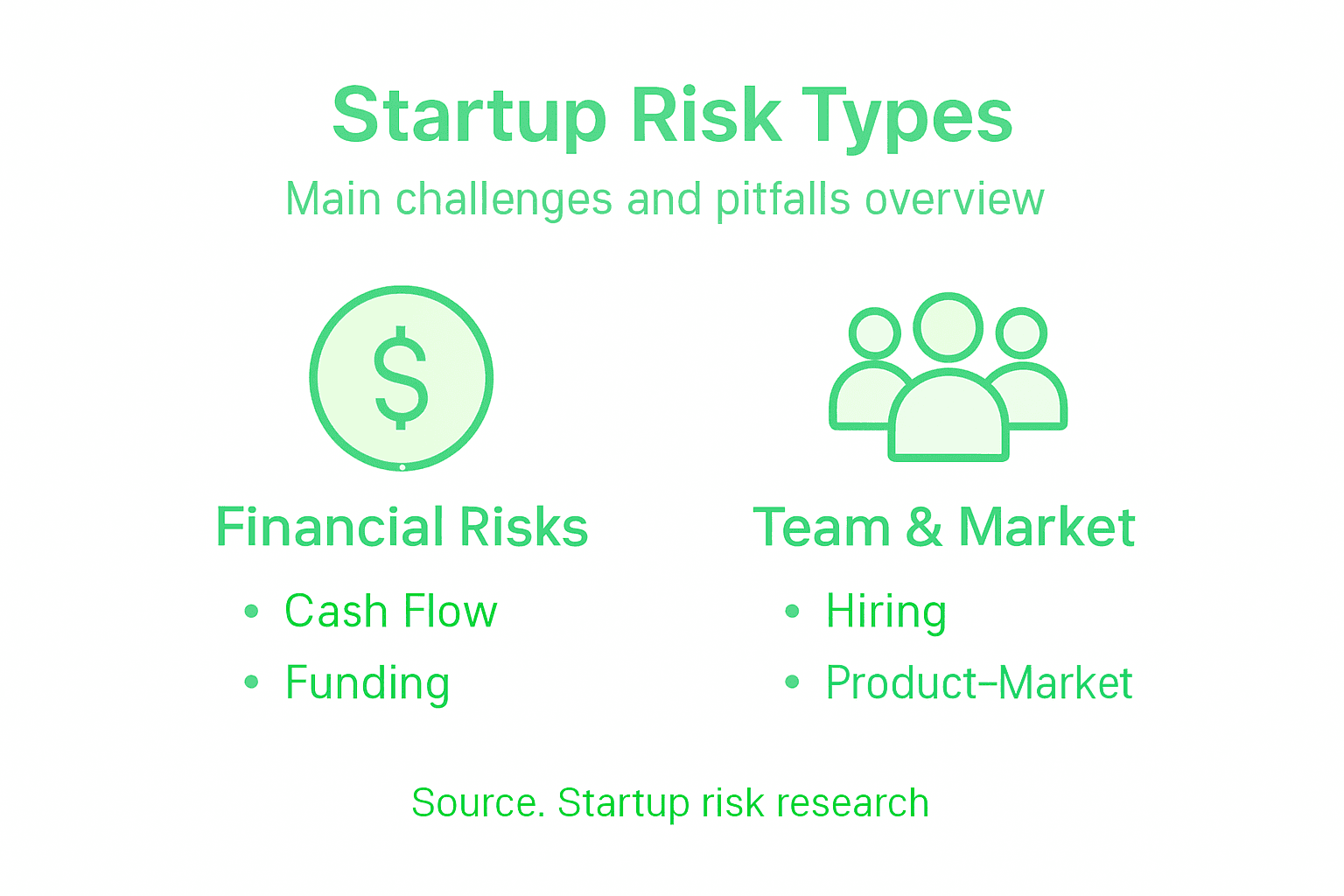
Financial risks constitute another critical dimension of startup vulnerability. Cash flow constraints, limited funding sources, unpredictable revenue streams, and high burn rates can rapidly undermine a startup’s potential. Effective financial risk management involves maintaining lean operational models, diversifying funding sources, establishing clear financial milestones, and developing contingency plans for potential economic downturns. Founders must balance ambitious growth objectives with prudent financial discipline, ensuring sufficient runway to weather unexpected challenges.
Team-related risks often represent the most nuanced and complex challenge for emerging ventures. Organizational dynamics, leadership capabilities, skill gaps, interpersonal conflicts, and alignment of vision can profoundly impact a startup’s trajectory. Successful founders invest heavily in building resilient, adaptable teams with complementary skills, shared values, and a strong commitment to collective goals. Implementing transparent communication protocols, regular performance assessments, and continuous learning opportunities can help mitigate potential team-related risks.

Pro tip: Create a quarterly risk assessment matrix that systematically evaluates your startup’s market positioning, financial health, and team performance to proactively identify and address potential vulnerabilities.
Why Product-Market Fit Is Essential
Product-market fit represents the critical intersection where a startup’s solution perfectly addresses genuine market needs. Understanding product-market validation reveals this concept as the fundamental determinant of startup success, where customer demand transforms an idea from potential to viable business opportunity.
At its core, product-market fit means creating a solution that not only solves a specific problem but does so in a way that resonates deeply with target customers. Successful startups recognize that this fit goes beyond superficial features, requiring profound insight into user pain points, preferences, and underlying motivations. Without genuine product-market alignment, even the most innovative concept can quickly become a costly experiment, consuming resources without generating meaningful traction.
The implications of achieving product-market fit extend far beyond initial product development. Comprehensive market research demonstrates that startups with strong market alignment experience exponentially higher customer retention, more predictable revenue streams, and significantly improved scalability. Founders who invest time in rigorous market validation can create products that customers not only want but actively seek out, reducing customer acquisition costs and building sustainable competitive advantages.
Achieving product-market fit requires a systematic, iterative approach. This involves continuous customer research, rapid prototyping, gathering granular feedback, and being willing to pivot quickly based on real-world insights. Successful founders treat product development as a dynamic conversation with their market, constantly refining their understanding of customer needs and adjusting their value proposition accordingly.
Pro tip: Conduct monthly customer interviews and track at least three core metrics that directly measure how well your product solves your target market’s most pressing problems.
Common Founder Mistakes and Oversights
Startup failure often stems from predictable patterns of founder missteps that can be systematically identified and mitigated. Startup founder mistake analysis reveals that most entrepreneurial setbacks are not random occurrences but result from predictable decision-making errors that can be anticipated and avoided with strategic thinking.
One of the most critical mistakes founders consistently make is premature scaling and misunderstanding market dynamics. Many entrepreneurs become enamored with their initial concept, investing significant resources into building complex products before validating actual customer demand. Common founder blindspots demonstrate that successful startups prioritize customer validation over product perfection. This means conducting extensive market research, creating minimum viable products, and being willing to pivot based on genuine user feedback rather than personal assumptions.
Financial management represents another significant area of potential founder mistakes. Inexperienced entrepreneurs often underestimate burn rates, overestimate revenue projections, and fail to maintain sufficient financial reserves. They might chase funding aggressively without a clear strategic roadmap, leading to diluted equity and misaligned investor expectations. Successful founders approach financial planning with discipline, maintaining lean operations, establishing clear metrics for success, and developing multiple revenue streams to create resilience.
Team dynamics and leadership challenges constitute another critical domain of potential founder mistakes. Many startup leaders struggle with building cohesive teams, delegating effectively, and maintaining clear communication channels. They might hire based on immediate needs rather than long-term strategic vision, or fail to create a culture of continuous learning and adaptability. Effective founders invest time in building robust organizational structures, fostering transparency, and creating environments that encourage innovation and collective problem-solving.
Pro tip: Implement a quarterly founder self-assessment protocol that critically examines your decision-making patterns, seeking external mentorship and honest feedback to identify and correct potential blind spots.
Financial and Legal Pitfalls to Avoid
Startup financial management requires strategic awareness of potential legal and monetary risks that can rapidly derail entrepreneurial ventures. Critical startup legal mistakes reveal a complex landscape of challenges that demand proactive navigation and sophisticated understanding.
Financial risks represent the most immediate threat to startup survival. Entrepreneurs frequently underestimate operational costs, create unrealistic revenue projections, and fail to maintain adequate cash reserves. Startup financial risk management highlights the dangers of over-relying on single revenue streams and neglecting comprehensive financial modeling. Successful founders develop robust financial strategies that include multiple funding sources, precise expense tracking, and flexible budgeting approaches that can adapt to rapidly changing market conditions.
Legal vulnerabilities pose equally significant challenges for emerging businesses. Common pitfalls include selecting inappropriate business structures, failing to separate personal and business finances, and overlooking critical intellectual property protections. Founders must invest time in understanding regulatory requirements, drafting comprehensive contracts, and establishing clear legal frameworks that protect their innovations and minimize potential disputes. This often requires consulting with legal professionals who specialize in startup ecosystems and can provide nuanced guidance tailored to specific industry contexts.
Technology and innovation-driven startups face additional layers of complexity in their financial and legal risk management. They must balance aggressive growth strategies with prudent risk mitigation, creating organizational structures that can scale while maintaining compliance and financial discipline. This requires continuous learning, strategic adaptability, and a willingness to seek expert guidance when navigating complex regulatory and financial landscapes.
Pro tip: Allocate at least 5% of your startup’s initial budget for professional legal and financial consultation to systematically identify and mitigate potential risk areas before they become critical problems.
AI-Driven Tactics for De-Risking Startups
Artificial intelligence represents a transformative approach to managing startup risks, offering unprecedented capabilities for predictive analysis and strategic decision-making. AI’s dynamic entrepreneurial capabilities demonstrate how emerging technologies can fundamentally reshape how founders navigate uncertainty and build resilient businesses.
AI-powered risk assessment tools enable startups to conduct more sophisticated and comprehensive market analyses than ever before. These technologies can rapidly process massive datasets, identifying potential market trends, competitive dynamics, and consumer behavior patterns that human analysts might miss. Machine learning algorithms can predict potential failure points, simulate various business scenarios, and provide data-driven recommendations for mitigating risks before they become critical challenges.
Data-driven decision-making represents another critical domain where AI transforms startup risk management. Advanced predictive models can analyze financial projections, cash flow models, and operational metrics with remarkable precision. These tools help founders make more informed choices about resource allocation, funding strategies, and growth trajectories by providing real-time insights and probabilistic forecasts that traditional analytical methods cannot match.
Technology-driven startups can leverage AI not just as a risk management tool, but as a core strategic asset. By integrating machine learning capabilities into their fundamental business processes, founders can create more adaptive, intelligent organizational structures that can rapidly respond to changing market conditions. This approach transforms risk from a potential threat into a dynamic opportunity for innovation and strategic positioning.
Below is a comparison of traditional and AI-driven risk management practices in startups:
| Aspect | Traditional Approach | AI-Driven Approach |
|---|---|---|
| Data Analysis Speed | Manual, slow | Real-time, automated |
| Predictive Capability | Limited forecasting | Sophisticated scenario modeling |
| Adaptability | Reactive to changes | Proactive, adaptive recommendations |
| Decision Support | Based on founder experience | Insights from large data sets |
Pro tip: Invest in AI-powered risk assessment tools that provide continuous, real-time monitoring of your startup’s key performance indicators and potential vulnerability zones.
De-Risk Your Startup Journey with AI-Powered Strategy
Navigating the riskiest part of a startup requires more than just passion and hard work. This article highlights the critical challenges founders face such as financial management, market uncertainties, and achieving true product-market fit. You need a reliable way to systematically identify blind spots, validate your ideas, and make data-driven decisions without emotional pressure or bias.
That is where siift.ai comes in. Our Intelligent Business Canvas is the ultimate founder’s strategy platform designed to guide you step-by-step through ideation, validation, and go-to-market strategies. With personalized AI feedback and prioritized actions, you can confidently tackle risks like premature scaling, team misalignment, and financial miscalculations highlighted in the article. Act now to transform uncertainty into clarity and avoid costly founder mistakes by using siift.ai Intelligent Business Canvas. Your startup’s success starts with the right strategy today.
Frequently Asked Questions
What are the most common risks faced by startups?
Startups typically face financial, market, operational, and strategic risks. Financial risks stem from limited capital and fluctuating revenues, while market risks involve customer adoption and competitive pressure. Operational risks relate to team dynamics and scalability, and strategic risks pertain to decisions about business models and growth paths.
How can startups effectively manage financial risks?
Startups can manage financial risks by maintaining lean operations, diversifying funding sources, setting clear financial milestones, and developing contingency plans. It’s crucial to balance ambitious growth with financial discipline to ensure they can survive unexpected challenges.
Why is product-market fit important for startup success?
Product-market fit is essential because it signifies that a startup’s solution addresses genuine customer needs. Achieving this fit can lead to higher customer retention, predictable revenue, and better scalability, making it a critical factor for sustainable growth.
What are some common founder mistakes that lead to startup failure?
Common founder mistakes include premature scaling, poor financial management, and ineffective team dynamics. Founders often overlook the importance of validating market demand before developing products, underestimate burn rates, and struggle with team cohesion, which can severely impact a startup’s chances of success.
Recommended
- Startup Failure Reasons: Complete Founder’s Guide | siift
- Startup Risk: How to Protect Your Founder Journey | siift
- Understanding Why Startups Fail: Key Insights Explained | siift
- blog | siift | Top Reasons Businesses Fail in 2025: A Guide for New Founders
- Reducing Operational Risk: Complete Guide -
- Business Startup Planner: Streamlining Launch and Growth | Gammatica