
More than 70 percent of startups close their doors within the first decade, according to CB Insights. That number grabs attention, but it barely scratches the surface. Startup failure is not just about running out of cash or making bad decisions. It is a mix of slow financial leaks, missed opportunities in the market, and everyday challenges that could quietly end a dream before it even takes off.
Table of Contents
- Defining Startup Failure: What Does It Mean?
- Key Reasons Startups Fail: Insights and Impacts
- The Role of Market Fit: Understanding Demand
- Financial Mismanagement: Causes and Consequences
- The Importance of Adaptability in Business Success
Quick Summary
| Takeaway | Explanation |
|---|---|
| Startup failure is multifaceted. | It’s not just about closing; it involves financial, strategic, and operational challenges. |
| Cash flow management is crucial. | Many startups fail due to running out of capital before stabilizing revenue streams. |
| Market fit is dynamic, not static. | Startups must continuously adapt to market needs for long-term success and growth. |
| Organizational adaptability drives success. | Companies that embrace flexibility can better navigate market changes and opportunities. |
| Emotional resilience is key for founders. | Founders should develop adaptability and resilience to cope with challenges in the startup ecosystem. |
Defining Startup Failure: What Does It Mean?
Startup failure is more nuanced than simply shutting down a business. It represents a complex landscape of financial, strategic, and operational challenges that prevent an emerging company from achieving sustainable growth and success. Startup experts from CB Insights suggest that failure is not just about monetary loss, but about an organization’s inability to create lasting value in its chosen market.
Beyond Financial Metrics
Defining startup failure goes well beyond simple profit and loss statements. A startup can be considered unsuccessful when it cannot:
- Generate consistent revenue streams
- Attract and retain customers
- Scale its business model effectively
- Secure necessary funding or investor confidence
- Develop a competitive and differentiated product offering
Understanding these multifaceted dimensions helps entrepreneurs recognize potential warning signs before complete business collapse. Failure is often a gradual process, not a sudden event, involving systematic breakdowns in vision, execution, and market alignment.
The Psychological and Strategic Dimensions
Startup failure also carries significant psychological weight for founders. It represents more than financial loss it symbolizes the potential collapse of a vision, personal investment, and professional identity. Research from Harvard Business Review indicates that emotional resilience and adaptability are critical in navigating the complex startup ecosystem.
For those interested in diving deeper into understanding startup challenges, read our comprehensive guide on startup business models, which explores the intricate dynamics of emerging businesses and potential pitfalls to avoid.
Key Reasons Startups Fail: Insights and Impacts
Comprehensive research from CB Insights reveals that startup failure is rarely a result of a single catastrophic event, but rather a combination of interconnected strategic and operational challenges. Understanding these reasons provides critical insights for entrepreneurs seeking to navigate the complex startup ecosystem.
Below is a comparison table summarizing key internal and external factors contributing to startup failure, helping readers distinguish how each area impacts success.
| Failure Factor | Description | Impact on Startups |
|---|---|---|
| Insufficient Market Demand | Product does not solve a large enough customer problem | Leads to poor sales and unscalable demand |
| Inadequate Cash Management | Ineffective budgeting and cash flow oversight | Causes early operational shutdown due to depleted funds |
| Poor Pricing Strategies | Misaligned or uncompetitive pricing for target market | Lowers revenue potential or drives customers to competitors |
| Team Dysfunction | Internal conflicts and lack of role clarity | Undermines execution and erodes company culture |
| Leadership Gaps | Absence of clear vision or decision-making authority | Leads to strategic misalignment and stagnation |
| Founder Conflicts | Disagreements among founders on direction or roles | Distracts from business goals and destabilizes company |
| Premature Scaling | Expanding too quickly before achieving product-market fit | Increases burn rate without proven demand |
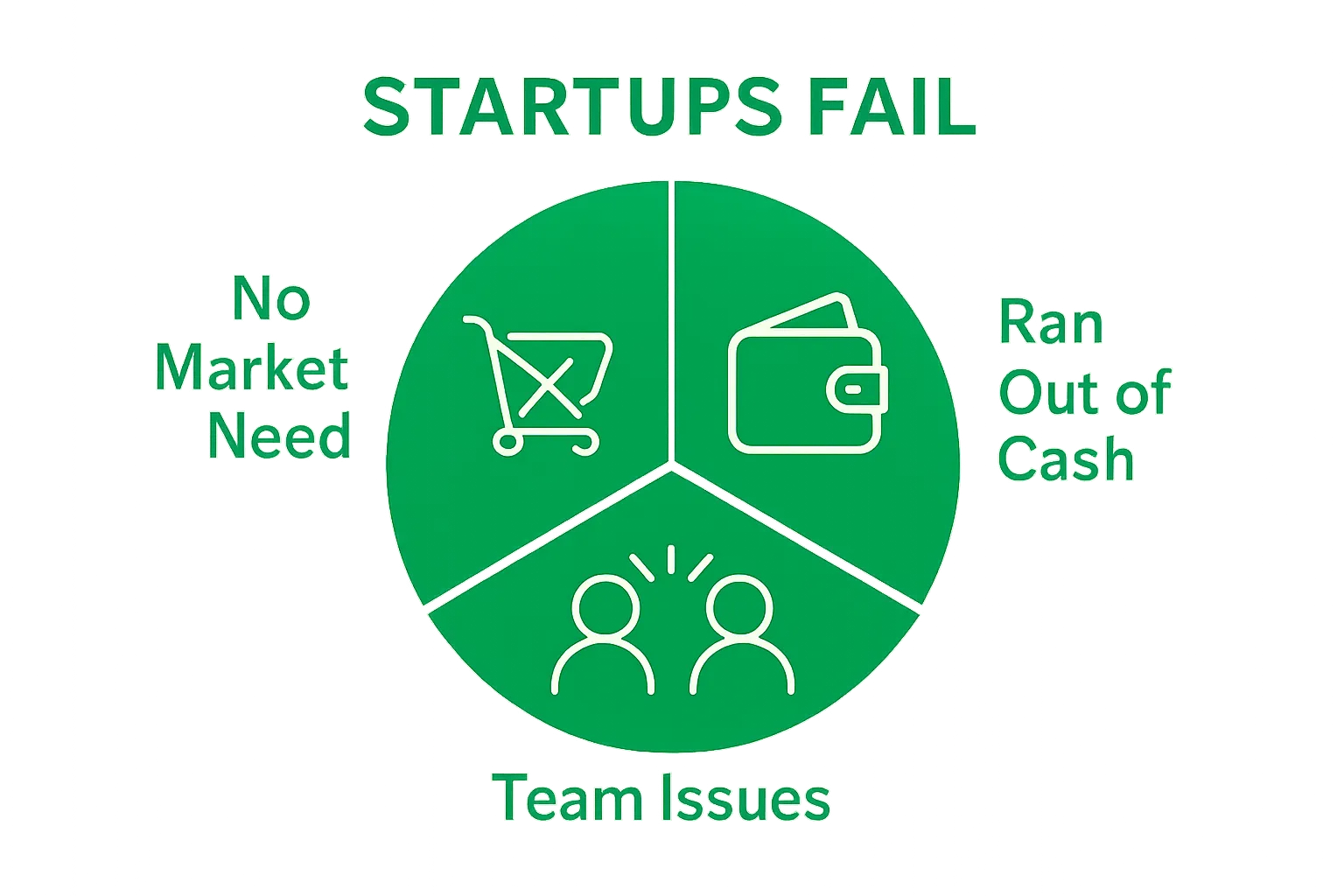
Financial and Market Alignment Challenges
Startups most frequently fail due to fundamental misalignments between their product and market needs. Key financial and market-related failure factors include:
- Insufficient market demand for the product
- Inadequate financial runway and cash management
- Poor pricing strategies
- Inability to compete effectively with existing solutions
- Premature scaling before achieving product market fit
Cash flow management emerges as a particularly critical factor. Many promising startups collapse not because their idea is fundamentally flawed, but because they run out of capital before establishing sustainable revenue streams.
Organizational and Strategic Breakdown
Beyond financial constraints, organizational dynamics play a significant role in startup failure. Internal challenges such as team dysfunction, leadership gaps, and misaligned strategic vision can rapidly erode a startup’s potential. Research from Harvard Business Review highlights that founder conflicts and inability to adapt to changing market conditions are recurring themes in startup postmortems.
For entrepreneurs looking to understand these complex dynamics more deeply, our comprehensive guide on business failure trends offers actionable insights into avoiding common startup pitfalls.
The Role of Market Fit: Understanding Demand
Product market fit research from Y Combinator reveals that understanding customer demand is more complex than simply creating a product people might want.
It requires deep, nuanced comprehension of market dynamics, customer pain points, and value proposition alignment.
Defining Market Fit Fundamentals
Market fit represents the critical intersection where a product’s capabilities precisely match genuine market needs. Successful startups recognize that market fit is not a static destination, but a dynamic, evolving relationship. This demands continuous adaptation and keen market observation.
Key characteristics of strong market fit include:
This table highlights the core components and defining characteristics of strong market fit, making it easy to compare and reference the essential elements for startups.
| Market Fit Component | Description |
|---|---|
| Consistent Customer Acquisition | Startups gain new users organically and regularly |
| High Retention Rates | Customers continue to use and recommend the product |
| Enthusiastic User Feedback | Positive reviews and active referrals signal satisfaction |
| Clear Differentiation | Product stands out from existing competition |
| Scalable Demand Generation | The market supports sustainable and growing sales |
- Consistent and organic customer acquisition
- High customer retention rates
- Enthusiastic user feedback and referrals
- Clear differentiation from existing solutions
- Scalable demand generation
Strategies for Validating Market Demand
Entrepreneurs must move beyond assumptions and implement rigorous validation strategies. This involves systematic market research, customer interviews, prototype testing, and iterative product development. The goal is not perfection, but progressive understanding of customer needs.
For founders seeking deeper insights into navigating market complexities, our comprehensive guide on founder market fit provides actionable frameworks for assessing and improving product market alignment.
Financial Mismanagement: Causes and Consequences
Financial research from Harvard Business Review demonstrates that financial mismanagement is not merely about insufficient funds, but about systematic strategic errors in resource allocation, budgeting, and financial planning. Understanding these nuanced challenges is crucial for startup survival.
Structural Financial Vulnerabilities
Financial mismanagement typically manifests through several critical pathways that undermine a startup’s fiscal health. Founders often conflate spending with growth, creating dangerous financial illusions that can rapidly deplete limited resources.
Key financial mismanagement indicators include:
- Uncontrolled operational expenditures
- Ineffective cash flow forecasting
- Premature scaling of team and infrastructure
- Neglecting financial contingency planning
- Misalignment between revenue potential and investment
Consequences of Financial Miscalculation
The repercussions of financial mismanagement extend far beyond immediate monetary losses. Startups experiencing chronic financial misalignment risk losing investor confidence, compromising strategic flexibility, and ultimately facing complete operational shutdown. **Sustainable financial management requires disciplined, strategic thinking and continuous fiscal reassessment.
 **
**
For entrepreneurs seeking comprehensive strategies to navigate financial challenges, our in-depth guide on business failure trends offers actionable insights into avoiding common financial pitfalls.
The Importance of Adaptability in Business Success
Research from MIT Sloan Management Review reveals that business adaptability is not merely a strategic advantage but a fundamental survival mechanism in today’s rapidly evolving marketplace. Successful startups recognize that rigidity leads to obsolescence, while flexibility enables continuous innovation and resilience.
Understanding Adaptive Capacity
Adaptability represents a startup’s ability to rapidly sense, interpret, and respond to emerging market changes. Adaptive organizations treat uncertainty as an opportunity, not a threat. This mindset transforms potential disruptions into strategic pivots and innovative solutions.
Core components of organizational adaptability include:
- Rapid decision making processes
- Continuous learning and skill development
- Flexible organizational structures
- Open communication channels
- Willingness to experiment and embrace calculated risks
Strategies for Developing Business Resilience
Building adaptability requires deliberate, systematic approaches. Successful entrepreneurs cultivate organizational cultures that encourage experimentation, tolerate failure, and prioritize learning. Adaptability is less about predicting the future and more about creating systems capable of responding effectively to unpredictability.
For founders seeking to enhance their business’s adaptive capabilities, our comprehensive guide on business resilience strategies provides practical frameworks for navigating complex entrepreneurial landscapes.
Ready to Break the Cycle of Startup Failure?
If you have ever felt overwhelmed by the fear of mismanaging funds, missing true market fit, or simply not knowing how to adapt fast enough, you are not alone. The article “Understanding Why Startups Fail: Key Insights Explained” reveals that founders often struggle with building sustainable revenue, identifying customer needs, and developing real business resilience. Managing these challenges can feel isolating and stressful, especially when every decision impacts your future.
What if you could turn confusion into clarity and worry into strategic progress? With siift, you get access to an intuitive AI platform that acts like your personal compass. Siift guides you step-by-step through the chaos of building a successful company, offering personalized feedback and actionable insights to avoid the common pitfalls discussed in the article. Take charge of your founder journey and start getting guidance tailored to your unique startup challenges. The sooner you begin, the sooner you can transform potential failure into proven success.
Frequently Asked Questions
What are the main reasons startups fail?
Startup failure often results from a combination of factors, including insufficient market demand, poor financial management, misaligned product offerings, and organizational breakdowns such as team dysfunction or leadership gaps.
How can startups ensure they achieve product-market fit?
Achieving product-market fit involves understanding customer needs, creating a product that meets those needs, and validating assumptions through systematic market research, customer interviews, and continuous adaptation based on feedback.
What role does financial management play in startup success?
Effective financial management is crucial for startups as it involves strategic resource allocation, budgeting, and cash flow forecasting. Poor financial oversight can lead to operational shutdowns even if the business idea has potential.
How important is adaptability for startups in a changing market?
Adaptability is essential for startups, allowing them to respond quickly to market changes and uncertainties. Building an adaptive organization encourages flexibility, fosters innovation, and helps navigate challenges effectively.