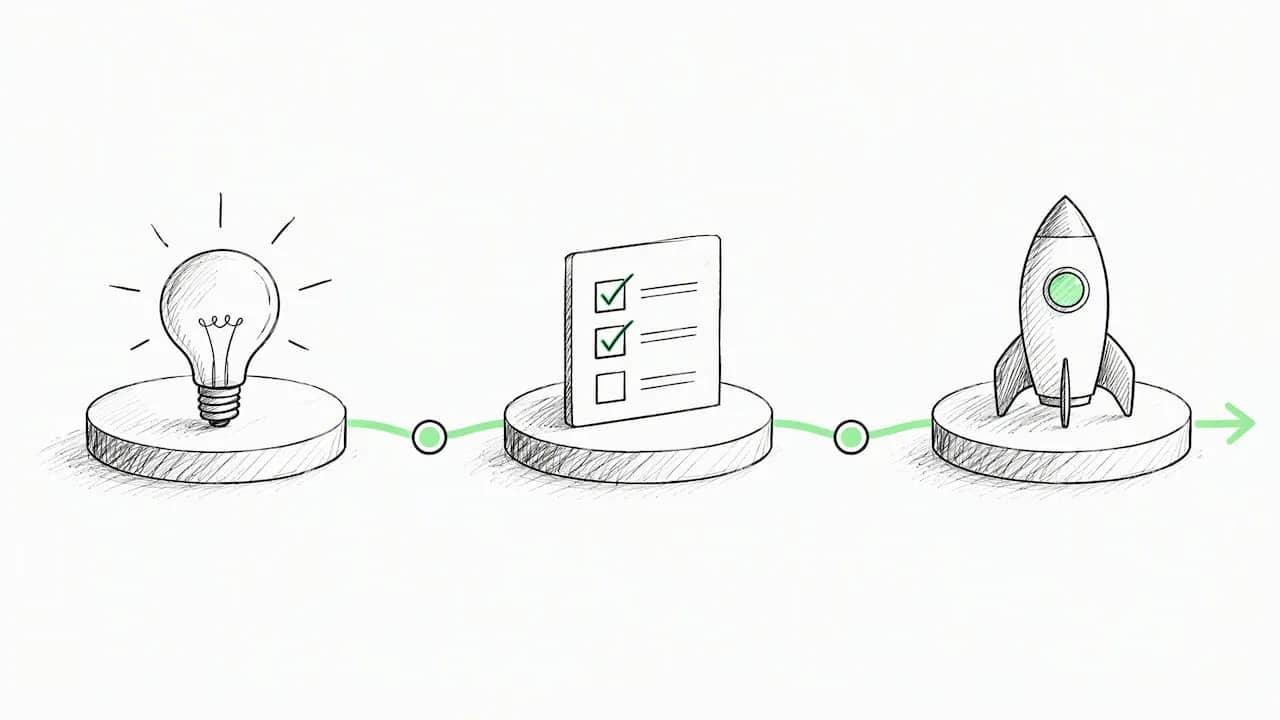

AI changes one thing for product managers above all else: it turns you from a synthesizer of scattered inputs into an orchestrator of decisions made faster and with more evidence. The single best next step is narrow and concrete: pick one measurable use case and run a 90 day prototype. With 78% of organizations now using AI somewhere in the business, frameworks like the NIST AI RMF and tools like siift built specifically for this kind of structured validation, there’s no excuse to keep guessing.
TL;DR:
- Narrow your AI experiments to one measurable use case and run a 90-day prototype to maximize learning and impact.
- Use generative AI for subjective tasks like drafting, while reserving predictive models for high-precision, high-volume decisions.
- Prioritize AI initiatives in discovery or post-launch phases to quickly see measurable improvements and avoid scattered pilots.
- Build workflows aligned with NIST governance standards, including risk tiers, data provenance, model limitations, and monitoring plans.
- Focus on skill sets like prompt writing and workflow design, with small cross-functional teams managing accountability without requiring dedicated ML engineers.
Table of Contents
- What AI actually means for your day-to-day decisions
- Where AI adds value across your product lifecycle
- Playbooks you can run this quarter
- Choosing tools and organizing your team around them
- A governance checklist built on the NIST framework
- Your first 90 days: a roadmap you can actually follow
- Why siift helps you navigate uncertainty and build around a new idea
- The product manager’s role is shifting, and that’s good news
- Try siift for structured idea validation and roadmapping
- Sources
- FAQ
What AI actually means for your day-to-day decisions
You don’t need a machine learning degree, but you do need a working vocabulary. Three categories cover most of what you’ll touch: generative AI (creates content, drafts, and summaries), predictive machine learning (forecasts outcomes from historical patterns), and agentic orchestration (chains multiple AI steps together to complete a multi-part task with less hand-holding).
Underneath all three sit the same building blocks:
- Data: what the model learns from or reasons over, and how clean it is.
- Model: the engine doing the prediction or generation.
- Compute: the processing power required to run it, now dramatically cheaper.
- Feedback loops: how the system improves or degrades based on what it sees.
- TEVV: testing, evaluation, validation, and verification, the discipline that keeps the other four honest.
The implication for you is simple: match the technique to the job. Use generative AI for messy, subjective work like drafting and synthesis. Reserve predictive models for high-volume, precision-dependent tasks where a wrong guess is expensive.
Where AI adds value across your product lifecycle
AI doesn’t help everywhere equally, and knowing where to point it saves you months of wasted pilots. Map it against the stages you already run:
- Discovery: AI synthesizes support tickets, interview transcripts, and reviews into themes in hours instead of weeks.
- Prototyping: generate working proofs of concept, mock UI, and synthetic data sets before writing production code.
- Delivery: automate the grunt work, release notes, test case generation, asset variants, and repetitive QA.
- Post-launch: monitor usage patterns, personalize experiences at the segment or individual level, and track outcomes against goals automatically.
Generative AI use inside organizations jumped from 33% in 2023 to 71% in 2024, which tells you adoption is no longer the bottleneck. Execution is. Most companies still report revenue lifts under 5% and cost savings under 10% from their AI investments, largely because they scattered pilots instead of picking one lifecycle stage and going deep. Start with discovery or post-launch personalization: they’re the fastest to show measurable movement.
Playbooks you can run this quarter
Forget the 40-slide AI strategy deck. Here are playbooks you can start this week, each following the same shape: goal, inputs, technique, steps, and the metric that tells you if it worked.
- Feedback synthesis to roadmap: Goal is turning scattered user feedback into three ranked roadmap bets. Inputs are support tickets, NPS comments, and sales call notes. Technique is generative summarization with clustering. Steps: feed the last 90 days of feedback into your tool, tag by theme, rank by frequency and revenue impact, present top three to leadership. Metric: time from raw feedback to prioritized backlog item, aim to cut it by half.
- AI-assisted prototyping: Goal is a clickable prototype in days, not sprints. Inputs are a one-page brief and reference screens. Technique is generative UI drafting. Steps: describe the flow, generate variants, test with five users, iterate. Metric: user comprehension rate in testing.
- Personalized onboarding pilot: Goal is lifting activation for a specific segment. Inputs are onboarding funnel data and segment definitions. Technique is predictive ML plus rules-based branching. Steps: identify the drop-off point, build two onboarding paths, A/B test, measure. Metric: activation rate lift.
- Agentic process automation: Goal is removing a recurring manual task, like weekly status reporting. Inputs are your existing data sources and report template. Technique is agent orchestration. Steps: define the task chain, connect data sources, run supervised for two weeks, then unsupervised. Metric: hours saved per week.
A worked example: a five-person product team ran the feedback synthesis playbook over three weeks, found their top complaint was buried in support tickets nobody read, and shipped a fix that cut related tickets by a third the following month.
Pro Tip: Run one playbook at a time. Parallel AI pilots create parallel governance headaches.
Choosing tools and organizing your team around them
Tool sprawl kills more AI initiatives than bad models do. Group your choices into four categories and pick one tool per category rather than five overlapping ones.
- Prototyping tools: for generating UI mockups, copy variants, and quick proofs of concept.
- Orchestration platforms: for chaining multi-step agent workflows without custom code.
- Feedback synthesis tools: for turning qualitative data into structured themes.
- Production infrastructure: for the APIs and pipelines that actually ship features, where enterprise integration patterns matter more than flash.
Workflow patterns matter as much as tool choice. Keep a human in the loop for any customer-facing decision. Use agent orchestration for internal, repeatable processes. Shift oversight right, meaning you monitor outputs continuously rather than only at launch, and treat your data as a product with its own owner and quality bar.
On staffing, you probably don’t need a dedicated machine learning engineer yet. You do need someone who can write and refine prompts reliably, someone accountable for TEVV, and at least one person comfortable designing agent workflows end to end. Smaller teams often combine these into one hybrid PM-plus-operator role, which works fine as long as accountability is clear.

A governance checklist built on the NIST framework
Governance sounds like a blocker until you realize it’s what keeps your AI feature from becoming a headline for the wrong reasons. The NIST AI Risk Management Framework’s Generative AI Profile gives you a practical starting checklist rather than an abstract policy document.
- Define risk tiers: not every AI feature carries the same stakes, so tier them and apply proportional scrutiny.
- Document data provenance: know where training or grounding data came from and who’s allowed to use it.
- Write down model limitations: specify what the system doesn’t know or can’t do reliably, and put that in your product spec.
- Plan TEVV before launch: testing and validation aren’t a post-mortem activity.
- Set up monitoring and an incident playbook: decide now who gets paged when the model produces something wrong.
NIST’s own guidance treats TEVV and documented knowledge limits as the backbone of trustworthy AI deployment, which means your acceptance criteria for any AI feature should include a line for “known limitations” before it ships.
Your first 90 days: a roadmap you can actually follow
You don’t need a year-long transformation program. You need three sprints of focused work.
- Weeks 1-2: Pick one narrow use case, define the success metric in advance, and assemble a small cross-functional squad, one PM, one engineer, one data or analytics person.
- Weeks 3-6: Build a working prototype, run TEVV-lite checks (does it fail gracefully, does it hallucinate on edge cases), and select a small pilot cohort.
- Weeks 7-12: Run the pilot with real users, instrument monitoring from day one, and evaluate against your original metric before deciding whether to scale.
Cost is less of a barrier than it used to be. Inference prices for GenAI models fell from roughly $20 per million tokens in late 2022 to about $0.07 by October 2024, a drop steep enough that experiments once reserved for well-funded teams are now within reach of a single squad’s budget.
Pro Tip: Set your success metric before you build anything. Retrofitting a metric to a finished pilot is how vanity projects get funded.
McKinsey’s research on agentic AI adoption backs this staged approach: organizations that treat AI as isolated pilots stall, while those that redesign workflows and form dedicated cross-functional squads move from experiment to industrialized delivery.

Why siift helps you navigate uncertainty and build around a new idea
Running the playbooks above manually works, but it’s slow and easy to bias. A New Business operating system can guide you through exactly this sequence, ideation, validation, and go-to-market, with structured prompts instead of a blank page. It maps your business context, flags blind spots you’d otherwise miss, and keeps your validation work organized instead of scattered across ten different documents. For a PM trying to prove out a new product direction inside your 90-day roadmap, that structure is the difference between a pilot that produces evidence and one that produces noise. You can fold such a platform directly into your weeks 1-6 work: use it to pressure-test the use case before you ever write a line of code, then carry that validated framing into your prototype.
The product manager’s role is shifting, and that’s good news
The PM job isn’t disappearing into AI, it’s moving up a level. You’re becoming less of a ticket router and more of a decision orchestrator, someone who decides which calls get automated, which stay human, and who’s accountable when a model gets it wrong. The practical advice is unglamorous: keep learning the tools, get fluent in governance basics, and get comfortable designing workflows where humans and agents both have clearly defined jobs. The PMs who treat this as a career upgrade, not a threat, are the ones who’ll be running the next decade of product teams.
— Samim Safaei
Try siift for structured idea validation and roadmapping
If you’re navigating the uncertainty of building something new, siift is the most practical place to start putting structure around it. Where generic AI tools give you a blank chat window, siift gives you a guided path through validation and go-to-market planning, built specifically for founders and product leaders figuring out if an idea has legs. Start with the Free plan to see the workflow, move to Discover at $29 per month per user once you’re validating a real concept, or go to Focus at $99 per month per user when you need the full go-to-market planning layer. Check the siift pricing page to pick the plan that matches where your project is right now.
Sources
- AI Index 2025 — Economy (Stanford HAI)
- Artificial Intelligence Risk Management Framework: Generative AI Profile (NIST)
FAQ
How can a product manager use AI in daily work?
A product manager can use AI to synthesize user feedback, generate prototypes faster, and automate repetitive reporting tasks. The most effective approach is picking one narrow use case, like feedback synthesis, and measuring the time saved before expanding to other stages of the lifecycle.
Which AI approach works best for product managers?
The right choice depends on the task: generative AI suits drafting, prototyping, and synthesis work, while predictive machine learning fits high-volume, precision-dependent forecasting. For structured idea validation and go-to-market planning specifically, a guided platform like siift is built for that exact workflow rather than general-purpose chat.
Can AI take over product management jobs?
AI is more likely to change what product managers do than to eliminate the role entirely. The job is shifting toward decision orchestration and governance oversight, where PMs decide what gets automated and stay accountable for outcomes.
Which jobs are least likely to be replaced by AI?
Roles requiring judgment under ambiguity, cross-functional coordination, and accountability for outcomes tend to be the most durable, which includes product management, since someone still has to decide what to build and why. Definitions of “safe” jobs vary by source, but the common thread is human judgment in unclear situations.
How much does it cost to start experimenting with AI as a PM?
Costs have dropped sharply: inference prices fell from around $20 per million tokens in 2022 to about $0.07 by late 2024. That makes a small 90-day pilot affordable for most product teams without a major budget request.