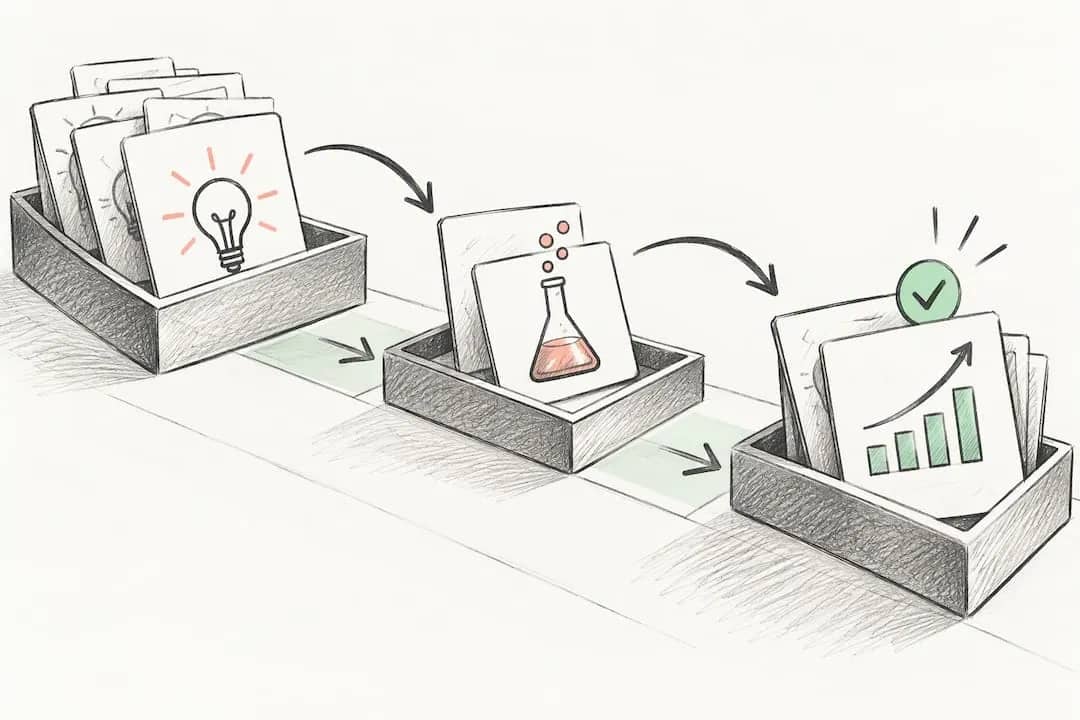

An innovator is a founder, product leader, or intrapreneur who treats a new venture like a lab experiment: form a falsifiable hypothesis, run a fast test, and let the results, not your gut, decide what happens next. This is not a personality trait, it is a method. And the method works better with AI doing the heavy lifting on research, documentation, and pattern spotting.
TL;DR:
- Testing with falsifiable hypotheses consistently outperforms intuition in increasing revenue and improving startup survival rates.
- AI tools accelerate hypothesis generation, test planning, evidence synthesis, and context tracking, enabling faster, more organized experimentation.
- A structured innovation pipeline that captures hypotheses, test results, and reasoning reduces chaos and improves decision-making.
- Building a testing-focused culture involves rewarding experiments, making small budgets accessible, and openly sharing failures to promote learning.
- Different types of innovation require varying validation rigor, with radical ideas needing the longest and most falsifiable hypotheses before scaling.
Table of Contents
- Who counts as an innovator, and what does the job actually require?
- Why the evidence favors testing over instinct
- The step-by-step roadmap: idea to dollars
- Getting your team (or your company) on board
- How AI changes the day-to-day work of testing
- Where experiments go wrong (and how to fix them fast)
- What separates innovators who ship from those who stall
- The four types of innovation you’re actually choosing between
- Why creativity alone won’t get you to a validated idea
- Building a culture where testing is normal, not radical
- What history’s clearest innovators actually did differently
- Keeping your pipeline from turning into chaos
- Treat your business like a lab, not a bet
- Where siift fits into this playbook
- Sources
- FAQ
Who counts as an innovator, and what does the job actually require?
You don’t need a garage, a hoodie, or a TED talk to qualify. An innovator is anyone whose job is to turn an unproven idea into something people will pay for, whether that’s a solo builder shipping a first product, a small team splitting the workload, or an intrapreneur pitching a new line inside a company that already has quarterly targets to hit.
The job to be done is the same across all three: reduce uncertainty faster than your runway (or your patience) runs out. What changes is the constraint.
- A solo founder juggles every role at once, so speed and low cost per test matter most.
- A small team can split ideation and validation but needs shared documentation so no one repeats a failed experiment.
- An intrapreneur has more resources but less freedom, and must sell each experiment internally before running it.
The scientific approach fits all three because it doesn’t care about your headcount. It just asks for a testable claim and a way to check it.
Why the evidence favors testing over instinct
Founders love their instincts. Instincts are also, statistically, not that reliable. A randomized experiment reported by Harvard Business Review found that firms trained to use the scientific method significantly outperformed a control group left to run on intuition.
The top quartile of scientific-method firms earned significantly more revenue than controls, with top performers pulling substantially ahead, according to Harvard Business Review’s study. That is not a rounding error. That is the difference between a business that survives its first hard winter and one that doesn’t.
A separate randomized control trial published in Management Science followed 116 startups and found that entrepreneurs taught to build falsifiable hypotheses made sharper decisions, pivoted at the right moments, and were less likely to quit early compared with intuition-led peers. Hypotheses, in other words, aren’t academic overhead. They’re a survival tool.
Then there’s Rapid Validity Testing, or RVT, a front-end innovation practice built on prototyping, early user integration, and honest commercial evaluation before you’ve spent real money. A study in the Journal of Product Innovation Management, drawing on 1,022 informants across 129 firms, found RVT meaningfully improves the odds of shipping on time, on budget, and at higher quality. The pattern across all this research points the same direction:
- Structured hypothesis testing beats intuition on revenue and survival.
- Early commercial checks catch feasibility problems before they get expensive.
- Testing works best as an organizational habit, not a one-time event.
The step-by-step roadmap: idea to dollars
Here’s the sequence that keeps showing up in the research, translated into something you can run this week.
- Frame the problem, not the solution. Write down who hurts, how badly, and how often. If you can’t name a specific person feeling a specific pain, you have a feature, not a business.
- Turn your idea into a falsifiable hypothesis. “Freelance designers will pay $15 a month for automated invoice chasing” can be proven wrong. “People need better tools” cannot.
- Pretotype before you prototype. Test the demand with a landing page, a concierge MVP, or a fake-door button before writing production code.
- Design the validation test with a stop and go line. Decide your primary metric and your decision threshold before you launch, not after you see the numbers.
- Run RVT-style checks in parallel. Combine a working prototype with real user feedback and an honest look at margins and unit economics, not just enthusiasm.
- Test go-to-market assumptions early. Try two channels and two price points before committing marketing budget to either.
- Scale only what the data supports. Reserve serious spend for the signal that survived contact with actual customers, not the one you liked best.
Pro Tip: Pick one metric per experiment tied to real behavior (purchases, sign-ups, repeat use), not vanity numbers like page views, and write your stop or go threshold down before you launch.
Sample size matters more than founders want to admit. A handful of enthusiastic friends is not evidence. Harvard Business School research found that companies adopting A/B testing as an ongoing capability, not a one-off trial, saw performance improve by 30 to 100% within a year. The gain came from organizational learning across many small tests, not from any single clever experiment.
Getting your team (or your company) on board
Great hypothesis, zero cooperation. It’s a common wall. Research on lean startup adoption, a longitudinal study of 152 NSF-supported teams, found that team composition, including the presence of MBAs used to traditional planning, can slow early adoption of experimental methods, even though the value tends to be recognized later.
Intrapreneurs face a sharper version of this problem: you’re asking an established system to tolerate uncertainty on purpose. Research on intrapreneurship inside institutions found that success depends on hybridizing existing processes with new ones and building internal allies before you need them, detailed further in our guide for intrapreneurs.
A few moves that lower the resistance:
- Run a split pilot. Test with a small, cross-functional subteam before asking for company-wide buy-in.
- Lead with commercial evidence, not vision. A chart showing real signups beats a slide deck every time.
- Frame experiments as low-risk pilots. Cap the budget and the timeline up front so stakeholders see a bounded bet, not an open-ended gamble.
- Document everything. Context and rationale saved today save someone else from repeating your failed test next quarter.
How AI changes the day-to-day work of testing
The scientific method hasn’t changed. What’s changed is how fast you can run it. AI-first tools now handle the grunt work that used to eat a founder’s week: drafting hypotheses from a rough idea, building a test plan, synthesizing competitor and market evidence, and tracking the context behind every decision so nothing gets lost between sprints.
- Hypothesis generation: turn a vague idea into several testable, falsifiable statements in minutes.
- Test-plan automation: get a structured experiment design instead of building one from scratch each time.
- Evidence synthesis: pull relevant market and competitor signals without a week of manual research.
- Context tracking: keep a running record of what you tested, why, and what happened, so the next decision builds on the last one instead of ignoring it.
This is exactly the workflow a modern AI-first, step-by-step business platform can be built around: guiding founders, product leads, and intrapreneurs through ideation, validation, and go-to-market with the kind of structure this article has been describing. You can read more in siift’s guide to validating a startup idea step by step.
Pro Tip: Save every experiment’s rationale, not just the result, so future you (or your teammate) doesn’t repeat a test that already had an answer.
Where experiments go wrong (and how to fix them fast)
Most failed experiments fail quietly, from bad design, not bad luck.
- Confirmatory bias: you unconsciously design the test to prove yourself right. Fix it by writing the “this would prove me wrong” condition before you launch.
- Vanity metrics: likes and pageviews feel good and mean little. Track behavior tied to money: purchases, retention, repeat use.
- Undersized tests: five friendly beta users is a focus group, not a validation. Widen your sample before trusting the result.
- Ambiguous stop or go lines: if you didn’t set a threshold beforehand, you’ll rationalize whatever number shows up. Set it first.
- Doubling down too early: one good week isn’t a trend. Confirm the signal holds before you commit serious budget.
For more test templates you can run this week, see 7 ways to test your startup idea.
What separates innovators who ship from those who stall
The best innovators share less charisma than you’d think and more discipline than you’d guess. They hold their own ideas loosely enough to kill them, but not so loosely that they abandon a good one after one rough week. That balance, conviction paired with a willingness to be proven wrong, is rarer than raw creativity.
They also tolerate ambiguity better than most people. Early-stage work rarely offers clean answers, and a founder who needs certainty before acting will freeze at exactly the moment speed matters most. Curiosity does real work here too: the innovators who keep learning treat every failed test as information, not as a verdict on their worth.
Resourcefulness matters more than resources. Constraints (of money, time, or headcount) force sharper hypotheses and cheaper tests, which is often a hidden advantage for solo builders over well-funded teams that can afford to skip the validation step. Finally, the strongest innovators are comfortable being the only person in the room who believes something, right up until the data either backs them up or doesn’t. Confidence without evidence is a gamble. Confidence built on a string of small validated tests is a strategy.
The four types of innovation you’re actually choosing between
Not every good idea is the same kind of idea, and knowing which type you’re building changes how you should test it.
Incremental innovation improves an existing product or process without changing its core, a faster checkout flow, a better onboarding email. These are the cheapest and fastest hypotheses to validate because the market already understands the category.
Disruptive innovation creates a simpler, cheaper, or more accessible alternative that starts at the edges of a market and moves upmarket over time. Testing here means finding the underserved segment first, not chasing the incumbents’ best customers.
Architectural innovation rearranges known components into a new configuration, think of a product that combines existing technologies in a way no one had bundled before. Validation focuses on whether the new combination actually removes friction, not on whether each piece works (they already do).
Radical innovation introduces something genuinely new to the world, with no existing market or established customer behavior to lean on. These need the longest validation runway and the most falsifiable hypotheses, because there’s no comparable product to benchmark against.
Most founders assume they’re building something radical when they’re actually building something incremental with better marketing. Being honest about which category you’re in tells you how much validation you actually need before you spend real money.

Why creativity alone won’t get you to a validated idea
Creativity generates options. It does not, by itself, tell you which option is worth building. The two need to work together: wide, loose ideation followed by narrow, disciplined testing.
Useful ideation techniques include reframing the problem from the customer’s point of view instead of your product’s, forced analogies (how would a completely different industry solve this?), and simply talking to ten potential customers before writing a single line of code. The goal of ideation isn’t to find the perfect idea. It’s to generate enough falsifiable candidates that testing has real options to choose between.
Where founders go wrong is treating a brainstorm as a decision. A room full of exciting ideas is not evidence any of them will work. The discipline comes after the creativity: turning your favorite three ideas into testable hypotheses and letting real behavior pick the winner.
Building a culture where testing is normal, not radical
Inside an organization, the biggest barrier to innovation is rarely a lack of ideas. It’s a culture where testing feels risky and failure feels career-limiting.
A few things reliably shift that culture:
- Reward the test, not just the win. Recognize teams for running a rigorous experiment even when the result is negative.
- Make small budgets easy to approve. If every test requires a committee, people stop proposing tests.
- Share failed experiments publicly. A well-documented failure that saves the next team six weeks is a win, and should be treated like one.
- Protect time for exploration. If every hour is booked against a roadmap item, no one has room to test something unproven.
None of this requires a foosball table or an “innovation lab” with a whiteboard wall. It requires leadership that treats a negative result as useful data instead of a wasted quarter.
What history’s clearest innovators actually did differently
The popular version of innovation history skips the boring part: relentless, structured testing. Consider the pattern behind some of the most cited examples.
Early e-commerce and software companies that scaled fastest weren’t guessing at what customers wanted, they were running constant, small experiments on pricing, layout, and messaging and keeping what worked. That habit, adopting A/B testing as a standing capability rather than an occasional event, is exactly the practice Harvard Business School’s research links to 30 to 100% performance gains within a year.
The common thread across well-known product turnarounds isn’t a single genius insight. It’s a willingness to test a specific, falsifiable claim, kill it fast when the data disagreed, and try the next one. The innovators remembered as visionaries were usually just the ones who tested faster and more honestly than their competitors, and were willing to be wrong in public along the way.
Keeping your pipeline from turning into chaos
One good idea is manageable. Ten ideas, three in validation, and a go-to-market plan for the winner, without a system, that’s chaos. An innovation pipeline needs a place to hold every hypothesis, its test design, its result, and the reasoning behind the next move.
The frameworks that tend to work share three traits: they force a falsifiable hypothesis before a test starts, they capture the result and the context (not just a pass or fail), and they make it easy to compare ideas at the same stage against each other. Spreadsheets can technically do this. They just don’t do it well once you have more than a handful of live experiments, because context gets lost in tabs and comments.
This is the gap agentic AI platforms are built to close: holding the hypothesis, the test plan, the evidence, and the decision rationale together in one place, so nothing depends on someone’s memory of a Slack thread from six weeks ago. For a fuller operational view of running this system end to end, see siift’s guide to data-driven entrepreneurship.
Treat your business like a lab, not a bet
Run one experiment this week. Not a perfect one, just a real one, with a hypothesis you’d be embarrassed to have been wrong about. I’ve watched founders spend months polishing an idea that a $50 landing page test would have killed in three days. Be the founder who runs the test.
— Samim Safaei
Where siift fits into this playbook
siift’s New Business OS turns this framework into a guided workflow: ideation, validation, and go-to-market planning inside one AI-first platform built for exactly the founders and intrapreneurs this article is written for. Check siift’s pricing or try the startup idea validation tool to run your first hypothesis test this week.
Sources
The research behind this framework includes the Harvard Business Review study on scientific-method firms, Harvard Business School’s A/B testing findings, the Management Science RCT on entrepreneurial hypothesis testing, and the JPIM study on Rapid Validity Testing. For tactical A/B testing techniques, see Amigo Labz’s conversion optimization guide.
- Harvard Business School: A/B testing and performance improvements
- Rapid validity testing at the front end of innovation (JPIM)
- A scientific approach to entrepreneurial decision making (Management Science / APA)
FAQ
What is the difference between an innovator and an entrepreneur?
An entrepreneur specifically starts and runs a business, while an innovator is anyone, founder, intrapreneur, or product leader, who develops and validates new ideas through structured testing. Every entrepreneur can act as an innovator, but the term also covers people building new ventures inside existing organizations.
How long does startup idea validation usually take?
Validation timelines vary by idea complexity, but lightweight tests like landing pages or concierge MVPs can produce a signal within one to two weeks. Full validation, including go-to-market checks, often takes several weeks to a few months depending on how many hypotheses need testing.
What is Rapid Validity Testing (RVT)?
Rapid Validity Testing is a front-end innovation practice combining prototyping, early user integration, and honest commercial evaluation before major resources are committed. A multi-company study in the Journal of Product Innovation Management found RVT improves the odds of on-time, on-budget, higher-quality innovation outcomes.
How does siift help with idea validation?
siift’s New Business OS guides founders and intrapreneurs step by step through ideation, validation, and go-to-market planning using an agentic AI workflow. Plans include a Free tier and paid options like Discover at $29 per month per user and Focus at $99 per month per user.
What causes most startup experiments to fail?
Most experiments fail from bad design rather than bad luck, confirmatory bias, undersized samples, or vanity metrics that don’t reflect real customer behavior. Setting a clear falsifiable hypothesis and a stop or go threshold before launching a test meaningfully reduces these risks.