

An intrapreneur is an employee who builds new products, business lines, or processes inside an existing company, using its resources instead of raising their own capital. That single trade, company backing for company politics, is the whole story. If you’ve got an idea worth building but no appetite for the entrepreneur’s existential risk, intrapreneurship might be the smartest career move you haven’t tried yet.
TL;DR:
- Intrapreneurs typically build inside existing company resources for reduced risk but must give up full ownership and control over their projects.
- Success depends heavily on relational traits like networking, persuasion, and proactive initiative, which are often trainable skills.
- Starting small and demonstrating measurable results quickly is crucial for gaining support and avoiding organizational barriers.
- Companies with risk-averse cultures may require structured processes and safe testing environments to support intrapreneurship effectively.
- Scaling an intrapreneurial venture requires documenting processes, securing ongoing sponsor support, and expanding gradually to avoid overextension.
Table of Contents
- What Is an Intrapreneur, and How Does It Actually Work?
- Intrapreneur vs Entrepreneur: What Actually Changes
- The Traits That Separate Intrapreneurs Who Ship From Those Who Don’t
- Real Intrapreneurship Examples Worth Studying
- Who Actually Benefits, and When It Doesn’t Pay Off
- How to Be an Intrapreneur: A Playbook You Can Start This Quarter
- The Corporate Immune System, and How to Get Past It
- What the Research and the Business Schools Actually Say
- Common Intrapreneurial Roles and Titles You’ll Find on Org Charts
- How to Measure Whether an Internal Venture Is Actually Working
- Tools and Methodologies Intrapreneurs Actually Use
- Why Company Culture Decides Whether Intrapreneurship Even Has a Chance
- How to Scale an Internal Venture Once the Pilot Works
- What Failed Internal Ventures Have in Common
- Why Intrapreneurship Is One of the Smartest Career Bets Right Now
- A Faster Way to Validate the Idea Before You Pitch It
- Sources
- FAQ
What Is an Intrapreneur, and How Does It Actually Work?
The word combines “intra” (internal) and “entrepreneur,” and it describes exactly what it sounds like: someone who acts like a founder while staying on payroll. The concept has been around since consultants started using it in the 1980s to explain why big companies kept losing their best innovators to startups, but the mechanics haven’t changed much since.
Intrapreneurs borrow what a founder has to build from scratch: an existing customer base, brand trust, distribution channels, and often a direct budget line. That access dramatically cuts the existential risk of building something new, according to Investopedia’s breakdown of the role. But the arrangement isn’t free. In exchange, an intrapreneur usually gives up:
- Full ownership or equity upside in whatever they build
- Complete control over hiring, budget, and direction
- The freedom to pivot without approval from a boss, committee, or steering group
How much room you actually get depends heavily on the industry. A software company might let a product manager spin up a new feature in weeks. A regulated utility or heavy manufacturer faces structural constraints, capital intensity and long approval cycles, that make rapid internal venturing far harder, as MIT Sloan points out.
Intrapreneur vs Entrepreneur: What Actually Changes
Both roles chase the same instinct: seeing a gap and building something to fill it. But the day-to-day reality diverges fast once you look at where the resources and the risk actually sit.
- Risk exposure. An entrepreneur risks personal savings, credit, and sometimes their house. An intrapreneur risks a performance review and maybe a bruised reputation if the pilot flops.
- Where the hustle goes. Entrepreneurs spend their energy chasing investors and capital. Intrapreneurs spend it navigating internal politics, building alliances, and pitching leadership, which Stanford GSB research argues is often the more decisive skill of the two.
- The ceiling on control. Founders answer to no one until they take on investors. Intrapreneurs answer to a boss, a budget owner, and sometimes a legal team, from day one.
Neither path is objectively better. One trades upside for safety. The other trades safety for upside.
The Traits That Separate Intrapreneurs Who Ship From Those Who Don’t
A review of 87 academic articles on corporate entrepreneurship pulled out 19 distinct characteristics tied to success, and the pattern is worth paying attention to. The traits cluster around three things: seeing what others miss, building support for it, and pushing it through despite friction, according to the Aalborg University literature review.
The highest-value traits from that list, translated into plain terms:
- Creative innovator — spots problems worth solving before anyone assigns you to solve them
- Proactive initiator — starts before getting full permission, then asks forgiveness with results in hand
- Organizational networker — knows who actually controls budget and influence, not just who’s on the org chart
- Persuasive influencer — can make a case that moves a skeptical VP, not just an enthusiastic peer
- Visionary — can describe the destination clearly enough that others want to help get there
Some of these are closer to fixed personality than skill. Networking and persuasion, though, are trainable, and they’re arguably the two most important on the list, since individual traits like self-efficacy and perseverance only translate into results when an organization’s structure and incentives let them, per the same Aalborg findings.
Pro Tip: Track who says yes to small favors before you ever need a big one. Your sponsor coalition should be built months before you need it, not the week you’re pitching a pilot.
Real Intrapreneurship Examples Worth Studying
The clearest intrapreneurship examples share a pattern: someone started small, inside an existing team, without asking for a new division.
- 3M’s Post-it Note. A researcher’s failed adhesive became a product only after internal champions kept sampling it to coworkers until demand was undeniable. Lesson: sometimes the pitch is letting people use the thing.
- Google’s 20% time projects. Formalized slack time gave employees room to prototype ideas that eventually became major products. Lesson: structured freedom beats ad hoc permission.
- Square’s internal banking tools. What began as an internal need for better cash flow tools for merchants grew into a standalone financial product line, an example Wharton highlights of starting small and scaling incrementally. Lesson: solve your own company’s problem first; the market version often follows.
None of these needed a new division on day one. They needed one person willing to keep pushing a small thing forward.
Who Actually Benefits, and When It Doesn’t Pay Off
The upside runs both directions. For you, it means visibility with leadership, a faster shot at promotion, and the kind of engagement that makes a job feel like more than a paycheck. For the company, it means new revenue lines, better retention of ambitious talent, and innovation that doesn’t require an acquisition.
- Individual payoff: internal reputation, promotion velocity, a resume line that reads very differently than “managed existing process”
- Organizational payoff: incremental revenue, reduced attrition of high performers, faster response to market shifts
It doesn’t always pay off. If your company has no real budget for pilots, no tolerance for failed experiments, or a culture where credit gets absorbed upward, the math on your time investment gets shaky fast. Read the room before you read the trait checklist.
How to Be an Intrapreneur: A Playbook You Can Start This Quarter
Here’s the sequence that separates people who talk about ideas from people who ship them.
- Validate the problem before the solution. Talk to five actual customers or internal users. Confirm the pain is real before building anything.
- Map your stakeholders. Figure out who controls budget, who controls approval, and who just likes to be asked their opinion. Build your coalition in that order.
- Define a minimum viable pilot with a learning metric attached. Not “we’ll test it,” but “we’ll know within four weeks if X% of users complete Y action.” Vague pilots die vague deaths.
- Ask for something specific and time-boxed. “Ten hours a week for six weeks and $2,000 for tooling” gets approved far more often than “some support for this idea.”
- Protect your day job while you advance the idea. Keep your core metrics visible and on track. Nothing kills an internal pilot faster than the sponsor hearing you’re behind on the job they actually pay you for.
A common failure mode here is what practitioners call ideation paralysis, staying in the brainstorming phase because a tested, imperfect MVP feels riskier than an untested, perfect-sounding idea. The Stanford GSB research is blunt about this: the intrapreneurs who succeed are the ones who convert ideas into measurable experiments fast, then use those results to persuade sponsors to commit real resources. A framework like lean startup methodology is built almost entirely to solve this exact problem.
Pro Tip: Write your resource ask as a one-page brief with a single clear number attached to success. Executives fund clarity, not enthusiasm.
The Corporate Immune System, and How to Get Past It
Every established company has an immune system that attacks anything that looks like risk, and it’s not personal, it’s structural. Common barriers include budget cycles that don’t account for experiments, risk-averse middle management, and metrics that only reward maintaining what already exists.
Companies that actually get good at supporting intrapreneurs tend to build specific mechanisms rather than just encouraging “innovative thinking” in a town hall:
- A dedicated innovation fund with a lightweight approval process
- Sandbox pilots that run outside normal reporting lines, so failure doesn’t tank a quarterly review
- A clear, safe career path back to your original role if the pilot doesn’t scale
If your company doesn’t have these yet, pitching a sandbox structure is often more persuasive than pitching your specific idea. Leaders fund process before they fund one person’s pet project.
What the Research and the Business Schools Actually Say
The academic and practitioner picture on intrapreneurship is more consistent than you’d expect from three very different sources.
The 19-characteristic review from Aalborg University backs this up with data: the traits tied most closely to success are relational (networking, persuasion, alliance-building), not purely creative. Wharton’s practitioner analysis adds a second layer, most transformative internal innovations started as small, low-visibility bets rather than big splashy launches. And MIT Sloan’s caveat matters for anyone in a capital-heavy or regulated industry: the same tactics that work at a software company can stall completely in sectors where product cycles run in years, not weeks.
Common Intrapreneurial Roles and Titles You’ll Find on Org Charts
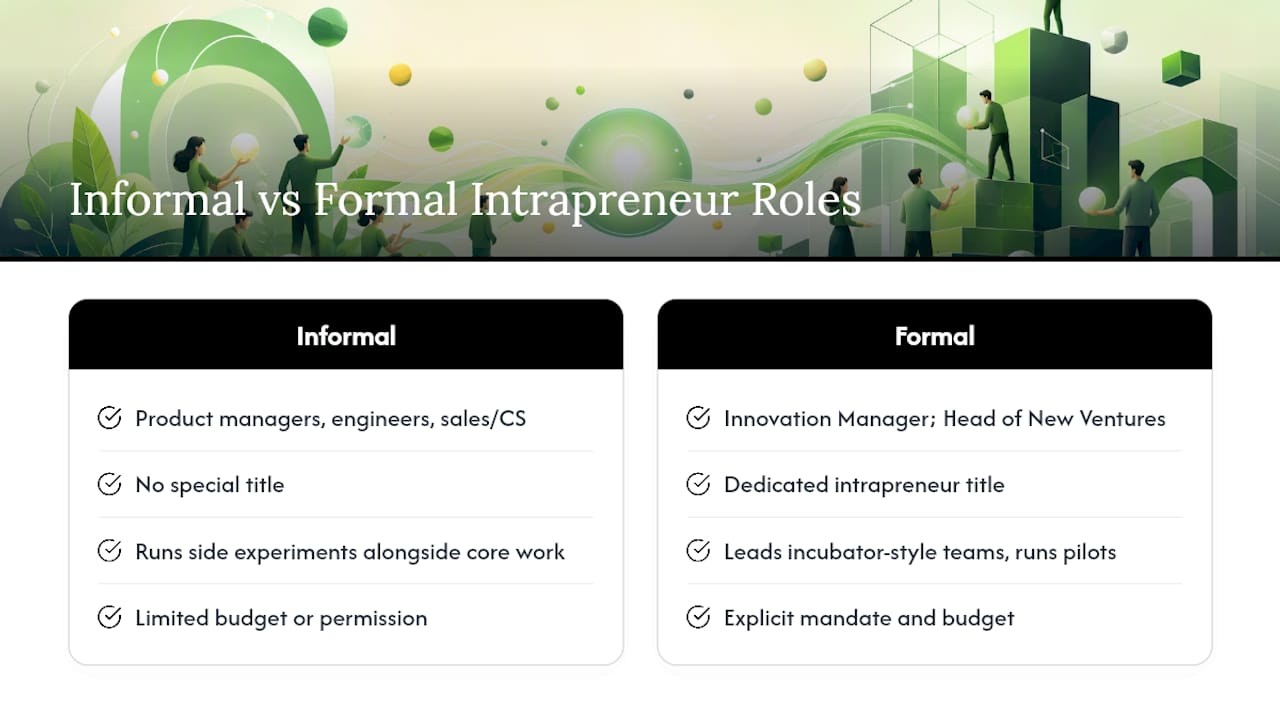
Intrapreneurship rarely comes with a job title that says “intrapreneur” on the business card. It shows up embedded inside other roles, or as a specific title created to formalize the function once a company takes it seriously.
At the informal end, you’ll find product managers who quietly run side experiments alongside their core roadmap, engineers who build internal tools nobody asked for but everybody starts using, and sales or customer success reps who spot a product gap and build the fix themselves before pitching it upward. These roles carry no special title, just a track record of shipping things outside the job description.
At the formal end, larger companies create titles specifically to house this work: Innovation Manager, Head of New Ventures, Director of Corporate Venturing, or Growth Product Lead running an incubator-style team. Some companies build an internal venture studio with its own P&L, staffed by people whose entire job is running pilots for the rest of the business. Google’s early 20% time policy essentially formalized intrapreneurship as a structural right rather than an exception, which is part of why it produced so many recognizable spinoff products.
The titles matter less than the mandate behind them. A “Senior Product Manager” with explicit permission and budget to run experiments outside the core roadmap is doing intrapreneurial work, regardless of what’s printed on the org chart. If you’re angling for a formal path, the smartest move is often proving the informal version works first, then asking for the title and budget to do it at scale. Companies rarely create a new role for an unproven idea. They create it to formalize something that’s already showing results.
How to Measure Whether an Internal Venture Is Actually Working
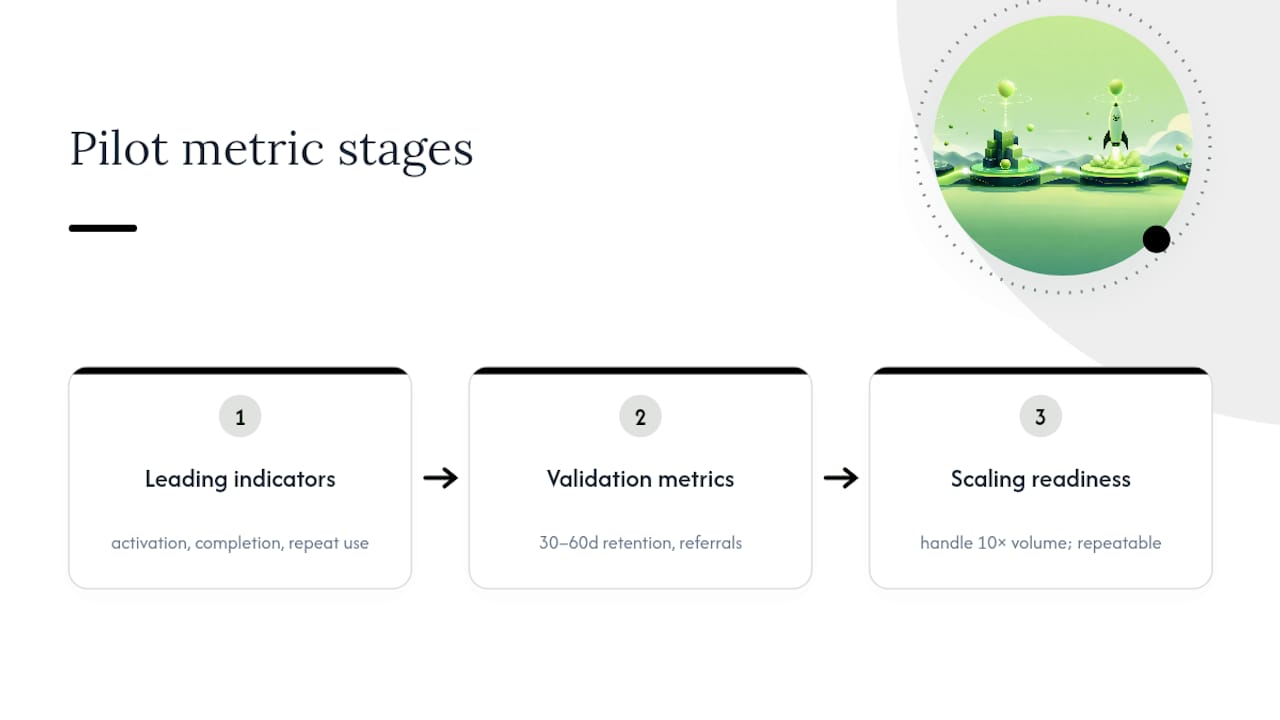
Vanity metrics kill internal pilots faster than bad ideas do. “People seem excited” is not a metric. What actually gets a pilot funded past its first round is a small set of numbers tied directly to the problem you set out to solve.
Start with leading indicators in the first few weeks: activation rate for a new feature, completion rate for a new workflow, or the percentage of target users who came back a second time without prompting. These tell you whether the thing works before you have enough data to know whether it’s profitable.
Move to validation metrics once the pilot has run long enough to matter: retention over 30 or 60 days, referral or word-of-mouth signals, and whether the unit economics look survivable at a small scale. This is the stage where most pilots either earn a second round of funding or quietly get shelved.
Finally, track scaling readiness metrics: can the process handle 10 times the current volume without 10 times the headcount? Does the pilot rely on one heroic team member, or does it run on a repeatable process? A pilot that only works because one person is personally holding it together isn’t ready to scale, no matter how good its early numbers look.
The mistake most intrapreneurs make is picking metrics that make the pilot look good to leadership rather than metrics that would tell them honestly if it’s working. Pick the metric that could kill your project. If you’re not willing to track that number, you’re not really testing the idea, you’re just hoping.
Tools and Methodologies Intrapreneurs Actually Use
You don’t need a new toolkit to think like an intrapreneur, you need the discipline to apply startup methodology inside a structure that wasn’t built for it.
Design thinking gets you from vague problem to testable prototype fast: define the problem, ideate broadly, build a rough prototype, and test it with real users before writing a business case nobody asked for. It’s especially useful early, before you have any data to argue with.
Lean startup methodology takes over once you have a rough concept. The build-measure-learn loop, ship something small, measure a real signal, learn and adjust, keeps you from over-investing in a direction before you know if it’s right. A structured approach to product iteration helps here, since internal pilots often die from too many features shipped too early rather than too few.
Stakeholder mapping isn’t a startup tool exactly, but it’s arguably the most important one for an intrapreneur specifically, since your biggest constraint usually isn’t market fit, it’s political permission. A practical guide to corporate strategy alignment can help you frame a pilot in language that matches leadership’s existing priorities, rather than inventing a new priority they have to be convinced to care about.
None of these tools work in isolation. Design thinking without lean validation produces beautiful prototypes nobody wants. Lean methodology without stakeholder mapping produces validated ideas that die in a budget meeting.
Why Company Culture Decides Whether Intrapreneurship Even Has a Chance
Two companies can have identical innovation funds and identical talent, and one will produce a stream of internal ventures while the other produces zero. The difference is almost always culture, not resources.
Cultures that actually support intrapreneurship share a few traits: failure is discussed openly rather than quietly punished in a performance review, credit for successful pilots flows to the team that ran it rather than getting absorbed by whoever sponsored it, and middle management is measured partly on enabling experiments, not just hitting quarterly numbers. Without that last piece specifically, middle managers have every incentive to say no to anything that risks their own metrics, and they will.
The flip side is just as instructive. In cultures where failure gets punished harshly, intrapreneurs learn fast to stop proposing anything risky, and the company quietly loses its most ambitious people to startups or competitors instead. That’s often the real cost of a risk-averse culture, not one failed pilot, but a slow drain of exactly the people who’d have built the next one.
If your company’s culture doesn’t currently support this kind of work, that’s useful information, not a dead end. It means your first pilot should be small enough to survive under the radar, and your first ask should be for permission rather than resources. Culture shifts slowly. Proof shifts it faster than argument does.
How to Scale an Internal Venture Once the Pilot Works
Getting a pilot to work is the easy part compared to scaling it without breaking the thing that made it work in the first place.
The first mistake most teams make is scaling headcount before scaling process. Adding five people to a system that one person was holding together with instinct and memory just multiplies the confusion. Document the process first, then add people to a documented system, not an improvised one.
The second is losing the original sponsor relationship. The executive who backed your pilot when it was small and cheap may not automatically back it when it needs a real budget line and a headcount request. Re-pitch scaling as its own decision, with its own numbers, rather than assuming early goodwill carries forward automatically.
The third is trying to scale everywhere at once. The pattern that actually works, echoed in Wharton’s analysis of internal ventures, is picking one adjacent market or team, proving the model transfers, and only then expanding further. Trying to roll a pilot out company-wide in one move is how a working idea turns into an underfunded mess spread too thin to succeed anywhere.
What Failed Internal Ventures Have in Common
Failed intrapreneurial projects rarely fail because the idea was bad. They fail for a small set of repeatable reasons worth knowing before you start.
The sponsor left, and the project had no second champion. A pilot tied to one executive’s personal interest often dies the moment that executive changes roles or leaves. Projects that survive have at least two people with influence who believe in them.
The metrics were vague from day one. Pilots that launch with “let’s see how it goes” instead of a specific learning target almost never get a clean verdict. They just quietly fade because nobody can prove they worked or definitively say they failed.
The team tried to build everything instead of borrowing what existed. Ventures that ignore the company’s existing distribution, brand, or customer base and try to build from scratch lose the very advantage that made intrapreneurship worth doing over just quitting and starting a company.
The idea outgrew its permission. Some pilots succeed too well, too fast, and outrun the informal goodwill that was funding them, triggering scrutiny before there was a real business case built to withstand it. The lesson isn’t to think smaller. It’s to build the case for scale before you need it, not after someone in finance asks an uncomfortable question in a budget meeting.
Why Intrapreneurship Is One of the Smartest Career Bets Right Now
Intrapreneurship gives you founder-level experience with a fraction of the downside, and that combination is rare enough to be worth pursuing deliberately, not just stumbling into. The traits that make it work, networking, persuasion, framing a clean experiment, transfer directly to any leadership track you’re aiming for, inside this company or the next one. If you’re weighing whether to build something new inside your current job, start smaller than feels comfortable and prove the model before asking for the budget.
— Samim Safaei
A Faster Way to Validate the Idea Before You Pitch It
Everything above works. It also takes real time to map stakeholders by hand, build a coherent MVP framework, and turn a hunch into a business case leadership will actually fund. That’s the exact gap siift’s New Business OS is built to close. Instead of assembling your validation plan, market research, and go-to-market map from scratch across a dozen documents, siift walks you through the process step by step, turning “I think this could work” into a structured pitch backed by real validation.
It suits intrapreneurs specifically well, since you need a repeatable process you can defend to a skeptical VP, not just a personal conviction. If you’re sitting on an idea worth testing, start validating your idea with siift and see what a funded pilot actually requires before you walk into that meeting.
Sources
- New insights on innovative individuals: uncovering the characteristics of corporate entrepreneurs (Aalborg University)
- How ‘Corporate Explorers’ Are Disrupting Big Companies From the Inside — Stanford GSB
- Launch Without Leaving: The Case for Intrapreneurship — Wharton
- Intrapreneurship, explained — MIT Sloan
FAQ
What is an intrapreneur vs entrepreneur?
An intrapreneur builds new ventures using an existing company’s resources and budget, while an entrepreneur builds independently and carries the full financial risk of the venture themselves.
What is the definition of an intrapreneur?
An intrapreneur is an employee who acts like a founder inside their own organization, using company resources to develop new products, services, or business lines without leaving to start their own company.
Who is an example of an intrapreneur?
The engineer behind 3M’s Post-it Note is a classic case, along with employees at Google and Square who built internal tools that became standalone products.
What is the difference between an entrepreneur and entrepreneurship?
An entrepreneur is the person who starts and runs a venture, while entrepreneurship is the broader activity, mindset, and process of building and scaling that venture, whether inside a startup or, in the case of intrapreneurship, inside an existing company.