

TL;DR:
AI marketing tools automate campaign creation, content, and analytics, reducing costs for early-stage startups. They improve speed, decision-making, and campaign performance while saving up to $290,000 annually compared to hiring a full team. Founders should start lean, prioritize integration, and control ad spend manually to maximize growth and efficiency.
The best AI tools for startup marketing automate campaign creation, content generation, and analytics, replacing the workload of a full marketing team at a fraction of the cost. A well-chosen AI marketing stack can save founders $190,000 to $290,000 annually compared to hiring traditional roles like a strategist, copywriter, and designer. For early-stage founders operating lean, that is not a nice-to-have. That is the difference between runway and running out.
What are the best AI tools for startup marketing?
The best AI tools for startup marketing fall into three core functions: campaign creation, customer communication, and performance analytics. Together, these categories cover the full marketing workflow a startup needs to generate awareness, convert leads, and measure results. The good news is that you do not need a six-figure budget to access them.
AI marketing tools work by automating the repeatable, time-consuming tasks that eat a founder’s week. Here is how that plays out in practice:
Campaign research and customer profiling. AI tools analyze audience data to identify customer segments, surface buying signals, and generate positioning angles. What used to take a strategist two weeks now takes hours.
Content generation. AI content creation tools produce ad copy, blog posts, email sequences, and social captions at scale. A founder can brief a tool in the morning and publish by afternoon.
Creative assembly. AI design tools generate on-brand visuals, ad creatives, and landing page layouts without a dedicated designer.
Performance reporting. AI analytics platforms flag underperforming campaigns, surface growth opportunities, and recommend budget shifts in real time.
The combined effect is a lean marketing operation that punches well above its weight. One founder with the right stack can genuinely out-execute a three-person team at a legacy competitor.
Pro Tip: Keep your AI tools connected to a single source of truth for customer data. When over 80% of your marketing data lives inside the same ecosystem, AI agents perform significantly better because they are working with complete context, not fragments.

One critical boundary to set from day one: never hand ad spend control to an AI tool. Manual ad budget control prevents accidental overspending and algorithm errors that can drain your account overnight. Let AI inform your decisions. You make the final call on where the money goes.
What categories of AI tools do startups actually need?
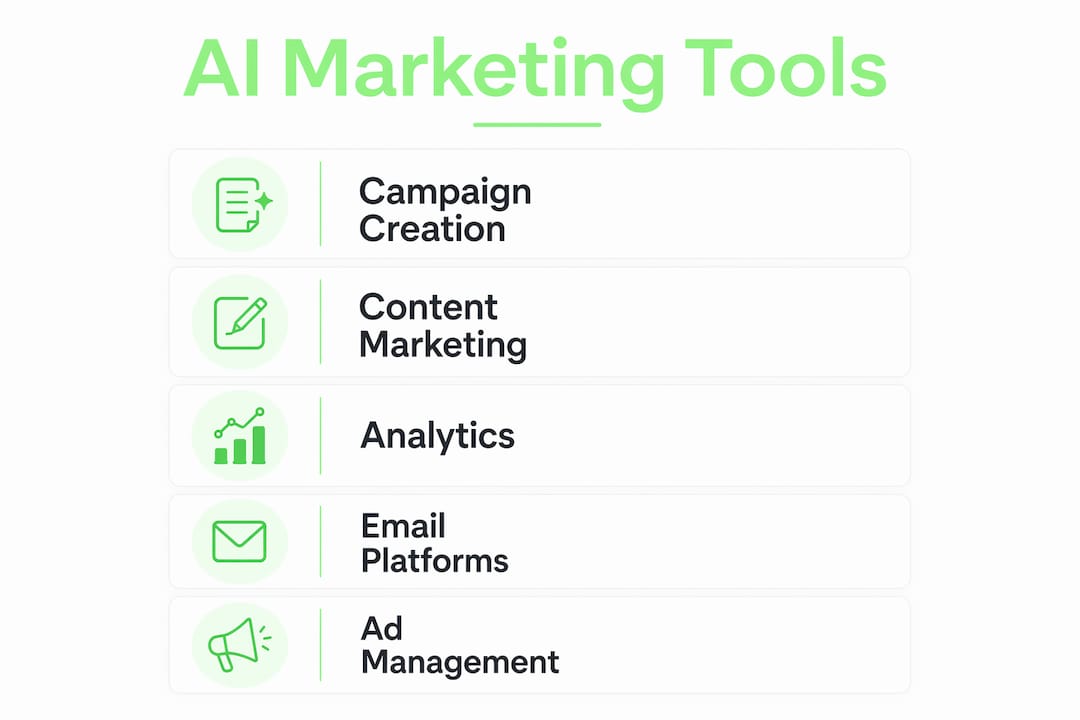
Not every AI tool deserves a slot in your stack. The categories below represent the core functions a startup marketing operation needs to run without a full team.
Campaign creation and automation tools. These platforms generate ad copy, build audience segments, and schedule campaigns across channels. They replace the day-to-day work of a paid media specialist and a copywriter.
Email marketing and sequence platforms. AI-powered email tools write sequences, personalize subject lines, and trigger sends based on user behavior. They are the highest-ROI channel for most early-stage startups.
Analytics and reporting platforms. The next generation of analytics does not just report numbers. AI-driven analytics platforms actively flag opportunities and surface decisions, rather than leaving founders to interpret raw data alone.
AI content creation tools. These cover blog posts, social content, video scripts, and product descriptions. They are the backbone of any content marketing effort that needs to produce volume without a full editorial team.
Generalist AI assistants. Using a generalist AI assistant alongside a specialist tool is standard practice for founders in 2026. The generalist handles research, drafting, and ideation. The specialist executes the specific workflow.
Here is how these categories map to startup marketing outcomes:
Tool Category | Primary Function | Startup Benefit |
|---|---|---|
Campaign creation | Ad copy, targeting, scheduling | Replaces paid media specialist |
Email automation | Sequences, personalization, triggers | Highest ROI channel for early-stage |
AI analytics | Insight generation, opportunity flagging | Faster, smarter decisions |
Content creation | Blog, social, video, product copy | Volume without a full editorial team |
Generalist AI assistant | Research, drafting, ideation | Multiplies founder productivity daily |
The AI content marketing category in particular has matured rapidly. Platforms now handle full content calendars, SEO briefs, and distribution workflows that previously required a content manager and an SEO specialist working in tandem.
How should founders choose AI marketing tools by stage?
The most common mistake founders make is overbuilding their marketing stack before they have validated their go-to-market. Most startups that fail do so by adding tools too early. The right approach is to start with a CRM, an AI co-pilot, and an analytics platform, then add only when an existing tool genuinely cannot meet a new need.
Here is a practical framework for choosing tools at each stage:
Pre-revenue. Use free tiers and trials exclusively. 19 of 28 essential startup tools offer free tiers, so there is no reason to pay before you have paying customers.
Early traction. Add a paid email automation platform and an AI content tool. These two categories have the clearest ROI at this stage.
Growth phase. Introduce campaign automation and a dedicated analytics platform. By this point, you have enough data for AI to work with meaningfully.
Choosing between tool types also depends on your specific bottleneck. Copy-focused AI agents suit founders constrained by content velocity. Orchestration platforms suit founders whose bottleneck is workflow coordination across channels. Diagnosing the constraint before buying the tool saves both money and time.
Pro Tip: Before adding any new tool, ask: does this integrate with what I already use? Prioritizing integration over price prevents data silos that quietly kill marketing performance. A cheaper tool that does not talk to your CRM costs more in the long run.
The integration question matters more than most founders realize. When your email platform, analytics tool, and CRM share data natively, AI can act on the full picture. When they do not, you spend more time exporting spreadsheets than making decisions. That is the opposite of why you bought the tools in the first place.
What cost savings can startups expect from AI marketing tools?
The financial case for AI marketing tools is direct. Early-stage startups can build a full marketing stack for under $50 per month using AI campaign tools, email platforms, and free analytics like Google Analytics 4. That is a monthly cost lower than most software subscriptions founders already carry.
The salary savings are where the numbers get genuinely striking. A full-pipeline AI marketing tool can replace the workload of a three-person team, saving $190,000 to $290,000 per year. That range reflects the combined cost of a marketing strategist, a copywriter, and a designer in most major markets. For a seed-stage startup, redirecting that budget toward product development or customer acquisition changes the entire growth trajectory.
The operational benefits compound over time:
Free tiers let founders validate tool fit before committing budget.
AI tools accelerate campaign iteration cycles from weeks to days.
Automated reporting frees founder time for higher-leverage decisions.
AI-driven insights replace the need for a dedicated data analyst in the early stages.
The real unlock is speed. A founder using AI marketing tools can test three campaign angles in the time it used to take to brief a single creative. That velocity compounds. More tests mean more learning. More learning means faster product-market fit. And faster product-market fit is the only metric that truly matters at the early stage.
For founders who want to go deeper on which specific tools earn their place in a lean stack, the top AI tools for startup marketing breakdown covers the 2026 picks with budget context.
Key Takeaways
The best AI tools for startup marketing replace the workload of a full marketing team for under $50 per month, saving founders up to $290,000 annually while accelerating campaign velocity and decision speed.
Point | Details |
|---|---|
Start with a lean stack | Use free tiers first; add paid tools only when existing ones fail your needs. |
Match tools to bottlenecks | Choose content AI for copy constraints; choose orchestration platforms for workflow gaps. |
Prioritize integration | Tools that share data natively outperform cheaper, siloed alternatives every time. |
Keep ad spend manual | Never let AI control your ad budget directly; manual oversight prevents costly errors. |
AI analytics must drive decisions | Platforms that only report data are obsolete; choose tools that flag opportunities actively. |
The uncomfortable truth about AI marketing tools
I have watched founders spend weeks evaluating tools they never needed and months recovering from stacks they built too fast. The pattern is almost always the same. A founder gets excited about what AI can do, signs up for five platforms in a single afternoon, and then spends the next month trying to make them talk to each other instead of actually marketing their product.
The honest advice is boring but it works: pick one tool per function, use the free tier until it breaks, then upgrade. The founders I have seen get the most out of AI marketing tools are not the ones with the most sophisticated stacks. They are the ones who picked the right two or three tools early and got genuinely good at using them.
The analytics piece is where I see the biggest gap between expectation and reality. Founders assume that adding an analytics platform means they will suddenly understand their data. But a tool that just reports numbers does not make you a better decision-maker. You need a platform that tells you what the numbers mean and what to do next. That distinction separates tools worth paying for from ones that just add noise.
One more thing: the strategic marketing planning layer matters as much as the tools themselves. AI can execute brilliantly on a bad strategy. Getting the strategy right first, then letting AI accelerate it, is the sequence that actually produces growth. Tools are multipliers. They amplify whatever direction you are already moving in.
— Samim
How Siift fits into your AI marketing stack
Siift is built for founders who want more than a collection of disconnected tools. As an agentic AI platform, Siift guides you through ideation, validation, and go-to-market in a structured, step-by-step process, so your marketing efforts are grounded in a validated strategy rather than guesswork. For founders who want to build a startup with AI from the ground up, Siift provides the strategic layer that makes every marketing tool in your stack work harder. When your positioning is clear and your go-to-market is validated, AI marketing tools stop being expensive experiments and start being genuine growth engines. That is the difference Siift makes.
FAQ
What are the best AI tools for startup marketing on a tight budget?
Early-stage startups can build a functional marketing stack for under $50 per month using AI campaign tools, email platforms, and free analytics. Many essential tools offer free tiers, so founders can validate fit before spending anything.
How do AI marketing tools save money compared to hiring a team?
A full-pipeline AI marketing tool can replace the workload of a three-person team, saving between $190,000 and $290,000 annually in salary costs. That covers the combined output of a strategist, copywriter, and designer.
Should founders let AI tools manage their ad spend?
No. Founders should always control ad budgets manually. Letting AI manage ad spend directly risks accidental overspending and algorithm errors that can drain accounts without warning.
How do I know which AI marketing tool to choose first?
Identify your biggest bottleneck first. If content volume is the constraint, start with an AI content creation tool. If workflow coordination is the problem, an orchestration platform addresses it more directly.
What makes an AI analytics platform worth paying for?
A platform worth paying for does not just report data. It actively surfaces opportunities, flags underperforming campaigns, and recommends next steps. Platforms that only display metrics without driving decisions are being replaced by tools that do both.