

Testing whether a digital product idea will actually sell often means cobbling together clunky spreadsheets, half-baked AI prompts, and generic templates that leave founders second-guessing their own hunches. Most idea validation tools either hide crucial workflows behind high subscription walls, lack rapid feedback cycles, or ignore privacy for the solo builder hustling to stand out. This comparison breaks down four leading idea validation platforms by workflow design, pricing, and speed so you can pick the one that accelerates launch without torpedoing your budget or your data.
Table of Contents
siift.ai
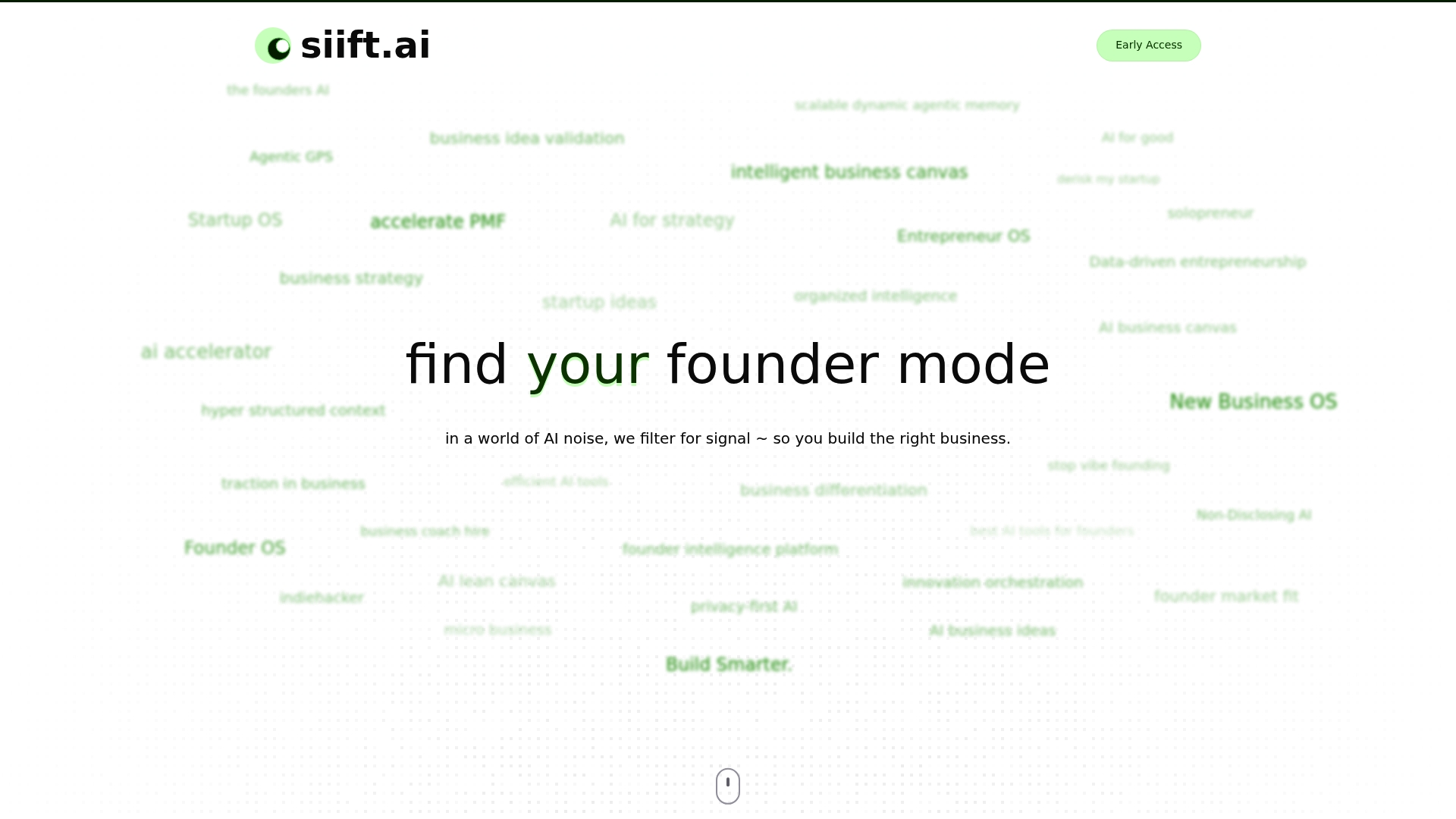
At a Glance
siift provides early access to a privacy-first New Business OS that uses proactive guided interactions and an intelligent business canvas to help founders derisk ideas. The vendor claims it accelerates founders toward product-market fit more efficiently than generic tools like Claude or Openclaw.
siift also positions itself as an Agentic AI platform for entrepreneurs, offering structured support for micro-businesses and solopreneurs.
Core Features
- AI-powered idea validation tools that score and challenge assumptions in a structured workflow.
- Intelligent business canvas and lean canvas interpretation that convert a canvas into prioritized hypotheses and tests.
- Proactive guided interactions with context hierarchies so the AI follows the conversation history and suggested next steps.
- Derisking and validation modules that map tests, metrics, and experiments into an organized planner.
- Organized intelligence and structured entrepreneurial workflows designed for solo founders and micro-businesses.
Key Differentiator
The clearest differentiator is the platform’s emphasis on privacy-first AI combined with proactive, guided interactions tailored to founders. That pairing aims to turn high-level strategy into repeatable validation work rather than leaving founders with static templates.
Pros
- Offers a focused toolset for early-stage founders who need a repeatable process. The platform ties ideation to concrete validation steps, which reduces guesswork for solo founders.
- Emphasizes privacy-first design, appealing to founders who handle sensitive customer or idea data and want tighter controls than public LLM chats.
- The context-hierarchy approach means the assistant remembers business context across sessions, so your canvases and hypotheses stay coherent as you iterate.
- Built-in derisking modules translate business hypotheses into experiments and metrics, making it easier to prioritize tests without building a custom spreadsheet.
- Community features surface peer feedback and modern founder perspectives so you can compare hypotheses with others facing similar trade-offs.
Cons
- Public evidence of long-term user outcomes and detailed UX walkthroughs is limited, so there is a learning curve and some uncertainty about real-world effectiveness.
Who It’s For
Solopreneurs, early-stage SaaS founders, and micro-business owners who need a disciplined, privacy-conscious way to validate ideas and create testable business models. Best for founders who prefer guided workflows over open-ended prompts.
Unique Value Proposition
A privacy-first New Business OS that converts a business canvas into a guided validation workflow rather than a static plan. That design shifts time from brainstorming to running prioritized experiments, which matters when you have one founder wearing every hat.
That claim from the vendor about speeding founders past early uncertainty should be seen as a positioning statement; use it as a hypothesis to test alongside the platform’s validation modules.
Real World Use Case
A solo founder with a SaaS concept imports a rough lean canvas, runs the platform’s validation sequence, and gets a prioritized list of three customer interviews and two micro-experiments to run in the first 30 days. The follow-up workflow links results back to the canvas so hypotheses evolve cleanly.
Pricing
Not applicable — informational only. The product is described as early access and informational in the provided materials, with no public pricing tiers listed.
Website: https://siift.ai
Kupkaike
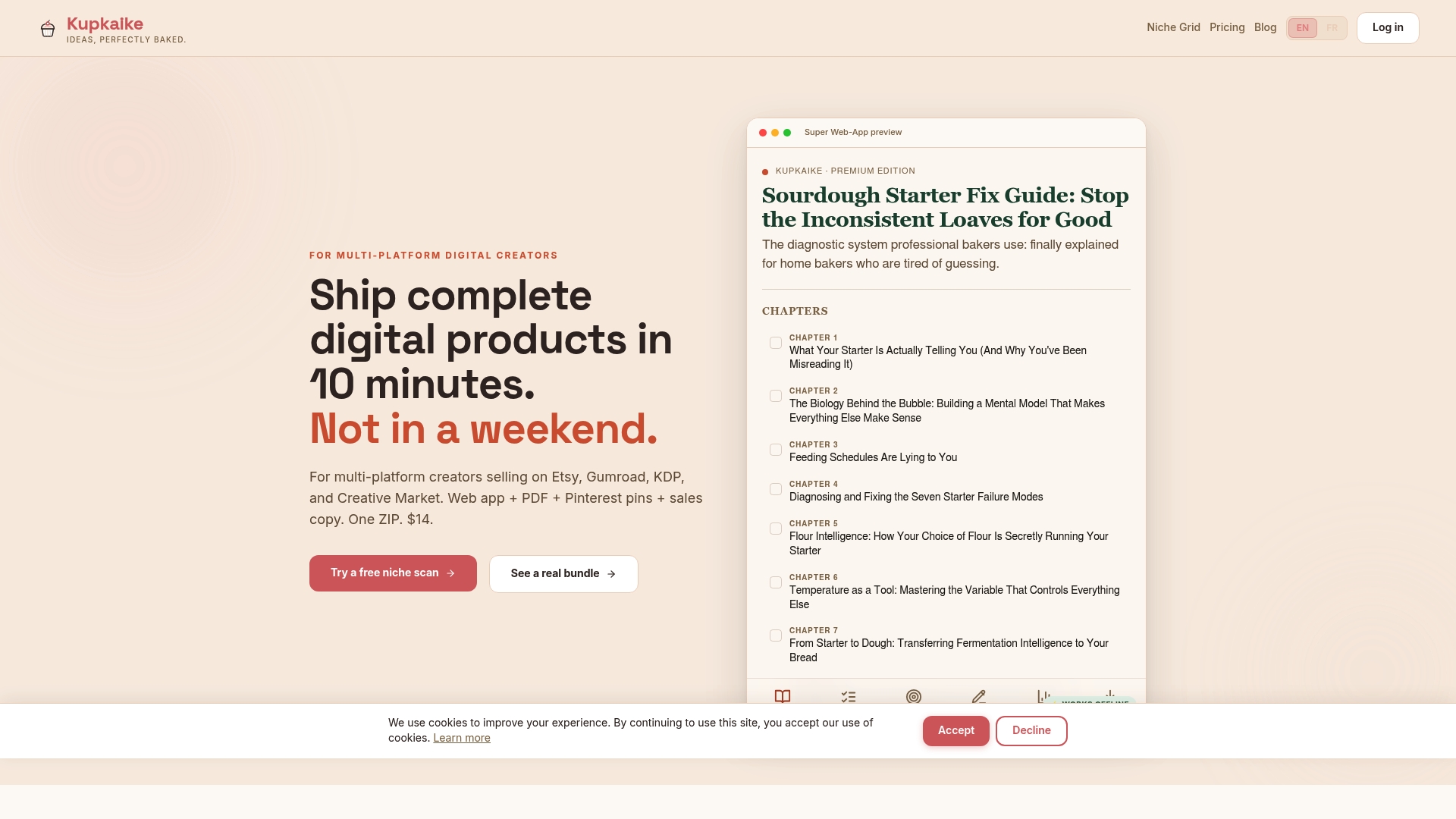
At a Glance
Kupkaike’s marketing materials claim it generates a complete, ready-to-sell digital product bundle in 10 minutes, combining market research with finished assets. That quick turnaround is the product’s headline promise and frames how creators judge its value.
Core Features
- Complete product bundles: interactive web app, PDF guide, cover image, Pinterest pins, and sales copy all produced together.
- Market analysis modules that pull live data from multiple marketplaces to inform positioning and keywords.
- AI-powered gap analysis and opportunity scoring to highlight niches and product angles.
- Multi-platform listing kits for Etsy, Gumroad, KDP, and personal websites to speed upload and formatting.
- A streamlined workflow designed to finish a product without repeated prompts.
Key Differentiator
Kupkaike ties market intelligence directly to asset generation. Instead of separate validation then production steps, its workflow feeds live niche signals into content creation so you get both a data-backed angle and deliverables in one flow.
Pros
- The niche scanner simplifies idea validation. It reduces guesswork by showing where demand and low competition overlap.
- End-to-end output saves days. You get formatted listings and marketing pins alongside the primary product rather than iterating across tools.
- Affordable one-time pricing for creators who prefer pay-per-product economics over subscriptions.
- Generates listing-ready copy and promotional assets informed by the platform data, which speeds publishing across channels.
- Works offline for final edits, so you can polish assets without constant connectivity.
Cons
- Limited third-party review coverage outside Reddit and Product Hunt makes independent vetting sparse.
- The platform leans heavily on automated analysis, which means subtle niche signals can be missed by the AI.
- Not built for teams. Collaboration features are thin, so larger shops will feel friction.
- Documentation and long-term case studies are still developing, which raises onboarding friction for less technical creators.
When It May Not Fit
If you run a multi-person studio that needs role-based workflows, Kupkaike will feel underpowered. If your niche requires deep ethnographic research or legal clearance, automated gap analysis alone is risky. Also, buyers who demand extensive independent reviews may prefer more established tools.
Who It’s For
Solo digital creators and micro-entrepreneurs who sell on Etsy, Gumroad, KDP, or personal storefronts and want a fast, data-informed route from idea to listing. Best for people who value speed and a pay-per-product model over enterprise-grade controls.
Real World Use Case
A solo creator researching “AI prompt engineering” runs a niche scan, accepts the suggested angle, and exports a bundled ebook, cover, pins, and listing copy. They upload the bundle to Etsy and Gumroad the same day and avoid a week of manual formatting and split-tool copywriting.
Pricing
Kupkaike charges $14 per product with free niche scans available at limited daily usage. There are no subscription fees for product creation, making it a pay-as-you-go option for occasional creators.
Website: https://kupkaike.com
Prodmill AI
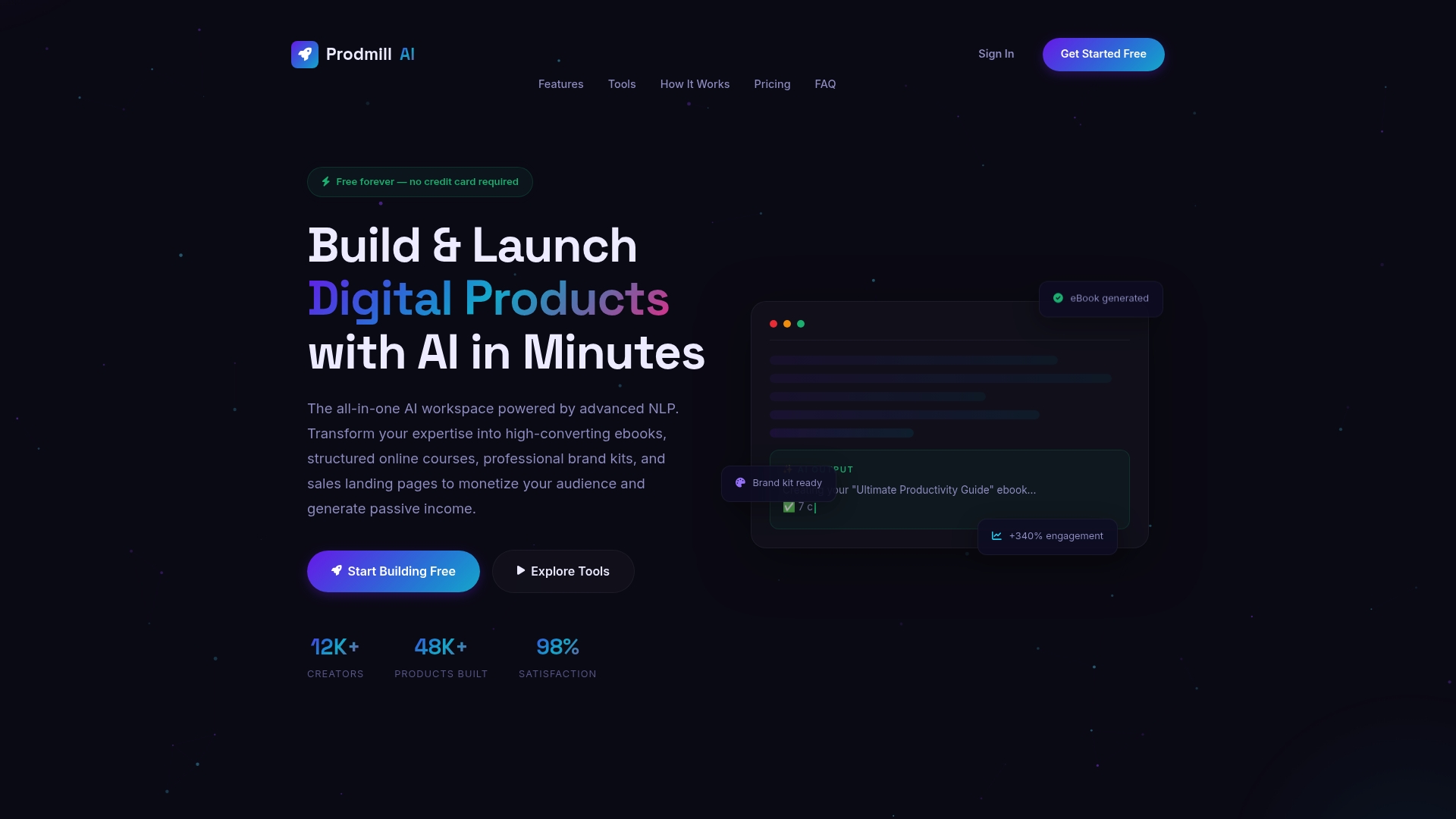
At a Glance
Prodmill’s marketing claims it can generate a complete digital product in under 60 seconds, including outlines, content, and visuals. The vendor also advertises a free forever starter plan and a multi-model engine that chooses between GPT-4, Claude, and Gemini for each task.
Core Features
-
All-in-one creator workspace that merges product design, content generation, and marketing asset output into a single interface.
-
Rapid product generation that the company advertises as producing finished ebooks, course skeletons, and sales pages in under a minute.
-
Automatic model selection using GPT-4, Claude, and Gemini to match tone and task without manual switching.
-
Built-in monetization playbooks, distribution checklists, and export options for common selling formats.
-
Content multipliers that convert one asset into blogs, videos, email sequences, and an AI-generated ebook.
Key Differentiator
The platform’s claim to fame is packing multi-model NLP and a generator engine into one workspace so you can go from idea to sellable asset without stitching tools together. That approach shortens the number of vendor handoffs and keeps drafts, assets, and revenue playbooks in one place.
Pros
-
Free forever starter plan: Low friction to test product-market fit since no card is required to start experimenting.
-
Automates structure and copy so you skip writer’s block and produce cohesive product skeletons rapidly.
-
Multiple AI models reduce single-model bias by letting the engine pick GPT-4, Claude, or Gemini per output.
-
Includes revenue playbooks and distribution checklists, which reduce guesswork about where to sell and how to price.
-
Export-ready formats let you publish to marketplaces or your own site without manual reformatting.
Cons
-
Several resource pages and parts of the site return 404 errors, which suggests incomplete or broken documentation.
-
Integrations are not documented in detail, and the product data lists no third-party connectors yet.
-
A number of advanced features are labeled “Coming Soon,” so some capabilities are not production-ready today.
When It May Not Fit
If you require enterprise-grade stability, audited connectors, or a mature app ecosystem, this is likely not the right choice yet. Teams that depend on guaranteed uptime, documented APIs, or deep platform integrations will find gaps given the 404s and missing integration details.
Who It’s For
Solo creators, digital entrepreneurs, and small teams that need a low-cost way to prototype and launch digital products fast. Best for people who prioritize speed of creation and bundled monetization guidance over enterprise-grade integrations.
Real World Use Case
A creator drafts an online course by feeding an outline to Prodmill, uses the generator to produce lessons and marketing copy, then exports a course bundle and sales page. According to the vendor, what would normally take days can be compressed to an hour of hands-on work when using templates and the multipliers.
Pricing
Free starter plan available. Paid tiers begin at $12.99 per month for Pro Creator and $29.99 per month for Enterprise. The vendor positions the free tier as sufficient for initial experiments before upgrading.
Website: https://prodmill.com
Ideadig
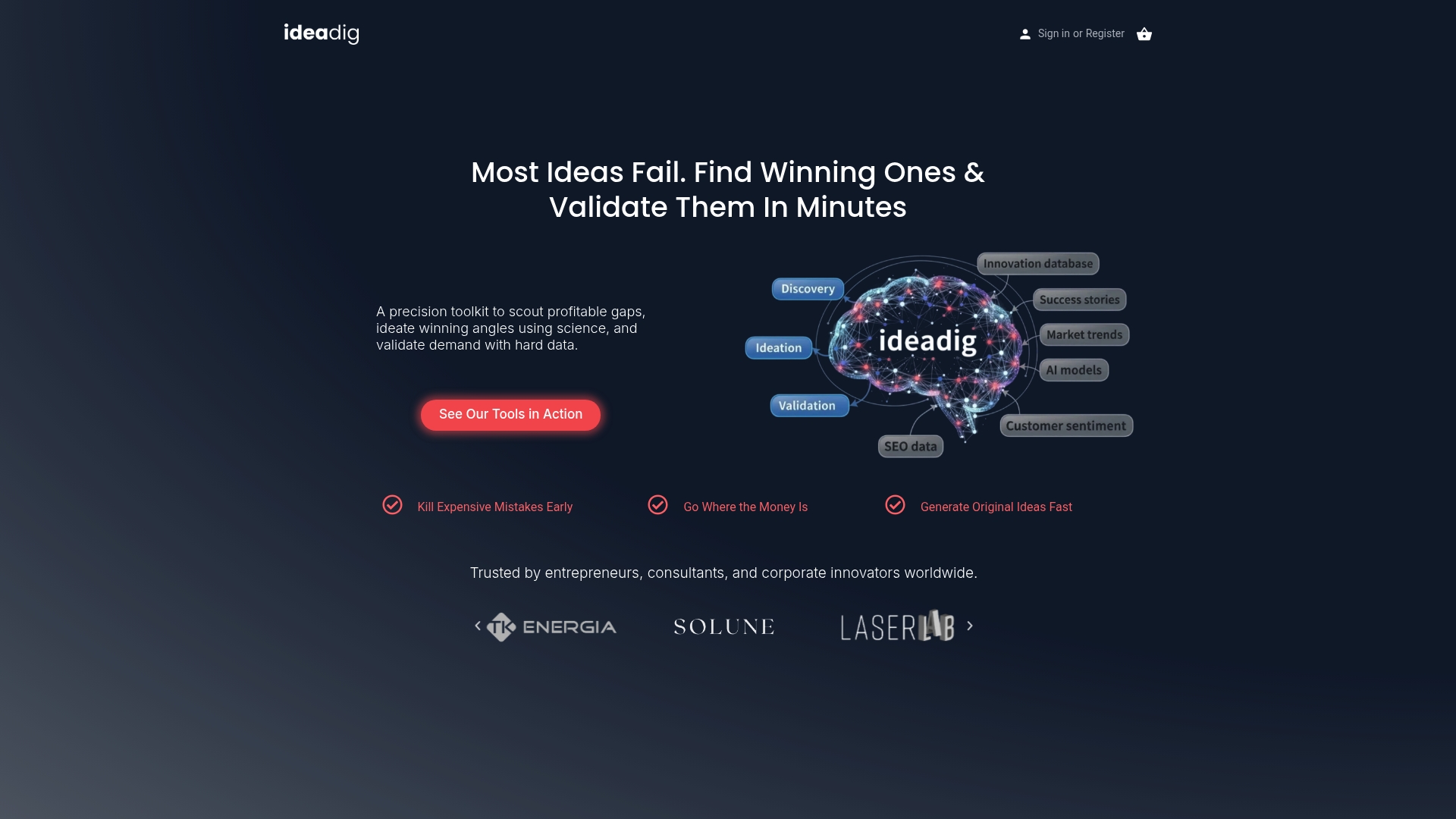
At a Glance
Combines structured frameworks, discovery databases, and AI-powered idea validation to help you test demand before you build. The toolkit targets the early stage where wrong bets are costly and promises faster, data-backed decisions for product and business ideas.
Core Features
Access to curated innovation and success stories databases for inspiration and comparable signals.
Frameworks that guide scouting, ideation, and validation so you do repeatable experiments rather than one-off guesses.
AI-driven market demand analysis and idea scoring that surface signals from search trends, product history, and behavioral cues.
Tools to generate and validate multiple concepts quickly plus companion apps for guidance and growth tracking.
Key Differentiator
The platform pairs structured validation frameworks with searchable discovery datasets and machine assistance. That mix shifts ideation from intuition to evidence faster than spreadsheet-first workflows, letting you prioritize concepts using both historical successes and synthesized demand signals.
Pros
- Data-focused validation reduces the chance of investing in low-demand ideas. The guided frameworks make experiments repeatable and less ad hoc.
- Fast idea iteration. You can generate several candidate angles in one session and move the best ones into short validation tests without rebuilding research every time.
- Companion apps and guided processes lower the operational overhead for founders who lack research teams. New users get step-by-step prompts that get results quickly.
- Scalable for different buyers. Consultants can reuse templates across clients and corporate teams can adapt frameworks to internal pipelines.
- The success stories database offers concrete examples you can model, not just abstract playbooks.
Cons
- Some buyers will be skeptical of automated demand signals. The platform relies on models and available market data rather than proprietary field research.
- Dependence on pre-seeded or proprietary structures such as pods or cubes may limit transparency for teams that prefer open tooling.
- Pricing follows subscription and framework usage and may vary for complex requests, which makes cost planning harder for tight budgets.
- Not open source and customization may incur additional fees for tailored frameworks.
When It May Not Fit
If your idea targets an ultra-niche market with scarce public data, the platform’s reliance on available market signals may miss those pockets. Teams that require fully open source tooling or control over every model parameter will find the proprietary elements restrictive.
If you cannot share customer or product telemetry with a third party for privacy or compliance reasons, Ideadig’s hosted validation workflow may be a poor match.
Who It’s For
Entrepreneurs, consultants, and corporate innovation teams that want rapid, repeatable validation without building a research function from scratch. Ideal for small teams that need a structured way to prioritize ideas and defend choices to stakeholders.
Real World Use Case
A startup ran ten short demand tests via Ideadig to rank product concepts. They used the database signals and validation framework to prioritize two ideas with the clearest traction metrics, saving months of development time and avoiding a low-demand build.
Pricing
Pricing is subscription based and tied to framework usage and customization. The vendor describes variable plans for standard subscriptions versus tailored engagements, so expect to request a quote for complex needs rather than find a public starting price.
Website: https://ideadig.com
Idea Validation Software Comparison
Selecting the right software for idea validation involves weighing features, privacy considerations, and pricing models to align with your venture’s specific goals.
| Product | Key Differentiator | Core Feature | Pricing | Notable Limitation |
|---|---|---|---|---|
| siift.ai | Privacy-first, guided validation tailored for founders | Structured business canvas workflows | Not disclosed | Limited evidence of long-term user outcomes |
| Kupkaike | Market intelligence integrated into asset generation | Bundled product and market analysis | $14 per product | Limited third-party review coverage |
| Prodmill AI | Multi-model engine for diverse output optimization | Rapid digital product creation | Free starter plan; paid plans start at $12.99/month | Incomplete documentation and missing integrations |
| Ideadig | Discovery databases combined with validation frameworks | AI-driven demand analysis | Subscription based | Relies on available market data, limiting niche insights |
Turn Your Digital Product Ideas Into Validated Wins with Siift
Choosing the right digital products ideas can feel overwhelming when you are juggling guesswork, validation, and privacy concerns all at once. The article highlights key challenges like needing structured workflows, actionable validation, and faster routes to product-market fit. Siift’s New Business OS addresses these exact pain points by offering a privacy-first, guided AI platform that transforms your idea into a prioritized, testable business strategy.
Why wrestle with static templates or generic AI tools when Siift helps solo founders and entrepreneurs systematically derisk ideas and build validated strategies? Visit Siift to experience how you can ramp up your experiments and refine your business canvas with clarity. Take control of your founder’s journey and unlock prioritized experiments designed to accelerate your path to market traction.
Frequently Asked Questions
How does Siift help founders validate their ideas more efficiently?
Siift offers AI-powered idea validation tools that score and challenge assumptions in a structured workflow. This feature is designed to tie ideation directly to concrete validation steps, significantly reducing guesswork for solo founders. If you’re looking to streamline your decision-making process, Siift is a strong choice.
What is the difference between Siift and Ideadig in terms of market analysis?
Ideadig excels in combining structured frameworks and discovery databases for idea validation, making it great for users who appreciate an evidence-based approach. On the other hand, Siift focuses on a privacy-first AI experience with proactive guided interactions, making it an ideal fit for founders needing structured workflows. If you prioritize privacy in your idea validation, Siift may resonate more with your needs.
Which platform offers more community features for feedback?
Kupkaike provides community features that surface peer feedback and modern founder perspectives, helping you compare hypotheses with others facing similar trade-offs. Siift has intelligence-focused capabilities but lacks dedicated community interaction. If peer feedback is crucial for you, consider Kupkaike alongside Siift.
Can I use Siift if I have an established team?
Siift is primarily designed for solo founders and micro-businesses who prefer guided workflows over open-ended prompts. If your setups require collaboration and role-specific workflows, this platform may not fully meet your needs, and you might want to explore alternatives.
What unique benefit does Siift offer over traditional templates?
Siift converts a business canvas into a guided validation workflow, which helps founders move from brainstorming to running prioritized experiments. This method helps in developing a flexible approach to validation, making it more effective than traditional static templates. By prioritizing iterative testing, you can expect to gain insights faster.