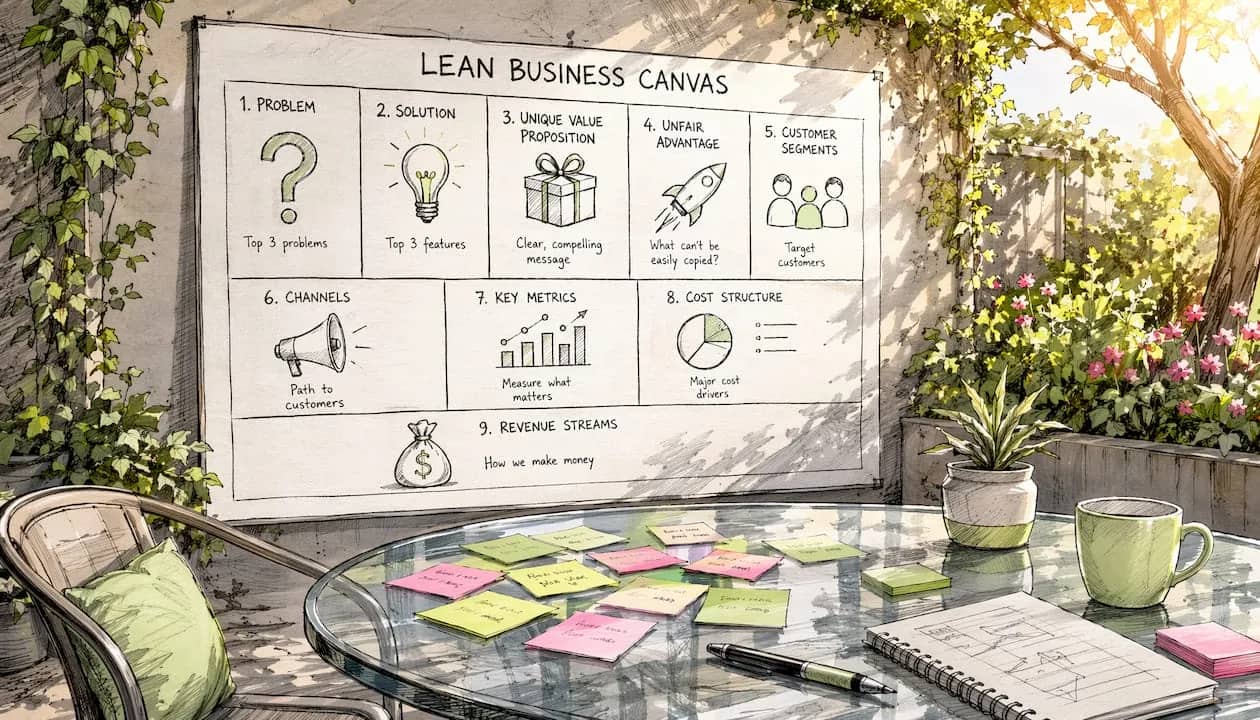
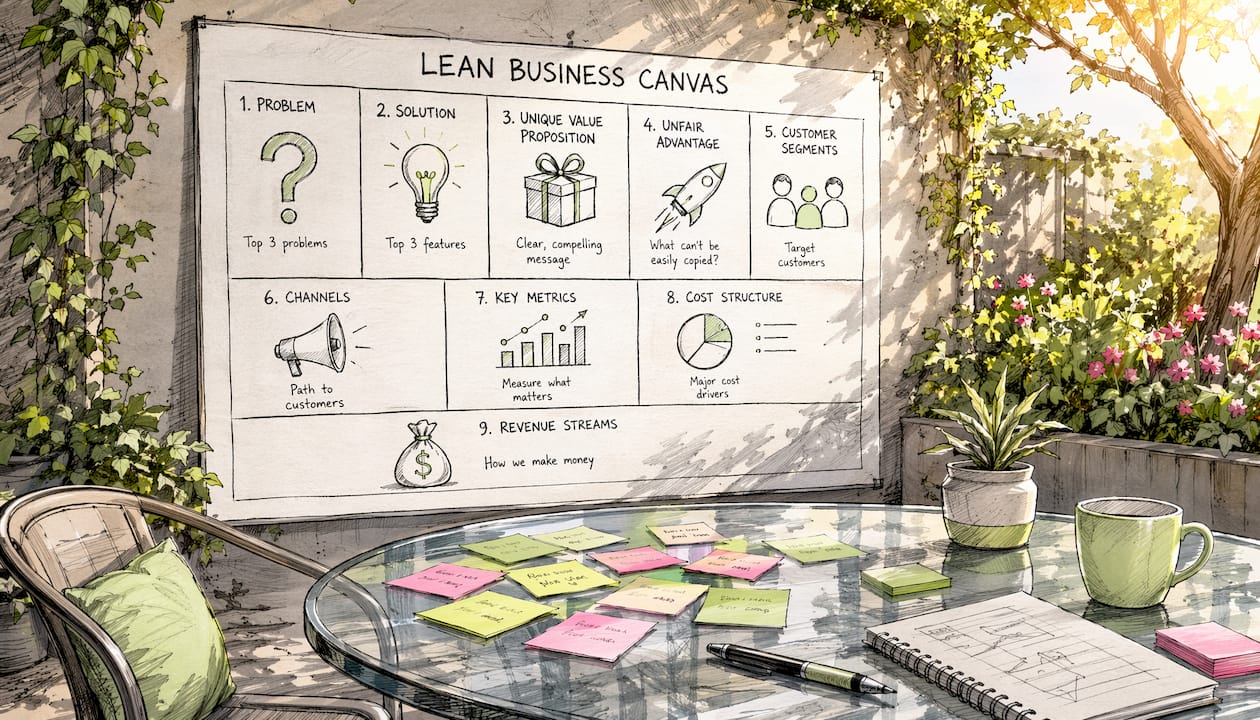
The lean business canvas model is a one-page visual framework that breaks your startup idea into nine testable assumptions, so you can validate what matters before you burn runway building the wrong thing. Created by Ash Maurya in 2010 as a startup-focused adaptation of Alexander Osterwalder’s Business Model Canvas, it sits at the heart of lean startup methodology and replaces long-winded business plans with a living hypothesis you can update weekly.
Here’s why that matters: 75% of startups fail, often because they build products nobody wants. The Lean Canvas forces you to confront that risk on day one, not after 18 months of development.
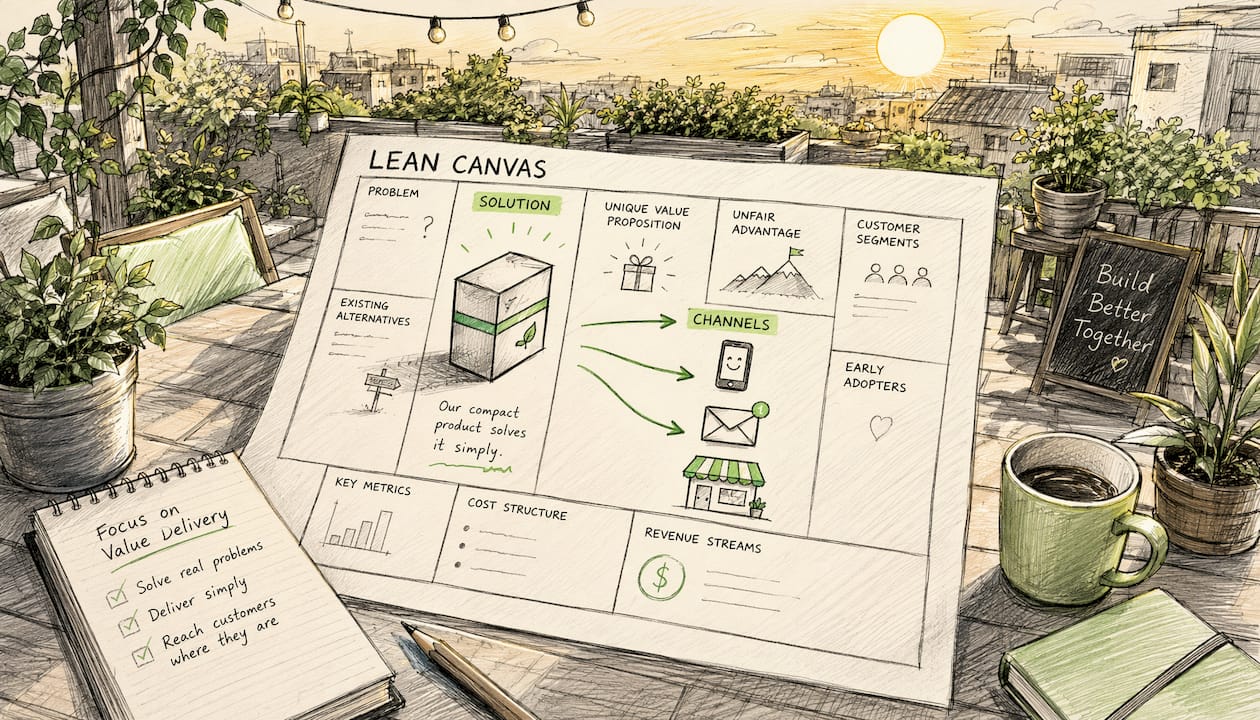
The nine building blocks are:
Problem: The top three customer pains you’re solving
Customer Segments: Who pays and who uses your product
Unique Value Proposition (UVP): Why customers should choose you
Solution: Your minimum viable product (MVP) features
Channels: How you reach and acquire customers
Revenue Streams: How money flows in
Cost Structure: What it costs to deliver your solution
Key Metrics: The vital signs that tell you if it’s working
Unfair Advantage: What competitors can’t easily copy
Unlike a 40-page business plan built on guesses dressed up as projections, the Lean Canvas is honest about uncertainty. It’s a snapshot of your current best thinking, designed to be wrong and then corrected fast.
What each of the nine Lean Canvas blocks actually does
Understanding the blocks individually is one thing. Knowing how they connect is what separates founders who iterate productively from those who spin their wheels.
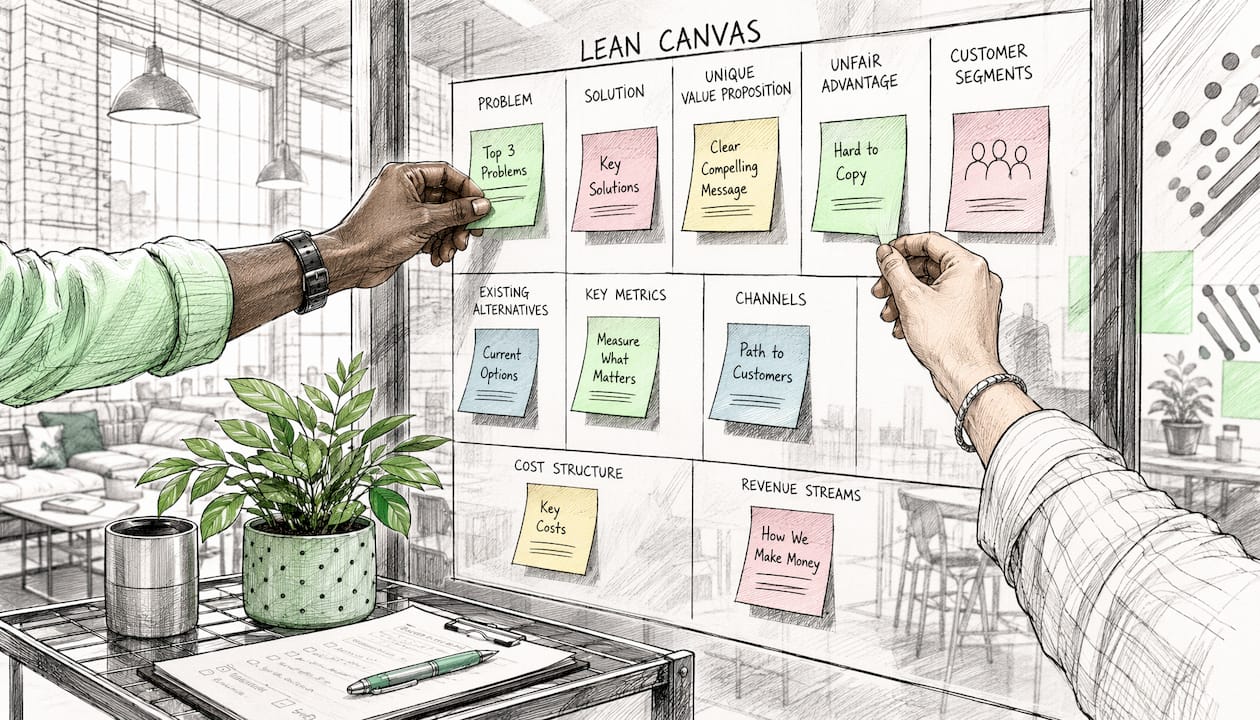
Problem
List your top three customer problems, and critically, the existing alternatives people use today. If your target customers are already solving the problem with spreadsheets, phone calls, or a competitor, that’s your real benchmark. Ash Maurya’s framework pushes you to identify MVP features that address those three problems directly, nothing more.
Customer segments
Split this into two groups: paying customers and end users. They’re often different people. A B2B SaaS tool might be purchased by a VP of Operations but used daily by a junior analyst. Knowing both shapes your messaging, your pricing, and your sales motion.
Unique value proposition
The UVP sits at the center of the canvas for a reason. It’s the one sentence that connects your customer’s biggest problem to the outcome they actually want. Weak UVPs describe features. Strong ones describe transformation.
Solution
This is your MVP, not your product roadmap. List the three features that directly address the three problems you identified. Resist the urge to add more. If you can’t solve the core problem with three features, you haven’t understood the problem well enough yet.
Channels
How do customers find you, and how do you deliver value to them? Early-stage channels should be cheap and fast to test: direct outreach, content, partnerships, communities. Don’t plan for paid acquisition at scale before you’ve confirmed the message works organically.
Revenue streams
Getting customers to pay from day one is one of the strongest signals that you’re solving a real problem. List your pricing model, whether that’s subscriptions, one-time fees, usage-based billing, or brokerage. Include your price point, even if it’s a guess, because it forces you to think about willingness to pay.
Cost structure
Focus on near-term, realistic costs: customer interviews, MVP development, basic operations. The goal is to understand your break-even point, not to build a five-year financial model.
Key metrics
Pirate Metrics (AARRR) give you a practical framework here: Acquisition, Activation, Retention, Revenue, and Referral. Pick one or two metrics per stage that tell you whether your business is healthy or broken. Tracking everything means tracking nothing.
Unfair advantage
This is the hardest block to fill honestly. It’s not your passion, your work ethic, or being “first to market.” Real unfair advantages include insider domain knowledge, exclusive partnerships, a proprietary dataset, or a community you’ve already built. If you can’t name one yet, leave it blank and come back to it.
How the Lean Canvas compares to the Business Model Canvas
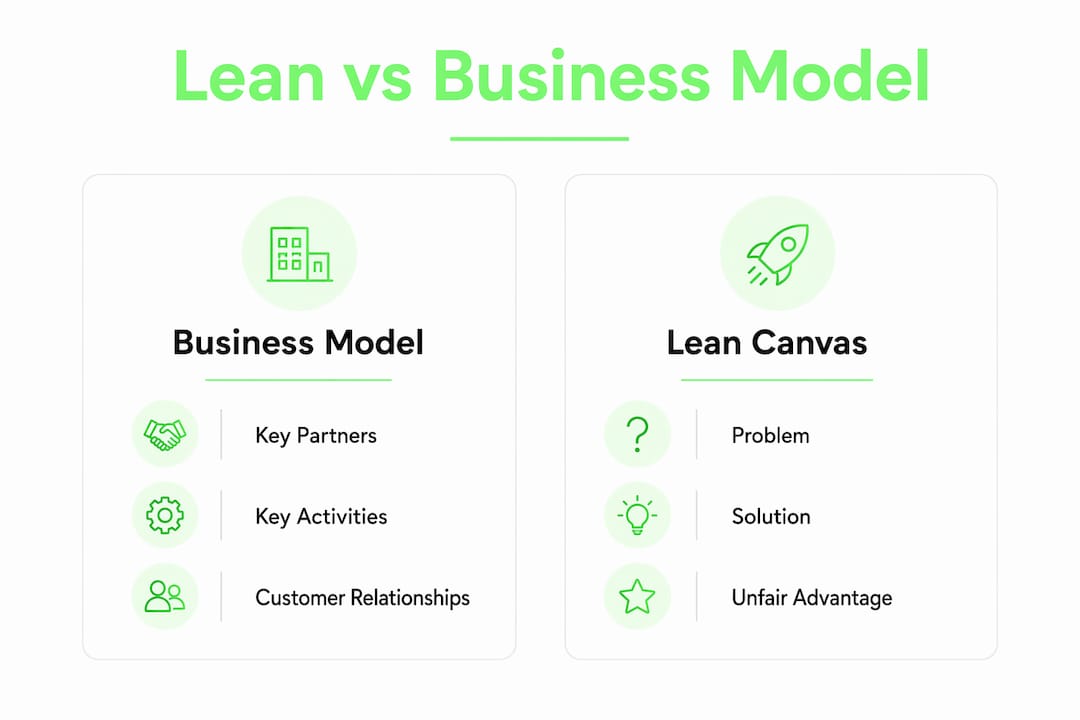
The Business Model Canvas (BMC), developed by Alexander Osterwalder, is a planning tool for businesses that already have a working model and need to map it clearly. The Lean Canvas, by contrast, is a validation tool for businesses that don’t know yet if their model works. That’s a fundamental difference in purpose, not just design.
Ash Maurya replaced four BMC blocks to make the canvas startup-ready:
BMC Block Removed | Lean Canvas Replacement | Why |
|---|---|---|
Key Partners | Problem | Startups need to validate the problem first |
Key Activities | Solution | MVP thinking over operational planning |
Key Resources | Key Metrics | Track learning, not assets |
Customer Relationships | Unfair Advantage | Focus on defensibility, not CRM |
The BMC asks “how does our business operate?” The Lean Canvas asks “what do we need to prove this works?” Use the BMC when you’re planning distribution, aligning costs with pricing, or communicating an established model to investors. Use the Lean Canvas when you’re still figuring out whether anyone actually wants what you’re building.
The value proposition canvas nests inside both tools, zooming into the Customer Segments and Value Proposition blocks to sharpen your understanding of customer jobs, pains, and gains before you commit to either canvas.
Strengths and weaknesses of the Lean Canvas
No tool is perfect. The Lean Canvas earns its place in every founder’s toolkit, but it comes with real limitations worth knowing upfront.
Strengths:
Speed. You can draft a first version in 20 minutes. That forces clarity and surfaces assumptions you didn’t know you were making.
Single-page constraint. If you can’t fit your idea on one page, you’re either solving too many problems or haven’t simplified your thinking enough.
Risk prioritization. The canvas pushes you to identify your riskiest assumptions and test them first, which is exactly what Eric Ries argues separates successful startups from expensive failures.
Shared language. A one-page canvas is far easier to share with co-founders, advisors, and early investors than a 30-page document.
Weaknesses:
Oversimplification risk. Compressing a complex business into nine boxes can create false confidence. Some industries, particularly regulated ones, need more operational depth than the canvas provides.
Product-centric bias. Founders often fill the canvas from the inside out, starting with their solution and working backward. That’s backwards. The canvas only works if you start with the customer.
Not a strategy document. The Lean Canvas is a hypothesis framework, not a go-to-market plan, a financial model, or a competitive analysis. Treating it as a finished strategy is a common and costly mistake.
Iteration discipline required. The canvas is only useful if you update it. A canvas that hasn’t changed in three months is a sign you’ve stopped learning.
Pair the Lean Canvas with complementary tools, like the Value Proposition Canvas for customer insight and a basic financial model for unit economics, and the weaknesses shrink considerably.
How to fill out your Lean Canvas step by step
The order you fill in the canvas matters more than most guides admit. Here’s the sequence that actually works.
Start with the Problem block. Write down the top three problems your target customers face. Be specific. “Scheduling is hard” is not a problem. “Freelancers lose 4–6 hours per week chasing client approvals over email” is a problem.
Define your Customer Segments. Who experiences those problems most acutely? Name them specifically: “independent consultants billing $5K–$15K per month,” not “small business owners.”
Draft your Unique Value Proposition. Write one sentence that connects the problem to the outcome. Test it with five people outside your company. If they can’t restate it in their own words, rewrite it.
Sketch your Solution. Three features, maximum. Each one should map directly to one of your three problems. This is your MVP hypothesis.
Map your Channels. Where do your customers already spend time? Start with the cheapest channel you can test this week.
Model your Revenue Streams. Name your pricing model and a specific price point. “Freemium with paid tiers” is a model. “$29/month for solo users, $99/month for teams” is a testable hypothesis.
Estimate your Cost Structure. List your top three costs for the next 90 days. Customer interviews, prototype development, and one marketing experiment are a reasonable starting set.
Choose your Key Metrics. Pick one AARRR metric per stage that tells you whether you’re making progress. For most early-stage founders, Activation (do users complete the core action?) and Retention (do they come back?) are the most revealing.
Identify your Unfair Advantage. Be honest. If you don’t have one yet, write “TBD” and treat it as an open research question.
Share it and get feedback. A canvas nobody has seen is just a diary entry. Show it to potential customers, advisors, and co-founders within 48 hours of drafting it.
Pro Tip: Fill the canvas from the customer outward, not from the product inward. Start with Problem and Customer Segments before you touch Solution or UVP. Founders who start with their solution almost always end up building products nobody wants.
Digital tools for creating and sharing your canvas include Miro, Notion, and dedicated canvas apps. Miro in particular works well for distributed teams because it supports real-time collaboration and version history, so you can track how your assumptions evolve over time.
Common mistakes that kill Lean Canvas effectiveness
The canvas is simple to draw and surprisingly easy to misuse. These are the mistakes that show up most often.
Overloading every section. Keeping each block to 2–3 bullet points is best practice. If you’re writing paragraphs, you’re planning, not hypothesizing.
Filling it from the product side. Starting with your solution and reverse-engineering a customer problem is the single most common failure mode. The canvas is a customer-first tool.
Skipping problem validation. Writing “customers struggle with X” without talking to a single customer is fiction. The Problem block should be grounded in at least five real conversations before you treat it as validated.
Treating it as a one-time exercise. Your first canvas is a set of guesses. Its value comes from iteration, not from the initial draft. Update it every time you learn something that changes an assumption.
Leaving Unfair Advantage blank forever. It’s fine to leave it blank early on. It’s a red flag if it’s still blank after six months of customer discovery.
Conflating channels with marketing tactics. Channels are how you reach and deliver value to customers. “Instagram ads” is a tactic. “Inbound content targeting freelance designers” is a channel hypothesis worth testing.
The consequence of these mistakes isn’t just a bad canvas. It’s misaligned product development, wasted runway, and a team that’s busy but not learning.
How the Value Proposition Canvas sharpens your Lean Canvas
The Value Proposition Canvas (VPC), developed by Alexander Osterwalder and colleagues, zooms into two of the most critical blocks in your canvas: Customer Segments and Unique Value Proposition. Think of it as the microscope you use before you draw the full map.
The VPC has two halves. The Customer Profile captures the jobs your customers are trying to do, the pains they experience doing them, and the gains they hope for. The Value Map describes how your product addresses those jobs, relieves those pains, and creates those gains. Fit emerges when your Value Map addresses the most important jobs, pains, and gains in the Customer Profile.
Pro Tip: Use the Kano model to prioritize your Value Map. Always solve “must-be quality” pains first — the ones whose absence creates massive dissatisfaction. Only then invest in “attractive quality” features that delight. A product that delights but fails on basics will lose to a product that just works.
The recommended sequence, supported by Strategyzer research, is to complete the VPC before you finalize your Lean Canvas. Sharpen your understanding of customer needs first, then build your business model hypothesis around a verified value proposition.
VPC Element | Lean Canvas Block It Informs |
|---|---|
Customer Jobs | Problem |
Customer Pains | Problem + UVP |
Customer Gains | UVP + Solution |
Pain Relievers | Solution |
Gain Creators | Unfair Advantage |
This pairing is one of the most underused approaches in early-stage startup validation. Founders who skip the VPC and go straight to the Lean Canvas often end up with a UVP that sounds good internally but lands flat with actual customers. The unique selling proposition work you do in the VPC feeds directly into the center of your canvas.
Lean Canvas examples across different industries
Seeing the framework applied to real contexts makes the abstract concrete. Here’s how the canvas adapts across three different startup types.
SaaS productivity tool: Problem: knowledge workers lose hours per week to manual status updates. Customer Segment: remote engineering teams at companies with 10–50 employees. UVP: “Async standups that write themselves.” Solution: AI-generated daily summaries from existing tools like GitHub and Slack. Revenue: $12 per user per month. Unfair Advantage: proprietary integration layer built by a team with deep DevOps experience.
Consumer health app: Problem: people with chronic conditions struggle to track symptoms consistently. Customer Segment: adults managing Type 2 diabetes without a dedicated care team. UVP: “Your health journal that actually talks back.” Solution: symptom logging, trend visualization, and plain-language summaries for doctor visits. Revenue: freemium with a $9.99/month premium tier. Key Metrics: daily active users and 30-day retention.
B2B marketplace: Problem: independent contractors can’t find vetted short-term projects without going through expensive staffing agencies. Customer Segment: freelance engineers with 3–8 years of experience. UVP: “Direct access to pre-vetted projects, no middleman.” Revenue: 8% transaction fee on completed contracts. Unfair Advantage: exclusive partnerships with three mid-market tech companies as founding clients.
What these examples share is specificity. Vague canvases produce vague strategies. The more concrete your entries, the faster you can test whether your assumptions hold.
How to validate your Lean Canvas assumptions
A canvas full of untested assumptions is just an expensive opinion. Validation is what turns it into a business strategy framework worth building on.
Start by ranking your assumptions by risk. Ask yourself: if this assumption is wrong, does the whole business model collapse? Those are your riskiest assumptions, and they go to the front of the testing queue. Eric Ries built the entire lean startup methodology around this principle: speed of validated learning beats initial design genius.
Practical validation approaches by block:
Problem: Five to ten customer discovery interviews before you write a single line of code. Ask about past behavior, not hypothetical future behavior.
UVP: Run a landing page test. Write your UVP as a headline, drive 100 targeted visitors to it, and measure sign-up or waitlist conversion.
Solution: Build the smallest possible version that lets a real customer complete the core job. Measure whether they actually use it, not whether they say they would.
Revenue: Ask for money early. A customer who gives you their credit card number is a validated assumption. A customer who says “I’d definitely pay for that” is not.
Channels: Test two or three channels simultaneously with small budgets or time investments. Double down on the one that produces the lowest cost per qualified lead.
Update your canvas after every significant learning. A canvas that changes is a canvas that’s working.
How the Lean Canvas fits inside Lean Startup methodology
The Lean Canvas is the artifact. The lean startup methodology is the operating system it runs on. Understanding the relationship between the two is what makes the canvas genuinely useful rather than just a pretty diagram.
Eric Ries’s Build-Measure-Learn loop is the engine. You build the smallest possible version of your idea (the MVP), measure how real customers respond, and learn whether your assumptions were right. The Lean Canvas maps directly onto this cycle: each block is a hypothesis, each customer interaction is a data point, and each canvas update is a learning milestone.
Ash Maurya designed the canvas specifically to optimize for this loop. The blocks aren’t arbitrary. Problem and Customer Segments define what you’re testing. Solution and Channels define how you’re testing it. Key Metrics define whether the test passed or failed. Unfair Advantage defines whether the result is defensible.
The canvas also forces what Ries calls “validated learning” over vanity metrics. Tracking page views feels productive. Tracking Activation, whether a new user completes the core action that delivers your promised value, tells you whether your product actually works. That shift in measurement focus is one of the most practical gifts the lean startup framework gives founders who use it honestly.
If you want to put this into practice with AI-guided structure, siift’s platform walks you through ideation, validation, and go-to-market planning systematically, so you’re not staring at a blank canvas wondering where to start.
Ready to build your first validated canvas?
The Lean Canvas is only as good as the action it drives. If your canvas has been sitting in a Notion doc for three weeks without a single customer conversation to update it, it’s not doing its job.
siift’s AI-powered platform guides founders through the full validation process, from first hypothesis to go-to-market planning, with structured prompts that keep you honest about your assumptions. No blank-page paralysis, no generic advice. Just a clear path from idea to traction.
Key Takeaways
The Lean Canvas is only valuable when treated as a living hypothesis, not a finished document; founders who iterate it against real customer data consistently outperform those who treat it as a one-time planning exercise.
Point | Details |
|---|---|
Start with the customer | Fill Problem and Customer Segments before touching Solution or UVP to avoid building products nobody wants. |
Nine blocks, one page | Each block is a testable hypothesis; keeping entries to 2–3 bullet points per section is best practice. |
Lean Canvas vs. BMC | Lean Canvas replaces four BMC blocks with Problem, Solution, Key Metrics, and Unfair Advantage for startup validation. |
Validate riskiest assumptions first | Rank assumptions by what would collapse the model if wrong, then test those first using the Build-Measure-Learn loop. |
VPC before Lean Canvas | Complete the Value Proposition Canvas first to sharpen customer insight, then build your Lean Canvas around a verified value proposition. |
FAQ
What is the Lean Business Canvas model?
The Lean Business Canvas is a one-page visual framework created by Ash Maurya that breaks a startup idea into nine testable blocks, replacing traditional business plans with a hypothesis-driven tool designed for rapid iteration and validation.
What are the 9 parts of a Lean Canvas?
The nine blocks are: Problem, Customer Segments, Unique Value Proposition, Solution, Channels, Revenue Streams, Cost Structure, Key Metrics, and Unfair Advantage. Each block represents an assumption to be tested with real customers.
What’s a good example of a Lean Canvas?
A SaaS productivity tool targeting remote engineering teams might define its Problem as “manual status updates waste hours per week,” its UVP as “async standups that write themselves,” and its Unfair Advantage as a proprietary integration layer built by a team with deep DevOps experience.
What are common mistakes in Lean Canvas?
The most common mistakes are overloading sections with too much detail, filling the canvas from the product side instead of the customer side, and treating it as a static document rather than updating it after every customer learning.
How does the Lean Canvas differ from the Business Model Canvas?
The Lean Canvas replaces four Business Model Canvas blocks (Key Partners, Key Activities, Key Resources, Customer Relationships) with Problem, Solution, Key Metrics, and Unfair Advantage, shifting focus from operational planning to early-stage hypothesis testing and validation.