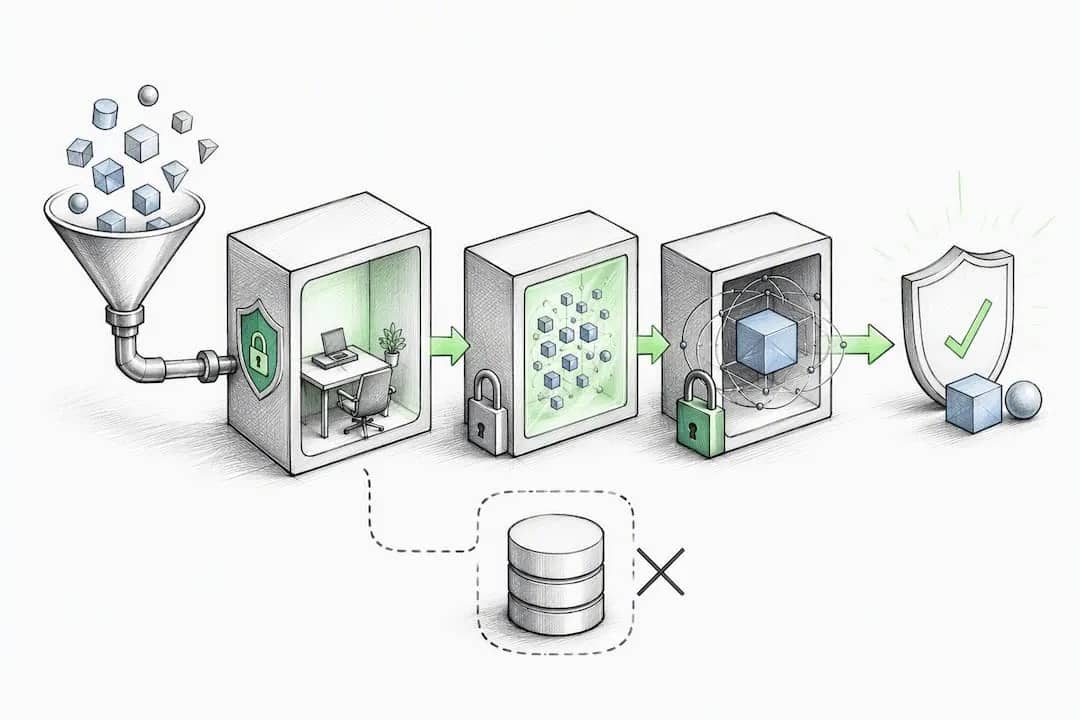
Privacy-first AI is an architecture, not a policy PDF: it prevents models and vendors from ever touching your raw sensitive data, using controls like tokenization, confidential computing, or differential privacy baked in before a single training run happens. The immediate move for any team is simple. Find your single most sensitive data flow right now, whether that’s customer PII or your unreleased product strategy, and lock it down with redaction, tokenization, or a trusted execution environment before you pick a model vendor.
TL;DR:
- Privacy-first AI ensures raw sensitive data is never accessible in identifiable form by implementing technical controls like TEEs, tokenization, and differential privacy from the start.
- Building a privacy-first system requires mapping the data lifecycle, encrypting in transit, running inference inside attested TEEs, and maintaining signed logs for verification.
- Combining multiple techniques, such as tokenization at capture, TEE isolation during inference, and differential privacy on outputs, creates a layered defense.
- Compliance frameworks like NIST and GDPR emphasize case-by-case assessment of anonymization and require detailed documentation of data handling and retention.
- Prioritizing the riskiest data flows with targeted controls and clear ownership reduces exposure, while ongoing monitoring and evidence preservation are vital for trust and audit readiness.
Table of Contents
- What Does Privacy-First AI Actually Mean?
- Which Technical Patterns Actually Protect Your Data?
- How Do You Build a Privacy-First AI Architecture?
- What Regulations Should Shape Your Privacy Controls?
- Who Owns Privacy When AI Goes Into Production?
- What Are the Real Tradeoffs of Privacy-First AI?
- What Should Your Team Do This Quarter?
- How Does siift Practice Privacy-First AI?
- What About Bias and Consent, Not Just Legal Compliance?
- Where Is Privacy-First AI Headed Next?
- Want a Privacy-Minded Workspace for Your Strategy?
- Sources
- FAQ
What Does Privacy-First AI Actually Mean?
Most “privacy-friendly” AI products are privacy as an afterthought: a policy document promising good behavior, bolted onto an architecture that technically could ingest your data into training pipelines. Privacy-first AI flips the sequence. You design the data lifecycle and the technical guarantees first, then build the product around those constraints.
Stanford HAI makes the case bluntly: the industry needs to move from voluntary safeguards to verifiable, system-level architectures that constrain what a model can output and how training data gets used. A pinky promise in a terms-of-service doc isn’t a control. A cryptographic attestation is.
A few things separate the real thing from the marketing version:
- Raw sensitive data never reaches the model in a usable, identifiable form.
- Controls are enforced technically (encryption, isolation, tokenization), not just contractually.
- Anonymization actually removes identifiability, whereas pseudonymization just swaps identifiers, leaving data re-linkable if the mapping leaks.
That last distinction trips up a lot of teams. Pseudonymized data still carries risk. Treat it accordingly.
Which Technical Patterns Actually Protect Your Data?
Here’s where the rubber meets the road. Four techniques do most of the heavy lifting in privacy-first systems, and they’re not interchangeable.
Trusted execution environments (TEEs), or confidential computing, isolate inference inside encrypted enclaves so even the infrastructure host can’t see plaintext data or model weights. The EphemeralML technical documentation describes per-inference attestation: a signed receipt proving exactly what model ran, on what data, with what guarantees, every single time. That’s verifiable execution, not a vendor’s word.
Differential privacy adds calibrated statistical noise so no single record can be reverse-engineered from outputs, but that noise trades off against model accuracy. Tune it wrong and your model gets dumber.
Federated learning trains models across decentralized data without moving raw data to a central server, useful for multi-party scenarios but limited by network overhead and secure aggregation complexity.
Synthetic data and tokenization swap real values for structurally similar fakes or reversible tokens before anything touches a model.
IBM’s guidance on AI data privacy recommends combining these rather than picking one champion.
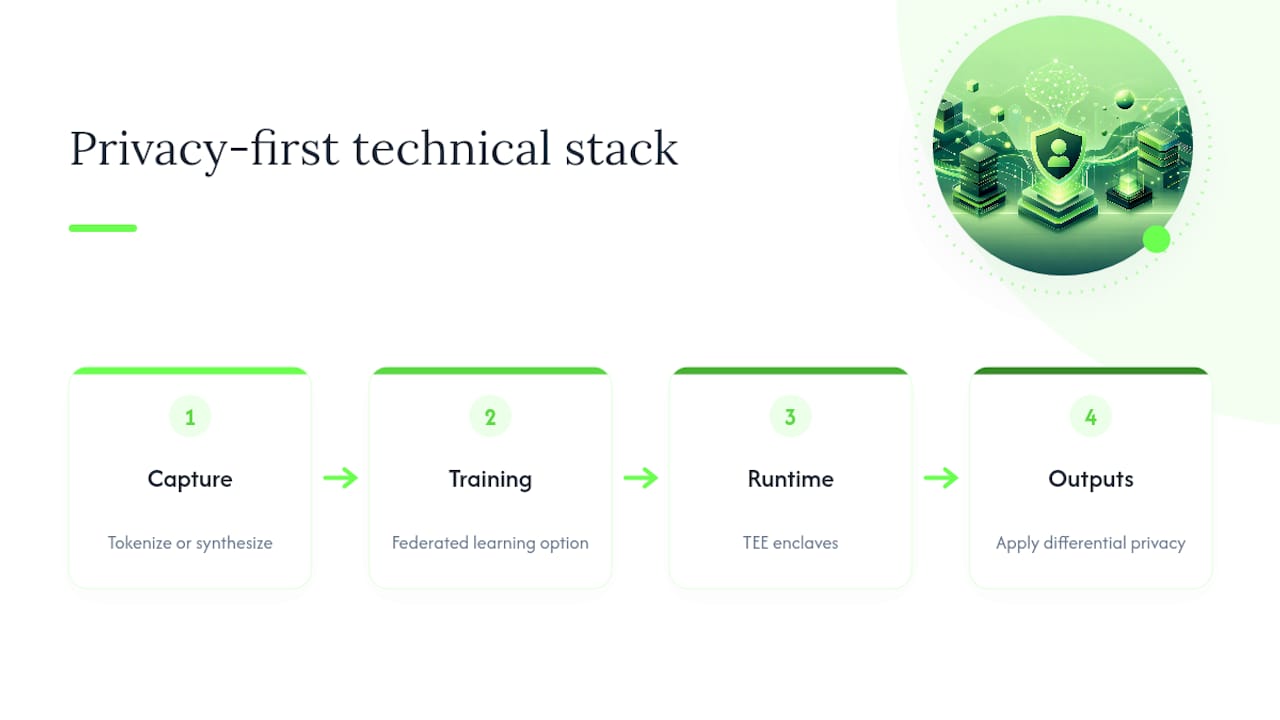
Pro Tip: Don’t treat these as mutually exclusive. The strongest deployments layer tokenization at capture, a TEE for runtime isolation, and differential privacy on any aggregate outputs.
How Do You Build a Privacy-First AI Architecture?
Privacy-first design means placing a control at every stage of the data lifecycle, not just at the point of collection. Here’s the sequence that actually holds up under scrutiny:
- Map the lifecycle. Trace data from collection through storage, preprocessing, training, inference, retention, and deletion. You can’t protect what you haven’t mapped.
- Redact or tokenize at capture. The earlier sensitive fields get stripped or swapped, the less exposure downstream systems inherit.
- Encrypt in transit, always. Non-negotiable, and cheap compared to the alternative.
- Confine runtime execution. Run inference inside a TEE with attestation, so you can prove, not just claim, what happened to the data.
- Enforce policy-as-code. Access rules live in versioned, auditable code, not a wiki page someone forgot to update.
- Log every inference with a signed receipt. This is your audit trail when someone (a regulator, a customer, your own security team) asks what happened to a specific request.
Skip step six and you’ve built a privacy-first system nobody can actually verify, which defeats the point.
What Regulations Should Shape Your Privacy Controls?
Compliance frameworks aren’t separate from architecture decisions, they’re the language you’ll need when someone audits your claims. The NIST Privacy Framework gives you a structured way to map risk management activities directly onto your AI data lifecycle stages.
In Europe, the EDPB’s opinion on AI models makes a point too many teams gloss over: a model trained on personal data isn’t automatically anonymous just because outputs don’t obviously contain names. Anonymity has to be assessed case-by-case and documented, not assumed.
For healthcare-adjacent products, HIPAA-style evidence expectations align cleanly with what attestation already produces:
- Documented data minimization and purpose limitation, matching EDPB expectations.
- Per-inference receipts that double as audit evidence for exactly which data touched which model.
- Retention and deletion logs mapped to NIST’s lifecycle categories.
If your infrastructure runs through third-party cloud providers, also check how legal process affects data custody. The Justice Department’s Cloud Act resources outline how cross-border legal requests can reach data held by cloud vendors, which matters when you’re choosing where keys live.
Who Owns Privacy When AI Goes Into Production?
Architecture without ownership falls apart fast. You need a data steward accountable for classification, a model owner accountable for what the model actually does with inputs, security owning monitoring, and legal owning the regulatory mapping. Four different hats, four different failure modes if nobody’s wearing one.
Monitoring has to watch for two distinct threats: active data leakage (something’s exfiltrating) and model memorization (the model quietly learned to regurgitate training examples verbatim). The Coalition for Secure AI pushes shared governance patterns and supply-chain security precisely because individual teams reinventing this wheel tends to produce gaps.
When something does go wrong, preserve attestations and logs immediately, before anyone starts debugging. Evidence you didn’t preserve is evidence you don’t have. And keep a human in the loop on anything touching sensitive categories. Full automation sounds efficient until its the thing that made the bad call at 2 a.m.
What Are the Real Tradeoffs of Privacy-First AI?
Nothing here is free. Differential privacy’s noise reduces accuracy, sometimes meaningfully, depending on your privacy budget. TEEs and encrypted inference add real computational overhead and latency compared to running plaintext on standard infrastructure.
Model memorization also creates residual reidentification risk that no amount of policy language erases; large models sometimes memorize and regurgitate training examples. Layered controls reduce this risk but don’t eliminate it outright.
The decision guide is straightforward: match control depth to sensitivity. A marketing analytics pipeline doesn’t need enclave-grade isolation. A pipeline touching health records or unreleased IP absolutely does.
What Should Your Team Do This Quarter?
Turning theory into action doesn’t require a massive overhaul on day one. Here’s a sequence that fits inside a single quarter:
- Inventory every data flow that touches an AI system and classify what’s actually PII or sensitive IP.
- Rank flows by sensitivity, then attack the riskiest one first, not the easiest one.
- Apply tokenization or TEE isolation to that top-ranked flow before touching anything else.
- Add per-inference attestation and logging so you have proof, not just intent.
- Write policy-as-code for access control instead of relying on tribal knowledge.
- Run privacy testing, including membership-inference checks and differential-privacy audits, on anything customer-facing.
- Document every decision as you make it. Auditors and future you will both thank you.
- Revisit the risk management strategies for AI that fit your team’s size before scaling further.
Pro Tip: Start with one pipeline done right instead of ten pipelines done halfway. A single verifiable, well-documented flow beats a portfolio of “we think it’s fine.”
How Does siift Practice Privacy-First AI?
Founders share their rawest thinking with siift: unreleased product roadmaps, competitive positioning, market bets nobody else has heard yet. That’s exactly the IP an AI product should never leak into someone else’s training set.
siift’s non-disclosing AI approach is built around that reality: your workspace data isn’t fed back into model training, and your strategy stays yours. Workspace isolation, encryption, and explicit non-disclosure assurances aren’t marketing lines here, they’re the product’s actual privacy-first architecture.
The takeaway for other builders: if your product touches customer strategy or proprietary thinking, isolate that workspace data from training pipelines by design, not by promise. Founders evaluating any AI tool should ask the same question they’d ask siift: where does my data go, and who can see it?
What About Bias and Consent, Not Just Legal Compliance?
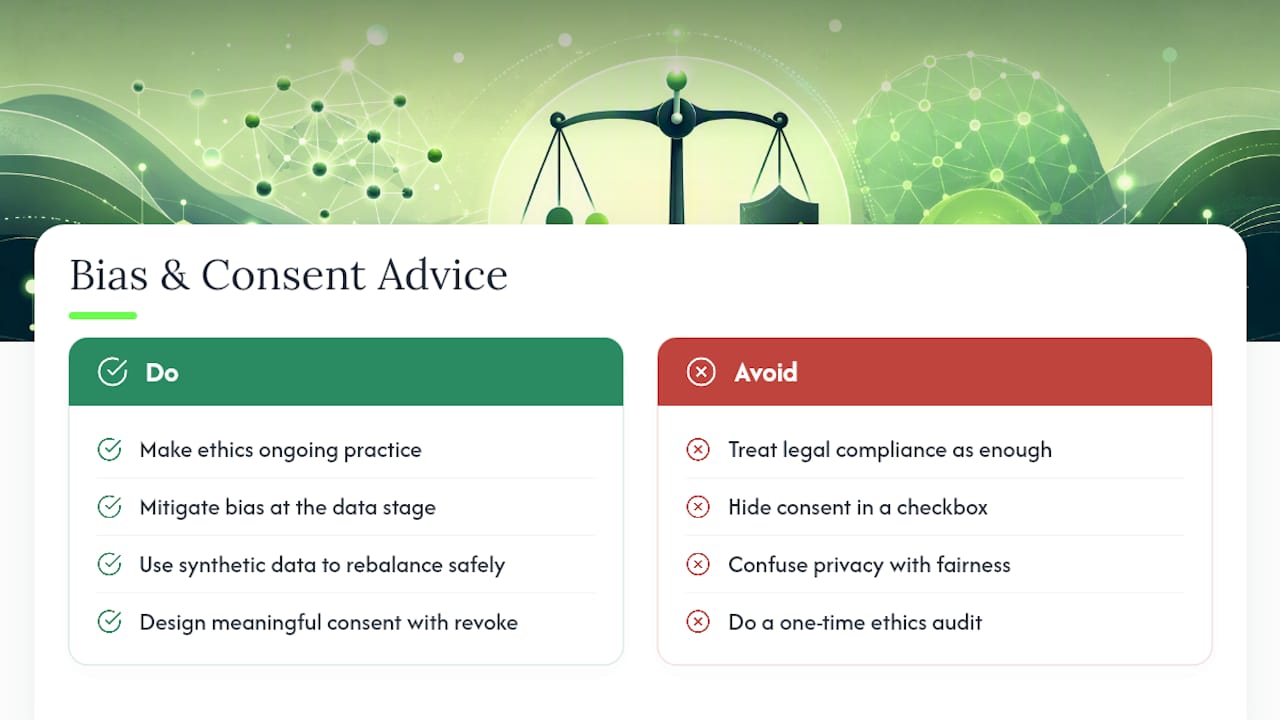
Legal compliance is the floor, not the ceiling. A system can satisfy every regulation on the books and still make biased decisions or quietly erode user trust through consent practices nobody reads carefully.
Bias mitigation starts with the data feeding the model. If training data underrepresents certain groups, outputs will too, regardless of how airtight your encryption is. Privacy-preserving techniques and fairness aren’t the same project, but they intersect: synthetic data generation, for instance, can be used to rebalance underrepresented categories while also reducing exposure of real records. That’s a rare case where privacy and fairness pull in the same direction instead of fighting each other.
Consent management deserves the same rigor as your technical controls. A checkbox buried in a signup flow isn’t meaningful consent, it’s legal cover dressed up as user choice. Real consent means users understand what data feeds what process, and can revoke it without filing a support ticket. That’s harder to build than a TEE, honestly, because it’s a design problem as much as an engineering one.
The teams that get this right treat ethics as an ongoing practice, not a one-time audit. Bias drifts as data drifts. Consent expectations shift as regulations and user awareness evolve. Bake in a review cadence, not just a launch checklist.
Where Is Privacy-First AI Headed Next?
Vendor promises are losing ground to proof. Expect verifiable attestations and interoperable receipt formats to become table stakes, with operational telemetry standardizing across providers. Prioritize protecting your riskiest data flow now. Standards will keep evolving, but exposure compounds daily.
— Samim Safaei
Want a Privacy-Minded Workspace for Your Strategy?
If you’re weighing generic AI assistants against something built specifically for founders, here’s the practical difference: siift is the alternative that keeps your unreleased strategy out of anyone’s training pipeline, full stop. Generic tools like Claude or Openclaw can help you brainstorm, but they weren’t architected around the specific promise that your competitive positioning and roadmap stay yours alone. siift’s AI business strategy platform guides you through ideation, validation, and go-to-market planning with that non-disclosure principle built into the product, not bolted on after a privacy scandal forced the issue. If you’re validating a new idea or mapping your next build, start a trial and see what a workspace that respects your IP actually feels like.
Sources
- Data privacy and foundation models: can we have both? — Stanford HAI
- NIST Privacy Framework
- EDPB opinion on data protection aspects related to AI models
- EphemeralML Technical Docs - Cyntrisec
- Data privacy guide to AI and machine learning — IBM
FAQ
What Is the 30% Rule in AI?
There’s no single, universally recognized “30% rule” in AI privacy or governance standards; if you’ve heard this framed as a canonical rule, it’s likely referring to a specific vendor’s internal benchmark rather than an industry standard.
Which AI Is Truly Private?
A truly private AI is one where raw sensitive data never reaches the model in identifiable form, verified through technical controls like TEEs and attestation rather than policy alone. siift, for example, keeps founder workspace data out of model training entirely, which is the core test any “private” AI claim should pass.
What AI Existed Before ChatGPT?
AI existed for decades before ChatGPT’s 2022 launch, including expert systems, early machine learning models, and earlier generations of language models like GPT-2 and GPT-3, along with non-generative AI used in search, recommendation, and fraud detection since the early 2000s.
What Is Privacy AI?
Privacy AI, more precisely called privacy-first AI, refers to AI systems architected so models and third parties never see raw sensitive data, using techniques like differential privacy, federated learning, tokenization, and confidential computing enforced technically rather than promised contractually.