TL;DR:
- Implementing agentic task management creates a unified workspace connecting humans and AI agents with shared context. It accelerates feedback, reduces setup costs, and enhances transparency through automation. Founders should adopt core principles, follow phased deployment, and ensure proper security to gain a competitive advantage.
Run task management as an agentic, converged workspace that embeds institutional knowledge and keeps humans in the loop at every critical decision point. That single shift shortens your validation cycles, cuts status meetings, and gives your team clearer handoffs without adding headcount. Platforms like Atlassian describe agent patterns that keep humans and agents in sync so strategic intent becomes shipped output. ClickUp calls the underlying principle a converged workspace: one environment where both humans and agents share 100% of relevant context. And monday.com has pushed this further with agents that update stakeholders and flag blockers around the clock. siift’s New Business OS is built around exactly this model, purpose-built for founders.
Three reasons to adopt this now:
- Faster iteration on product hypotheses without scheduling a meeting to find out where things stand
- Investor-ready reporting that writes itself from live project data
- Lower per-project setup cost as templates and agent runbooks replace manual coordination
Table of Contents
- Why agentic task management matters for founder teams
- Core design principles every founder must apply first
- Your 30/60/90-day roadmap for getting this running
- How to choose your tooling and integrations
- KPIs and governance: knowing when it’s working and when to pull the plug
- Common pitfalls and red flags to watch for
- How siift operationalizes this for founders
- Security and privacy in AI-driven task management
- Key Takeaways
- The part nobody tells you about agentic workflows
- siift gives founders a faster path to validated strategy
- Useful sources and further reading
- FAQ
Why agentic task management matters for founder teams
Founders don’t lose to bad ideas. They lose to slow feedback loops and coordination drag. Agentic task management attacks both directly.
Atlassian’s agent patterns show how giving agents project history and institutional knowledge, rather than generic prompts, converts plans into shipped work. One reported project using centralized tooling reduced setup cost from $2.8M to $600K and shortened recurring project timelines from 18 months to 6 months. That’s not a marginal gain; it’s a structural advantage.
monday.com’s agentic platform replaces manual status tasks with 24/7 automated execution, so your PMO agent is working while you sleep. The practical outcomes founders care about:
- Time-to-learn: Faster hypothesis validation because blockers surface in hours, not days
- Cost-to-set-up: Reusable templates and agent runbooks slash recurring project overhead
- Stakeholder transparency: Automated status reports replace weekly check-ins
siift operationalizes these outcomes through its founder-first New Business OS, connecting validation pipelines directly to your task layer.
Core design principles every founder must apply first
Adopt these principles as policy before you pick a single tool. Tooling without principles is just expensive chaos.
- Converged workspace: One source of context for humans and agents. ClickUp’s research shows that work sprawl across dozens of apps is the primary cause of agent failure.
- Institutional memory: Feed agents your project history and domain data, not blank-slate prompts. Agents with context act; agents without it hallucinate.
- Human-in-the-loop: Approval gates on any decision with financial, legal, or reputational weight. Non-negotiable.
- Scoped agents: Narrow responsibilities per agent. A status reporter should report status, not also triage bugs.
- Identity and access: Use guest seats strategically. ProjectManager.com notes that guest licenses let external stakeholders collaborate without consuming full-seat costs.
Pro Tip: Track estimated vs. actual effort from day one. Toggl’s project management research identifies this as the earliest signal of scope creep and over-automation. If actuals consistently exceed estimates by more than 20%, your agents are doing the wrong work.
Your 30/60/90-day roadmap for getting this running
Use a phased approach to limit risk and bank early wins before scaling. Here’s the minimum viable playbook.
Phase breakdown:
| Phase | Owner | Key Actions | Expected Outcome |
|---|---|---|---|
| Days 1–30 | Founder / Ops Lead | Centralize context, deploy one status-reporting agent, add one guest (client or advisor) | Single source of truth live; first automated status report sent |
| Days 30–60 | Ops Lead + Core Team | Expand to triage and blocker-flagging agents, deploy recurring workflow templates, instrument estimated vs. actual | Rework rate drops; team trained on agent-assisted workflows |
| Days 60–90 | Full Team | Scale agent roles, automate handoffs, run scope-creep post-mortem, measure ROI vs. baseline | Positive ROI confirmed or pivot decision made |
Artifacts to produce by day 90:
- Converged workspace with full project history imported
- Agent runbook for status reporter (inputs, outputs, approval gates)
- Triage and blocker-flagging agent runbook
- Recurring workflow templates for your top three project types
- Estimated vs. actual tracking dashboard
- Guest access policy document
- Post-mortem report on scope creep signals
Asana’s multi-homing capability is worth noting here: a single task living in multiple projects with real-time sync is exactly what prevents duplication as you scale agent roles across workstreams.
How to choose your tooling and integrations
Prioritize tools that support a converged workspace, open agent connectors, and robust audit trails. Everything else is secondary.
Decision checklist:
- Knowledge base + searchable project history: Can agents query past decisions and project context? If not, your agents are flying blind.
- API and agent connectors: Look for MCP-compatible platforms. monday.com’s open connectors support Claude, ChatGPT, Copilot, and Gemini, giving you model flexibility without vendor lock-in.
- Audit logs and action tracing: Every agent action must be logged. No log, no governance.
- Guest-license strategy: Protect full seats for core team; use guest access for clients and advisors.
- Workspace views: Board, list, and timeline views in one place prevent the “which app do I open?” tax.
For communication hubs, Microsoft Teams centralizes chat, files, and task integrations in one place, which matters for hybrid teams managing distributed workflows.
The core trade-off: best-in-class single-purpose apps give you depth but fragment context. A converged workspace sacrifices some depth for the context completeness that agents actually need. For most founder teams under 15 people, the converged workspace wins. For free task management app alternatives at the early stage, the calculus shifts slightly, but the principle holds.
Pro Tip: For engineering workflows, automated status reporting and issue tracking via agents can surface blockers before they become sprint-killers. Pair this with your converged workspace for maximum signal.
KPIs and governance: knowing when it’s working and when to pull the plug
Measure agentic task management with a short KPI set and explicit stop conditions. Governance without metrics is just hope.
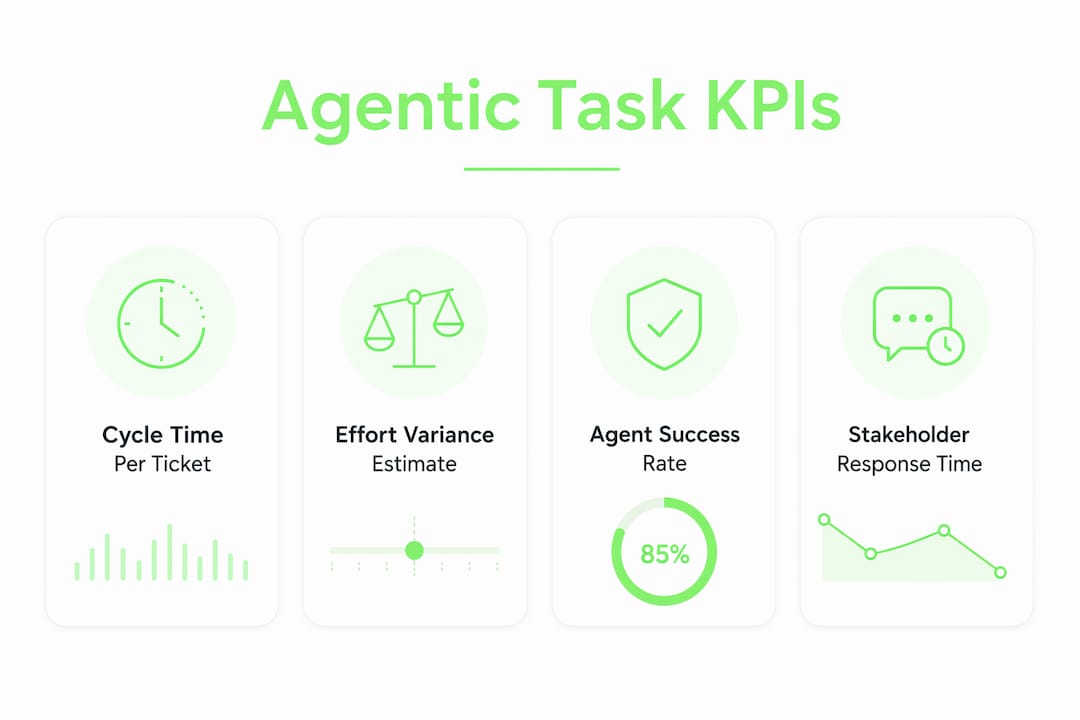
| KPI | Target | Stop Condition |
|---|---|---|
| Cycle time per ticket | Trending down week-over-week | Flat or rising for 3+ consecutive weeks |
| Estimated vs. actual effort | Within 20% variance | Consistently >30% over for 2+ sprints |
| Agent action success rate | >90% | Drops below 75% for one week |
| Stakeholder response time | <24 hours on flagged blockers | Exceeds expected duration for multiple weeks |
| ROI per project | Positive by day 90 | Negative through day 90 with no trend improvement |
Governance rules:
- Approval gates on all financial and legal decisions, no exceptions
- Action logs retained for a minimum of 90 days for audit purposes
- Humans own any decision that changes project scope or budget
- Weekly agent review in the first 60 days; bi-weekly after positive ROI is confirmed
Common pitfalls and red flags to watch for
Most failures trace back to four root causes: poor context, over-automation, missing effort tracking, and guest access mismanagement.
Red-flag checklist with immediate fixes:
- Duplicated tasks across projects — Immediate fix: enable multi-homing so one task lives in multiple projects without copies. Follow-up metric: duplicate task count.
- Agents making unreviewed changes — Immediate fix: add an approval gate to every agent action type. Follow-up metric: agent action success rate.
- Rising rework rates — Immediate fix: audit estimated vs. actual for the last two sprints. Follow-up metric: rework hours as a percentage of total hours.
- No project history in the workspace — Immediate fix: import past project data before expanding agent scope. Follow-up metric: agent query success rate.
- Poor onboarding documentation — Immediate fix: assign one team member to own the agent runbook for each active agent. Follow-up metric: time-to-productive for new team members.
How siift operationalizes this for founders
siift is a founder-first Agentic OS that implements the converged workspace and agent patterns described throughout this playbook, without requiring a dedicated ops team to configure it.
What siift brings to this framework:
- Founder playbooks that map directly to the 30/60/90 roadmap
- Validation pipelines that connect hypothesis testing to task execution
- Agent templates for status reporting and triage, pre-scoped for startup contexts
- Audit logs and approval gate configurations built in
- Guest access flows for advisors, investors, and early customers
- Integrations with knowledge stores so agents have real institutional context
Pro Tip: Use siift’s AI productivity tools alongside the 30/60/90 roadmap to validate your product hypotheses faster. The platform’s step-by-step guidance means you’re not configuring from scratch.
Security and privacy in AI-driven task management
AI agents operating inside your task layer have access to sensitive project data, client information, and sometimes financial context. That access requires deliberate governance, not just good intentions.
Start with the principle of least privilege: each agent should access only the data it needs to complete its scoped role. A status reporter doesn’t need budget data. A triage agent doesn’t need client contract terms. Scope access at setup, not after a breach.

Audit logs are your primary security control. Every agent action, every data query, every automated update should be logged with a timestamp and actor ID. Retain logs for at least 90 days; longer if your industry has compliance requirements. For teams handling any personally identifiable information, confirm your workspace provider’s data residency and encryption standards before deploying agents.
Guest access adds another surface area. Treat external collaborators as untrusted by default: read-only access unless write access is explicitly required for their role. Review guest permissions quarterly and revoke access when a project closes.
Finally, never let an agent make an irreversible decision autonomously. Budget changes, client communications, and scope modifications all require a human approval gate. The cost of a single unreviewed agent action in a client-facing context almost always exceeds the time saved by skipping the gate.
Key Takeaways
Agentic task management works when founders combine a converged workspace, scoped agents, and human approval gates before scaling automation.
| Point | Details |
|---|---|
| Converged workspace first | Centralize all project context before deploying any agent or template. |
| One scoped agent in 30 days | Deploy a single status-reporting agent in the first month to prove the model before expanding. |
| Measure estimated vs. actual | Track effort variance from day one; a consistent gap over 20% signals scope creep or over-automation. |
| Enforce approval gates | Humans must approve all financial, legal, and scope decisions, regardless of agent confidence. |
| siift accelerates the roadmap | siift’s New Business OS maps directly to this 30/60/90 framework with pre-built founder playbooks and validation pipelines. |
The part nobody tells you about agentic workflows
The biggest surprise in adopting agentic task management isn’t the technology. It’s the team.
Most founders assume the hard part is configuring agents or picking the right platform. In practice, the friction almost always comes from the first two weeks of team adoption, when people aren’t sure whether to trust the agent’s output or override it. That ambiguity kills momentum fast.
The practical fix is embarrassingly simple: make the agent’s reasoning visible. When a status reporter flags a blocker, show the team what data it used to make that call. Transparency builds trust faster than any onboarding deck. We’ve seen teams go from skeptical to reliant in under two weeks once the “why” behind an agent action is legible.
The second thing that surprised us: institutional memory is the real moat. Founders who imported their past project data before deploying agents saw dramatically faster agent accuracy than those who started fresh. Context isn’t a nice-to-have; it’s the whole game. If you’re evaluating Notion project management alternatives for your knowledge layer, prioritize searchability and API access above everything else.
siift gives founders a faster path to validated strategy
Founders who’ve worked through this playbook know the framework is sound. The question is execution speed. siift’s startup idea validation workflow puts the converged workspace, agent templates, and validation pipelines in one place, so you’re not stitching together five tools to get to your first automated status report. It’s built for founders who want clarity and traction, not another configuration project. Try the startup idea validation workflow and see how fast your first 30 days can move.
Useful sources and further reading
- Atlassian Jira: Project Management for the AI Era — Agent patterns, institutional knowledge design, and centralization ROI data
- monday.com: The AI Work Platform — Agentic workflow examples, open LLM connectors, and stakeholder automation
- ClickUp: Converged Workspace — Work sprawl research and single-source-of-truth principles
- Asana: Task Management Software — Multi-homing and cross-project task management
- Microsoft Teams Collaboration — Communication hub integration with task systems
- Toggl: Project Management — Estimated vs. actual tracking and scope creep detection
- ProjectManager.com — Guest access strategy and external collaboration licensing
- siift: Top 4 Asana Alternatives — Workspace consolidation and migration guidance
- siift: AI Tools for Entrepreneurs — AI tool categories for founder stacks
FAQ
What is agentic task management for teams?
Agentic task management uses autonomous AI agents to handle status reporting, triage, and blocker-flagging within a shared workspace, so human team members focus on decisions rather than coordination. Atlassian describes this as giving agents project history and institutional knowledge so plans become shipped output.
How long does it take to set up an agentic workflow?
A founder can deploy a single scoped status-reporting agent within the first 30 days using a phased approach. Full agentic coverage with triage, handoffs, and ROI measurement typically takes 60–90 days.
What KPIs should I track for team task management?
Track cycle time per ticket, estimated vs. actual effort variance, agent action success rate, and stakeholder response time on flagged blockers. Toggl identifies estimated vs. actual as the earliest signal of scope creep.
How does siift support agentic task management for founders?
siift’s New Business OS includes pre-built founder playbooks, validation pipelines, agent templates for status and triage, and audit logs, mapping directly to the 30/60/90 implementation roadmap described here.
What security controls matter most in AI-driven task management?
Least-privilege access per agent, full audit logs retained for at least 90 days, and human approval gates on all financial and scope decisions are the three non-negotiable controls for any AI-assisted task layer.