

TL;DR:
- Startups aim for rapid, scalable growth by disrupting markets and depend on outside funding.
- Validation through MVPs and customer interviews is crucial to avoid costly failures and attract investors.
A business startup is an early-stage company built to introduce an original idea and scale it rapidly, with the goal of disrupting an existing market or creating a new one entirely. The term gets thrown around loosely, but the business startup definition has real teeth: startups pursue exponential growth through scalable, disruptive models, not just steady revenue. They operate under high uncertainty, depend on outside capital, and live or die by how fast they can find product-market fit. If you’re an aspiring founder trying to figure out whether your idea qualifies, and what to do next, this guide gives you the full picture.

What is a business startup, and how is it different from a small business?
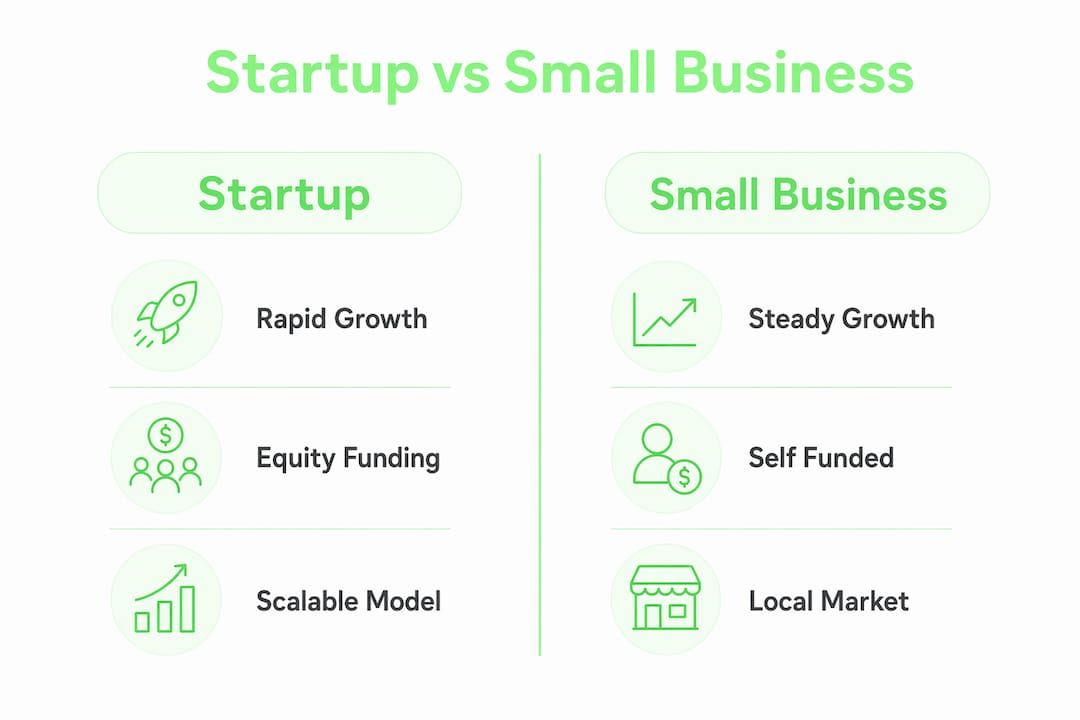
A startup and a small business are not the same thing, even though both involve someone taking a risk and building something from scratch. The distinction matters because it shapes your funding strategy, your team, and your entire growth plan.
Startups seek outside capital such as venture capital or angel investments in exchange for equity. Small businesses typically rely on personal savings, bank loans, or SBA-backed financing. That difference alone changes everything about how you operate.
Here is a clear breakdown of the core distinctions:
| Factor | Startup | Small Business |
|---|---|---|
| Primary goal | Rapid, exponential growth | Steady, sustainable revenue |
| Funding source | Equity investment (VC, angels) | Personal savings, debt financing |
| Business model | Scalable, often tech-driven | Established, proven models |
| Risk tolerance | High, by design | Moderate, managed carefully |
| Exit strategy | Acquisition or IPO | Long-term ownership or succession |
The mindset gap is just as wide as the financial one. A startup founder is betting on a hypothesis. A small business owner is executing a known playbook. Not every new business is a startup. True startups aim to disrupt industries or create new markets, not simply operate within existing ones. Your local bakery is a small business. A bakery that uses AI to predict demand and franchises nationally through a proprietary platform? That is a startup.
What are the essential steps to launch a startup?
Getting from idea to launched company requires more structure than most first-time founders expect. The excitement of a new idea can make you want to skip straight to building. That instinct will cost you.
The foundational steps to launch a startup follow a clear sequence:
- Ideate and research. Define the problem you are solving and who has it. Conduct market research to size the opportunity and identify competitors.
- Validate before you build. Test your core assumptions with real potential customers before writing a single line of code or spending on production.
- Write a lean business plan. Cover your value proposition, target customer, revenue model, and basic financial projections. You do not need a 40-page document. You need clarity.
- Choose a legal structure. Most startups incorporate as a C-Corp or LLC. Your choice affects taxes, liability, and your ability to raise equity funding later.
- Register your business. File with your state’s secretary of state office and obtain an EIN from the IRS. This number is your business’s tax identity.
- Open a dedicated business bank account. Mixing personal and business finances creates legal and tax headaches that compound fast.
- Set up basic operations. Accounting software, a business address, and a simple website are the minimum viable infrastructure.
The IRS and SBA both publish checklists confirming that early legal and financial setup directly affects your liability exposure and future tax obligations. Skipping these steps early does not save time. It creates expensive problems later.
Pro Tip: Open your business bank account the same week you get your EIN. Separation of finances from day one protects you legally and makes tax season dramatically less painful.
Why is market validation critical for startup success?
Validation is the process of confirming that real people have the problem you think they have, and that they will pay for your solution. It sounds obvious. Founders skip it constantly anyway.
Skipping validation is one of the primary causes of early-stage startup failure. The logic is seductive: you believe in your idea, so you build it. Then you discover the market does not care. Months of work and thousands of dollars disappear.
The minimum viable product (MVP) is the standard tool for validation. An MVP is the simplest version of your product that lets you test your core assumption with real users. It is not a rough draft of your full product. It is a focused experiment. Airbnb’s original MVP was a simple website with photos of an apartment. Dropbox validated demand with a demo video before building anything.
Qualitative methods matter just as much as the MVP. Problem interviews ask potential customers to describe their current frustrations without you pitching your solution. Solution interviews present your concept and measure genuine interest. Both methods surface insights that surveys miss entirely.
The business idea validation process also signals investor readiness. Without a validated, scalable business model, companies are rarely considered venture-backable startups regardless of how novel the idea sounds. Validation is not just about reducing your own risk. It is the language investors speak.
Pro Tip: Talk to 20 potential customers before you build anything. If you cannot find 20 people willing to spend 20 minutes discussing their problem, that tells you something critical about your market.
What traits and team roles make a startup succeed?
The founding team is the single most predictive factor in early startup success. Ideas are cheap. Execution is everything. And execution requires the right people in the right seats.
Successful founding teams typically cover three core roles:
- Technical or product. The person who builds the thing. In a software startup, this is usually a developer or product manager with deep domain knowledge.
- Marketing or customer acquisition. The person who finds customers, tells the story, and drives growth. Without this role, even great products stay invisible.
- Finance or operations. The person who manages the money, the processes, and the infrastructure that keeps the company running as it scales.
Solo founders can and do succeed, but the data consistently favors balanced teams. Each role covers a blind spot the others have. A technical founder without a marketing co-founder often builds a product nobody knows about. A marketing founder without a technical co-founder often promises something that cannot be built.
Financial discipline separates startups that survive from those that do not. Startup financial management prioritizes managing burn rate and scaling, which is fundamentally different from a small business focused on immediate profitability. Burn rate is the speed at which you spend your cash reserves. Every founder needs to know their number. If you have $200,000 in the bank and spend $20,000 per month, you have 10 months to prove your model. That clock is always running.
The right mindset matters as much as the right team structure. Risk tolerance, comfort with ambiguity, and the ability to iterate fast without ego are traits that separate founders who adapt from those who dig in and fail slowly.
How do startups grow sustainably after launch?
Growth after launch is where most startups discover the gap between their plan and reality. The launch phase feels like the finish line. It is actually the starting gun.
Most startups do not reach profitability within five years but attract investment through demonstrated growth potential. That means your job post-launch is not to be profitable immediately. It is to prove that your model can scale. Investors fund potential, not just performance.
Funding rounds follow a typical progression as a startup matures:
| Stage | Funding Type | Primary Purpose |
|---|---|---|
| Pre-seed | Founder capital, friends and family | Build MVP, validate idea |
| Seed | Angel investors, early-stage funds | Hire core team, refine product |
| Series A | Venture capital firms | Scale marketing and operations |
| Series B+ | Larger VC rounds | Expand markets, build infrastructure |
Founders go through multiple funding rounds as part of the growth lifecycle, each one requiring stronger proof of traction than the last. The metrics that matter shift at each stage. Pre-seed investors bet on the founder. Seed investors bet on early traction. Series A investors bet on a repeatable growth engine.
Sustainable growth also requires a scalable online presence from early on. Organic channels compound over time in ways that paid advertising cannot. Founders who invest in content and SEO early build assets that pay dividends for years.
The first five years carry extreme uncertainty and failure risk. Demonstrating a repeatable, scalable model is more critical than early profit. The founders who survive this phase share one trait: they stay close to their customers and adjust faster than the market changes.
Key Takeaways
A business startup is defined by its intent to scale rapidly through innovation, and that intent shapes every decision from team structure to funding strategy.
| Point | Details |
|---|---|
| Startups differ from small businesses | Startups pursue exponential growth through equity funding; small businesses focus on steady revenue through debt financing. |
| Legal setup is non-negotiable | Obtain an EIN, choose a legal structure, and open a business bank account before you spend a dollar on product. |
| Validation prevents costly mistakes | Test your core assumption with real customers using MVPs and problem interviews before committing to full development. |
| Team composition predicts success | Cover technical, marketing, and finance roles in your founding team to reduce execution blind spots. |
| Post-launch focus is scalability | Investors fund demonstrated growth potential, not early profitability; prove your model can repeat and expand. |
What I’ve learned about when a startup idea is actually ready
Here is the uncomfortable truth most startup content skips: the majority of founders I have seen struggle did not fail because they lacked talent or resources. They failed because they fell in love with their solution before they understood the problem.
The startup world romanticizes the “build fast and break things” ethos. That works if you have already validated the problem. Without that foundation, you are just building fast toward a wall. I have watched technically brilliant founders spend 18 months on a product that their target customers never asked for. The pain of that is real, and it is avoidable.
The non-linear reality of the early startup validation process is that you will loop back. You will think you have validated your idea, talk to 10 more customers, and realize you had the wrong customer segment entirely. That is not failure. That is the process working. The founders who treat each loop as data rather than defeat are the ones who eventually find their footing.
My strongest advice: build your team before you think you need it. The instinct to stay lean and solo as long as possible is understandable. But the gaps in your founding team show up at the worst possible moments, usually when a big opportunity or a serious crisis demands skills you do not have. Complementary co-founders are not a luxury. They are a risk management strategy.
The mindset shift that matters most is moving from “I have a great idea” to “I have a hypothesis I need to disprove.” That single reframe changes how you spend your time, your money, and your energy. It makes you a better founder before you have built a single thing.
— Samim
How Siift helps founders go from idea to validated startup
Turning a startup idea into a real, fundable business requires more than enthusiasm and a pitch deck. Siift’s New Business OS guides founders step by step through ideation, validation, and go-to-market planning with an AI-driven approach built specifically for early-stage entrepreneurs. Unlike generic AI tools, Siift filters out the noise, biases, and blind spots that derail most founders before they find traction. If you are ready to validate your startup idea with a structured, proven process, Siift gives you the clarity and confidence to move forward without the guesswork that kills most ventures early. Visit siift.ai to start building your validated strategy today.
FAQ
What is the business startup definition?
A business startup is an early-stage company designed for rapid growth and scalability through an innovative product or service. Startups typically seek equity investment and aim to disrupt existing markets or create new ones.
How is a startup different from a regular small business?
Startups pursue exponential growth through scalable models and equity funding, while small businesses focus on steady revenue through personal savings or debt financing. The goals, risk profiles, and exit strategies are fundamentally different.
What are the first steps to launch a startup?
The first steps include validating your idea with real customers, writing a lean business plan, choosing a legal structure, registering your business, and obtaining an EIN from the IRS. Separating business and personal finances from day one is also critical.
Why do most startups fail in the early years?
Skipping market validation is one of the primary causes of early-stage startup failure. Founders who build without confirming real customer demand often discover too late that the market does not need their solution.
What makes a startup attractive to investors?
Investors fund demonstrated growth potential and a scalable, repeatable business model, not immediate profitability. A balanced founding team, validated market demand, and clear traction metrics are the strongest signals for early-stage funding.