
TL;DR:
Most founders mistakenly see a business model solely as a revenue strategy, but it is actually a comprehensive system for creating, delivering, and capturing value that influences startup longevity.
Understanding and testing each core element—value proposition, operations, go-to-market plan, and profit formula—builds an adaptable, integrated blueprint essential for market success.
Most founders think a business model is just their revenue strategy. That’s a costly misunderstanding. A business model is far more than a way to make money — it’s a complete system for creating, delivering, and capturing value, and how you design that system will determine whether your startup earns loyal customers or quietly disappears within its first two years. The founders who grasp this early move faster, waste less money, and build ventures that actually last. This guide breaks it all down, step by step.
Table of Contents
Key Takeaways
Point | Details |
|---|---|
Business model basics | A business model integrates how your venture creates, delivers, and captures value. |
Key elements matter | Founders must understand value proposition, operations, go-to-market, and profit to build real businesses. |
Canvas frameworks help | The Business Model Canvas is a practical tool for mapping and testing your idea step-by-step. |
Validation is crucial | Testing your assumptions with real feedback is the difference between theory and traction. |
Think beyond your startup | Winning business models interact with competitors and ecosystems, shaping bigger outcomes. |
What is a business model?
Now that we’ve established why a business model is critical, let’s start by defining what it actually is — and why the definition matters more than most early-stage founders realize.
At its core, a business model is your startup’s operating logic. It answers the questions every investor, customer, and teammate will eventually ask: Who are you serving? What problem are you solving? How do you deliver that solution? And how does the math actually work? Think of it as the blueprint beneath your product, the architecture that holds everything else together.
“A business model is the system a company uses to create value for customers, deliver that value efficiently, and capture enough of it back to sustain and grow the business.”
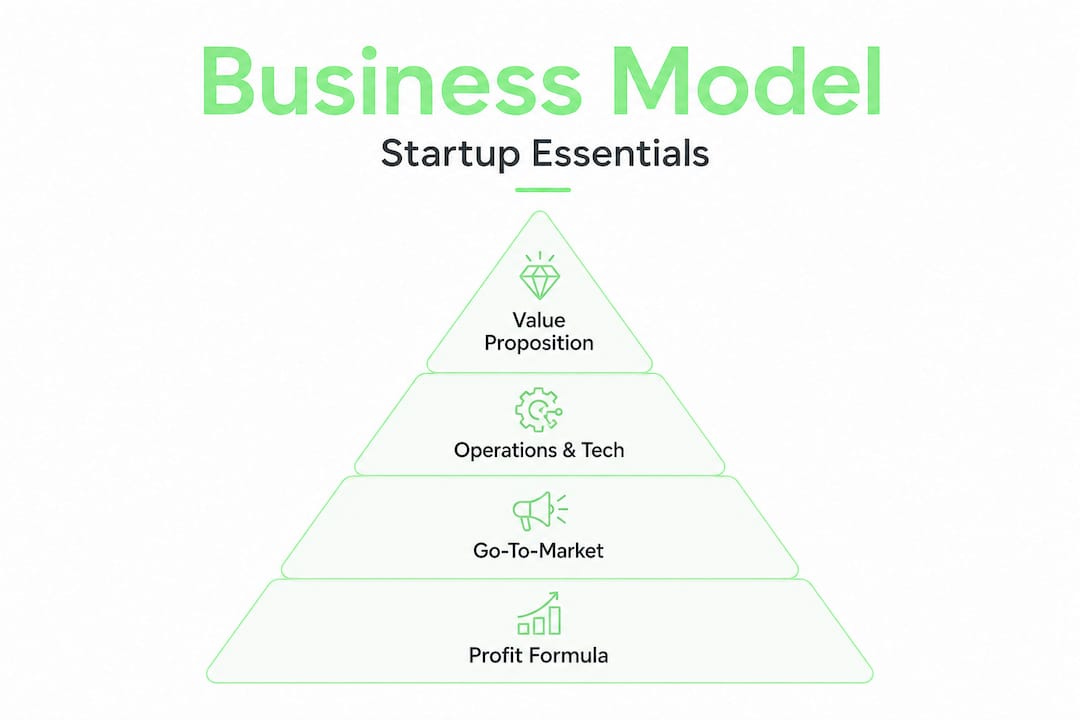
Harvard Business School frames four essential elements that every viable business model must address: a customer value proposition, a technology and operations plan, a go-to-market plan, and a profit formula. Each one must work in concert with the others. Pull any single element out and the whole system weakens.
It’s worth noting that the academic world hasn’t fully settled on one definition. Scholarly debates around what business models are and how they function — whether they’re attributes, schemas, or formal conceptual representations — continue to evolve. For founders, though, this ambiguity is actually liberating. It means you don’t need to chase a textbook answer. You need a working blueprint you can test, adjust, and iterate on in the real world.
The key components worth anchoring to are straightforward:
Value proposition: The specific outcome your customer gets from choosing you
Operations and technology: The internal systems that make delivery possible and scalable
Go-to-market plan: How you reach, acquire, and retain customers
Profit formula: The revenue, cost, and margin dynamics that make growth financially sustainable
Understanding your value proposition basics is where most founders should start, because without clarity there, the other three elements tend to drift and misalign.
Core elements of a business model
With a clear definition in place, understanding the building blocks is the next step. Founders need to see how each part underpins a cohesive whole, not just as isolated concepts but as an integrated system that either works together or falls apart together.

HBS emphasizes that early founders must build their business model as an integrated system, not a collection of separate decisions. Here’s how each element shows up in practice:
Element | What it answers | Startup example |
|---|---|---|
Value proposition | Why should anyone buy from you? | “We help freelancers get paid 3x faster” |
Operations and tech | How do you deliver consistently? | Automated invoicing platform with smart reminders |
Go-to-market plan | How do customers find and choose you? | LinkedIn content + referral partnerships |
Profit formula | What does the unit economics look like? | $49/month subscription, 80% gross margin |
Notice how each row connects to the next. If your value proposition targets freelancers who hate chasing invoices, your operations need to make payment collection frictionless, your marketing needs to reach people experiencing that exact pain, and your pricing needs to reflect the real value of time saved.
Pro Tip: Before you finalize your business model, write one sentence for each of the four elements above. If any sentence contradicts another, you’ve found a misalignment that could hurt you in the market later.
For founders still figuring out their positioning, spending serious time creating a value proposition that’s grounded in real customer language is one of the highest-leverage activities in the early stage. It shapes everything downstream.
Here’s a practical checklist for building each element with intention:
Value proposition: Interview at least 10 potential customers before locking this in
Operations: Map your delivery process from “customer signs up” to “customer achieves outcome”
Go-to-market: Identify two or three specific channels where your target customer already spends time
Profit formula: Model three scenarios (conservative, base, optimistic) for revenue and costs in year one
These aren’t just planning exercises. They’re the foundation for every pitch, partnership, and product decision you’ll make going forward.
Mapping your model: the Business Model Canvas
With the essential elements clarified, founders need a way to capture, visualize, and test them. This is where the Business Model Canvas comes in, and it’s arguably one of the most useful tools ever created for early-stage startups.
The Business Model Canvas (BMC) is a single-page strategic tool that lets you map your entire business on one sheet. Originally developed by Alexander Osterwalder, it organizes your model into nine essential building blocks, from customers and value to channels, revenue streams, key resources, partnerships, and cost structures. What makes it so powerful for founders is that it turns an abstract business concept into something visual, shareable, and easy to iterate.
The nine blocks of the Business Model Canvas are:
Customer segments — Who exactly are you building for?
Value propositions — What outcome or benefit do you deliver?
Channels — How do customers discover, buy, and receive your product?
Customer relationships — How do you attract, retain, and grow customers?
Revenue streams — How does your business earn money from each segment?
Key resources — What assets does your business model require to function?
Key activities — What must you do exceptionally well to deliver value?
Key partnerships — Who do you rely on to fill gaps in resources or capabilities?
Cost structure — What are your most significant costs and how do they scale?
Pro Tip: Fill out the BMC in this order — customer segments first, then value proposition, then the rest. Founders who start with revenue streams often build models optimized for their own preferences rather than real customer needs.
The canvas is also a powerful communication tool inside your team. When everyone can see the whole model on one page, conversations sharpen quickly. Disagreements about strategy become visible, not just theoretical. For a deeper look at how to use this tool in practice, our guide on canvas-based startup validation walks through the process with real founder examples, and our AI-powered BMC guide shows how to accelerate the process using intelligent tools.
Traditional approach | Canvas approach |
|---|---|
Long written business plan | One-page visual model |
Hard to iterate quickly | Easy to pivot and re-map |
Siloed team understanding | Shared team clarity |
Static document | Living, testable framework |
The canvas doesn’t replace deep thinking. It accelerates it.
Testing and validating your business model
Developing the business model on paper is only half the journey. To survive and scale, startups must validate their model assumptions in the market, because assumptions left untested are just guesses dressed up as strategy.
Business model success depends on rigorous testing of value, operations, go-to-market, and profit, not just the quality of your original idea. Here’s how to move from theory to evidence:
Identify your riskiest assumptions. Every box on your canvas contains at least one assumption. Which one, if wrong, would kill your business? Start there.
Design a minimum viable experiment. You don’t need a full product to test your value proposition. A landing page, a prototype, or even a manual “Wizard of Oz” service can surface real customer signals.
Talk to real people, not just supportive friends. Customer discovery interviews are your most reliable early data. Ask about behaviors, not opinions.
Measure what matters. For the value proposition, track conversion rates. For operations, track delivery time and error rates. For go-to-market, track cost per acquisition and retention.
Iterate with intention. When data contradicts your model, adjust the specific element that’s failing, not your entire strategy. Precision matters here.
“The goal of early-stage validation isn’t to prove you’re right. It’s to figure out where you’re wrong before the market does it for you, at full cost.”
There’s a rich body of ongoing scholarly discussion around how business models function under real-world conditions, and one consistent thread is that models are never truly finished. They evolve. Our simple BMC startup guide is a great starting point for structuring your first validation sprint, and our resource on AI-enhanced BMC strategies shows how founders are using intelligent tools to cut validation time significantly.
Pro Tip: Create a simple “assumption log” — a spreadsheet that lists each canvas assumption, how you’ll test it, what result would confirm it, and what result would challenge it. Review it weekly during your first 90 days.
Competitive dynamics and virtuous cycles
A validated business model faces its toughest test when exposed to real competitors and shifting market dynamics. This is where many founders are caught off guard, because they built a great model in isolation but didn’t account for how it performs inside a competitive ecosystem.
Business models can create powerful competitive dynamics, and success often depends on interactions with others and the potential for network effects. Network effects occur when your product becomes more valuable as more people use it — think of social platforms, marketplaces, and communication tools. When your model captures this dynamic, growth accelerates and your competitive moat deepens with every new user.
But there are real traps here too. Consider these competitive risks:
Winner-take-all markets: In some industries, the dominant player captures nearly all the value, leaving little room for number two. Understanding whether you’re entering that kind of market is critical.
Commoditization pressure: If your model doesn’t include a defensible differentiator, competitors can replicate your offering and compete purely on price.
Platform dependency: Relying too heavily on a single distribution channel (like one social media platform or one marketplace) creates fragility that can unravel quickly.
Ecosystem misalignment: Sometimes your model is sound, but it disrupts existing players who then actively work to block your growth.
The best founders think about their model not as a static design but as a living system that interacts with partners, competitors, and customers simultaneously. Exploring lean canvas alternatives can help you find frameworks better suited to mapping these competitive dynamics in problem-driven markets.
Key insight: The startups that build virtuous cycles — where growth reinforces value, which drives more growth — are the ones that scale disproportionately. Design for that loop from day one.
What most founders get wrong about business models
Here’s the counterintuitive truth we’ve observed from working with early-stage founders across industries: most of the confusion around business models comes not from lack of knowledge but from treating the model as a destination rather than a tool for continuous learning.
Founders read about the Business Model Canvas, fill it out once, file it away, and return to building their product. That’s the trap. Because business model research itself lacks consensus on definitions, frameworks, and mechanisms, no single template can tell you whether your specific model will work in your specific market for your specific customer. Only the market can tell you that, and only if you’re actively listening.
What we’ve seen work is treating the business model not as a document but as a set of live hypotheses. Every customer conversation either confirms or challenges one of those hypotheses. Every failed campaign tells you something about your go-to-market assumptions. Every pricing experiment teaches you about the real perceived value of your offer.
The founders who scale fastest aren’t those with the most sophisticated models. They’re the ones willing to update their model based on what they learn, quickly and without ego. Business uniqueness matters too. Every venture has a different customer, a different context, a different competitive reality. Borrowing a framework from a successful startup in a different category can guide you, but it cannot substitute for first-principles thinking about your own model.
Our perspective: stop chasing the “perfect” business model and start chasing customer clarity. Use tools like the practical BMC innovation frameworks to structure your thinking, then get out and test it. The model gets sharper with every real-world signal.
Apply business model strategy with founder-focused tools
Ready to put your business model skills to work? The right tools can make the difference between ideas that stall and ventures that thrive. At siift, we built our platform specifically for founders who are done guessing and ready to build with a systematic, validated approach. Whether you’re still mapping your first canvas or pressure-testing your go-to-market assumptions, siift.ai’s founder tools guide you through ideation, validation, and go-to-market step by step, using agentic AI that’s purpose-built for your founder journey. You get structured thinking, bias filtering, and strategic clarity — all without needing a VC or a consultant to tell you what to do next. Start building smarter.
Frequently asked questions
What is the main purpose of a business model?
A business model explains how a company creates and captures value for its customers and itself, serving as the operating logic behind every key decision.
How is a business model different from a business plan?
A business model focuses on the system that delivers value and generates profit, while a business plan is a detailed proposal for executing and scaling that model over time.
What are the key components of a business model for startups?
Key components include a value proposition, operations and technology, a go-to-market plan, and a profit formula. HBS emphasizes these four as the integrated foundation every early-stage founder must address.
Is the Business Model Canvas only for tech startups?
No. The BMC’s nine building blocks are a flexible strategic tool applicable to any type of venture, from product startups to service businesses to nonprofits.
Why do some business models fail even if the product is good?
Failure often stems from gaps in operations, marketing, or competitive positioning, not the product itself. Startup outcomes hinge on how well the entire model system performs, not just one element of it.