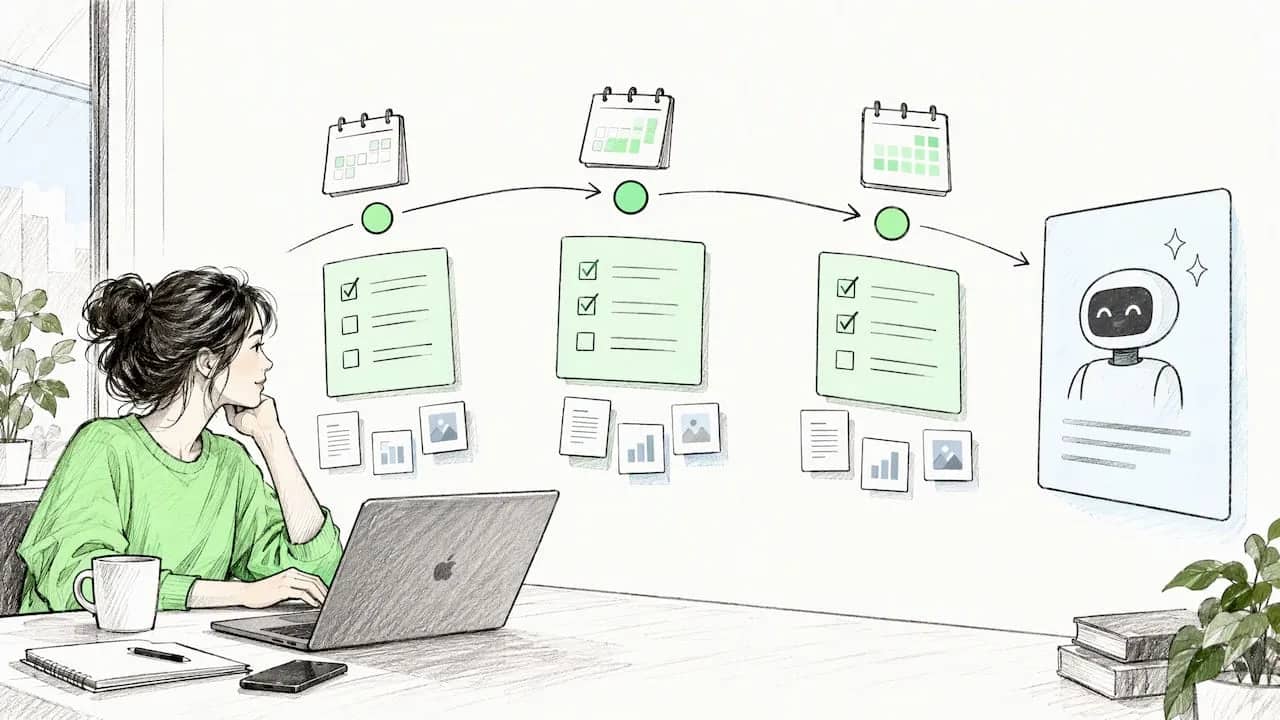

AI transforms product managers from workflow coordinators into orchestrators of AI-generated outputs, and that shift changes what good PM work actually looks like. Your single best next move is simple: build a lightweight evaluation rubric, pick one AI-driven feature, and run a 30 to 90 day experiment against it. We developed our own operating approach around exactly this instinct, because the PMs who win this transition aren’t the ones who adopt AI fastest. They’re the ones who measure it best.
TL;DR:
- Building a clear evaluation rubric and labeling real outputs helps measure AI feature quality more effectively than simply adopting AI tools.
- Conducting short, focused 90-day pilots with defined success metrics enables product teams to prove AI improves outcomes before scaling.
- Developing technical literacy, evaluation skills, and human judgment is crucial to succeed in managing AI-generated outputs.
- Using curated golden outputs, human review, and automation in evaluation helps ensure AI performance meets safety and accuracy standards.
- Prioritizing proof of impact over vocabulary or tool adoption will distinguish AI-native product managers in the evolving landscape.
Table of Contents
- What is an AI product manager, and how does the role shift?
- Core skills, mindsets, and practices to develop
- How to run evals and instrument AI output quality
- Which AI tools map to which PM jobs?
- Training, certifications, and career pathways for AI-native PMs
- A 90-day starter playbook you can copy
- What hiring managers actually value in AI-native PMs
- How siift helps you run your own 90-day AI experiment
- FAQ
- Sources
What is an AI product manager, and how does the role shift?
An AI product manager is still a product manager, but the job has grown a new core muscle: judging the quality of machine-generated work, not just the process that produced it. Traditional PM craft centers on writing specs, sequencing roadmaps, and shipping workflows that humans execute. When AI agents and copilots start doing the executing, the PM’s job moves one level up: defining what “good” looks like for an output the PM didn’t personally write or review line by line.
That shift touches every stage of the lifecycle. Discovery now includes testing what an AI model can and can’t reliably do before you commit a roadmap slot to it. PRDs increasingly need to specify quality thresholds and failure tolerances alongside features. Delivery means watching for model drift, not just bug reports. And metrics expand beyond conversion and retention to include things like task completion accuracy and trace-level success rates.
This isn’t a hypothetical future state. 64% of product teams already report integrating AI into their products, according to the Pragmatic Institute’s State of Product Management & Marketing report. But adoption and clarity are two different things: the same research notes that integrating AI hasn’t automatically translated into better decision-making. Having the tool isn’t the win. Knowing what to do with it is.
That gap between adoption and competence is exactly where the next few sections live.
Core skills, mindsets, and practices to develop
The PMs pulling ahead right now aren’t the ones with the flashiest AI vocabulary. They’re the ones building a specific, learnable skill set around judging and shaping machine output. Three buckets matter most.
Technical literacy means understanding enough about how models work to spot when they’re likely to fail, writing prompts that actually constrain behavior, and reading through model traces to diagnose what went wrong and why. You don’t need to train a model. You need to read its homework critically.
Evaluation skills are the newest and most undervalued muscle. This means building rubrics that define quality across multiple dimensions, curating “golden” examples of ideal output, and labeling real production traces against that standard consistently enough that two different reviewers reach the same verdict.

Human skills haven’t gone anywhere, they’ve gotten more valuable. Judgment calls about what tradeoffs matter, stakeholder alignment when an AI feature underperforms expectations, and plain clear communication about uncertainty are still entirely a human job.
Here’s where to start practicing:
- Pick one AI feature in your product and write a one-page rubric scoring its output on accuracy, tone, and safety.
- Pull 20 real output examples and label them against your rubric by hand before automating anything.
- Shadow an engineer reading model traces for a week and note every failure pattern you didn’t expect.
- Draft a PRD section that specifies acceptable failure rates, not just desired features.
Each of these becomes a concrete artifact you can point to later: proof you’ve done the work, not just read about it.
How to run evals and instrument AI output quality
Static workflow specs assume a human will execute every step predictably. AI breaks that assumption, so the PM’s new job is defining golden outputs: curated examples of what “right” looks like, which then become the yardstick for everything the model produces afterward. This is the practical core of what Calibre Labs calls the shift in AI evals: moving from describing workflows to specifying desired outputs and the quality bar they must clear.
Here’s the sequence that works in practice:
- Collect 20 to 50 real or representative output examples from the feature you’re evaluating.
- Have designers or domain experts hand-craft a small set of ideal “golden” outputs to anchor the rubric.
- Build a rubric with orthogonal dimensions, accuracy, helpfulness, tone, and safety work well as a starting set, so reviewers aren’t scoring the same thing twice under different labels.
- Label a batch of real traces against the rubric manually first, to catch ambiguity before you automate.
- Automate repeatable checks once human labeling is consistent, and route edge cases back to human review.
- Fold the rubric into your PRD, QA checklist, and release gate so a feature can’t ship without clearing its evaluation bar.
Pro Tip: Use an LLM-as-judge for high-volume, low-stakes scoring to save reviewer time, but keep humans in the loop for anything touching safety, bias, or edge cases a model hasn’t seen before.
Teams that treat evaluation as a core discipline are addressing a real gap: 77% of surveyed product managers reported lacking clarity on how to define and implement responsible AI practices, per UC Berkeley’s Responsible AI Initiative. Rubrics and golden outputs give that clarity a concrete, shippable form instead of leaving it as a vague aspiration.
Treating evals as a first-class artifact, versioned and reviewed like code, is what separates teams measuring real task success from teams still measuring app session duration and calling it a proxy for AI quality.
Which AI tools map to which PM jobs?
Rather than chasing every new tool launch, map categories to the job you actually need done. Each category carries its own data and governance tradeoffs.
- Agents and copilots handle multi-step task execution inside a workflow; they need access to your product data and a clear audit log of every action taken.
- Analytics and observability tools track model behavior and output quality over time; they need trace-level logging, not just aggregate dashboards.
- Annotation pipelines support the human labeling work behind your rubrics; they need clear labeling guidelines and reviewer consistency checks built in.
- Prototyping LLMs let you test feature ideas fast before committing engineering time; they need sandboxing so test prompts never touch production data.
- Experiment platforms run your pilots and measure results against a control; they need clean success metrics defined before the pilot starts, not after.
Before adopting any tool in these categories, run through a short procurement checklist: who has access, what gets logged, how traceable is a given output back to its inputs, and where customer data lives once it enters the pipeline. This matters even more as orchestration-first approaches become standard; productivity research on AI-driven workflows consistently points back to the same lesson: the gains show up when the process around the tool is disciplined, not just when the tool itself is powerful.
Training, certifications, and career pathways for AI-native PMs
Short courses build vocabulary fast but rarely teach judgment. Certificate programs, like the IBM AI Product Manager Professional Certificate on Coursera, combine product fundamentals with generative AI skills across a structured, multi-course path, useful if you want a credential and a curriculum in one package. Cohort programs add peer accountability but cost more time. Internal rotations into data or ML teams teach the most durable skills but depend entirely on your company having that team to rotate into.
A staged curriculum beats a scattered one. Start with fundamentals: how models work, where they fail, basic prompt design. Move into evals practice: build your first rubric, label your first batch of traces. Then run a production pilot with real users and real stakes. Finish with governance: bias testing, data privacy review, and documentation your legal and security teams will actually sign off on.

Credentials matter less than evidence. The artifact that gets you promoted isn’t a certificate, it’s a rubric you built, a pilot you ran, and a metric you moved. Skill gaps around AI and data capability remain a documented bottleneck across product teams according to Emergn’s 2025 survey, which means a PM who can show, not just claim, AI fluency stands out fast.
A 90-day starter playbook you can copy
A good AI pilot doesn’t need six months and a committee. It needs a tight scope, a rubric, and a deadline. Here’s a sequence that compresses the work into three phases.
- Weeks 1 to 3, discovery: pick one feature, interview five users about the problem it solves today, and draft your initial rubric dimensions.
- Weeks 4 to 6, prototype: build a thin AI-powered version using an existing model, no custom training needed yet.
- Weeks 7 to 9, evals: collect 30 to 50 real outputs, label them against your rubric, and craft three to five golden examples to anchor future scoring.
- Weeks 10 to 12, pilot: ship to a small user segment, track task success and rubric scores weekly, and write a one-page experiment brief summarizing what you learned.
The deliverables that matter at the end: a versioned rubric, a golden output set, a pilot readout with real numbers, and a clear go or no-go recommendation. Our own 90-day AI playbook for product managers walks through this exact structure with more detail on each phase, if you want a template to adapt rather than build from scratch. Running small, tightly instrumented pilots like this is also the clearest defense against what Emergn’s research calls the “intelligent delusion”: investment in AI tools rising without proof those tools are actually improving outcomes.
What hiring managers actually value in AI-native PMs
Hiring managers aren’t impressed by AI vocabulary anymore, everyone has that. What stands out is evidence: a rubric you built, a pilot you ran, a metric you moved, and the judgment to explain why it mattered. Orchestration skill and eval mastery are becoming the real differentiators, not prompt tricks.
What AI still can’t do is read a room, sense when a stakeholder’s “sounds good” actually means “I have concerns,” or know which battles are worth fighting. That judgment is still entirely yours, and it’s the part no model is coming for.
— Samim Safaei
How siift helps you run your own 90-day AI experiment
Building an AI feature on instinct is a fast way to waste a quarter. We designed a New Business OS to give product leaders and founders a structured, step-by-step way to validate ideas instead of guessing, with built-in frameworks for mapping context, filtering out blind spots, and turning a rough concept into a tested strategy. If you’re navigating the uncertainty of building something new around AI, this approach stands out as the practical way to do it with structure instead of guesswork: the platform walks you through validation and go-to-market planning systematically, so your 90-day pilot has a real strategic backbone instead of a loose set of good intentions.
Our Discover plan starts at $29 per month per user, and our Focus plan runs $99 per month per user for teams ready to go deeper on strategy mapping and execution planning. You can also start on our Free plan to see how the workflow fits your process. Check out our startup idea validation tools to see how we support the exact experiment structure this playbook describes.
FAQ
Which AI is best for product managers?
There’s no single “best” AI tool for every PM task, the right choice depends on whether you need an agent for execution, an analytics tool for tracking quality, or a prototyping model for fast testing. Match the tool category to the specific job, and prioritize ones with strong logging and traceability so you can evaluate output quality later.
How can a product manager use AI?
PMs use AI across the lifecycle: speeding up discovery research, prototyping features before committing engineering time, and automating repetitive analysis work. The highest-leverage use is building evaluation rubrics and golden outputs so you can measure whether AI-generated work actually meets your quality bar.
Can AI take product management jobs?
AI is more likely to reshape the PM role than eliminate it, shifting responsibility from writing specs toward evaluating and orchestrating AI-generated outputs. The judgment, stakeholder alignment, and prioritization work at the center of product management remain distinctly human tasks.
What is the best AI course for product managers?
The right course depends on your starting point: the IBM AI Product Manager Professional Certificate on Coursera combines generative AI skills with product fundamentals across a structured, multi-course path. For hands-on learning, pairing a course with a real pilot project, like building your own evaluation rubric, tends to build more durable skill than coursework alone.
How do I measure the impact of an AI product feature?
Go beyond traditional metrics like session duration and track task completion accuracy, rubric scores against your golden outputs, and failure rate trends over time. A clear experiment brief with a defined success threshold, set before the pilot starts, keeps the measurement honest.
Sources
- UC Berkeley: Guide helps business leaders navigate AI ethics
- How AI evals are changing product management | Calibre Labs
- The 2025 State of Product Management & Marketing Report | Pragmatic Institute
- Emergn Survey Report 2025 - The Global Intelligent Delusion
- IBM AI Product Manager Professional Certificate | Coursera