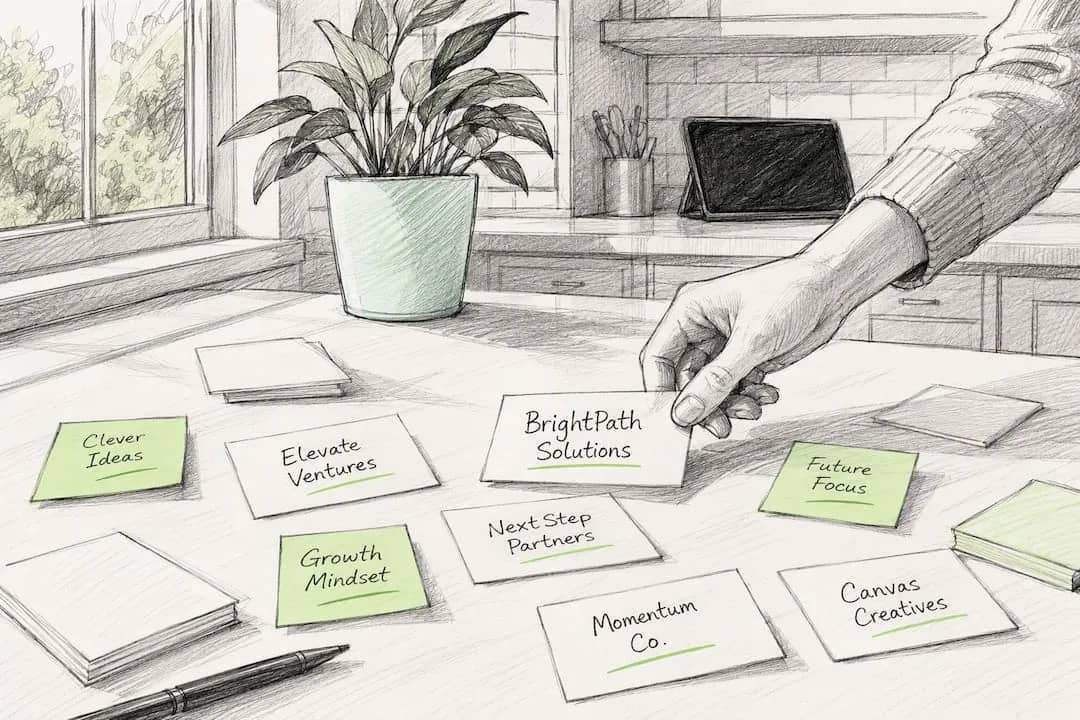
A good business name is short, easy to say and spell, flexible enough to grow with you, and legally free to use. Your first move isn’t more brainstorming, it’s a reality check: run a quick domain search, a Secretary of State entity check, and a basic USPTO trademark search before you fall in love with anything.
TL;DR:
- Conduct a thorough domain search, state entity check, and USPTO trademark search to ensure name availability before becoming emotionally attached.
- Generate 15 to 50 raw name candidates through broad brainstorming and value mapping, avoiding early judgment to allow creative options to mature.
- Use objective scoring based on memorability, pronunciation, distinctiveness, scalability, and domain availability to narrow down your top choices effectively.
- Test final candidates with a trust scale poll of target customers and perform quick stress tests on pronunciation and online presence to ensure practical usability.
- Register your business entity, federal trademark, domain, and social handles in sequence, checking all four for each name to avoid costly rebrands or legal conflicts later.
Table of Contents
- Where do good business names actually come from?
- How do you narrow a name list down to your top three?
- What legal protections does a business name actually need?
- How do you check domain names and social handles fast?
- What’s the full pre-launch naming checklist?
- What naming mistakes force an expensive rebrand later?
- How does siift help founders systematize name validation?
- Where can you double-check name availability yourself?
- The part nobody tells you about naming
- Sources
- FAQ
Where do good business names actually come from?
Nobody wakes up with the perfect name fully formed. It comes from casting a wide net first, then ruthlessly narrowing. Skip the net and you’ll end up circling the same three mediocre options for weeks, second-guessing every one.
The goal here is volume before judgment. You want 15 to 50 raw candidates before you let your inner critic anywhere near the list, according to the naming framework BigCommerce lays out. Judging too early kills good-but-weird ideas before they’ve had a chance to evolve into something great.
Structured brainstorming exercises that actually work
Start with a word dump. Grab a notebook or open a blank doc and write down every word connected to your business: what you do, who you serve, how it feels to use your product, the problem you solve. Don’t edit. Don’t filter. Just dump.
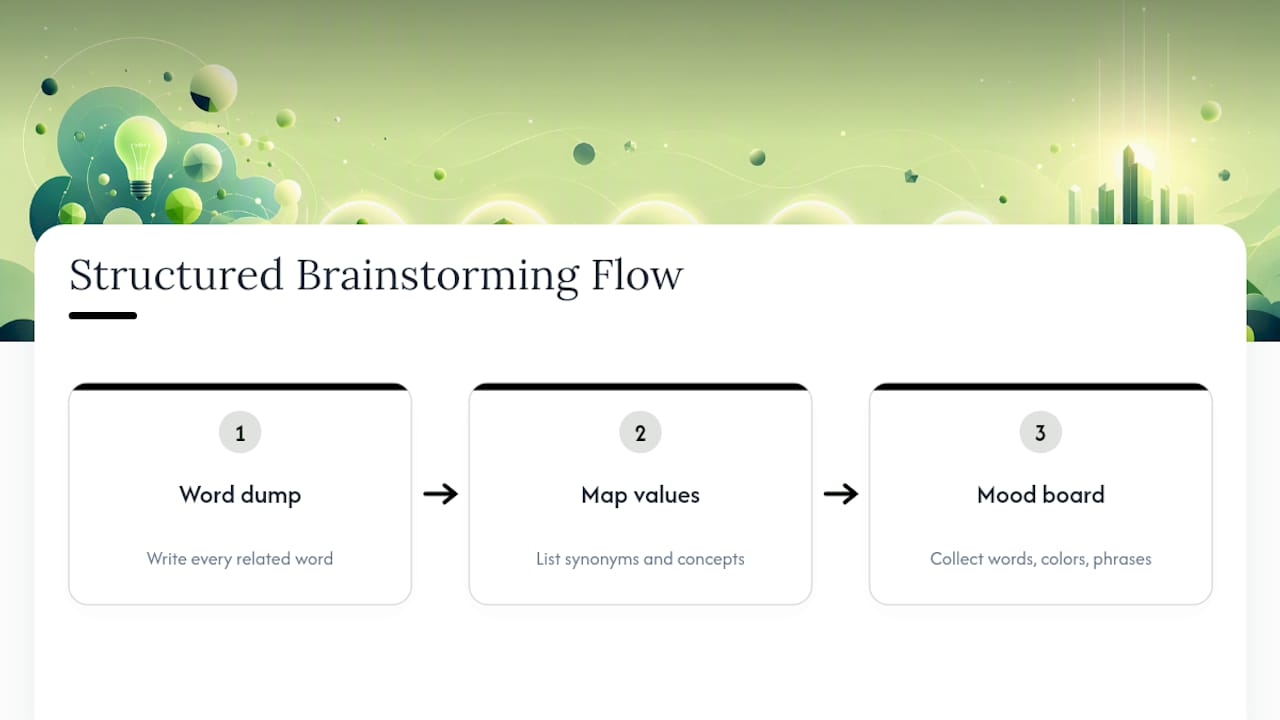
Next, map your values to words. If your brand stands for speed, trust, and simplicity, write synonyms and adjacent concepts for each: swift, quick, instant, reliable, honest, steady, clean, clear, easy. This is raw material, not final answers.
Mood boards help too, and not just for visuals. Pull together words, colors, and phrases that capture the feeling you want customers to have. A fintech app aiming for “calm confidence” pulls very different words than one aiming for “scrappy hustle.”
Creative devices for turning words into names
Once you’ve got your word pile, run it through a few classic naming devices:
- Alliteration: repeating starting sounds (Coca-Cola, PayPal) makes names stickier in the ear.
- Compounding: smashing two relevant words together (Facebook, Snapchat) to create instant meaning.
- Blending: merging parts of two words into something new (Instagram, Pinterest).
- Acronyms: useful for long, technical, or multi-word business descriptions, but only if the letters are easy to say out loud.
- Invented words: made-up but pronounceable terms (Google, Spotify) that you can own completely, trademark-wise.
- Foreign roots: borrowing Latin, Greek, or other language roots for meaning or texture, just double-check the word doesn’t mean something unfortunate elsewhere.
- Controlled puns: fine in small doses for lighter brands, risky for anything serious like legal or healthcare.
Pro Tip: Pick two or three devices max and run your whole word list through each one systematically. Randomly trying everything at once is how you end up with a page of nonsense instead of a shortlist.
Using AI generators without losing your voice
AI naming tools are genuinely useful, but only as a starting point. Feed one your word dump and brand values, and it’ll spit out combinations you’d never think of on your own. The trap is grabbing an AI output and running straight to the trademark office with it.
Treat AI-generated names as raw ingredients, not finished dishes. Combine two AI suggestions, tweak the spelling, swap in your own word from the earlier brainstorm. That extra step of humanizing the name also reduces your odds of accidentally landing on something already trademarked, since generic-sounding AI outputs tend to cluster around the same popular word combinations everyone else is generating too.
If you’re naming something in the AI or tech space specifically, it helps to look at naming patterns other AI startups have used before you commit to your own category conventions.
By the end of this stage, you should have a messy, unfiltered list of 30 to 50 candidates. That’s the point. Quality comes next.
How do you narrow a name list down to your top three?
Objectivity is the whole game here. Left to your own gut, you’ll pick whatever sounds coolest to you personally, which isn’t the same as what works for your customers. You need a scoring system and a second opinion.
Score every candidate on the same rubric
A workable scoring rubric weighs five criteria: memorability, pronunciation and spellability, distinctiveness, scalability, and domain/social availability. One version worth borrowing weighs memorability at 30%, pronunciation and spellability at 25%, distinctiveness at 20%, scalability at 15%, and domain availability at 10%, converted to a 1 to 20 scale and averaged across the criteria to rank your candidates.
Run every name on your shortlist through this same rubric so you’re comparing apples to apples, not vibes to vibes.
- List your top 10 to 15 candidates from the brainstorm round.
- Score each one 1 to 20 on all five criteria.
- Average the scores per name.
- Rank the list from highest to lowest.
- Take the top five into testing.
Run a real poll, not a guess
Once you’re down to five, get outside your own head. A simple, effective method: pick your finalists, run a single-question poll asking respondents something like “Would you trust this business name for a [your category]?” on a 1 to 5 trust scale.
A modest sample of respondents in your target demographic is often enough to reveal a clear front-runner, per the testing approach BigCommerce recommends. You don’t need a market research firm. A Google Form shared with friends of your target customer, a quick Instagram poll, or a post in a relevant subreddit or Facebook group all work.
Stress-test the finalists before you commit
Before you settle, run each remaining name through three quick gut checks:
- Say it out loud, to a stranger. If they hesitate or ask you to repeat it, that’s a real problem, not a nitpick. Customers who can’t pronounce your name confidently are far less likely to recommend it verbally, which quietly chokes word-of-mouth growth before it even starts.
- Ask someone to spell it after only hearing it once. If they can’t, you’re going to spend years correcting people, and losing customers who mistype your domain.
- Google it. Search each name plus your industry and see what comes up. A crowded results page, or worse, an existing company with the exact name, is a red flag you want now, not after you’ve printed business cards.
Whatever survives all three tests, that’s your real top three. Everything else goes back in the drawer.
What legal protections does a business name actually need?
There are four distinct ways to register or protect a business name in the U.S., and they don’t overlap as much as people assume: entity name registration with your state, federal trademark registration, a DBA filing, and domain registration. Skipping any one of them because you assume another covers it is a common, expensive mistake.
Here’s what each one actually does:
- Entity name (state): Registering your LLC or corporation name with your state’s Secretary of State prevents another business from registering the exact same name in that state. It does not protect you nationally, and it doesn’t stop someone in another state from trademarking the same name for a similar product.
- Trademark (federal): A federal trademark through the USPTO protects your brand name nationwide for the specific goods or services you register it under. This is the strongest protection available and the one most founders underuse.
- DBA (“doing business as”): If you’re operating under a name different from your legal entity name (say, your LLC is “Harbor Ventures LLC” but you’re branding as “Coastline Coffee”), most states or counties require you to file a DBA. Check your local requirements early.
- Domain name: Registering the matching domain locks up your digital storefront but grants you zero legal rights to the name itself. Someone else can still trademark it out from under you.
Step-by-step availability checks
Do these in order, and don’t skip any because an earlier one came back clean:
- Search your state’s Secretary of State database for existing entity names. Every state has this search tool online, and it takes about five minutes.
- Run a basic USPTO TESS search at the federal trademark database to see if your name, or something confusingly similar, is already registered in your category. TESS is free and public, though the search logic takes a little getting used to.
- Check DBA requirements with your city or county clerk if you’re branding under something other than your legal entity name.
- Confirm domain and handle availability (more on that next).
Pro Tip: A clean state search doesn’t mean you’re trademark-safe, and a clean federal trademark search doesn’t mean the domain is free. Check all four, every time. Skipping one because “the others were fine” is exactly how founders end up rebranding eighteen months in.
When to hire a trademark lawyer vs. DIY it
If your TESS search comes back completely clear and you’re a small, local, low-risk business (a bakery, a local repair shop), a DIY filing through USPTO’s online system is usually fine. If your search turns up anything remotely close, or you’re planning to raise investment, sell nationally, or operate in a crowded, litigious category, spend the money on a trademark attorney for a proper clearance search. A few hundred dollars now beats a cease-and-desist letter and a forced rebrand two years from now.
How do you check domain names and social handles fast?
Aim for the exact-match .com domain if you can get it. It’s still the default customers type without thinking, and it signals legitimacy. in a way that .co, .io, or .biz variants sometimes don’t, depending on your industry.
Check availability across every channel at once, not one at a time over a week:
- Search your top candidates on a major domain registrar (GoDaddy, Namecheap, Google Domains) to see .com status instantly.
- Check the same handle across Instagram, X, TikTok, and LinkedIn before you get attached to a name.
- Search the exact name plus common variations in quotes on Google to spot existing businesses using it informally, even if they haven’t trademarked or registered a domain.
- Note which platforms show the handle as “taken but inactive,” since some of those are negotiable.
What to do if the .com is taken
If your dream domain is gone, you have real options before abandoning the name entirely. A concise domain with a clean brand modifier, like “brandconest.com” instead of a clunky “brand-online-store.com,” tends to work better than an awkward workaround, and avoids the kind of deceptive-looking variant that confuses customers or looks spammy in search results.
You can also try reaching out to the current domain owner directly if it’s sitting unused, or on a marketplace like GoDaddy’s aftermarket. Expect to pay anywhere from a few hundred to a few thousand dollars for a decent unused domain, sometimes more if it’s a short, dictionary-word name.
For a deeper look at how naming decisions ripple into your broader brand strategy, siift’s guide on naming your startup walks through the tradeoffs in more detail. A branding consultant’s take on domain-first naming tactics is also worth a read if you’re stuck between two close options.
What’s the full pre-launch naming checklist?
Here’s the sequence, start to finish, with realistic time and cost expectations for each step so you know what you’re actually signing up for.
- Brainstorm and shortlist (2 to 5 days). Generate your 30 to 50 raw candidates, run them through the scoring rubric, and land on a top five. Cost: free, aside from your time.
- Legal and state search (1 to 3 days). Run the Secretary of State entity search and the USPTO TESS search on your top five. Cost: free for basic searches; budget $300 to $1,500 if you bring in an attorney for clearance on a borderline result.
- Domain and handle check (same day). Confirm .com availability and matching social handles for your remaining candidates. Cost: $10 to $20/year for the domain itself, more if you’re buying an aftermarket domain.
- User testing (3 to 7 days). Run your trust-scale poll across 50 to 200 target respondents. Cost: free to $50, depending on whether you use a paid survey boost.
- Register and claim (1 to 4 weeks, depending on the step). File your entity name change if needed, submit a federal trademark application if warranted, lock the domain, and claim every social handle immediately, even ones you’re not using yet. Entity filing is typically fast; trademark applications can take several months to fully process, though your filing date protects your priority.
When to commit vs. keep iterating
Set a threshold before you start scoring, not after you fall for a name. Don’t keep shopping for something marginally better, because that’s how founders spend three more months circling instead of launching.
If nothing clears that bar, that’s useful information too. Go back to brainstorming with fresh constraints rather than settling for your least-bad option.
| Step | Typical time | Typical cost | Skip this and risk… |
|---|---|---|---|
| Brainstorm & score | 2 to 5 days | Free | Weak, unmemorable finalists |
| State + USPTO search | 1 to 3 days | Free to $1,500 | Forced rebrand, legal letters |
| Domain + handles | Same day | $10 to $20/year | Inconsistent branding across platforms |
| User poll | 3 to 7 days | Free to $50 | Picking a name customers don’t trust |
| Register & claim | 1 to 4 weeks | Varies by filing type | Losing the name to a competitor |
For founders who want this whole sequence handled inside one workflow instead of juggling five browser tabs, siift’s startup idea validation tool rolls the scoring and testing steps into your broader validation process.
What naming mistakes force an expensive rebrand later?
The most common naming trap is baking a location or a single product into the name. “Brooklyn Web Design” sounds specific and trustworthy on day one, but it becomes dead weight the moment you open a second office or expand past web design into apps. A name too tightly tied to a single product or location becomes a liability the moment the business pivots, and pivots happen more often than founders expect.
Spelling and phonetic traps are the second big offender. Clever misspellings (“Kwik,” “Xtra”) might feel distinctive at the whiteboard stage, but they quietly tax every single customer who tries to find you online later. If someone hears your name once and can’t spell it into a search bar, you’re losing word-of-mouth traffic you’ll never even know you lost.
- Watch for unintended meanings or slang in other languages, especially if you plan to expand internationally.
- Check that your name doesn’t accidentally echo a well-known trademarked brand in an adjacent category.
- Avoid names that only make sense with context you have to explain every time.
- Skip acronyms unless every letter is easy to say out loud in one breath.
Pro Tip: If you’re already explaining your name’s backstory to every new customer within the first thirty seconds of meeting them, that’s a signal, not a charming quirk. Great names don’t need a translator.
As for rebrands: if your current name is actively blocking growth (a trademark conflict, a geography that no longer fits, a product pivot that makes the name confusing) it’s worth the pain now rather than later, when you’ve got more customers, more brand equity, and more to lose in the switch.
How does siift help founders systematize name validation?
Most naming advice stops at “brainstorm, then pick your favorite.” That’s how founders end up relying on gut feel dressed up as a decision, which is exactly the kind of blind spot siift’s New Business OS is built to catch.
Inside siift’s structured validation workflow, name testing isn’t a separate, disconnected task, it’s folded into the same market-signal work you’re already doing to validate the business idea itself. That matters because a name score in isolation tells you very little. A name score alongside real competitor positioning and audience research tells you whether the name actually fits the market you’re entering.
Here’s where a structured platform earns its keep in the naming process specifically:
- Running your shortlist against real market and competitor data instead of gut feel alone.
- Keeping your scoring criteria consistent across every candidate, instead of drifting toward whichever name you already like best.
- Surfacing positioning conflicts early, before you’ve sunk money into a domain and logo for a name that overlaps with an established competitor.
- Cutting the back-and-forth of re-testing names weeks apart, since context and prior scoring stay attached to the decision.
Where can you double-check name availability yourself?
A handful of official sources cover everything you need, and they’re all free. Start with USPTO for federal trademark searches through its TESS database, the single most important check before you commit to a name nationally. The SBA’s business naming guidance walks through the registration types in plain language if you want the government’s own framing.
For entity checks, your state’s Secretary of State page is the source of truth, every state runs its own searchable database. Round it out with a domain registrar search and a quick pass through Instagram, X, TikTok, and LinkedIn’s built-in username search to confirm your handles are actually free before you get attached to anything.
The part nobody tells you about naming
Here’s the uncomfortable truth: the naming advice you’ll find everywhere treats brainstorming as the hard part and legal checks as an afterthought. It’s backwards. Generating name ideas is the easy, even fun, part. The actual risk sits in the availability check most founders rush through in an afternoon because they’re excited to move on to logo design.
I’d argue the single most overrated piece of conventional naming advice is “pick something you love.” Love is not a filter. It’s a bias. The names that survive five years of growth are the ones that scored well on distinctiveness and scalability before anyone got emotionally attached to them, not the ones that felt exciting on day one.
If you take one thing from this: run your legal and domain checks before you fall for a name, not after. Everything else, the alliteration, the AI-assisted brainstorming, the trust polls, is genuinely useful. But it’s all reversible. A trademark conflict discovered six months post-launch is not.
— Samim Safaei
Sources
- Choose your business name | U.S. Small Business Administration
- How to choose a business name | Business News Daily
- How to come up with a business name | Xero US
- How to Name a Business (BigCommerce)
- United States Patent and Trademark Office (USPTO)
FAQ
How do I come up with a catchy business name?
Start with a broad word dump tied to your brand values, then run promising combinations through devices like alliteration, blending, or compounding. Aim for 15 to 50 raw candidates before narrowing, since quantity first tends to produce better final choices than judging too early.
How do I find the perfect name for my business?
There’s no single “perfect” name, but a strong process gets you close: brainstorm widely, score candidates on memorability, pronunciation, distinctiveness, and scalability, then test your top five with a real audience poll before checking legal and domain availability.
What is the best way to choose a business name?
The most reliable method combines objective scoring, a 1 to 20 rubric across memorability, pronunciation, distinctiveness, and scalability, with real customer feedback through a small trust-scale poll of 50 to 200 people, rather than relying on personal preference alone.
How do you check if a business name is already taken?
Search your state’s Secretary of State database for entity name conflicts, run a federal trademark search through USPTO’s TESS system, and check domain and social handle availability across major platforms, all four, not just one.
Do I need a trademark if I already registered my business name with the state?
No, state entity registration and federal trademark protection are separate systems. Registering your name with your state stops others from using the exact name in that state, but it doesn’t give you nationwide trademark rights, so a federal USPTO search and filing are worth doing separately.
Ready to stop guessing and start systematizing your naming and validation process? Try siift’s New Business OS and turn your shortlist into a decision, backed by real market signals instead of gut feel.