

TL;DR:
- Motivation is a skill that can be cultivated through environment design, psychological tools like WOOP, and process-oriented goal setting. Consistently starting small with the five-minute rule and reducing distractions enhances long-term drive, even during burnout or setbacks. Building systems that make showing up effortless helps maintain momentum and align goals with genuine values for sustained success.
Motivation is the internal drive that powers action, and knowing how to keep motivated consistently is the difference between goals that stick and goals that quietly die in a notebook. Psychologists distinguish between intrinsic motivation, which comes from genuine interest and personal values, and extrinsic motivation, which relies on external rewards. Long-term motivation is better sustained by meaningful purpose than by incentives alone. Whether you’re a founder grinding through early traction, a student pivoting careers, or simply trying to finish what you start, the science of staying motivated is more practical than most people realize. Tools like WOOP, dopamine feedback loops, and habit formation techniques give you a real framework, not just a pep talk.
What are common science-backed ways to stay motivated daily?
The most reliable ways to stay motivated daily are built on small, repeatable actions rather than bursts of willpower. Willpower is a finite resource. Routines are not.
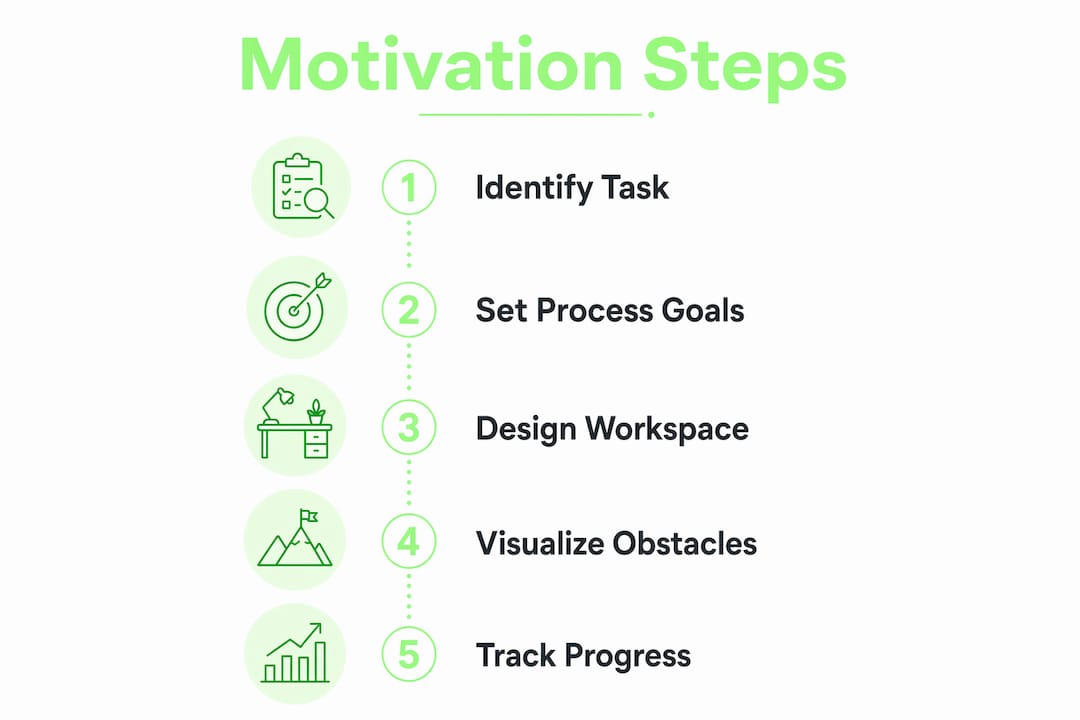
Start your morning by identifying your single most important task before you open email or social media. This is called priority-setting, and it protects your highest-energy hours for the work that actually moves the needle. Founders who use tools like Trello or Notion to map their top three priorities each morning report fewer decision fatigue spirals by midday.
Phone notifications are a silent motivation killer. Keeping your smartphone nearby increases distraction and disrupts focus states, even when you don’t check it. The fix is simple: turn off non-urgent notifications and move your phone to another room during deep work blocks.
Two rules from behavioral science are worth knowing:
- The two-minute rule: If a task takes less than two minutes, do it immediately. This clears mental clutter and leverages the Zeigarnik effect, where your brain prioritizes unfinished tasks and keeps them top of mind until resolved.
- The five-minute rule: Commit to just five minutes on a task you’re avoiding. Motivation often follows action, not the other way around. Five minutes is enough to trigger a dopamine feedback loop that makes continuing feel natural.
Process goals beat outcome goals for daily motivation. “Write 500 words today” is a process goal. “Finish my book” is an outcome goal. Process goals give you a daily win to chase, which keeps momentum alive even when the big picture feels distant.
Pro Tip: Redesign your workspace to remove friction. Put your most important tool, whether that’s a notebook, a laptop, or a specific app, front and center. Motivation flows toward the path of least resistance.
How can psychological frameworks like WOOP improve your motivation?
WOOP is a structured mental strategy developed by psychologist Gabriele Oettingen, and it is one of the most research-supported tools for improving motivational consistency. The acronym stands for Wish, Outcome, Obstacle, Plan. It works because it combines positive visualization with realistic obstacle planning, which is a combination most people skip.
Here’s how to apply WOOP to a real goal:
- Wish: Name a meaningful goal. “I want to validate my startup idea in 30 days.”
- Outcome: Visualize the best possible result. What does success look, feel, and mean for you?
- Obstacle: Identify the most likely internal barrier. Not external circumstances. Your own habits, fears, or blind spots.
- Plan: Create an if-then statement. “If I feel overwhelmed by the scope, then I will break the task into one 30-minute session per day.”
The reason WOOP outperforms pure positive thinking is that purely positive visualization can actually reduce your drive to act. When your brain experiences a vivid success fantasy, it partially satisfies the desire, which lowers urgency. Mental contrasting, the practice of visualizing obstacles alongside outcomes, prevents this and keeps your planning realistic.
WOOP is especially useful for students navigating career transitions or founders facing a pivot. It forces you to name the real obstacle, not the comfortable story you tell yourself about why things aren’t moving.
Pro Tip: Revisit your WOOP every Sunday evening. Goals shift, obstacles change, and a weekly reset keeps your plan aligned with where you actually are, not where you were three weeks ago.
How to overcome motivation challenges like burnout and procrastination
Burnout, perfectionism, and anxiety are the three most common motivation blockers, and they each require a different response.
Perfectionism masquerades as high standards but functions as a stall tactic. The antidote is a “done, not perfect” mindset. When you’re burned out or overwhelmed, lowering the bar consciously is not giving up. It’s a deliberate strategy to rebuild capacity. Traditional productivity advice, “push harder, wake up earlier, do more,” actively backfires in burnout states.
“Motivation is better viewed as a fluctuating capacity rather than a constant effort. Rest and mental health care are part of sustainable motivation strategies.” — Spring Health
Here’s what actually helps when motivation collapses:
- Shrink the task: Break any project into the smallest possible unit of action. Not “write the pitch deck.” Instead: “open the file and write one sentence.”
- Plan for imperfection: Decide in advance what you’ll do when you miss a day or fall behind. This removes the shame spiral that kills momentum.
- Align goals with values: Intrinsic motivation is enhanced when goals connect to deeply held values. If a goal feels hollow, ask whether it’s actually yours or someone else’s expectation.
- Use reflective functioning: When motivation fades, reassessing goals and reducing shame linked to past failures restores forward movement. Journaling, therapy, or even a candid conversation with a mentor can unlock this.
Low self-efficacy, the belief that you can’t succeed, is often the hidden root of procrastination. The fix is not motivation. It’s building confidence through small successes. Start with goals so easy they feel embarrassing. Then build from there.
What role does your environment play in maintaining motivation?
Your environment shapes your behavior more than your intentions do. This is not a metaphor. It’s neuroscience.

A cluttered desk, a phone within arm’s reach, and an open browser with 14 tabs are not neutral. They are active drains on your attention and drive. The research on phone proximity is clear: even a face-down phone on your desk reduces cognitive capacity. The solution is physical distance, not discipline.
| Environmental change | Motivation benefit |
|---|---|
| Phone in another room during work blocks | Reduces distraction, protects focus states |
| Single-task workspace setup | Lowers decision fatigue, increases task completion |
| Change of scenery (café, library, co-working) | Novelty effect resets attention and boosts energy |
| Trello or Notion for task visibility | Reduces mental load, creates clear progress signals |
| Notification-free morning block | Protects peak energy hours for high-value work |
The novelty effect is real and underused. Changing your physical location, even temporarily, resets your attention system and can restore motivation that felt completely gone. Students and founders who build productivity habits around environment design consistently outperform those who rely on motivation alone.
Pro Tip: “Dumb down” your phone once a week. Remove social apps from your home screen, set grayscale mode, and delete anything that doesn’t serve your current goal. Friction is your friend when it’s working against distraction.
How to build momentum with goal setting and progress tracking
Momentum is built through small wins, not grand gestures. The dopamine system in your brain rewards progress, not completion. This means tracking incremental movement is more motivating than waiting for the finish line.
The distinction between process goals and outcome goals matters here. Outcome goals define where you want to end up. Process goals define what you do today. For an entrepreneur, the outcome goal might be reaching 100 paying customers. The process goal is making five outreach calls before noon. Process goals give your brain a daily dopamine hit, which is exactly what keeps you showing up.
Practical ways to track progress and boost motivation:
- Daily journals: A simple three-line entry, what you did, what you’ll do tomorrow, and one win, creates a visible record of momentum.
- Visual progress bars: Tools like Notion, Trello, or even a hand-drawn chart make progress tangible. Seeing a bar fill up triggers the same reward circuitry as completing the task.
- Milestone rewards: Rewards improve motivation temporarily, but over-reliance undermines intrinsic interest. Use them sparingly and tie them to process milestones, not just outcomes.
- Weekly reviews: A 15-minute Friday review of what moved and what didn’t keeps your strategy honest and your goals calibrated.
Celebrating small wins is not self-indulgent. It’s neurologically sound. Every acknowledged win reinforces the behavior that produced it, making the next session easier to start.
Key takeaways
Sustained motivation requires a system, not just willpower. The most effective approach combines environment design, psychological frameworks like WOOP, and process-based goal tracking to build drive that outlasts any single burst of inspiration.
| Point | Details |
|---|---|
| Action precedes motivation | Use the five-minute rule to start tasks and let dopamine do the rest. |
| WOOP beats pure positivity | Visualizing obstacles alongside outcomes builds realistic, lasting drive. |
| Environment shapes behavior | Remove phone proximity and design your workspace to reduce friction. |
| Process goals create daily wins | Track what you do today, not just where you want to end up. |
| Rest is part of the strategy | Lowering the bar during burnout is a recovery tool, not a failure. |
What I’ve learned about motivation that nobody tells you
Here’s the uncomfortable truth I’ve come to after working with founders and watching countless smart people stall out: motivation is not a personality trait. It’s a skill, and most people are practicing it wrong.
We’re taught to chase inspiration. Wait for the right moment, the right mood, the right conditions. But the founders I’ve seen build real traction are the ones who show up on the days when motivation is nowhere to be found. They’ve built systems that make showing up the default, not the exception. That’s the real secret.
The other thing nobody says loudly enough: your goals might be wrong. Not wrong in a catastrophic sense, but misaligned with what you actually value. I’ve watched people grind for months toward a goal that was never really theirs, and wonder why they felt hollow even when they hit it. Reflective functioning, actually sitting with the question of why this goal matters, is not soft. It’s the most practical thing you can do before investing serious energy.
For students in career transitions and early-stage founders especially, self-compassion is not a luxury. It’s a performance tool. The time management strategies that work long-term are the ones built around your actual energy patterns, not an idealized version of yourself. Give yourself the same grace you’d give a teammate, and watch what becomes possible.
— Samim
How Siift helps you stay focused and build real momentum
Staying motivated is easier when you have a clear path forward. Siift is the Agentic AI platform built specifically for founders and entrepreneurs who want to move from idea to validated business without getting lost in the noise. When your goals feel vague or your progress stalls, Siift gives you a structured, step-by-step system to clarify your strategy, validate your assumptions, and build traction with confidence. It’s the kind of clarity that makes motivation feel less like a daily battle and more like a natural byproduct of knowing exactly what to do next. If you’re ready to stop spinning and start building, explore what Siift can do for your founder journey.
FAQ
What is the fastest way to regain motivation when you’ve lost it?
The fastest way to regain motivation is to start with a task so small it feels trivial. The five-minute rule triggers a dopamine feedback loop that makes continuing easier once you’ve begun.
How does the WOOP method help with staying motivated?
WOOP helps by combining goal visualization with obstacle planning, which prevents the false confidence that comes from purely positive thinking. It gives you a concrete if-then plan to follow when resistance shows up.
Can your environment really affect how motivated you feel?
Yes. Research shows that phone proximity alone reduces cognitive capacity and disrupts motivation, even without active use. Designing a low-distraction workspace is one of the highest-return changes you can make.
What’s the difference between intrinsic and extrinsic motivation?
Intrinsic motivation comes from personal values and genuine interest, while extrinsic motivation relies on external rewards. Overusing rewards can undermine intrinsic interest, so long-term drive is best built on meaningful purpose.
How do you maintain motivation during burnout?
During burnout, the most effective strategy is to lower expectations deliberately and prioritize rest. Embracing a “done, not perfect” mindset and revising goals as needed rebuilds capacity without compounding exhaustion.