

TL;DR:
- Effective task prioritization involves capturing all work in one place, then applying a structured method to rank and schedule the most important tasks first. Choosing the right framework, like the Eisenhower Matrix or MIT method, depends on your workload and context, and should be used consistently to build productive habits. Regular re-prioritization and disciplined scheduling protect focus, prevent reactive work, and ultimately drive progress toward key goals.
Task prioritization is the practice of ranking your work by importance and urgency so the right things get your attention first. Whether you’re a founder juggling product, sales, and hiring, a student balancing coursework and side projects, or a professional drowning in Slack notifications, knowing how to prioritize tasks is the single skill that separates productive days from exhausting ones. Frameworks like the Eisenhower Matrix, the MIT method, and the ABCDE technique give you a repeatable system to cut through the noise and focus on what actually moves the needle.
What are the best methods to prioritize tasks?
Not all prioritization methods are created equal. The right one depends on your work style, the complexity of your list, and how much planning bandwidth you have at any given moment.
The Eisenhower Matrix is the most widely used framework for sorting tasks. It splits your work into four quadrants based on urgency and importance. Urgent and important tasks get done immediately. Important but not urgent tasks get scheduled. Urgent but not important tasks get delegated. Tasks that are neither get deleted. This forces a decision on every item, which means nothing stagnates in your list without a clear next action.
The ABCDE method works well for long, complex lists. You label each task A through E based on consequence. An “A” task has serious consequences if skipped. An “E” task can be eliminated entirely. This ranking system is especially useful for professionals managing multiple projects with overlapping deadlines.
The MIT method defines 1 to 3 Most Important Tasks tied to your long-term goals that you complete first each day. The logic is simple: if you finish nothing else, you still moved the ball forward on what matters most. Students and founders find this particularly powerful because it creates a daily win before the chaos of the day takes over.
The 1-3-5 Rule prescribes planning 1 big, 3 medium, and 5 small tasks per day. It sets a realistic ceiling on your daily ambitions and reduces the decision fatigue that comes from staring at a 40-item to-do list every morning.
The Ivy Lee method asks you to list and rank six important tasks at day’s end for the next day, then work through them in order. Any unfinished tasks roll over. The genius here is that you make your prioritization decisions the night before, when you’re not yet in reactive mode.
| Method | Best for | Core mechanic |
|---|---|---|
| Eisenhower Matrix | Sorting mixed workloads | Urgent vs. important quadrants |
| ABCDE | Long task lists | Consequence-based ranking |
| MIT | Daily focus | 1 to 3 top goals per day |
| 1-3-5 Rule | Realistic daily planning | Fixed task-size slots |
| Ivy Lee | Pre-planning the next day | End-of-day ranked list of six |
Pro Tip: Don’t pick a method and stick with it religiously forever. Use the Eisenhower Matrix when your list is chaotic and mixed. Switch to MIT on days when you need deep focus. The best prioritization system is the one you actually use.
How to build your master task list before you prioritize
Effective prioritization starts with seeing your entire workload in one place. You cannot rank what you haven’t captured. This step sounds obvious, but most people skip it and wonder why their prioritization system keeps breaking down.

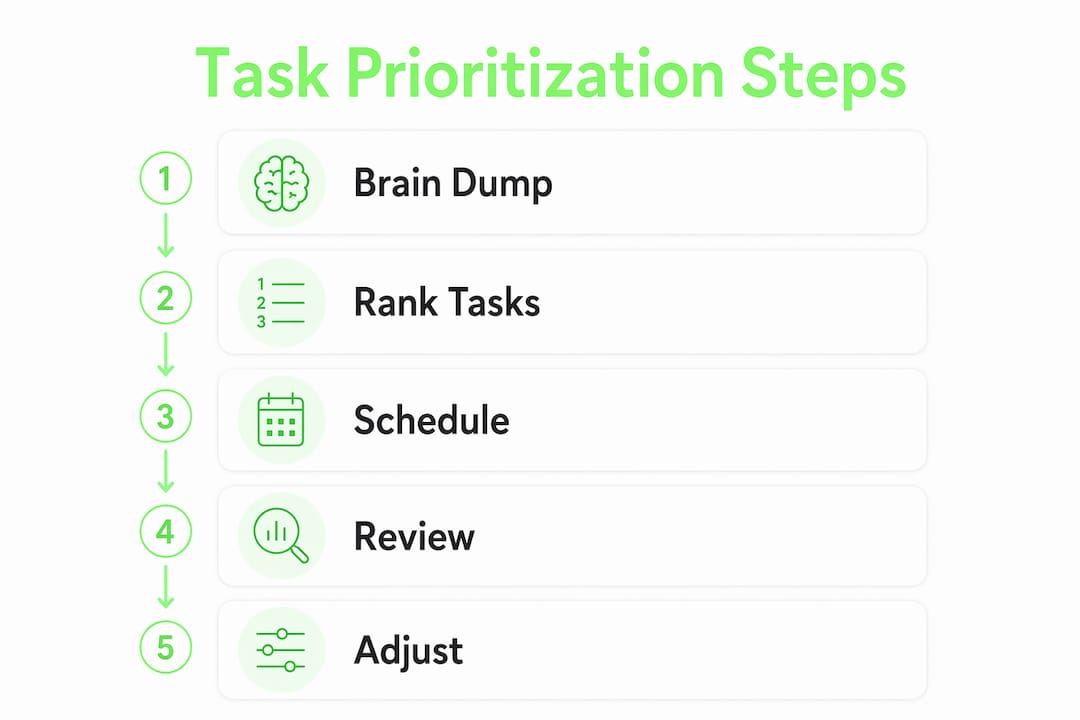
Start by doing a full brain dump. Write down every task, commitment, and nagging to-do across every area of your life and work. Use one tool, whether that’s Notion, Todoist, Asana, or a plain notebook. The medium matters less than the consolidation. Scattered lists across three apps, two notebooks, and a sticky note on your monitor are a recipe for missed deadlines and mental clutter.
Once everything is captured, break large tasks into subtasks. “Launch marketing campaign” is not a task. It’s a project. Breaking it into “write email copy,” “design banner,” and “schedule send” gives you discrete, completable units that you can actually rank and schedule. This also reveals hidden complexity before it ambushes you.
Add context to each item: the deadline, your estimated effort in hours, and any dependencies on other people or tasks. This context is what makes prioritization decisions fast and accurate. Without it, you’re guessing.
- Capture every task in a single tool or list before ranking anything
- Break projects into subtasks of two hours or less where possible
- Note deadlines, effort estimates, and dependencies for each item
- Review and update your master list at the start or end of each day
Pro Tip: If you’re a founder or student managing a startup alongside other responsibilities, check out these time management strategies for balancing entrepreneurial work without burning out.
How to apply prioritization methods and schedule tasks effectively
Capturing and ranking tasks means nothing if they never make it onto your calendar. Scheduling is where prioritization becomes real.
Here’s a practical step-by-step process for turning your ranked list into a working schedule:
- Rate every task using your chosen method. Apply the Eisenhower Matrix quadrants, ABCDE labels, or MIT designations to each item on your master list.
- Block time for your top priorities first. Put your MIT tasks or Eisenhower “Do” quadrant items into your calendar before anything else. Treat these blocks like meetings you cannot cancel.
- Build buffer zones around high-priority work. Scheduling tasks with buffer times reduces reactive work and protects your focus from interruptions. A 15-minute buffer before and after a deep work block is not wasted time. It’s insurance.
- Batch similar tasks together. Task batching groups similar work to minimize context switching and increase efficiency. Answer all emails in one block. Make all calls in another. Your brain stays in one mode longer and produces better output.
- Create a quick decision filter for new tasks. When something new lands in your inbox or Slack, ask: Is this urgent and important? If yes, slot it in. If not, add it to your master list and rank it at your next review. Don’t let incoming requests hijack your planned priorities without that filter.
- Communicate your priorities to collaborators. If you’re working with a team, let people know what you’re focused on and when you’re available. This reduces interruptions and sets expectations before they become friction.
| Priority tier | Scheduling action | Example |
|---|---|---|
| Urgent + important | Block time today | Fix a critical product bug before launch |
| Important, not urgent | Schedule this week | Write next quarter’s growth strategy |
| Urgent, not important | Delegate or batch | Reply to routine status update emails |
| Neither | Delete or defer | Reorganize a folder that works fine already |
Pro Tip: Review your productivity frameworks regularly. A scheduling system that worked in Q1 may need recalibration by Q3 as your goals and constraints shift.
Common prioritization pitfalls and how to avoid them
Even with a solid method in hand, most people fall into the same traps. Recognizing them is half the battle.
- Confusing urgency with importance. The loudest task is rarely the most valuable one. Differentiating urgency from importance is the core of every effective prioritization framework. A ringing phone feels urgent. Writing your business plan is important. These are not the same thing.
- Mixing planning with execution. When you sit down to work and still haven’t decided what to do first, you’ve already lost. Mixing execution decisions into planning leads to indecision and lost productivity. Decide your priorities the night before or at the start of the day, then execute without second-guessing.
- Overloading your daily list. Listing 20 tasks for a single day is not ambition. It’s a setup for disappointment. The 1-3-5 Rule exists precisely to prevent this. Realistic lists get completed. Unrealistic ones get abandoned.
- Ignoring re-prioritization when things change. Task priorities should be reviewed regularly since priorities shift with new information, stakeholder changes, and market conditions. A weekly review is the minimum. Daily check-ins are better for fast-moving environments.
- Letting interruptions override your plan without filtering. Not every Slack message deserves an immediate response. Not every “quick question” is actually quick. Protect your scheduled priority blocks by batching communication and setting response windows.
“When everything feels important, nothing is. The urgency vs. importance split is not a productivity hack. It’s a decision-making discipline.”
The urgency vs. importance split recommended by productivity experts like Any.do is not just a framework. It’s a mindset shift that prevents the chronic crisis mode that burns out founders, students, and professionals alike.
Key takeaways
Effective task prioritization requires capturing all work in one place, applying a structured ranking method, and scheduling priorities into protected time blocks before the day begins.
| Point | Details |
|---|---|
| Capture before you rank | Build a complete master list in one tool before applying any prioritization method. |
| Match method to context | Use Eisenhower for mixed workloads, MIT for deep focus days, and Ivy Lee for pre-planning. |
| Schedule priorities first | Block time for top tasks before filling your calendar with reactive work. |
| Protect your focus | Buffer zones and task batching reduce context switching and guard high-priority work. |
| Re-prioritize regularly | Review your list daily or weekly to reflect shifting goals and new information. |
Why I think most people prioritize backwards
Here’s what I’ve found after working with founders and watching how they actually spend their days: most people prioritize reactively. They open their inbox, respond to what feels urgent, and call that a productive morning. By noon, their actual priorities haven’t moved an inch.
The mental clarity that comes from a structured prioritization practice is not subtle. It’s the difference between ending a day feeling accomplished and ending it feeling busy but behind. I’ve seen founders use the MIT method and suddenly realize they were spending 80% of their time on tasks that didn’t appear anywhere in their top three. That’s not a scheduling problem. That’s a clarity problem.
My honest take: the method you choose matters far less than the discipline of choosing one and using it consistently. The Eisenhower Matrix is not magic. The Ivy Lee method is not magic. What’s magic is the habit of deciding your priorities before the day decides them for you. Start there. Adapt as you go. And don’t let the perfect system be the enemy of a working one.
For founders especially, integrating AI-powered tools into your prioritization workflow can cut the cognitive load significantly. But the thinking still has to be yours.
— Samim
How Siift helps founders prioritize what actually matters
Knowing the frameworks is one thing. Applying them consistently when you’re building a business, managing a team, and trying to find product-market fit is another challenge entirely. That’s where Siift comes in. Siift’s New Business OS is built for founders and entrepreneurs who need more than a generic to-do app. It guides you step by step through ideation, validation, and go-to-market planning, helping you filter out distractions, blindspots, and the noise that pulls your attention away from what moves your business forward. If you’re serious about improving your entrepreneurial productivity and want a system that thinks alongside you, Siift is worth exploring.
FAQ
What is the most effective method for prioritizing tasks?
The Eisenhower Matrix is widely recognized as one of the most effective prioritization frameworks because it forces a clear action on every task: do, schedule, delegate, or delete. For daily focus, combining it with the MIT method gives you both a sorting system and a concrete daily target.
How do I prioritize tasks when everything feels urgent?
Apply the urgency vs. importance split. Urgent tasks demand immediate attention but may not drive meaningful outcomes. Important tasks move you toward your goals even when they don’t feel pressing. Sorting your list through this lens breaks the cycle of reactive work.
How often should I re-prioritize my task list?
Task priorities should be reviewed at least once a week, with a lighter daily check-in to account for new inputs. Fast-moving environments like startups or exam seasons may require more frequent reassessment to stay aligned with shifting goals.
What is the 1-3-5 Rule for task management?
The 1-3-5 Rule prescribes planning one big task, three medium tasks, and five small tasks per day. This structure sets a realistic daily ceiling, reduces decision fatigue, and improves completion rates by matching your ambition to your actual capacity.
How do I stop interruptions from derailing my priorities?
Batch your communication into designated windows and apply a quick decision filter to new requests before acting on them. Scheduling buffer zones around your high-priority blocks and communicating your focus hours to collaborators significantly reduces unplanned interruptions.