Over 60 percent of new entrepreneurs now use AI tools to brainstorm and launch their ideas in record time. This rise in vibe founding has turned traditional startup wisdom on its head, making business creation feel more accessible than ever. Yet, as AI fuels this rapid innovation, misconceptions and real risks quietly shape outcomes. Understanding what vibe founding truly means—and what separates hype from reality—can help you avoid pitfalls and make smarter decisions in today’s fast-moving startup scene.
Table of Contents
- Defining Vibe Founding and Common Myths
- The Influence of AI Tools on Vibe Founding
- Shortcomings of Emotion-Driven Ventures
- Risks and Real-World Consequences
- Critical Thinking Versus Convenience-Driven Startups
Key Takeaways
| Point | Details |
|---|---|
| AI Enhances Entrepreneurship | Vibe founding leverages AI tools to streamline business ideation and validation, accelerating the process significantly compared to traditional methods. |
| Expertise Remains Essential | Despite AI’s capabilities, foundational business knowledge and strategic thinking are crucial for long-term success and operational integrity. |
| Risks of Emotional Bias | Relying heavily on intuition and AI can lead to oversight of critical business factors, creating vulnerabilities that may compromise endeavors. |
| Critical Thinking is Key | Sustainable entrepreneurship requires a balance between AI convenience and deep analytical understanding to navigate complex market landscapes effectively. |
Defining Vibe Founding and Common Myths
The vibe founding phenomenon represents a new entrepreneurial approach powered by AI technologies that allow founders to rapidly prototype and validate business ideas with unprecedented speed and minimal traditional barriers. According to Wikipedia, this method enables individuals to describe desired functionalities in natural language, with AI generating corresponding strategic frameworks and operational plans.
At its core, vibe founding emerges from the intersection of AI accessibility and low-entry entrepreneurship. Unlike traditional business development processes that require extensive market research, detailed business plans, and significant upfront capital, vibe founding leverages AI tools to generate business concepts, research potential markets, and draft initial strategies within hours or days. The key distinction is the emotional and intuitive approach: founders are less constrained by rigid methodological frameworks and more driven by creative impulses and technological enablement.
Myths About Vibe Founding
Several common misconceptions surround this emerging entrepreneurial approach:
-
Myth: AI Can Replace Business Expertise Reality: While AI accelerates ideation, it cannot substitute deep market understanding and strategic thinking
-
Myth: Vibe Founding Guarantees Success Reality: AI tools provide frameworks, but execution, passion, and adaptability remain critical success factors
-
Myth: Anyone Can Become an Entrepreneur Instantly Reality: Vibe founding lowers barriers, but sustainable businesses still require commitment, learning, and persistent effort
As Vibe Writing notes, this approach “democratizes development” while simultaneously raising critical questions about depth, quality, and long-term viability. Entrepreneurs must balance AI-generated insights with personal expertise, market research, and a nuanced understanding of their specific business landscape.

For founders curious about systematically developing their business ideas, our AI Business Canvas tool provides personalized guidance to transform vibe-based concepts into robust, actionable strategies.
The Influence of AI Tools on Vibe Founding
AI tools have fundamentally transformed the entrepreneurial landscape, enabling a radical shift in how founders conceptualize, develop, and launch business ideas. According to The Vibe Economy, AI-powered interfaces are dismantling traditional technical barriers, empowering individuals without extensive technical backgrounds to rapidly bring innovative concepts to market.
The democratization of entrepreneurship through AI manifests in multiple critical dimensions. Modern AI tools provide founders with unprecedented capabilities: generating business plans, conducting market research, creating financial projections, and even drafting initial marketing strategies with minimal human intervention. Where traditional entrepreneurship required years of expertise and significant capital investment, vibe founding powered by AI compresses these timelines into weeks or even days.
Key AI Tool Transformations
The most significant influences of AI tools on vibe founding include:
-
Rapid Prototyping AI enables instant concept validation and preliminary product mockups
-
Market Research Acceleration Tools can analyze market trends, competitor landscapes, and potential customer segments within minutes
-
Personalized Strategy Generation AI creates tailored business strategies based on specific founder inputs and contextual data
-
Reduced Entry Barriers Lowered technical and financial thresholds for launching entrepreneurial ventures
However, this technological empowerment comes with critical caveats. While Understanding the Best AI Tools for Founders highlights the transformative potential, successful founders recognize that AI remains a tool, not a replacement for human creativity, strategic thinking, and persistent execution.
The future of entrepreneurship lies not in total AI dependence, but in strategic AI collaboration—where human intuition and technological capabilities complement each other to unlock unprecedented innovation potential.
Shortcomings of Emotion-Driven Ventures
Emotion-driven ventures, characterized by their reliance on intuition and AI-generated insights, carry significant hidden risks that can derail entrepreneurial success. According to Wikipedia, while these approaches facilitate rapid development, they can lead to critical issues such as undetected bugs, strategic errors, and potential security vulnerabilities stemming from founders not thoroughly understanding their own business foundations.
The Illusion of Ease creates a dangerous entrepreneurial trap. Vibe founding makes business creation look deceptively simple, encouraging founders to skip essential steps like comprehensive market validation, deep competitive analysis, and rigorous business model stress-testing. This shortcuts-driven approach might generate exciting initial momentum, but frequently results in ventures that lack sustainable infrastructure and resilient strategic planning.
Key Emotional Pitfalls Include:
-
Confirmation Bias AI tools often reflect founders’ existing beliefs, reinforcing rather than challenging assumptions
-
Surface-Level Understanding Emotional excitement replaces deep market and operational comprehension
-
Overestimating AI Capabilities Mistaking AI-generated content for genuine strategic insight
-
Reduced Critical Thinking Relying on algorithmic suggestions instead of independent analysis
As Vibe Writing critically notes, this approach “democratizes creation but introduces significant challenges in debugging, security, and long-term maintainability.” Successful founders recognize that while AI can accelerate ideation, it cannot replace the nuanced judgment, persistent effort, and strategic thinking required to build enduring businesses.
To navigate these challenges, entrepreneurs must cultivate a balanced approach: leveraging AI tools as supplements to, not substitutes for, rigorous entrepreneurial diligence. Reasons Businesses Fail in 2025 provides crucial insights into avoiding the most common emotional and strategic pitfalls that can transform promising vibe ventures into cautionary tales.
Risks and Real-World Consequences
Vibe founding presents a treacherous entrepreneurial landscape where seemingly innovative approaches can rapidly unravel into catastrophic business failures. According to Wikipedia, the adoption of emotion-driven development raises critical concerns about understanding and accountability, potentially exposing ventures to undetected vulnerabilities that can destroy entire business models.
The real-world consequences of vibe founding extend far beyond theoretical risks. Entrepreneurs who rely exclusively on AI-generated insights and emotional momentum frequently encounter devastating financial and reputational challenges. These ventures typically fail due to fundamental structural weaknesses: inadequate market validation, superficial competitive analysis, and a profound misunderstanding of core business mechanics. The illusion of progress created by rapid AI-assisted ideation masks the complex, nuanced work required to build sustainable enterprises.
Critical Risk Categories:
-
Financial Instability Premature scaling and misallocated resources leading to rapid capital depletion
-
Legal Vulnerabilities Non-compliance with regulatory requirements due to incomplete understanding
-
Operational Fragility Unsustainable business models lacking robust strategic foundations
-
Reputation Damage Quick market exit and potential brand destruction from poorly conceived ventures
As Vibe Writing critically emphasizes, this approach “introduces significant challenges in debugging, security, and long-term maintainability.” The consequences aren’t merely theoretical—they represent tangible risks that can obliterate entrepreneurial dreams and personal financial stability.
Entrepreneurs must recognize that while AI tools offer unprecedented ideation capabilities, they cannot substitute for rigorous strategic thinking, deep market understanding, and persistent execution. Reasons Businesses Fail in 2025 provides crucial insights into transforming these potential pitfalls into strategic opportunities for genuine, sustainable business development.
Critical Thinking Versus Convenience-Driven Startups
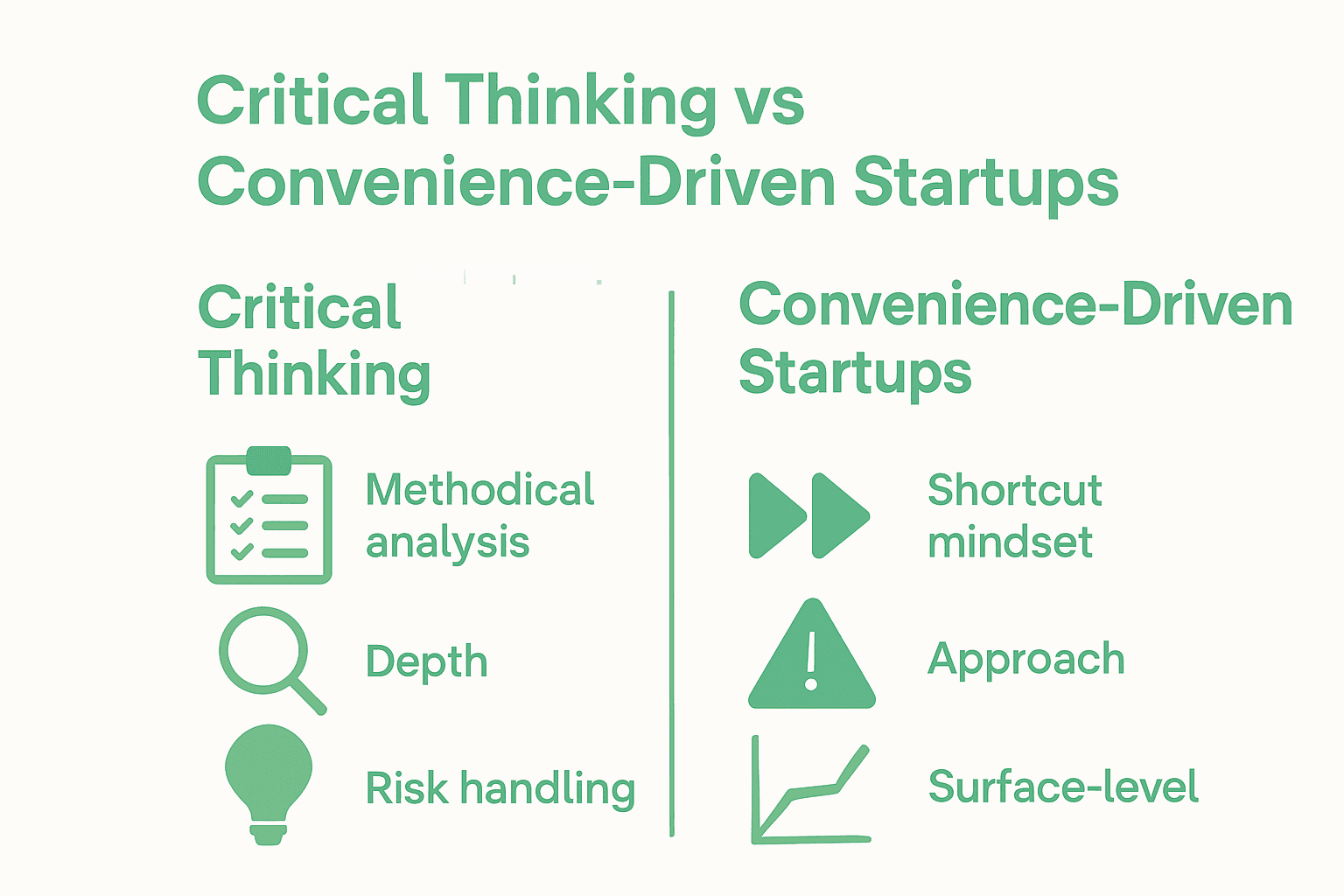
Critical thinking represents the fundamental differentiator between sustainable entrepreneurship and ephemeral business fantasies. According to Wikipedia, convenience-driven approaches like vibe coding enable rapid development but simultaneously create a dangerous illusion of progress by masking fundamental understanding gaps in core business mechanics.
The seductive convenience of AI-powered startup tools creates a perilous entrepreneurial trap. Founders who prioritize speed over substance find themselves building businesses on fragile foundations, mistaking technological accessibility for genuine strategic insight. These convenience-driven startups typically collapse when confronted with real-world complexities, revealing that technological shortcuts cannot substitute for deep market comprehension, rigorous analysis, and adaptive strategic thinking.
Critical Thinking Versus Convenience Characteristics:
-
Depth of Understanding Critical thinking: Comprehensive market analysis Convenience-driven: Surface-level insights
-
Problem-Solving Approach Critical thinking: Systematic, methodical Convenience-driven: Quick, superficial solutions
-
Risk Management Critical thinking: Proactive risk identification Convenience-driven: Reactive risk response
-
Strategic Planning Critical thinking: Long-term vision Convenience-driven: Short-term momentum
As Vibe Writing emphasizes, relying exclusively on convenience-driven methods introduces “significant challenges in debugging, security, and long-term maintainability.” True entrepreneurial success demands more than algorithmic shortcuts—it requires nuanced human judgment, persistent learning, and the ability to navigate complex, unpredictable business landscapes.
Entrepreneurs committed to sustainable growth must cultivate critical thinking skills that complement technological tools.
 Creative Thinking Exercises for Future Entrepreneurs 2025 offers practical strategies for developing the analytical mindset necessary to transform convenience-driven impulses into robust, strategic business opportunities.
Turn Vibe Founding Challenges Into Real Business Success
Vibe founding offers an exciting way to rapidly launch new ventures using AI but comes with hidden risks like shallow market understanding and overreliance on emotion-driven insights. If you want to avoid common pitfalls such as confirmation bias and operational fragility, adopting a more structured, strategic approach is essential. Founders aiming to balance creativity with rigorous validation can benefit greatly from tools designed to provide clarity, guidance, and personalized feedback throughout the startup journey.
Discover how the siift.ai Intelligent Business Canvas helps you transform vibe-driven ideas into solid, viable businesses by guiding you step-by-step through ideation, validation, and go-to-market strategies. This intuitive AI app offers unbiased insights and prioritized actions to help you de-risk your founder’s journey with confidence. Don’t let the illusion of quick success turn into costly mistakes. Visit siift.ai now and start building your business on a foundation of critical thinking and clear strategy.
Frequently Asked Questions
What is vibe founding?
Vibe founding is a modern entrepreneurial approach that utilizes AI technologies to rapidly prototype and validate business ideas, allowing founders to create and launch ventures more efficiently and with fewer traditional barriers.
How do AI tools influence vibe founding?
AI tools significantly enhance vibe founding by enabling rapid prototyping, accelerating market research, generating personalized strategies, and reducing entry barriers, making entrepreneurship more accessible to individuals without extensive technical backgrounds.
What are some common myths about vibe founding?
Common myths include the belief that AI can replace business expertise, that vibe founding guarantees success, and that anyone can become an entrepreneur instantly. In reality, deep market understanding and commitment are still essential for sustainable success.
What are the risks associated with emotion-driven ventures in vibe founding?
Emotion-driven ventures can lead to critical issues such as financial instability, legal vulnerabilities, operational fragility, and reputation damage due to a lack of thorough understanding and strategic planning.