

A long-tail keyword is a highly specific search phrase with low individual volume but high buyer intent, and specificity, not word count, is what defines it. That precision is why long-tail terms convert roughly 2.5 times better than broad head terms. If you’re a founder or marketer without a massive domain budget, this is your fastest path to ranking. The tactics below show you exactly how to find, target, and measure them.
TL;DR:
- Long-tail keywords are defined by their low search volume and high specificity, not by the number of words, and they convert at roughly 2.5 times the rate of head terms.
- Finding effective long-tail keywords involves a filtering process that prioritizes queries with buying intent, clear connection to products, and already-existing customer language, rather than just volume.
- Structuring content around long-tail keywords requires answering questions quickly in the first 80 words and building a pillar page with related variations linked internally.
- Clustering related long-tail phrases based on shared intent boosts traffic potential, especially when prioritizing those closest to a purchase decision.
- Using existing customer conversations, support logs, and internal search data often yields the most relevant long-tail keywords with the highest conversion potential.
Table of Contents
- What Are Long Tail Keywords? Short-Tail vs Mid-Tail vs Long-Tail
- Why Long Tail Keywords Matter More in 2026
- Common Long-Tail Mistakes (And a 3-Question Checklist)
- How to Find Long Tail Keywords: A Step-by-Step Workflow
- How to Rank for Long Tail Keywords
- Keyword Clustering: Turning Small Volumes Into Real Traffic
- Long-Tail Keyword Examples and Templates You Can Steal
- How to Measure Whether Long-Tail SEO Is Working
- siift’s Founder Checklist for Prioritizing Long-Tail SEO
- The Real Skill Isn’t Finding Keywords, It’s Choosing Them
- Sources
- FAQ
What Are Long Tail Keywords? Short-Tail vs Mid-Tail vs Long-Tail
Here’s the myth that trips up almost every beginner: “long-tail” doesn’t mean “long phrase.” It means low search volume and high specificity. Word count is a vanity metric, not the definition. A five-word phrase can still be a head term if it’s broad and hotly contested; a three-word phrase can be pure long-tail if it’s narrow enough.
Think of it as a spectrum:
- Short-tail (head terms): One or two words, massive volume, brutal competition, vague intent. “Business software.”
- Mid-tail: A bit more shape, moderate volume, moderate competition. “Business planning software.”
- Long-tail: Specific, lower individual volume, weaker competition, sharp intent. “Business planning software for solo founders validating a first idea.”
Within long-tail itself, there are three flavors worth knowing: topical (a distinct question that deserves its own page), supporting (a variation that folds into a bigger pillar page), and conversational (the natural-language queries typed or spoken into AI tools). Ahrefs breaks these three types down well, and the distinction matters more than most guides admit, because it decides whether you build a new page or just tweak an existing one.
Why Long Tail Keywords Matter More in 2026
Conversion uplift, in one number: long-tail searchers convert at about 2.5 times the rate of head-term searchers. Someone typing “CRM” is browsing. Someone typing “CRM for a two-person consulting business that hates spreadsheets” is ready to buy, and they’ve basically told you what to say to close them.
There’s also the competition math. Head terms are dominated by sites with a decade of backlinks and a marketing budget bigger than your seed round. Long-tail phrases have thinner competition, which means a new domain can rank in weeks instead of years.
Then there’s the AI layer, and this is where 2026 changes the calculus. AI search systems don’t just match your query. They use query fan-out, expanding one question into a cluster of sub-questions and stitching together an answer from whichever pages address each piece precisely. That fan-out behavior rewards content that answers narrow, specific sub-questions clearly, which is exactly what long-tail content does by design. Voice search behaves the same way: people speak in full sentences, not keyword fragments, and that conversational phrasing is long-tail by nature.
Common Long-Tail Mistakes (And a 3-Question Checklist)
The single biggest mistake: assuming length equals tail. “Best project management software for creative agencies with five or fewer employees” is long, sure, but it’s also genuinely a distinct topical query with real intent behind it. Meanwhile “software” with four extra filler words tacked on is still a head term wearing a costume.

The second mistake is treating every long-tail variation as worthy of its own page. It isn’t. Some deserve dedicated pages (topical); others should live as a section or FAQ entry on an existing pillar (supporting), a distinction Ahrefs’ framework captures cleanly.
Run this checklist before you write anything:
- Does this query return different top-ranking pages than your existing content when you search it? If yes, it’s topical. Build a new page.
- Would answering it fully require more than two or three sentences squeezed into an existing page? If yes, it earns its own section or page.
- Does it drive toward a decision (buy, sign up, book) rather than general curiosity? If yes, prioritize it regardless of volume.
Pro Tip: When in doubt, Google the exact phrase yourself. If the results look nothing like the results for your “parent” keyword, treat it as its own topic, not a variation.
How to Find Long Tail Keywords: A Step-by-Step Workflow
You don’t need an expensive keyword database to start. You need a process, and here’s one that works whether you’re validating a brand-new idea or optimizing an existing site.
- Start with seed topics. List the core problems your product solves, in plain language, the way a customer would describe them.
- Mine autocomplete. Type each seed into Google’s search bar and note every suggestion. This surfaces real, current phrasing.
- Check “People Also Ask.” These boxes are essentially a free list of the exact sub-questions AI systems fan out to answer.
- Scan forums and reviews. Reddit threads, Amazon reviews, and G2 comments are goldmines of unfiltered, specific language your customers actually use.
- Pull from Google Search Console. If you have any existing content, check the Queries report for impressions on phrases you never intentionally targeted. GSC often reveals long-tail wins hiding in plain sight.
- Check your own site search and support logs. What are people typing into your internal search bar or asking support? That’s intent data nobody else has.
- Mine AI chat transcripts and video transcripts. Since AI and voice search favor conversational phrasing, transcripts capture full-sentence queries autocomplete tools miss entirely.
- Filter ruthlessly. For every candidate, ask: does this match buyer intent, is competition realistic for my site’s current authority, and does it connect to something I actually sell? If any answer is no, drop it.
That last filtering step is where most keyword lists die a slow, cluttered death. Nobody needs 400 long-tail phrases. You need 40 that actually move revenue.
How to Rank for Long Tail Keywords
Ranking for long-tail terms comes down to answering the question fast, then structuring the page so both readers and AI systems can parse it.
Put the direct answer in the first 80 words. Don’t build up to it with three paragraphs of throat-clearing. If someone searches “how to price a subscription SaaS product for early customers,” your opening lines should answer that, not tease it.
Beyond that first answer, a few structural moves consistently help:
- Build a pillar page for the topical query, with supporting variations answered in FAQ blocks or subsections underneath it.
- Use internal links between the pillar and its supporting pages so search engines (and readers) understand the relationship.
- Add FAQ schema to your structured FAQ sections. It’s a small technical lift with outsized payoff for snippet visibility and AI citation.
- Write titles and meta descriptions that mirror the actual phrasing people search, not a paraphrased marketing version of it.
- Monitor everything in Google Search Console. It’s still the most honest feedback loop you have.
If you’re still nailing down the fundamentals of on-page structure, siift’s SEO basics primer walks through the essentials without the fluff.
Pro Tip: Write your FAQ answers as if a voice assistant is going to read them out loud. Short, complete sentences win both AI citations and actual human patience.
Keyword Clustering: Turning Small Volumes Into Real Traffic
One long-tail keyword rarely moves the needle. Forty of them, organized correctly, absolutely do. That’s the entire logic behind clustering: group related long-tail phrases around a shared intent and target the cluster, not the individual phrase.
A cluster starts with a parent topic, then branches into every specific question, comparison, and edge case tied to it. Identify shared intent by grouping queries that would satisfy the same searcher at the same stage of their decision.
To prioritize which clusters to build first:
- Rank clusters by proximity to a buying decision, not by raw search volume.
- Favor clusters where you already have partial content, since expanding beats starting cold.
- Deprioritize clusters that require authority you don’t have yet (heavily regulated topics, for instance).
Validate your groupings with a parent-topic tool or by simply reviewing your own internal search logs for repeated phrasing patterns. If ten different queries all lead searchers to want the same outcome, that’s your cluster boundary.
Long-Tail Keyword Examples and Templates You Can Steal
Seeing the pattern beats reading another definition. Here are five real-shaped examples across intent types:
- Product query: “Project management tool for remote agencies under 10 people” → Title: “The Best Project Management Tool for Small Remote Agencies.” Opening line: state the top pick and the one feature that matters most, in sentence one.
- How-to query: “How to validate a business idea before quitting your job” → H1 matches the question almost verbatim. Opening line answers it directly, then the page expands.
- Commercial-intent query: “Cheapest AI writing tool with no monthly commitment” → Include price and terms high on the page. This searcher wants numbers, not a story.
- Comparison query: “X vs Y for early-stage founders” → Lead with a one-sentence verdict, then break down the reasoning.
- Informational query: “What counts as a minimum viable product” → Stay purely educational; a hard sell here kills trust and rankings both.
Include specifics (price, spec, timeframe) whenever the query itself signals a buying decision. Stay general and educational when the query signals research mode.
How to Measure Whether Long-Tail SEO Is Working
Track this in Google Search Console: impressions, average position, and click-through rate, ideally at the cluster level, not the single-keyword level. A single long-tail phrase might swing wildly week to week just from search-volatility noise, but cluster-level aggregation smooths that out and gives you a far more reliable signal of real progress.
Pair that with landing-page conversion tracking, since ranking without conversion is a hollow win.
- Check GSC monthly, not daily. Long-tail movement is gradual.
- Treat any single keyword’s rank drop as noise unless the whole cluster trends down.
- Run small experiments: publish one cluster, measure for 60 days, then decide whether to expand it.
siift’s Founder Checklist for Prioritizing Long-Tail SEO
Founders don’t have six months to build a keyword database. You have a weekend, maybe. So mine what you already have: support tickets, sales call notes, and any customer interview transcripts for the exact phrases people use when they’re stuck or ready to buy.
Then run this in under an hour:
- Does the query match something you actually sell?
- Is there buying intent in the phrasing?
- Can you answer it in under 300 words?
- Would answering it require new expertise you don’t have yet?
- Does it connect to a cluster you can build on?
For deeper go-to-market sequencing beyond keywords, siift’s go-to-market planning tools help connect this kind of demand signal to your actual launch strategy.
The Real Skill Isn’t Finding Keywords, It’s Choosing Them
Most long-tail advice stops at “find more phrases,” which misses the actual bottleneck. Founders don’t struggle to generate long-tail keyword lists. Google’s autocomplete alone will hand you two hundred in an afternoon. The struggle is deciding which forty actually deserve a page, a paragraph, or nothing at all.
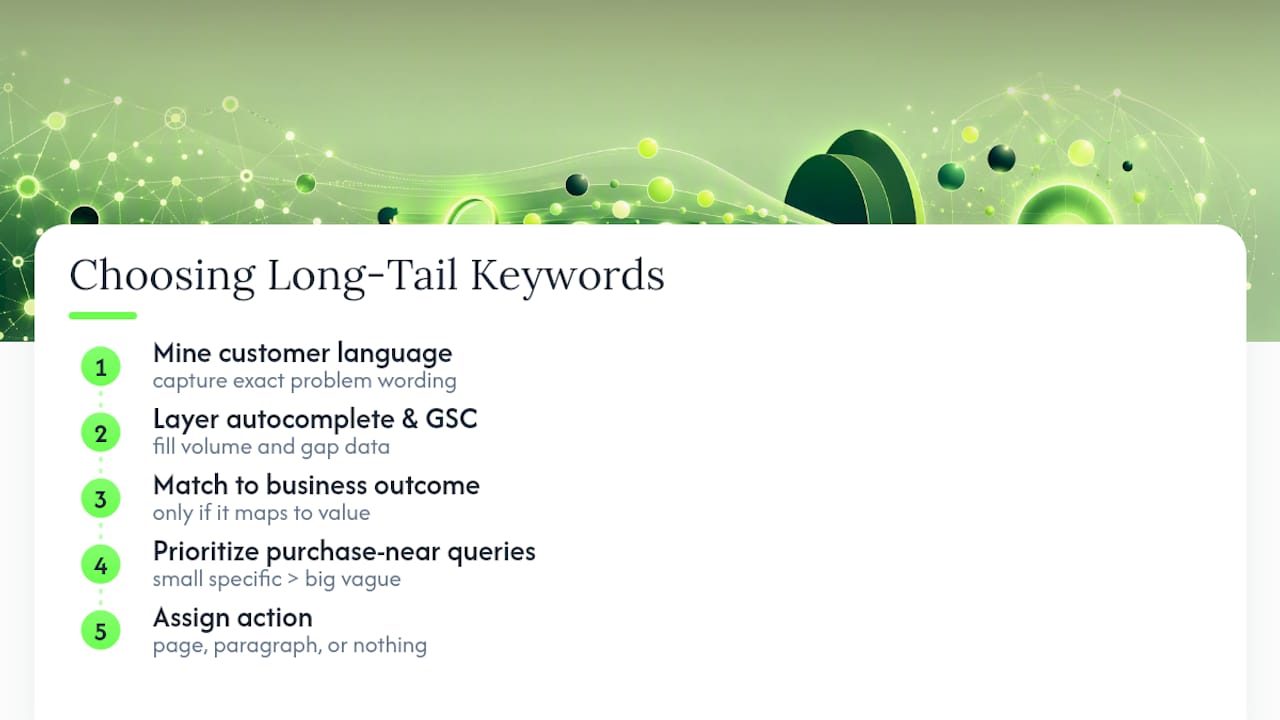
That’s where I think the conventional playbook falls short. It treats keyword research as a volume game when it’s really a filtering game. The founders who win with long-tail content aren’t the ones with the biggest spreadsheet. They’re the ones who ruthlessly matched each phrase to a real business outcome before writing a word.
If you’re building something new, your customer conversations are a better keyword tool than any paid database, because they capture the exact language of someone who already has the problem you solve. Mine that first. Then, and only then, layer on autocomplete and GSC data to fill gaps. Prioritize the queries that sit closest to a purchase decision, even if the volume looks embarrassingly small. Small and specific beats big and vague, every time it’s measured. If you’re validating a business idea from scratch, tools like siift’s startup idea validation platform can help you connect that customer language directly to a stronger go-to-market plan, instead of guessing at keywords in a vacuum.
— Samim Safaei
Sources
- Long-Tail Keywords: The Ultimate 2026 Guide
- Long-tail keywords: length is a vanity metric
- Long-tail keywords: what they are and how to get search traffic from them
- Long-tail keywords: the ultimate guide
FAQ
What is an example of a long-tail keyword?
“Best budgeting app for freelancers with irregular income” is a long-tail keyword. It’s specific, has clear intent, and has far less competition than “budgeting app.”
What is the difference between long-tail and short-tail keywords?
Short-tail keywords are broad, high-volume, and highly competitive (like “shoes”). Long-tail keywords are specific, lower-volume, and carry stronger buyer intent (like “waterproof hiking boots for wide feet with a budget in mind”).
What are the benefits of long-tail keywords?
Long-tail keywords convert about 2.5 times better than head terms, face less competition, and are far easier for newer sites to rank for while collectively adding up to significant traffic.
Does keyword length determine whether it’s long-tail?
No. Specificity and low search volume define a long-tail keyword, not the number of words. A short phrase can be long-tail if it’s narrow enough, and a long phrase can still be a broad head term.
Should every long-tail keyword get its own page?
Only topical long-tail keywords, ones with distinct intent and different search results, need dedicated pages. Supporting variations are better handled inside an existing pillar page or FAQ section.