
Most aspiring entrepreneurs spend 12 to 18 months validating business ideas through guesswork and trial and error, facing high failure rates and wasted resources. AI integration transforms this timeline by enabling data-driven decisions that accelerate validation and market entry. This article delivers a structured, AI-powered stepwise strategy to help you validate and launch your business efficiently, cutting time to product-market fit to under 9 months.
Table of Contents
- Why AI-Driven Business Strategy Matters For New Entrepreneurs
- Prerequisites: What You Need Before Starting Your AI-Driven Strategy
- Stepwise AI-Driven Business Strategy: From Idea To Market Fit
- Using AI To Validate Business Ideas Effectively
- Common Mistakes And How To Troubleshoot Them In AI-Driven Startups
- Expected Results And Timelines When Using AI-Driven Business Strategies
- Alternative AI Tools And Strategy Tradeoffs For Entrepreneurs
- Safety Considerations And Ethical Warnings In AI-Driven Business Strategy
- Accelerate Your AI-Driven Startup Journey With siift.ai
Key Takeaways
| Point | Details |
|---|---|
| Speed to Market | Stepwise AI integration reduces startup time from 12 to 18 months to under 9 months. |
| Validation Advantage | Data-driven idea validation lowers failure rates and improves ROI significantly. |
| Phased Implementation | Foundation, pilot, and scaling phases ensure structured, de-risked progress. |
| Common Pitfalls | Skipping pilot tests and choosing unsuitable AI tools lead to 70% higher failure rates. |
| Ethical Foundation | Responsible AI use builds customer trust and supports sustainable growth. |
Why AI-Driven Business Strategy Matters for New Entrepreneurs
AI offers aspiring entrepreneurs a competitive edge by accelerating growth and enabling faster market entry through automation and advanced analytics. Traditional startup methods rely heavily on intuition, which often leads to costly mistakes and extended timelines. Data-driven decisions reduce this guesswork dramatically, helping you validate ideas before investing significant time and capital.
Integrating AI helps reduce the notoriously high startup failure rates by enabling early validation of assumptions. A structured AI-driven approach accelerates your path to product-market fit, reducing time from 12 to 18 months to under 9 months. This speed advantage allows you to iterate faster, respond to market feedback quickly, and adjust your strategy before competitors do.
Key benefits of AI integration include:
- Automated customer feedback analysis saves weeks of manual work
- Market trend identification happens in real time instead of quarterly reviews
- Predictive analytics help forecast demand and optimize resource allocation
- Personalized customer experiences improve engagement and retention rates
- Operational efficiency gains free up time for strategic decisions
AI is a powerful tool, not a magic solution. Success requires deliberate implementation combined with strategic thinking. Entrepreneurs who embrace AI thoughtfully gain significant advantages in speed, insight quality, and decision confidence. The key is applying AI systematically within a structured framework rather than adopting tools randomly.
Prerequisites: What You Need Before Starting Your AI-Driven Strategy
Before launching your AI-powered business strategy, you need specific foundational elements in place. Basic digital literacy and access to AI tools or platforms are critical starting points. You don’t need to be a programmer, but comfort with technology and willingness to learn new platforms is essential. Digital literacy includes understanding how to navigate software interfaces, interpret data dashboards, and communicate effectively with AI tools.
Clearly defining the problem your business idea solves comes next. Vague ideas lead to scattered efforts and wasted resources. Write down the specific pain point you’re addressing, who experiences it, and why current solutions fall short. Setting measurable goals helps you track progress objectively. Instead of “grow the business,” aim for “acquire 100 validated customer emails in 90 days.”
An openness to adapt based on AI-derived insights enables iterative improvement. Many entrepreneurs struggle when data contradicts their assumptions. Building foundational skills saves time and reduces frustration later. Understanding basic AI concepts like machine learning, natural language processing, and predictive analytics helps you select appropriate tools and workflows.
Essential prerequisites include:
- Access to affordable AI platforms with user-friendly interfaces
- Clear documentation of your business problem and target customer
- Willingness to test assumptions and pivot based on evidence
- Basic understanding of data interpretation and metrics tracking
- Commitment to continuous learning as AI capabilities evolve
Pro Tip: Start with one AI tool focused on a single task like customer feedback analysis. Master it completely before adding more tools. Depth beats breadth when building foundational skills.
Stepwise AI-Driven Business Strategy: From Idea to Market Fit
A clear, phased roadmap transforms AI integration from overwhelming to manageable. The phased AI implementation approach spans three distinct stages, each with specific objectives and timelines. This structured method reduces risk and speeds progress toward product-market fit by ensuring you validate before scaling.
Phase 1: Foundation (0 to 3 months)
- Define your core business problem with precision and clarity
- Research and select AI tools matching your technical skill level
- Build basic data collection pipelines for customer insights
- Establish key performance indicators to measure progress
- Create your initial value proposition and test messaging
Phase 2: Pilot Testing (4 to 8 months)
- Launch minimum viable product to small, targeted audience segment
- Use AI to automate feedback collection and sentiment analysis
- Validate core assumptions through iterative testing cycles
- Refine your business model based on real customer data
- Document what works and what fails for scaling decisions
Phase 3: Scaling (9 to 12 months)
- Expand validated workflows to broader market segments
- Optimize operations using AI-driven efficiency insights
- Automate repetitive tasks to focus on strategic growth
- Monitor metrics continuously and adjust strategy proactively
- Prepare infrastructure for sustainable growth trajectory
| Phase | Duration | Primary Focus | Success Metric |
|---|---|---|---|
| Foundation | 0 to 3 months | Problem definition and tool setup | Data pipeline operational |
| Pilot Testing | 4 to 8 months | Validation and iteration | 50+ customer feedback points |
| Scaling | 9 to 12 months | Growth and optimization | Revenue or user acquisition targets |
This AI-driven approach reduces startup time to product-market fit from 12 to 18 months to under 9 months. Structured phases prevent premature scaling and ensure you’re building something customers actually want. Many entrepreneurs skip the pilot phase, leading to expensive failures when scaling unvalidated ideas.

Pro Tip: Treat each phase boundary as a checkpoint. If you haven’t achieved phase objectives, pause and troubleshoot rather than advancing prematurely. Strategic progression matters more than speed, and data-driven entrepreneurship builds sustainable businesses.
Using AI to Validate Business Ideas Effectively
AI-powered validation methods enable you to test business ideas faster and more accurately than traditional approaches. Automating customer feedback analysis using natural language processing helps you quickly identify key pain points across hundreds of responses. Machine learning and NLP enable non-technical entrepreneurs to automate customer feedback analysis, reducing analysis time by over 50%.
Leveraging AI tools to analyze market trends and competitor behavior at scale provides insights impossible to gather manually. These platforms scan thousands of data points daily, identifying emerging patterns and opportunities. You can track competitor pricing changes, feature launches, and customer sentiment shifts in real time rather than waiting for quarterly market reports.
Using AI to test hypotheses iteratively refines your business model rapidly. Traditional validation might take months of manual surveys and interviews. AI compresses this timeline to weeks by processing feedback continuously and highlighting actionable insights. This speed enables you to pivot or persevere based on solid evidence rather than gut feeling.
Effective AI validation techniques include:
- Sentiment analysis of social media conversations about your problem space
- Predictive modeling to forecast market demand for your solution
- A/B testing automation to optimize messaging and positioning
- Competitor monitoring to identify gaps and differentiation opportunities
- Customer segmentation to target the most promising audience groups
Combining qualitative and quantitative AI insights creates robust validation. Numbers tell you what is happening, while text analysis reveals why it’s happening. AI for business model strategy transforms validation from guesswork into systematic investigation. Collecting data-driven insights informs pivot or persevere decisions with confidence, reducing the emotional difficulty of changing direction when evidence demands it.
Common Mistakes and How to Troubleshoot Them in AI-Driven Startups
Many entrepreneurs stumble by making predictable mistakes when integrating AI into their startup strategy. Recognizing these pitfalls early helps you avoid costly setbacks and accelerate progress. Overreliance on intuition without data validation, poor AI tool selection, and skipping feedback automation lead to 70% higher failure rates.
Relying on gut feeling over data validation creates a dangerous illusion of progress. You may believe customers want your solution, but without systematic validation, you’re building on assumptions. Skipping pilot testing or scaling prematurely increases failure rates by 50% due to poor product-market fit. The excitement of initial traction tempts entrepreneurs to scale before validating that traction is sustainable and replicable.
Selecting unsuitable or overly complex AI tools causes integration issues and technical debt. Entrepreneurs often choose enterprise-grade platforms when simpler tools would suffice, creating unnecessary complexity. Poor tool fit wastes time on troubleshooting instead of building your business. Solutions include adopting automated feedback systems early and following phased rollout plans that test before expanding.
Frequent startup mistakes include:
- Implementing AI without clear business objectives or success metrics
- Choosing tools based on hype rather than fit for your specific needs
- Neglecting data quality, leading to unreliable AI insights
- Skipping the pilot phase to “save time” and launching at full scale
- Ignoring customer feedback that contradicts your original vision
“The biggest AI implementation failures come from entrepreneurs who treat AI as a shortcut rather than a strategic tool requiring thoughtful integration and continuous refinement.”
Investing in simple, well-integrated AI tools with focused upskilling minimizes technical bottlenecks. Start with platforms designed for non-technical users, then advance to more sophisticated tools as your skills grow. Startup risk management using AI requires acknowledging these common patterns and deliberately avoiding them through systematic planning and validation.
Expected Results and Timelines When Using AI-Driven Business Strategies
Setting realistic expectations prevents frustration and helps you measure progress accurately. Typical measurable results appear between 6 and 12 months after starting AI integration. Entrepreneurs typically see measurable outcomes within 6 to 12 months, including customer engagement and initial revenue. This timeline assumes consistent effort and proper implementation of phased strategies.
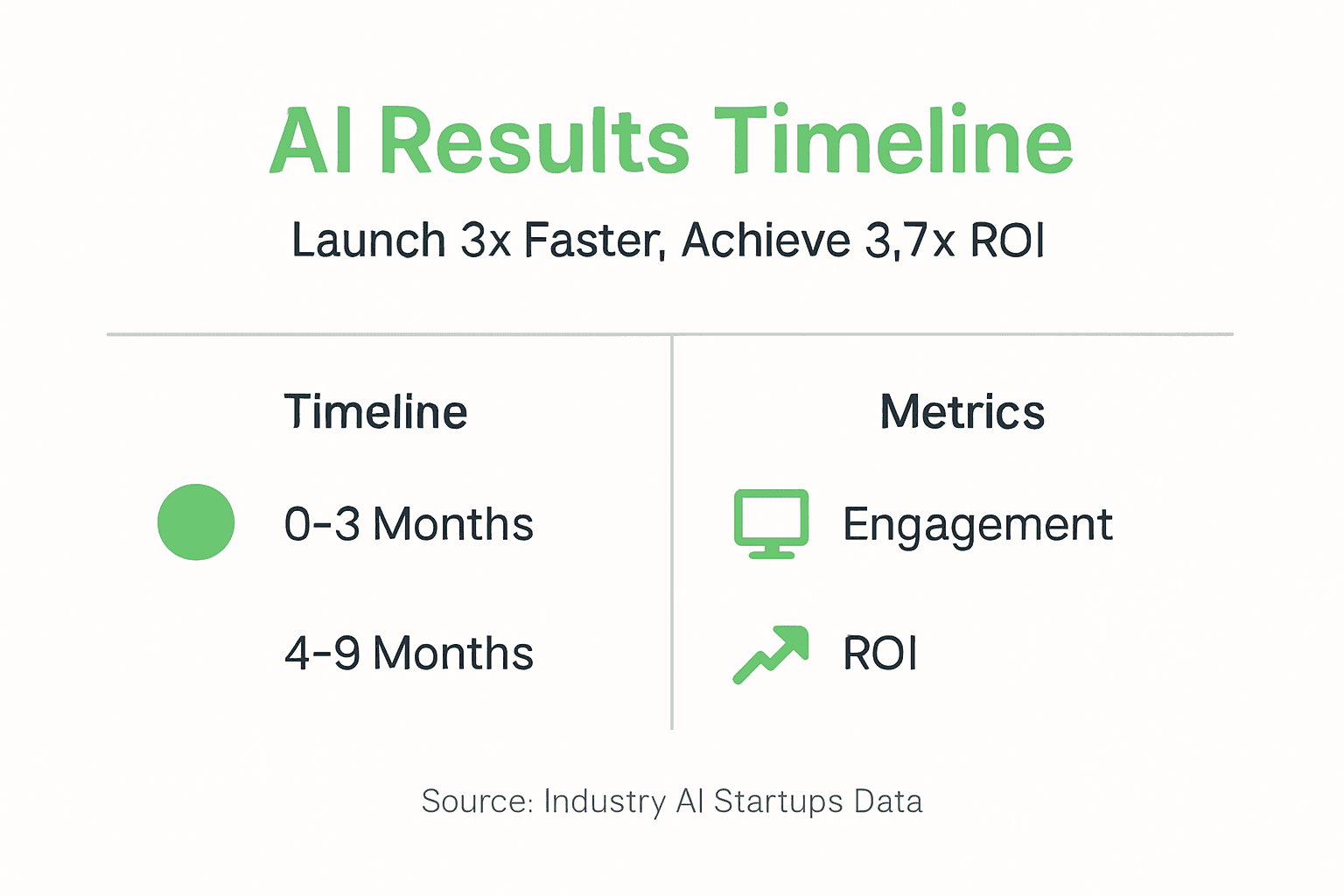
Customer engagement metrics and initial revenues serve as key success indicators during early stages. Engagement includes email open rates, website visits, demo requests, and social media interactions. Initial revenue might be small, but it validates that customers will pay for your solution. Tracking these metrics helps you adjust strategy early rather than waiting months to discover problems.
Successful AI-driven startups achieve on average a 3.7x ROI within their first year. This return comes from reduced operational costs, faster time to market, and improved customer targeting. The investment includes tool costs, learning time, and initial experimentation, but AI efficiencies compound quickly once systems are operational.
| Timeline | Expected Outcome | Key Metrics |
|---|---|---|
| 0 to 3 months | Foundation established | AI tools operational, data collection active |
| 4 to 6 months | Early validation signals | 50+ customer feedback responses, refined value proposition |
| 7 to 9 months | Product-market fit indicators | Consistent engagement growth, initial revenue |
| 10 to 12 months | Sustainable traction | 3.7x ROI, repeatable customer acquisition process |
Progress can be tracked via validated metrics to adjust strategy early. If engagement stalls at month 5, investigate messaging or targeting rather than waiting until month 10. Setting realistic milestones helps maintain motivation and focus through inevitable challenges. Startup traction steps build momentum systematically rather than relying on lucky breaks.
Remember that these timelines assume active work and proper implementation. Sporadic effort or skipping validation phases extends timelines significantly. Consistency and systematic execution matter more than initial speed.
Alternative AI Tools and Strategy Tradeoffs for Entrepreneurs
Choosing the right AI tools requires understanding tradeoffs between complexity, cost, control, and ease of use. Large Language Models versus Small Language Models present a fundamental choice. LLMs offer sophisticated capabilities but demand more computational resources and often higher costs. SLMs provide focused functionality at lower cost, ideal for specific tasks like sentiment analysis or basic chatbots.
Cloud-based AI platforms enable scalability and lower upfront costs compared to on-premise solutions. You pay for usage rather than infrastructure, reducing financial risk during validation phases. However, cloud platforms mean less control over data and potential privacy concerns. On-premise solutions offer complete control and privacy but require technical expertise and significant upfront investment.
Startups with limited technical skills benefit most from user-friendly, cloud platforms with intuitive interfaces and strong support. Bootstrapped startups should prioritize cost-effectiveness and simpler integrations that deliver immediate value. Selecting AI tools requires balancing ease of use, integration capability, and cost, with tradeoffs dependent on startup stage and resources.
| Tool Type | Pros | Cons | Best For |
|---|---|---|---|
| Cloud LLM Platforms | High capability, scalable, low upfront cost | Ongoing costs, less control, internet dependent | Growing startups needing flexibility |
| Cloud SLM Tools | Focused functionality, affordable, easy integration | Limited scope, vendor lock-in risk | Specific tasks like feedback analysis |
| On-Premise Solutions | Complete control, data privacy, one-time cost | High upfront investment, technical expertise needed | Established businesses with IT resources |
| No-Code AI Builders | User-friendly, fast deployment, minimal learning curve | Limited customization, potential scalability issues | Non-technical founders validating ideas |
Key considerations when selecting tools include:
- Your current technical skill level and willingness to learn
- Budget constraints and preference for upfront versus ongoing costs
- Data sensitivity and regulatory compliance requirements
- Integration needs with existing workflows and systems
- Expected growth trajectory and scalability requirements
Understanding these tradeoffs helps balance startup needs for speed, budget, and control. AI business model canvas frameworks help map tool choices to strategic objectives. Start simple and upgrade as validated needs emerge rather than over-investing in capability you may never use.
Safety Considerations and Ethical Warnings in AI-Driven Business Strategy
Responsible AI implementation protects both your customers and your business reputation. Using AI ethically maintains transparency and builds customer trust, essential foundations for long-term success. Customers increasingly scrutinize how businesses collect and use their data, making ethical practices a competitive advantage rather than just a compliance checkbox.
Ensuring compliance with data privacy laws such as GDPR and CCPA prevents costly legal issues and demonstrates respect for customer rights. These regulations require explicit consent for data collection, transparent usage policies, and robust security measures. Non-compliance risks significant fines and permanent damage to brand reputation. Implementing data security best practices for customer information includes encryption, access controls, and regular security audits.
Avoiding premature scaling before validation reduces risk of costly failure at larger scale. The temptation to grow quickly can override caution, but scaling unvalidated models multiplies problems rather than profits. Ethical AI practices reduce risk exposure, build customer trust, and significantly impact long-term viability.
Critical safety and ethical considerations include:
- Transparent communication about how AI is used in your business
- Obtaining explicit consent before collecting or analyzing customer data
- Regular bias audits to ensure AI systems treat all users fairly
- Clear opt-out mechanisms for customers uncomfortable with AI interactions
- Secure data storage with encryption and limited access protocols
“Ethical AI use isn’t just about avoiding problems. It’s about building genuine trust that becomes your strongest competitive moat in an increasingly skeptical market.”
Startup risk management using AI insights requires proactive ethical frameworks from day one. Building these practices into your foundation costs less than retrofitting them later. Ethical AI contributes to brand reputation and sustainable growth by creating customer relationships based on trust rather than exploitation.
Accelerate Your AI-Driven Startup Journey with siift.ai
Transforming these strategies into action requires the right tools and guidance. siift.ai offers AI-powered platforms specifically designed to validate and launch your business smarter, not harder. The Intelligent Business Canvas for AI startups structures your ideation process systematically, eliminating guesswork and reducing validation time.
Access expert guides and actionable workflows aligned with AI startup best practices through the step-by-step AI entrepreneurship guide. These resources translate complex strategies into practical actions you can implement immediately. Leverage siift.ai to reduce risk and speed your path to product-market fit through personalized feedback, prioritized actions, and continuous insights that filter out biases and uncertainty.
FAQ
What skills do I need to start an AI-driven business strategy?
Basic digital literacy and access to AI tools are essential starting points. You don’t need programming expertise, but comfort navigating software platforms and interpreting data dashboards is critical. Understanding your business problem clearly helps you apply AI effectively rather than adopting tools randomly.
How long does it take to see results from AI-driven validation?
Typically 6 to 12 months to see measurable customer engagement and initial revenue. The phased approach helps you track progress through specific milestones and iterate quickly based on evidence. Consistent effort matters more than initial speed when building sustainable traction.
What are the biggest mistakes to avoid when using AI for my startup?
Avoid relying solely on intuition without systematic data validation. Never skip pilot testing and incremental validation phases, as this increases failure rates by 50%. Choose AI tools suitable for your actual technical skills and integrate them carefully rather than selecting based on hype or complexity.
How should I choose the right AI tools for my startup?
Prioritize user-friendly tools if you have minimal technical expertise, focusing on platforms designed for non-technical founders. Consider integration capabilities with your current workflows and budget constraints carefully. Evaluate tradeoffs between complexity, cost, and scalability based on your specific startup stage and resources.
Recommended
- Master Business Strategy to Launch Your AI Venture | siift
- Business Strategy AI for Startups: Smarter Growth Strategies
- AI Accelerator: Fast-Tracking Startup Success in 2026 | siift
- AI for Business Model Strategy: Achieving Product-Market Fit | siift
- 7 Key Advantages of AI in Sales for B2B Success
- Cloud Server Instant Deployment for AI & ML Workloads