

Over 45 percent of AI-generated code may carry potential vulnerabilities, raising serious questions about how we build and launch technology today. The rise of vibe coding and vibe founding promises to make software creation and entrepreneurship accessible to millions, removing traditional barriers that once favored specialists. This article unpacks how these AI-driven shortcuts can create opportunities while introducing new risks, helping you understand the real impact behind the buzz.
Table of Contents
- Defining Vibe Coding And Vibe Founding
- AI-Driven Shortcuts And Their Risks
- Technical Debt Vs. Business Debt Explained
- Why Vibe Approaches Are So Tempting Today
- Best Practices To Avoid Accumulating Debt
Key Takeaways
| Point | Details |
|---|---|
| Vibe Coding Accessibility | Vibe coding democratizes software development, allowing non-developers to create applications through AI, but raises significant security vulnerabilities. |
| Risks of AI-Driven Shortcuts | AI-generated outputs can lead to technical and business debt, as well as critical security flaws, emphasizing the need for human oversight. |
| Mitigation Strategies | Effective debt mitigation requires rigorous code reviews, continuous testing, and clear accountability to prevent issues related to AI-generated code. |
| Strategic Use of AI | AI should supplement human expertise rather than replace it; understanding underlying principles is essential for long-term success. |
Defining Vibe Coding and Vibe Founding
In the rapidly evolving landscape of AI-driven development, vibe coding and vibe founding have emerged as transformative yet controversial approaches that leverage artificial intelligence to reduce traditional barriers to entry. According to ITpro, vibe coding involves using large language models (LLMs) to automatically generate software code by simply describing a project, which dramatically lowers the technical expertise required for software development.
At its core, vibe coding represents a paradigm shift where amateur programmers can produce functional software without extensive coding training. As noted by ITpro, this approach increases development efficiency but simultaneously raises significant security concerns, with nearly 45% of AI-generated code containing potential vulnerabilities. The technique allows developers to describe a project concept to an AI, which then generates corresponding code based on that description.
Similarly, vibe founding mirrors this approach in the entrepreneurial domain, enabling individuals to leverage AI tools for rapidly conceptualizing, validating, and launching business ideas with minimal traditional research or planning. Both vibe coding and vibe founding share critical characteristics: they democratize complex processes, reduce entry barriers, and introduce substantial risks through over-reliance on AI-generated outputs. Learn more about founder strategies in our guide on founders, business, and AI.
While these approaches offer unprecedented accessibility, they are not without significant pitfalls. The convenience of AI-generated solutions can mask critical blind spots:
- Technical debt in code development
- Superficial market understanding in business creation
- Potential security and legal vulnerabilities
- Reduced personal skill development and critical thinking
The key is not to abandon these approaches, but to use them strategically and supplement AI outputs with human expertise, validation, and rigorous testing.
AI-Driven Shortcuts and Their Risks
In the emerging world of AI-powered development, AI-driven shortcuts have become a double-edged sword, offering unprecedented accessibility while simultaneously introducing complex risks. According to ITpro, nearly 45% of AI-generated code contains potential vulnerabilities, revealing the hidden dangers lurking beneath the surface of seemingly convenient technological solutions.
Security risks are the most immediate concern with these AI-driven approaches. As reported by Tom’s Guide, vibe coding enables users to create software applications through natural language prompts, but this convenience comes at a significant cost. The lack of foundational technical skills means developers might unknowingly introduce critical security flaws, injection errors, and authorization problems into their codebase.
The risks extend beyond mere technical vulnerabilities. These AI shortcuts can create a false sense of competence, encouraging developers and entrepreneurs to bypass critical thinking and deep understanding. Learn more about common founder challenges in our guide.
To mitigate these risks, experts recommend a strategic approach:
- Treat all AI-generated code as inherently untrustworthy
- Implement rigorous code review and security testing
- Maintain foundational technical skills despite AI assistance
- Develop a deep understanding of underlying principles
- Use AI as a tool, not a complete replacement for expertise
Ultimately, AI-driven shortcuts are powerful but require careful, informed navigation. They are not magic wands but sophisticated tools that demand human wisdom, critical assessment, and ongoing vigilance.

Technical Debt vs. Business Debt Explained
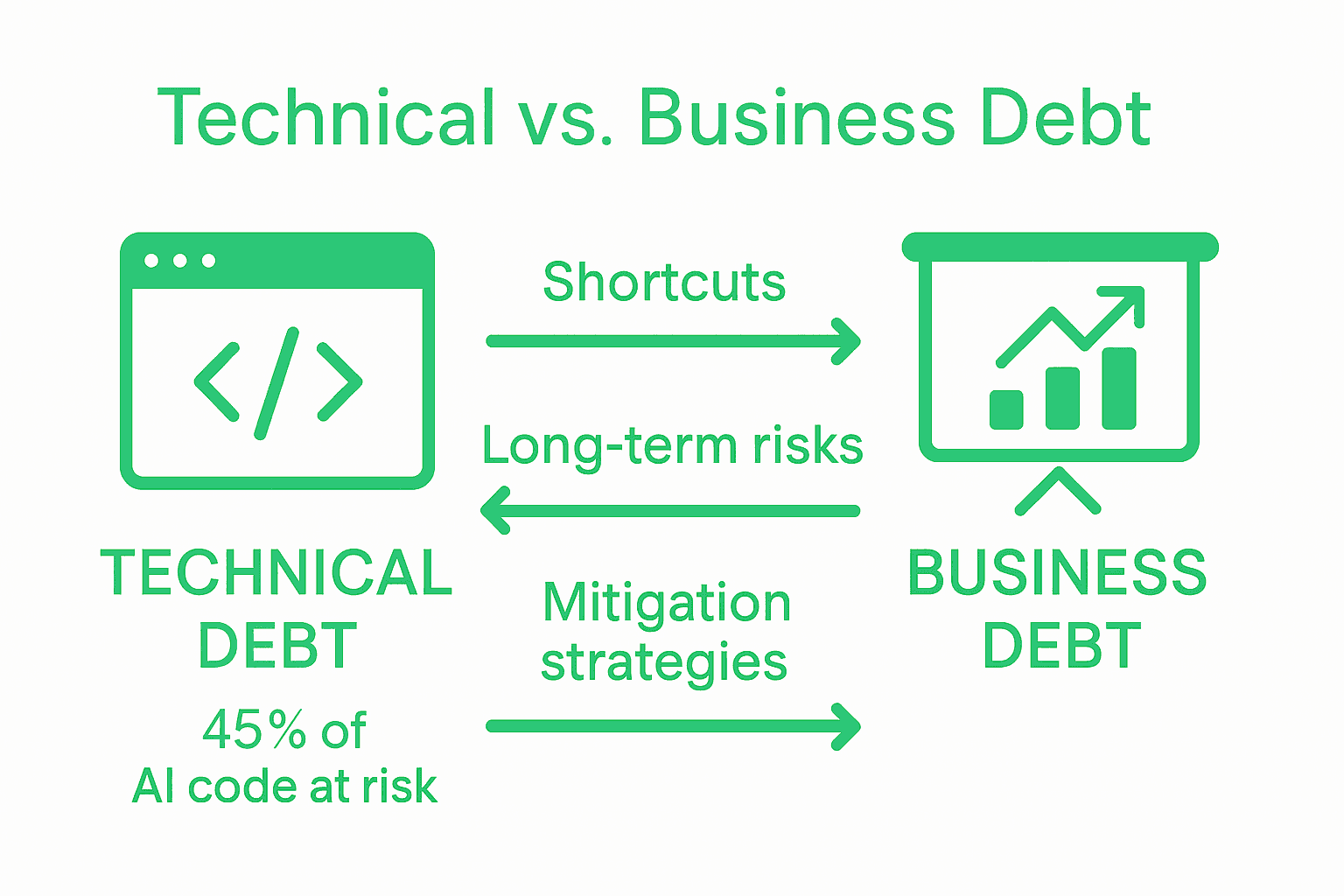
Technical debt and business debt represent parallel risks in the AI-driven entrepreneurial landscape, where shortcuts can lead to cascading long-term consequences. According to Wikipedia, technical debt refers to the implied cost of additional rework caused by choosing an easy solution now instead of using a more robust approach that would take longer to implement.
As highlighted by TechRadar, vibe coding particularly amplifies technical debt risks. When AI-generated code is not thoroughly reviewed and tested, it can create a foundation of software that is difficult to maintain, prone to errors, and increasingly expensive to modify over time. This mirrors the concept of business debt, where entrepreneurs accumulate strategic liabilities by taking rapid but superficial approaches to market entry.
Business debt emerges when founders prioritize speed over substance, making decisions that look appealing in the short term but create significant challenges down the line. Explore more about founder challenges in our comprehensive guide. Just as technical debt can cripple a software project, business debt can derail an entire entrepreneurial venture.
Key characteristics of technical and business debt include:
- Accumulation through repeated shortcuts
- Increased complexity over time
- Higher long-term remediation costs
- Potential complete system/business failure
- Reduced adaptability and strategic flexibility
The critical insight is understanding that both technical and business debt are not just financial concepts, but holistic measures of systemic risk. Smart entrepreneurs and developers recognize that the momentary convenience of AI-driven shortcuts can create profound structural weaknesses that may ultimately prove more costly than the time saved.
Here’s a comparison of technical debt and business debt in AI-driven projects:
| Aspect | Technical Debt | Business Debt |
|---|---|---|
| Definition | Rework cost from quick coding fixes | Strategic liabilities from rapid decisions |
| Common Cause | Unreviewed AI-generated code | Fast market entry without planning |
| Short-Term Effect | Faster development Immediate product release |
Quicker launch Initial growth |
| Long-Term Risk | Hard-to-maintain software Hidden bugs |
Unscalable model Market misfit |
| Mitigation Strategy | Code reviews Automated testing Human oversight |
Deep market analysis Strategic planning Continuous validation |
Why Vibe Approaches Are So Tempting Today
Vibe approaches are seducing a generation of entrepreneurs and developers with their promise of instant creation and minimal barriers to entry. According to Tom’s Guide, these methods allow individuals with minimal technical expertise to create software applications by simply interacting with AI through natural language prompts, dramatically lowering traditional development obstacles.
As highlighted by TechRadar, vibe coding represents a democratization of software creation, enabling non-developers to build functional prototypes and solutions with unprecedented efficiency. This approach fosters a more collaborative and agile development process, making technological innovation feel accessible to anyone with a creative idea and an AI assistant.
The psychological appeal runs deeper than mere convenience. These vibe approaches tap into a fundamental desire to bypass complex learning curves and immediately transform abstract concepts into tangible results. Understand more about the marketing dynamics behind these approaches in our guide, which explores how AI-driven shortcuts are reshaping entrepreneurial expectations.
Key reasons vibe approaches feel irresistible include:
- Instant gratification of seeing ideas materialize
- Reduced financial and time investment in skill acquisition
- Perception of being technologically cutting-edge
- Elimination of traditional gatekeeping mechanisms
- Illusion of creative empowerment
Yet, the most compelling aspect of vibe approaches is their promise of democratization—the belief that anyone can now become a creator, developer, or entrepreneur without years of specialized training. It’s a siren song of technological potential that’s hard to resist.
Best Practices to Avoid Accumulating Debt
Debt mitigation in the AI-driven development landscape requires a proactive and strategic approach. According to ITpro, organizations must treat AI-generated code as inherently untrustworthy, implementing strict governance frameworks and assigning clear human accountability to prevent technical debt from accumulating.
As highlighted by TechRadar, comprehensive testing and proper oversight are critical in maintaining code quality when utilizing AI-assisted development methods. This approach allows developers to leverage AI’s capabilities while maintaining a high-level focus on architectural integrity and problem-solving strategies.
Beyond technical considerations, founders must also develop a holistic risk management perspective that extends beyond immediate coding challenges. Explore strategies for navigating founder challenges in our comprehensive guide, which provides insights into building sustainable business models that resist the allure of shortcuts.
Key strategies to avoid accumulating debt include:
- Implement rigorous code review processes
- Conduct continuous automated security testing
- Maintain human oversight and critical evaluation
- Avoid using AI for critical system components
- Develop a deep understanding of generated code
- Create clear accountability mechanisms
- Regularly refactor and optimize AI-generated solutions
The ultimate goal is not to reject AI tools, but to use them intelligently—as powerful assistants that augment human expertise rather than replace critical thinking and strategic planning.
Navigate the Risks of Vibe Coding and Vibe Founding with Confidence
The article highlights critical challenges like technical debt and business debt that arise from rapid AI-driven shortcuts such as vibe coding and vibe founding. If you have felt the pressure to launch quickly or trusted AI tools without deep oversight you know how risky this approach can be. Avoid hidden pitfalls like security vulnerabilities, shallow market insight, and strategic blind spots by gaining clear, step-by-step guidance.
Discover how siift.ai empowers founders to turn ideas into viable businesses without falling into these common traps. Our intuitive AI platform offers personalized feedback and prioritized actions that help you validate and build your business systematically while managing risks. Start leading your founder journey with confidence today by visiting siift.ai. Learn more about overcoming founder challenges and get actionable insights to prevent pitfalls before they grow. Take control of your future—explore practical, trustworthy support for vibe founders now.
Frequently Asked Questions
What is vibe coding?
Vibe coding is an approach that uses large language models (LLMs) to automatically generate software code based on simple project descriptions, allowing amateur programmers to create functional software without extensive coding knowledge.
What are the main risks associated with vibe coding?
The primary risks of vibe coding include the introduction of security vulnerabilities, technical debt, and the potential for superficial understanding of market needs. Nearly 45% of AI-generated code may contain vulnerabilities.
How does vibe founding differ from vibe coding?
Vibe founding resembles vibe coding but applies to the entrepreneurial realm. It enables individuals to leverage AI tools to rapidly conceptualize, validate, and launch business ideas without the need for in-depth traditional research or planning.
What best practices can help prevent accumulating technical and business debt?
To avoid accumulating debt, it’s essential to implement rigorous code reviews, conduct continuous testing, maintain human oversight, and develop deep knowledge about the AI-generated outputs. Engaging in strategic planning and market analysis is also crucial for entrepreneurs.