

TL;DR:
OKRs are a goal-setting framework that pairs ambitious objectives with measurable key results to foster strategic focus. They are effective across organizations of all sizes, requiring disciplined implementation, consistent check-ins, and a culture shift for success. Proper use of OKRs drives meaningful progress, aligns teams, and scales from startups to large enterprises.
OKRs, short for Objectives and Key Results, are a goal-setting framework that pairs an ambitious qualitative goal with 2 to 5 measurable outcomes to drive strategic focus across teams and organizations. Adopted by Google, IBM, and Atlassian, the framework has moved far beyond Silicon Valley into corporate boardrooms and solo founder workflows alike. Yet only 16% of knowledge workers report their companies are effective at setting and communicating goals. That gap is exactly what OKRs are designed to close. Understanding OKRs is not just an academic exercise. It is the difference between a team that moves with purpose and one that stays perpetually busy without getting anywhere meaningful.
What are OKRs and how do they work?
An OKR consists of two parts: an Objective and a set of Key Results. The Objective is a qualitative, inspiring statement of what you want to achieve. The Key Results are the specific, quantitative metrics that tell you whether you got there. Together, they answer two questions every leader should be asking: where are we going, and how will we know we have arrived?

The OKR framework structure specifies 2 to 5 Key Results per Objective, keeping the focus tight enough to be actionable. Objectives should feel slightly uncomfortable. They are meant to stretch your team, not describe business as usual. Key Results, on the other hand, must be measurable and time-bound. “Increase monthly recurring revenue to $50,000 by Q3” is a Key Result. “Grow revenue” is not.
Here is a concrete example for a startup founder:
Objective: Establish product credibility in the B2B SaaS market
Key Result 1: Secure 10 paying pilot customers by end of quarter
Key Result 2: Achieve a Net Promoter Score of 40 or above
Key Result 3: Publish 3 customer case studies with verified ROI data
And for a corporate marketing team:
Objective: Become the most recognized brand in our category
Key Result 1: Increase organic search traffic by 40%
Key Result 2: Grow LinkedIn followers from 5,000 to 12,000
Key Result 3: Land 5 earned media placements in tier-one publications
One counterintuitive truth about OKRs: 60 to 70% achievement is the sweet spot. Hitting 100% consistently signals your goals were not ambitious enough. This reframes failure productively. Missing a stretch goal by 30% while learning what actually moves the needle is more valuable than comfortably ticking boxes.
Pro Tip: The most common drafting mistake is writing Key Results that describe activities rather than outcomes. “Launch a new website” is a task. “Increase website conversion rate from 1.2% to 3.5%” is a Key Result. If your Key Result sounds like a to-do list item, rewrite it.
How do OKRs differ from KPIs and KRAs?
This is where most teams get tangled. OKRs, KPIs, and KRAs are not interchangeable, and treating them as such is one of the fastest ways to kill adoption before it starts.
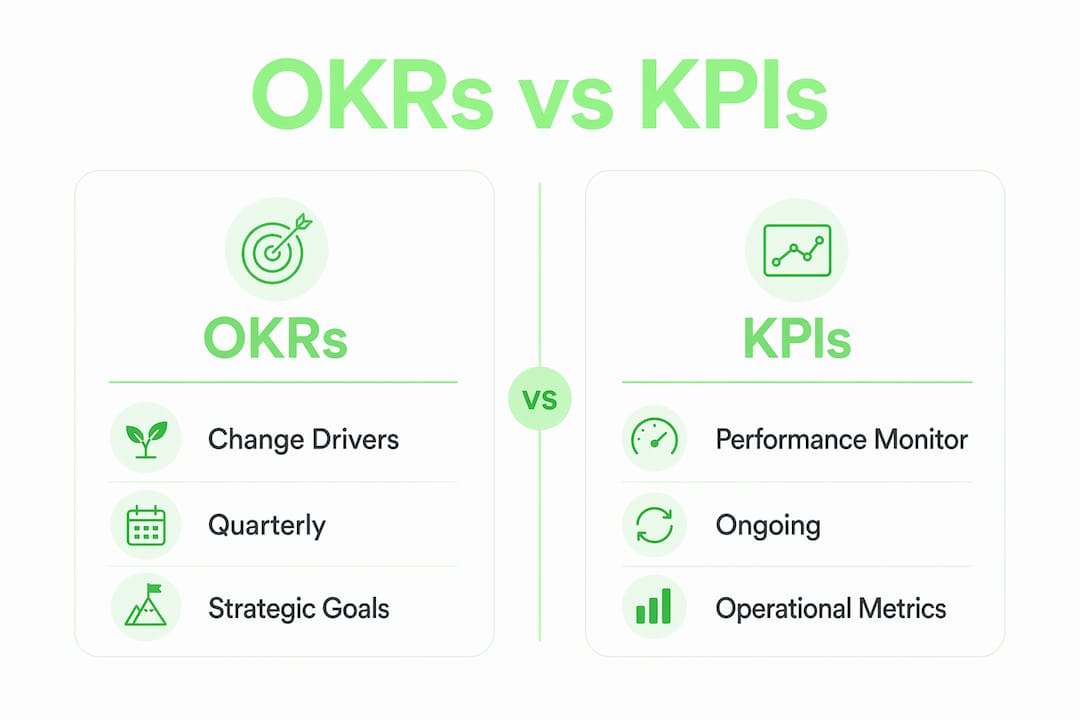
KPIs monitor ongoing performance health while OKRs drive improvements and strategic breakthroughs. Think of KPIs as your vital signs and OKRs as your physical therapy plan. You need both, but they serve fundamentally different purposes. KRAs, or Key Result Areas, define the broad domains a role or department is responsible for. They are descriptive, not directional.
Framework | Primary purpose | Time horizon | Scope |
|---|---|---|---|
OKRs | Drive strategic change and improvement | Quarterly | Team, company, or individual |
KPIs | Monitor ongoing performance health | Ongoing or monthly | Role or department |
KRAs | Define areas of responsibility | Annual or role-based | Individual or department |
The practical implication: a sales team’s KPI might be monthly call volume. Their KRA is “revenue generation.” Their OKR for Q2 might be “Break into the enterprise segment,” with Key Results tracking new enterprise logos and average contract value. All three coexist without conflict. Mature organizations use KPIs to maintain operations and OKRs to push the frontier. Choosing one over the other is a false trade-off.
OKRs also shift the dynamic from top-down Management by Objectives to a collaborative, decentralized methodology. Teams propose their own OKRs within the strategic anchor set by leadership. That shift in ownership is not cosmetic. It is what drives the engagement that makes OKRs actually work.
How to set OKRs that stick
Setting OKRs is a skill, and like most skills, the first attempt is usually the worst one you will ever produce. Here is a proven sequence for getting it right from the start.
Set the strategic anchor. Leadership defines 3 to 5 company-wide Objectives for the quarter. These are non-negotiable priorities that every team’s OKRs should connect to. Limiting to 3 to 5 objectives prevents the strategic dilution that kills focus.
Let teams draft their own OKRs. Once the company anchor is set, teams propose their own Objectives and Key Results that ladder up to it. This bottom-up contribution increases buy-in and produces more realistic Key Results than anything handed down from above.
Run a pilot before scaling. Starting with a pilot team of 5 to 15 people for one quarter before company-wide rollout minimizes failure and builds institutional knowledge. Pick a team that is motivated and representative, not the one that needs the most fixing.
Hold weekly check-ins. A 15 to 30 minute weekly meeting to score progress and surface blockers is the heartbeat of OKR execution. Skipping these check-ins for two consecutive weeks causes adoption to collapse within two quarters. That is not an exaggeration. It is a documented pattern.
Score and review at quarter end. Rate each Key Result on a 0 to 1 scale. Reflect on what drove the scores, not just what the scores were. The debrief is where the learning lives.
Embed the capability. Successful OKR implementation requires Strategic Anchoring, Team Alignment, Outcome Drafting, Execution Cadence, Adaptive Review, and Capability Embedding. Organizations that skip the last step treat OKRs as a one-quarter experiment rather than a management operating system.
Pro Tip: Avoid “alignment paralysis,” the trap of spending so much time making sure every OKR perfectly mirrors the company strategy that you never actually start. Rough alignment in week one beats perfect alignment in week six. You can refine as you go.
Practical applications for corporate teams and entrepreneurs
OKRs are not just a corporate tool. They are equally powerful for a solo founder trying to figure out where to spend the next 90 days. The framework forces the kind of prioritization that most people avoid because it requires saying no to things that feel important.
For corporate employees, OKRs create a shared language for performance conversations. Instead of vague mid-year reviews, you have a scored record of what was attempted and what was achieved. Teams using OKRs consistently report higher clarity on priorities and stronger cross-functional alignment, because everyone can see how their work connects to company goals.
For entrepreneurs, the benefits are even more direct. Here is how founders typically apply them:
Validate faster. Set an Objective around customer discovery with Key Results tied to interviews completed, hypotheses tested, and conversion rates observed.
Focus the roadmap. Use OKRs to decide which features ship this quarter and which ones wait. If a feature does not connect to a Key Result, it goes to the backlog.
Track traction. Founders chasing product-market fit can use OKRs to measure signal, not just activity. Key Results like “achieve 40% week-over-week retention among pilot users” cut through the noise.
Communicate with stakeholders. OKRs give investors and advisors a clear, structured view of what you are building toward and how you are measuring progress.
For tracking and managing OKRs, tools like goal tracking software and dedicated OKR platforms for founders make the weekly scoring ritual far less painful. The tool matters less than the habit, but the right tool removes friction at exactly the moment you need it least.
Key takeaways
OKRs work because they combine directional ambition with measurable accountability, giving teams and founders a shared operating rhythm that generic goal-setting never delivers.
Point | Details |
|---|---|
OKR structure | Each Objective pairs with 2 to 5 quantitative Key Results to define both direction and success criteria. |
Ideal success rate | Hitting 60 to 70% of OKRs signals the right level of ambition. 100% means you aimed too low. |
OKRs vs. KPIs | KPIs maintain operational health. OKRs drive strategic change. Mature organizations use both simultaneously. |
Implementation cadence | Quarterly cycles with weekly 15 to 30 minute check-ins are the minimum viable rhythm for sustained adoption. |
Start small | Pilot with 5 to 15 people for one quarter before scaling. It saves months of painful course correction. |
Why OKRs are harder than they look, and worth it anyway
I have seen OKRs introduced with genuine enthusiasm and quietly abandoned by month two more times than I care to count. The pattern is almost always the same: leadership announces the framework, teams dutifully write their Objectives and Key Results, and then the weekly check-ins get bumped for “more urgent” meetings. Within six weeks, OKRs become a document nobody opens.
The uncomfortable truth is that OKRs are not a tool problem. They are a culture problem. The framework itself is simple enough to explain in ten minutes. The discipline required to actually run weekly scoring sessions, to score honestly when progress is behind, and to have real conversations about blockers? That takes a genuine shift in how a team operates. Most organizations underestimate that shift and overestimate what the software will fix.
What I have found actually works is starting smaller than feels necessary. One team. One quarter. Real accountability. The leadership skills required to hold that space, to celebrate a 0.6 score as a win and treat a 1.0 with healthy skepticism, are the real unlock. Once a team experiences a quarter where OKRs genuinely shaped their decisions, the skeptics become the loudest advocates.
For founders especially, OKRs are one of the few frameworks that scale with you. They work when you are a team of two and still work when you are a team of two hundred. The investment in learning them early pays compounding returns. Treat the first quarter as a learning sprint, not a performance test, and you will be surprised how quickly the habit takes hold.
— Samim
Turn your OKRs into real traction with Siift
Understanding OKRs is step one. Executing them with clarity and confidence is where most founders and teams stall. Siift is built for exactly that moment. As an agentic AI platform for entrepreneurs, Siift guides you through ideation, validation, and go-to-market strategy in a structured, step-by-step way that generic AI tools simply cannot match. It helps you set goals that are grounded in real market insight, not wishful thinking. If you are ready to move from goal-setting theory to measurable progress, start your journey with Siift and see what a validated strategy actually feels like in practice.
FAQ
What does OKR stand for?
OKR stands for Objectives and Key Results. It is a goal-setting framework where an Objective defines what you want to achieve and Key Results measure how you will know you have achieved it.
How many OKRs should a team set per quarter?
Most teams set 3 to 5 Objectives per quarter, each with 2 to 5 Key Results. Fewer Objectives with sharper Key Results consistently outperform long lists of loosely defined goals.
Are OKRs only for large companies?
No. OKRs are equally effective for solo founders, small startups, and enterprise teams. The framework scales with the size of the organization and can be adapted for individual productivity as well as company-wide alignment.
What is the difference between an OKR and a KPI?
KPIs track ongoing operational performance, such as monthly churn rate or support ticket volume. OKRs set stretch goals for strategic improvement. Both serve different purposes and work best when used together.
How long does it take to implement OKRs successfully?
Organizations typically need 2 to 3 quarters to move from a pilot team to full company-wide adoption. Rushing the rollout is one of the most common reasons OKR programs fail in the first year.