
TL;DR:
- Most founders learn the importance of market research after experiencing costly failures due to a lack of market understanding. Market research is vital for reducing risk, securing funding, and making informed product and pricing decisions before launching. Using both primary and secondary methods, founders can gather critical insights through free tools and community conversations to build sustainable, customer-focused businesses.
Most founders discover what market research is the hard way: after launch, after the loss, after the lessons. One in four businesses fail within their first year, and a significant portion of those failures trace back to a single, avoidable mistake — not understanding the market before building for it. Market research isn’t a corporate luxury reserved for teams with six-figure budgets. It’s the practice of gathering real information about your customers, competitors, and industry before you spend a dollar building anything. If you have a business idea and you haven’t done this yet, you’re flying blind. Let’s fix that.
Table of Contents
- Key takeaways
- What is market research, really?
- Primary vs. secondary research methods
- How to conduct market research as a founder
- Why market research matters for your business outcomes
- My take: the research trap most founders fall into
- How Siift helps you research smarter
- FAQ
Key takeaways
| Point | Details |
|---|---|
| Market research reduces failure risk | Researching your market before launch dramatically lowers the odds of building something nobody wants. |
| Two main research types exist | Primary research captures original data; secondary research uses existing sources. Most projects use both. |
| Free tools are your starting point | Federal databases, competitor analysis, and simple surveys can anchor solid research at zero cost. |
| Research supports funding conversations | Lenders and investors expect market data. Pre-launch research increases your odds of securing financing. |
| It’s a habit, not a one-time task | The most resilient founders treat market research as an ongoing practice, not a box to check once. |
What is market research, really?
Let’s get precise about the definition of market research before anything else. Market research is the process of collecting, analyzing, and interpreting information about a market, including its size, trends, customer behavior, and competitive dynamics, in order to make informed business decisions. It answers a simple but powerful question: is there a real, paying audience for what you’re building?
The American Marketing Association defines marketing research as the function that links consumers to marketers through information, helping identify and evaluate opportunities and problems. That framing matters. Market research isn’t just data collection. It’s the connective tissue between what customers actually want and what your business chooses to offer.
It’s worth separating three terms that often get used interchangeably:
- Market research focuses on a specific market: its size, growth, customer segments, and competitive environment.
- Marketing research is broader. It covers any research that supports marketing decisions, including brand perception, advertising effectiveness, and pricing tests.
- Market intelligence refers to ongoing competitive monitoring. Think tracking a rival’s pricing or watching shifts in consumer sentiment over time.
Understanding these distinctions keeps you from confusing a one-time survey with a real research strategy. They’re related, but they serve different purposes. For most early-stage founders, the starting focus should be market research in the classic sense: who is buying, what do they need, and who else is competing for their attention?
The goal is always to link customer insight to business strategy. Data without a decision attached to it is just noise.
Primary vs. secondary research methods
Once you understand why market research matters, the next question is how to actually do it. The two foundational categories are primary research and secondary research, and knowing when to use each is one of the most practical skills a founder can develop.
| Method | What it is | Strengths | Weaknesses | Best for |
|---|---|---|---|---|
| Primary research | Original data you collect yourself | Specific, current, proprietary | Costly and time-consuming | Validating specific hypotheses |
| Secondary research | Existing data from published sources | Fast, affordable, broad | May be outdated or too general | Market sizing and context setting |
Primary research provides exclusive, highly relevant data tailored to your specific questions. Examples include customer interviews, online surveys, usability tests, and focus groups. The tradeoff is real: it takes more time and, depending on your approach, more money.

Secondary research is fast and affordable but can lack the specificity you need for nuanced decisions. It includes published industry reports, academic studies, government databases, competitor websites, and trade association data. It’s the ideal starting point for understanding the broad market before you zoom into your niche.
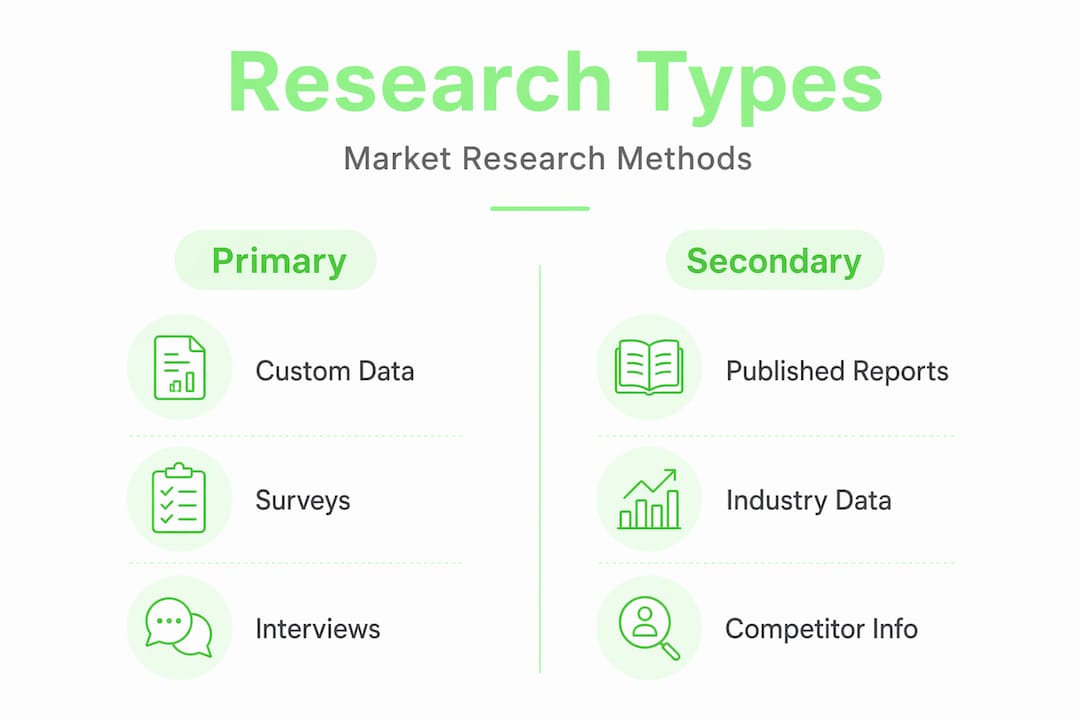
Think of it this way: primary research answers the “why” behind behavior specific to your business, while secondary research answers the “what” about the overall market. You need both lenses to see clearly.
Over 70% of market research projects combine both approaches, and for good reason. Secondary research sets the context. Primary research fills the gaps that published data simply can’t address.
Pro Tip: Start with secondary research to build your knowledge base and identify what questions remain unanswered. Then design your primary research to target exactly those gaps. This saves you time and sharpens the quality of questions you ask real customers.
How to conduct market research as a founder
Here’s the practical reality: you don’t need a research firm or a PhD to do this well. You need a clear process and the discipline to follow it. These steps work whether you’re validating a brand new idea or refining a product you’ve already started building.
-
Define your core research questions. Before you collect a single data point, write down what decisions you need to make. Are you trying to confirm there’s demand? Understand who your best customer is? Know what competitors are charging? Vague research produces vague answers.
-
Build a basic buyer persona. Sketch out your ideal customer in enough detail to guide your research. Age, location, job, pain points, spending habits. This shapes what you look for and who you talk to.
-
Start with free secondary sources. Federal databases like Census CBP, BLS QCEW, and BLS OES provide credible data on competitor counts, employment levels, and wage benchmarks at no cost. Google Trends, Statista’s free tier, and even Reddit threads in your niche can surface genuine customer language and unmet needs.
-
Run competitor analysis. Visit their websites, read their reviews on G2 or Yelp, study their pricing pages, and pay attention to what customers complain about. Gaps in competitor offerings are your clearest market entry signals.
-
Design simple surveys or interviews. You don’t need 500 respondents. Ten thoughtful customer interviews will often tell you more than a poorly designed survey sent to 1,000 strangers. Use open-ended questions. Listen for patterns. Let people tell you what they actually care about rather than confirming what you already believe.
-
Analyze and apply your findings. Group your insights by theme. Look for patterns that either validate or challenge your assumptions. Then make a concrete decision based on what you found. Adjust your offering, your pricing, your messaging, or your target segment accordingly.
-
Avoid the common traps. Confirmation bias is the silent killer of market research. Founders often find the data that agrees with them and ignore the rest. Build in skepticism. Share your findings with someone who will push back.
Pro Tip: The best market research for a pre-revenue founder often happens in community spaces. Facebook Groups, LinkedIn communities, Slack channels, and subreddits in your target niche are goldmines of real, unfiltered customer language. You don’t have to run a formal study to learn what people actually want.
You can deepen your approach by reading how AI-assisted customer discovery is reshaping the research process for founders in 2026. The basics still apply; AI just helps you move faster.
Why market research matters for your business outcomes
Knowing why is market research important isn’t enough. Understanding what it actually unlocks in practice is what motivates founders to do it consistently.
Here’s what solid market research tangibly delivers:
- Financing and funding credibility. Pre-launch research significantly increases your likelihood of securing a business loan or investor commitment. Lenders don’t just want to see your passion. They want to see that you understand the market. Credible, sourced data from free federal databases is often prioritized by lenders over polished report formats.
- Better product decisions. When you know what customers actually struggle with, not just what you assume they struggle with, you build features that earn loyalty instead of features that look good in a pitch deck.
- Smarter pricing. Market research reveals what competitors charge and what customers believe fair value looks like. Pricing without this context is guesswork with financial consequences.
- Sharper messaging. The language your customers use to describe their problems is the language that should appear in your marketing. Research surfaces this vocabulary. You stop guessing and start resonating.
Consider the flip side. Over 20% of small businesses fail within their first year specifically because of insufficient market demand. They built something real people didn’t actually want in numbers large enough to sustain a business. That’s a painful and expensive lesson. Market research exists precisely to avoid it.
You can learn how the most common startup traps connect to poor research by exploring common startup mistakes and how to sidestep them early.
“Market research links consumers to marketers through information, enabling identification of opportunities and improved performance.” Amazon Advertising / AMA
That quote captures it well. Market research isn’t just a risk reduction tool. It’s a performance catalyst. The founders who treat it as an ongoing practice, not a one-time box to check, consistently outperform those who treat their first instinct as gospel.
My take: the research trap most founders fall into
I’ve watched founders skip market research for every conceivable reason. They say they don’t have time. They say their idea is “obviously” needed. They say they’ll validate after the MVP is live. Every one of those justifications has cost someone real money.
What I’ve learned is that the biggest trap isn’t laziness. It’s overconfidence dressed up as vision. The founders who resist research are often the most passionate, and passion is wonderful until it becomes a filter that blocks out inconvenient truths.
Here’s my honest take: data and instinct are not opponents. The best founders I’ve seen use research to sharpen their intuition, not replace it. You start with a hunch. Research either confirms it, adjusts it, or saves you from an expensive mistake. That’s not a threat to your creativity. That’s a superpower.
I also think we overcomplicate what research has to be, especially early on. Ten customer conversations. A few hours in federal databases. A competitor pricing audit you do in an afternoon. That’s enough to substantially change the quality of your decisions before you’ve committed significant resources. Startup validation basics don’t require a research budget. They require curiosity and honesty.
Make research a habit. Block an hour a month. Talk to customers regularly. Read your competitor reviews. The founders who stay close to the market don’t just build better products. They build businesses that last.
— Samim
How Siift helps you research smarter
If doing all of this manually sounds like a lot, that’s because it can be. Siift was built specifically to help founders move through ideation, validation, and go-to-market strategy without having to piece together a dozen disconnected tools or spend weeks figuring out where to start.
Siift’s founder intelligence platform guides you step by step through the research and validation process with AI-powered insights that surface what matters most for your specific idea. It filters out the noise, the bias, and the guesswork so you can make faster, smarter decisions. Whether you’re at the napkin-sketch stage or already testing your first offer, Siift helps you build a strategy grounded in real market data. You can also explore how AI tools support product-market fit to see exactly where automation can accelerate your research workflow.
FAQ
What is market research in simple terms?
Market research is the process of gathering and analyzing information about your customers, competitors, and industry to make smarter business decisions. It helps you confirm whether real demand exists for your idea before you invest time or money building it.
What is the definition of market research vs. marketing research?
Market research focuses on understanding a specific market: its size, customers, and competition. Marketing research is broader and covers any research that informs marketing decisions, including brand studies and advertising tests. Market research is a subset of marketing research.
Why is market research important for startups?
Market research helps startups avoid building products nobody wants. Over 20% of small businesses fail in their first year due to lack of market demand, and pre-launch research is one of the clearest ways to reduce that risk before it becomes real.
What are the two main types of market research?
The two main types are primary research, which is data you collect yourself through surveys or interviews, and secondary research, which uses existing published sources. Most research projects combine both for the best results.
Can I do market research without a big budget?
Absolutely. Free federal databases, competitor analysis, Google Trends, and direct customer interviews are all zero-cost approaches that can produce credible, decision-ready insights for early-stage founders.