
Many believe affiliate marketing is a quick path to easy money, but the reality is different. Success typically takes 3 to 6 months of consistent effort, and most beginners earn nothing in the first two months. This guide breaks down the fundamentals, realistic timelines, and strategic steps to help you build a sustainable affiliate side business without falling into common traps.
Table of Contents
- What Is Affiliate Marketing? Understanding The Basics
- Common Misconceptions And Realistic Expectations
- Niche Selection: The Foundation Of Affiliate Success
- Affiliate Program Selection And Revenue Realities
- Building Your Platform: Website Vs. Social Media
- Content Creation And Trust Building
- Choosing Affiliate Programs With Long-Term Value
- Leveraging Technology: Ai As An Accelerator
- Grow Your Affiliate Side Business With Siift.ai
- Frequently Asked Questions
Key takeaways
| Point | Details |
|---|---|
| Affiliate marketing is low risk and pay for performance | You earn commissions only when sales occur, with no inventory or product management required. |
| Niche focus and program selection drive success | Choosing one focused niche and 1 to 2 aligned programs improves content clarity and conversion rates. |
| Authentic content builds trust better than sales pitches | Problem solving content based on real experience converts better than pushy promotional tactics. |
| Owning a website ensures sustainable growth | Personal platforms provide SEO benefits and control, reducing reliance on unpredictable social media algorithms. |
| AI tools accelerate work but authentic voice converts | AI assists with brainstorming and efficiency but cannot replace genuine expertise and personal credibility. |
What is affiliate marketing? Understanding the basics
Affiliate marketing is a performance-based business model where affiliates promote products via unique tracking links and earn commissions only when sales occur, providing a low-risk, leverage-driven income opportunity without the need to create or manage products. You simply recommend products or services to your audience, and when someone makes a purchase through your unique link, you earn a commission.
Four key roles define this ecosystem:
- Merchant: The company or creator selling the product or service
- Affiliate: You, the promoter who shares products with your audience
- Customer: The person who purchases through your affiliate link
- Tracking platform: The technology that connects your link to the sale and ensures proper commission credit
Tracking links contain unique identifiers that let merchants know which affiliate generated the sale. When a customer clicks your link, a cookie is stored in their browser for a set duration, often 24 hours to 90 days depending on the program. If they purchase within that window, you earn the commission.
The beauty of this model is its low barrier to entry. You don’t manufacture products, handle inventory, or manage customer service. Your role is to create valuable content that connects the right products with the right audience. This makes affiliate marketing basics ideal for aspiring entrepreneurs testing business ideas with minimal financial risk.
Common misconceptions and realistic expectations
The biggest myth about affiliate marketing is that it delivers quick, passive income with minimal effort. The reality is that success typically takes 3 to 6 months of consistent content creation and audience building before earning commissions. Most beginners see zero income in the first one to two months as they establish their platform and start attracting traffic.
Understanding these realistic affiliate marketing expectations helps you stay committed when results feel slow. Common mistakes that delay success include:
- Switching niches frequently before giving one enough time to gain traction
- Joining too many affiliate programs and creating unfocused, scattered content
- Writing shallow, overly promotional content that fails to build audience trust
- Expecting overnight results and quitting before the 3 to 6 month mark
Consistency matters more than perfection. Publishing one quality piece of content per week in a single niche will outperform sporadic, topic hopping efforts every time.
Pro Tip: Commit to one niche and one to two affiliate programs for at least six months. This focused approach builds topical authority faster and produces better quality content that resonates with your audience.
Niche selection: the foundation of affiliate success
Choosing a specific niche, particularly one that solves real problems and where the entrepreneur can produce consistent content, drastically improves chances of affiliate marketing success by improving SEO ranking and authority. A focused niche signals to search engines and readers that you are an expert in a particular area, making your content more discoverable and trustworthy.
For 2026, beginner friendly niches with strong affiliate potential include:
- AI tools and automation: Growing demand as businesses adopt AI solutions
- SaaS products: Recurring commissions and high lifetime customer value
- VPNs and cybersecurity: Increasing privacy concerns drive consistent interest
- Health and wellness: Evergreen niche with diverse sub-niches like fitness, mental health, and nutrition
- Personal finance: Credit cards, investment platforms, and budgeting tools offer solid commissions
Avoid overly broad niches like “lifestyle” or “business” that dilute your focus and make it harder to rank in search results. Similarly, don’t mix unrelated topics on one platform, as this confuses both search engines and your audience about your expertise.
Your best niche sits at the intersection of audience demand, affiliate program availability, and your ability to create consistent content. Check out recommended affiliate marketing niches to explore proven options.

Pro Tip: Choose a niche aligned with your personal interests or professional experience. Your genuine enthusiasm and knowledge will shine through in your content, making it easier to sustain effort over months and build authentic audience connections.
Affiliate program selection and revenue realities
Affiliate marketers need to limit themselves to promoting 1 to 2 affiliate programs rather than joining numerous programs at once. This focus supports clearer messaging and better conversion rates. When you promote too many programs, your content becomes scattered and promotional, reducing trust and clicks.
Typical conversion rates for affiliate links hover around 2%. This means if you drive 1,000 visitors to your content, you might expect 20 sales. At a $50 commission per sale, that translates to $1,000 in revenue. These benchmarks help set realistic income expectations as you build traffic.
When evaluating programs, consider fit with your audience and product relevance above all else. A high commission rate means nothing if your audience has no interest in the product. Look for programs offering:
- Clear commission structures with transparent payout terms
- Products or services you have personally tested or genuinely believe in
- Reliable tracking technology and timely commission payments
- Marketing resources like banners, product images, and promotional copy
| Program Type | Commission Rate | Cookie Duration | Recurring Revenue | Best For |
|---|---|---|---|---|
| Amazon Associates | 1% to 10% | 24 hours | No | Physical products, wide product range |
| SaaS Tools | 20% to 50% | 30 to 90 days | Yes (often) | Software, productivity tools, business solutions |
| Digital Products | 30% to 70% | 30 to 60 days | Sometimes | Courses, ebooks, templates, memberships |
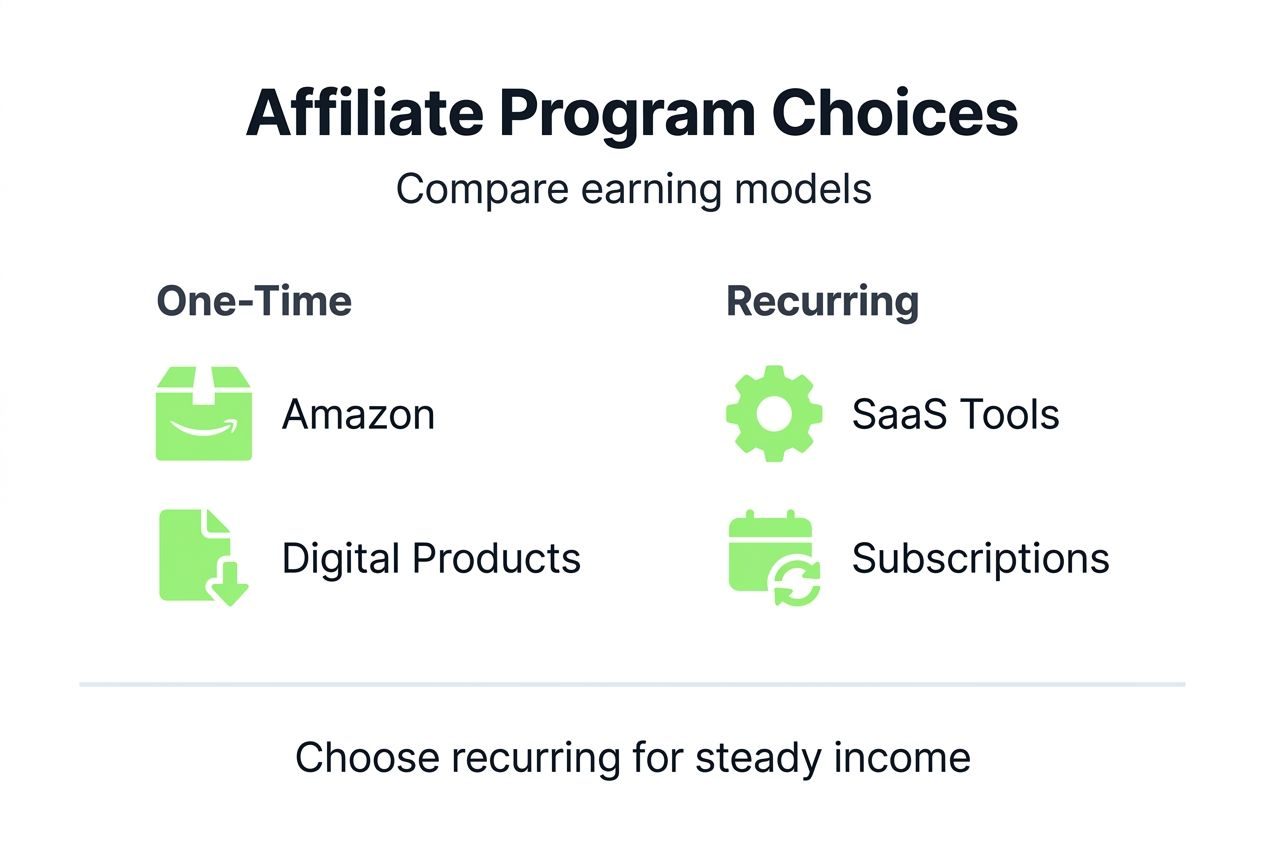
Pro Tip: Prioritize programs with recurring commissions and longer cookie durations. SaaS and subscription models provide steady monthly income from a single referral, creating more predictable revenue as your audience grows. Learn more about how to select affiliate programs that match your goals.
Building your platform: website vs. social media
Building a personal platform like a website or YouTube channel under your control is essential for sustainable affiliate marketing growth, as relying solely on social media platforms introduces risk and limits long-term asset creation. Algorithm changes, account bans, or platform policy shifts can wipe out your audience overnight if you depend entirely on Instagram, TikTok, or YouTube.
An SEO optimized website offers compounding benefits:
- Organic traffic growth: Quality content ranks in search engines and attracts visitors months or years after publication
- Platform control: You own your content, audience data, and monetization methods
- Email list building: Capture visitor emails to communicate directly without algorithmic interference
- Credibility and professionalism: A custom domain signals authority and commitment to your niche
This doesn’t mean abandoning social media entirely. The smartest approach combines a website as your home base with social platforms for traffic diversification and audience engagement. Use Instagram, TikTok, or LinkedIn to drive visitors to your website where deeper content and affiliate links live.
Email list building deserves special attention. An email list provides a direct line to your audience, immune to platform changes. Offer a free resource like a checklist, template, or mini course in exchange for email signups. Then nurture that list with valuable content and relevant affiliate recommendations. Explore strategies for building your affiliate marketing platform to maximize growth.
Content creation and trust building
Consumers detect and reject pushy sales pitches instantly. Authentic content based on personal experience or genuine value builds trust and loyalty far more effectively than promotional copy. Your job is to educate, inform, and solve problems first, with affiliate recommendations woven naturally into helpful content.
Focus on addressing real audience pain points using your niche expertise. If you promote project management software, create tutorials showing how to organize team workflows, comparison guides evaluating different tools, or case studies demonstrating results. The affiliate link becomes a logical next step for readers who find value in your insights.
Marketing budgets increasingly shift toward influencer marketing and trust based campaigns because consumers trust recommendations from people they follow more than traditional advertising. Your authenticity is your competitive advantage in a crowded affiliate landscape.
Content formats that build trust effectively include:
- How to guides: Step by step instructions solving specific problems
- Product comparisons: Honest evaluations of multiple solutions in your niche
- Case studies: Real examples showing results and lessons learned
- Personal reviews: Your genuine experience using a product or service, including limitations
Pro Tip: Use storytelling and specific examples to make content relatable and credible. Instead of saying “this tool is great,” share exactly how it solved a problem you faced, what you tried before, and the measurable results you achieved. Specificity builds trust.
Choosing affiliate programs with long-term value
Affiliate programs with recurring commissions, like SaaS tools, offer higher lifetime value per customer referral and improve affiliate income stability compared to one-time commission programs like Amazon Associates. A single referral to a $50 per month software tool earning you 30% commission generates $15 monthly, totaling $180 annually if the customer stays subscribed.
Cookie duration also significantly impacts your earning potential. A 24 hour cookie window means the customer must purchase within one day of clicking your link. A 90 day cookie gives them three months, increasing the likelihood you receive credit for the sale even if they need time to decide.
| Factor | Amazon Associates | SaaS Programs | Digital Products |
|---|---|---|---|
| Commission Type | One time | Recurring (often) | One time (mostly) |
| Commission Rate | 1% to 10% | 20% to 50% | 30% to 70% |
| Cookie Duration | 24 hours | 30 to 90 days | 30 to 60 days |
| Income Stability | Low (need constant new sales) | High (monthly recurring) | Medium (larger payouts per sale) |
| Best Suitability | High volume, low ticket items | Subscription software, business tools | Courses, templates, memberships |
For sustainable growth, prioritize SaaS and subscription models where possible. These programs reward you for customer retention, not just acquisition, aligning your incentives with providing genuine value. As your referred customers succeed with the product, your income grows predictably.
Explore affiliate program long-term value considerations to make strategic choices that compound over time rather than requiring constant new sales to maintain income.
Leveraging technology: AI as an accelerator
AI tools can accelerate affiliate marketer workflows by assisting in brainstorming ideas, writing outlines, and refining copy, but they cannot replace authentic expertise and unique personal voice essential for genuine audience trust. Use AI as a productivity enhancer, not a replacement for your creativity and experience.
AI excels at specific tasks:
- Brainstorming content ideas: Generate topic suggestions based on your niche and keywords
- Outlining articles: Create structured frameworks to organize your thoughts efficiently
- Refining copy: Improve clarity, grammar, and readability of draft content
- Keyword research: Identify search terms your audience uses to find solutions
However, AI cannot replicate lived experience, nuanced opinions, or the personal stories that make content memorable and trustworthy. Readers connect with human voices, not generic information they could find anywhere. Your unique perspective, specific examples, and authentic recommendations are what convert browsers into buyers.
Balance AI use with genuine, personal content creation. Let AI handle repetitive tasks like formatting, initial research, or generating variations of headlines. Then inject your expertise, voice, and real world insights to create content that stands out. Check out AI tools for affiliate marketers that enhance efficiency without sacrificing authenticity.
The most successful affiliates use technology to work smarter while maintaining the human connection that builds trust. AI speeds up the process, but your authentic voice closes the sale. Tools from platforms exploring AI acceleration in affiliate marketing can help you find this balance.
Grow your affiliate side business with siift.ai
Starting an affiliate side business requires more than just picking products and creating content. You need a strategic foundation to validate your niche, understand your audience, and build a sustainable business model. siift.ai provides AI powered tools designed specifically for aspiring entrepreneurs like you.
Use the AI business model canvas guide to map out your affiliate strategy, identify key assumptions, and test your approach before investing months of effort. The platform guides you through ideation, validation, and go-to-market systematically, helping you avoid common pitfalls and focus on what actually drives results. Access the complete guide for aspiring entrepreneurs to accelerate your journey from idea to profitable side business. Explore all the tools and resources available at siift.ai to turn your affiliate marketing ambitions into reality.
Frequently asked questions
What is the typical timeline to earn commissions in affiliate marketing?
Typically, beginners see their first commissions after 3 to 6 months of consistent content creation and audience building. Months one to two usually have little to no income as you establish your platform, build search rankings, and start attracting organic traffic.
How do I choose the right affiliate programs for my niche?
Focus on 1 to 2 programs closely aligned with your niche and audience interests rather than joining many programs at once. Look for programs offering clear commission structures, reputable products or services you genuinely believe in, and preferably recurring commissions or longer cookie durations.
Can I rely only on social media to build my affiliate business?
Relying only on social media can be risky due to algorithm changes, platform policy shifts, or potential account bans. Owning a website gives you control over your content, provides SEO benefits for compounding organic traffic growth, and creates a long-term asset independent of any single platform’s rules.
Recommended
- Master Self Employment: Build Your Side Business in 2025 | siift
- How to Identify Trends for Your Side Business in 2025 | siift
- Master Business Growth Strategies for Side Hustlers | siift
- 7 Best Side Hustles for Beginners to Try in 2023 | siift
- Generative search optimization steps: boost engagement 50% in 2026 | Artificial Intelligence