
TL;DR:
- Agile is a mindset for navigating uncertainty, crucial for startups testing new ideas.
- AI tools turbocharge Agile cycles, enabling faster MVPs and validated learning.
- Successful founders adapt Agile frameworks flexibly, focusing on outcomes over rituals.
Most founders assume Agile is a software developer’s tool, something for engineering teams running sprints in tech companies. That assumption is costing you time and money. Agile, rooted in the 2001 manifesto, is fundamentally a mindset for navigating uncertainty, and nothing is more uncertain than validating a new business idea. When you layer AI tools on top of Agile principles, you get a validation engine that lets you test, learn, and pivot faster than any traditional business planning approach ever could. This article breaks down what Agile really means, which frameworks fit your stage, and how to use AI to compress your learning cycles dramatically.
Table of Contents
- What is Agile methodology? Origins and core principles
- Main Agile frameworks: Scrum, Kanban, and hybrids
- How Agile empowers entrepreneurs: MVPs, fast iteration, and AI
- Avoiding Agile pitfalls: Culture, scaling, and bad habits
- Why true agility means breaking rules (and how AI changes the game)
- Unlock smarter startup validation with siift.ai
- Frequently asked questions
Key Takeaways
| Point | Details |
|---|---|
| Agile accelerates validation | Using Agile lets you quickly test and refine business ideas for faster feedback. |
| AI supercharges Agile execution | AI tools automate tasks and speed up MVP development for entrepreneurs. |
| Frameworks are adaptable | Scrum, Kanban, and hybrids can be flexibly tailored for startups and side hustles. |
| Pitfalls are avoidable | Common Agile mistakes stem from rigid processes and culture clashes, but adaptation prevents them. |
What is Agile methodology? Origins and core principles
Agile was born out of frustration. In 2001, seventeen software practitioners gathered in Snowbird, Utah, and produced the Manifesto for Agile Software Development. They were tired of rigid, document-heavy processes that delivered software months or years late, often solving the wrong problem entirely. Their solution was radical for its time: prioritize people over processes, working products over exhaustive documentation, customer collaboration over contract negotiation, and responding to change over following a fixed plan.
Those four values sound simple. But they represent a fundamental shift in how you think about building anything, including a business.
“Agile mechanics rely on empiricism, lean thinking, and iterative cycles for early value delivery and risk control.”
Empiricism means you make decisions based on what you observe, not what you predicted. Transparency, inspection, and adaptation are its three pillars. For a founder, this translates directly: share what you’re building openly, check whether it’s working constantly, and change course when the evidence demands it. Lean thinking adds another layer, cut waste ruthlessly, deliver value early, and keep your feedback loops tight.
Why does this matter for entrepreneurs and side hustlers? Because startups live and die by their ability to learn fast. Traditional business plans assume you know your customer, your market, and your solution before you’ve tested any of them. Agile assumes the opposite. It treats every assumption as a hypothesis to be tested, not a fact to be executed on.
Here’s what that looks like in practice. Instead of spending three months building a full product, you spend two weeks building the smallest version that teaches you something real. You show it to customers. You listen hard. Then you adjust. That cycle, repeated consistently, is how you find product-market fit without burning through your runway.
For AI tools for first-time founders, Agile provides the operating rhythm that makes those tools genuinely useful rather than just impressive. AI can generate ideas, draft content, and analyze feedback, but without an Agile structure, those outputs have no systematic home. Agile gives you the cadence. AI gives you the speed. Together, they’re a powerful combination for anyone trying to validate a business idea without a large team or budget.
The origins and principles of Agile also reveal something important: this methodology was designed for environments where requirements change frequently and the cost of being wrong is high. Sound familiar? That’s exactly the environment every early-stage founder operates in.
Main Agile frameworks: Scrum, Kanban, and hybrids
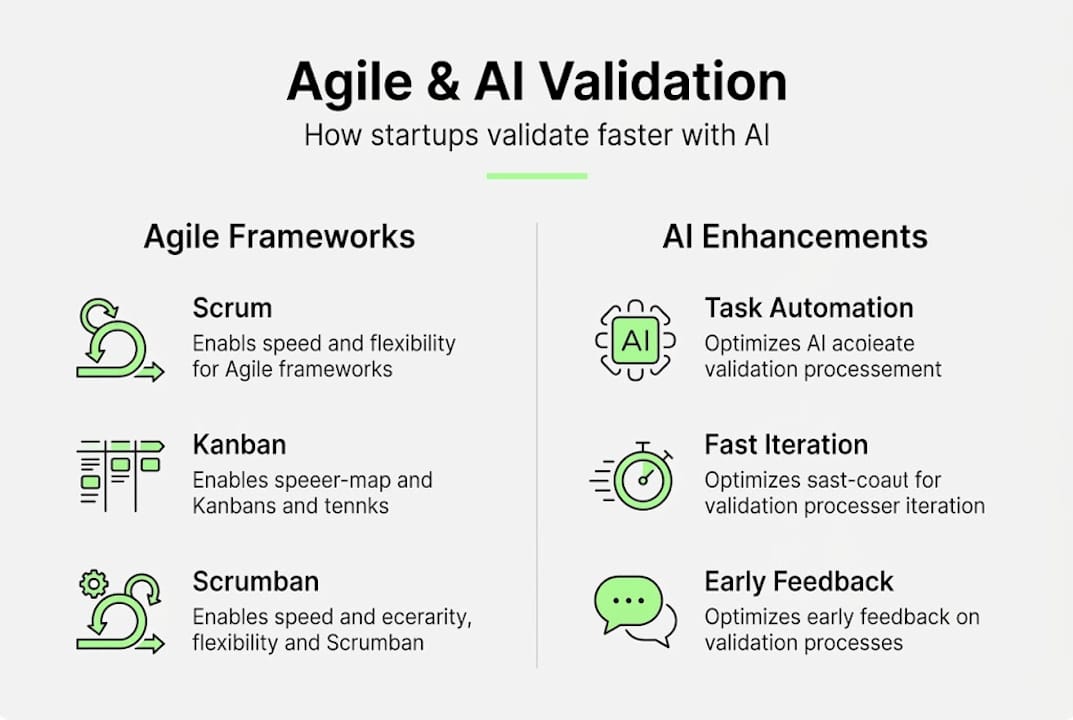
Knowing Agile’s principles is one thing. Knowing which framework to actually use is another. Three frameworks dominate the conversation: Scrum, Kanban, and hybrid approaches like Scrumban.
Scrum is the most structured of the three. According to the Scrum Guide, it organizes work into fixed-length cycles called sprints, typically one to four weeks. Each sprint has a defined goal, and the team commits to delivering a working increment by the end. Scrum defines clear roles: the Product Owner (who prioritizes what gets built), the Scrum Master (who removes obstacles), and the Developers (who do the work). Key events include Sprint Planning, the Daily Scrum, the Sprint Review, and the Sprint Retrospective.
Kanban is more fluid. It visualizes your workflow on a board, with columns representing stages like “To Do,” “In Progress,” and “Done.” The key discipline is limiting work-in-progress (WIP), which forces you to finish tasks before starting new ones. Kanban suits continuous workflows where priorities shift frequently.
Scrumban blends both. You get Scrum’s planning rhythm with Kanban’s visual flow and flexibility. Many solo founders and small teams gravitate toward Scrumban naturally, even without knowing the name.
Here’s a quick comparison to help you choose:
| Framework | Best for | Key feature | Ideal situation |
|---|---|---|---|
| Scrum | Teams with defined goals | Time-boxed sprints | Idea validation cycles |
| Kanban | Solo founders, ongoing work | Visual WIP limits | Content, outreach, ops |
| Scrumban | Small teams, shifting priorities | Hybrid planning | Early-stage startups |
For most side hustlers and early founders, the sequence looks like this:
- Start with a simple Kanban board (even a free tool like Trello works).
- Add weekly or biweekly sprint goals as your workload grows.
- Introduce retrospectives once you have a team or co-founder.
- Evolve toward Scrumban as complexity increases.
Pro Tip: Don’t let framework selection become a procrastination trap. Pick Kanban, start moving tasks, and refine your process as you go. The Scrum Master role in startups looks very different from corporate settings, often it’s just you, wearing every hat, which is exactly why simplicity wins early.
The best AI tools for founders integrate naturally with these frameworks, auto-generating task lists, suggesting sprint priorities, and flagging bottlenecks before they stall your momentum.
How Agile empowers entrepreneurs: MVPs, fast iteration, and AI
The minimum viable product, or MVP, is Agile’s most powerful gift to entrepreneurs. An MVP is the smallest version of your product that delivers real value to a real customer and generates real learning. It’s not a half-built product. It’s a deliberately scoped experiment.
Agile sprints are the engine that builds MVPs efficiently. You define your riskiest assumption, design a sprint around testing it, build only what’s needed to run that test, and then review the results. Repeat. Each sprint reduces uncertainty and sharpens your understanding of what customers actually want versus what you assumed they wanted.
AI is now turbocharging this cycle in ways that weren’t possible even two years ago. AI agents for project management can auto-generate task lists from a simple brief, refine your product backlog based on customer feedback, and help you build functional MVP prototypes in days rather than weeks. What used to take a small team a month can now be compressed into a single focused sprint by a solo founder with the right AI stack.

Here’s a snapshot of the impact:
| Task | Manual effort | With AI support |
|---|---|---|
| Backlog creation | 4-6 hours | 20-30 minutes |
| Customer interview synthesis | 3-5 hours | 15-20 minutes |
| MVP landing page copy | 2-4 hours | 30-60 minutes |
| Sprint planning | 2-3 hours | 45-60 minutes |
The tools making this possible include:
- AI chatbots for rapid customer persona development and assumption mapping
- Auto-generators for sprint task lists, user stories, and acceptance criteria
- MVP builders that turn validated concepts into functional prototypes without heavy coding
The right validation approach for uncertain startup environments isn’t about perfecting your plan. It’s about running smarter experiments faster. Agile gives you the structure. AI gives you the leverage.
For getting early customers with AI, combining Agile iteration with AI-driven outreach means you’re not just building faster, you’re learning from real market signals while you build. And usability testing in Agile ensures that what you’re building actually works for the people you’re building it for. Pair that with AI tools for startup strategy and you have a genuinely unfair advantage over founders still stuck in waterfall planning mode.
Avoiding Agile pitfalls: Culture, scaling, and bad habits
Agile is powerful. It’s also easy to get wrong. And when you get it wrong, it creates the illusion of productivity while delivering very little actual value.
The most common pitfall is treating Agile as a set of rituals rather than a mindset. Teams run daily standups, fill out sprint boards, and hold retrospectives, but never actually change anything based on what they learn. This is sometimes called “Dark Scrum,” where the ceremonies exist but the spirit is absent. Process for process’s sake is worse than no process at all, because it consumes time without generating insight.
Culture clash is the biggest impediment in Agile adoption, cited by 52% of practitioners as their primary barrier. For founders, this often shows up as resistance to sharing unfinished work, fear of admitting a sprint failed, or an inability to prioritize ruthlessly. Agile demands psychological safety and intellectual honesty. Without those, the framework breaks down fast.
Scaling is another trap. Frameworks like SAFe (Scaled Agile Framework) were designed for large enterprises coordinating dozens of teams. Applying SAFe to a two-person startup is like using a freight train to deliver a pizza. It’s technically possible but wildly inefficient.
Here are the pitfalls to watch for:
- Ceremony over delivery: Running every Scrum event without questioning whether they’re generating value
- Scope creep mid-sprint: Adding new tasks after a sprint has started, which destroys focus and predictability
- Skipping retrospectives: This is where the real learning happens. Skipping it means repeating the same mistakes
- Applying Agile rigidly outside software: Manufacturing, legal, and hardware contexts need significant adaptation
“Poor Agile implementation leads to Dark Scrum or ceremony over delivery, undermining the very agility you set out to achieve.”
Pro Tip: Focus on outcomes, not rituals. Ask yourself after every sprint: “Did we learn something that changes what we build next?” If the answer is no, your process needs rethinking, not more ceremony. The AI accelerator for startup success mindset applies here too: use tools that amplify your learning, not ones that add bureaucratic weight.
Why true agility means breaking rules (and how AI changes the game)
Here’s the uncomfortable truth most Agile articles won’t tell you: the founders who get the most value from Agile are the ones who break its rules deliberately and intelligently.
Rigid adherence to any framework is the enemy of real agility. Progressive elaboration over upfront design is the expert’s approach, meaning you build understanding incrementally, not all at once. You don’t need a perfect backlog on day one. You need enough clarity to start, and the discipline to refine as you learn.
AI is accelerating this shift in a profound way. Context-rich AI tools can now help you adapt your framework in real time, suggesting when to tighten your sprint scope, when to switch from Scrum to Kanban, and when your current assumptions need challenging. This is what hybrid, spec-first development looks like in practice: AI holds the context, you make the judgment calls.
The founders we see winning aren’t the ones who follow Agile perfectly. They’re the ones who use frameworks as starting points, not cages. They treat every sprint as a learning loop, every retrospective as a strategy session, and every pivot as evidence that the system is working. Understanding the intelligent business canvas with AI is one way to see how this adaptive, iterative approach gets embedded into your entire business strategy, not just your product development.
Unlock smarter startup validation with siift.ai
If this article has sparked a new way of thinking about how you build and validate your business idea, the next step is putting it into practice with tools built specifically for founders. siift’s Intelligent Business Canvas is designed exactly for this: guiding you through ideation, validation, and go-to-market using an Agile-inspired, AI-driven approach that’s faster and more systematic than generic tools. You don’t need a big team or a VC check to move like a lean, learning machine. You need the right operating system for your founder journey. Explore how to launch faster with AI-driven strategy and start turning your assumptions into validated insights today.
Frequently asked questions
Is Agile methodology only for software development?
No. Agile principles apply across many industries, but non-software contexts like manufacturing or legal require meaningful adaptation to work effectively.
How do AI tools work with Agile for startups?
AI tools automate task creation, refine product backlogs, and compress MVP development timelines, making Agile cycles dramatically faster for solo founders and small teams.
What’s the best Agile framework for a side hustle?
Kanban is often the easiest entry point for solo hustlers, while Scrum suits teams with defined sprint goals. Most founders naturally evolve toward a Scrumban hybrid as they grow.
What are common mistakes when applying Agile?
The biggest mistakes are treating process as the goal, ignoring culture fit issues (cited by 52% of practitioners), and applying enterprise-scale frameworks to early-stage startups that need simplicity and speed.
Recommended
- AI Lean Canvas: Startup Validation in 2026 | siift
- Early Startup Validation: Complete Guide for Founders | siift
- 6 Smart Ways AI Accelerates Business Idea Validation | siift
- Fastest Way to Validate Business Idea: A Step-by-Step Guide | siift
- AI Powered Video Production: Accelerating Creative Outcomes