

For most early-stage founders, siift is the strongest starting point: it’s built specifically for validation-first workflows, guides you step-by-step from idea to go-to-market, and doesn’t assume you already know what you’re building. Here’s how the shortlist breaks down:
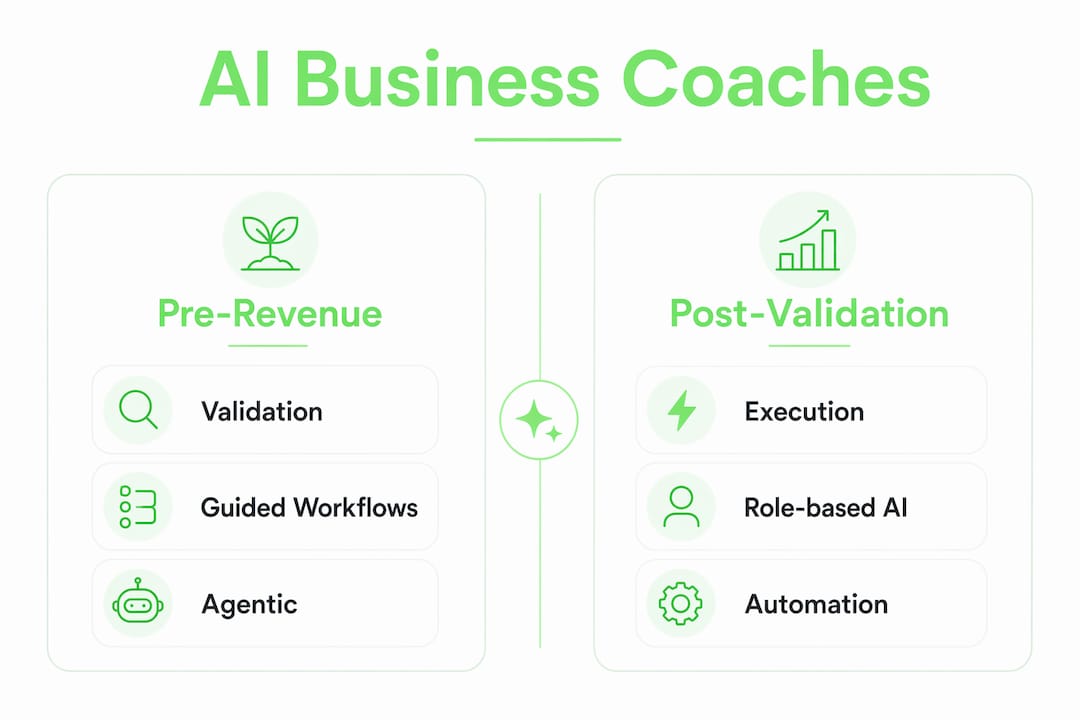
- siift — Best for founders who need a structured, agentic path from raw idea to validated strategy. Purpose-built for early-stage clarity, not generic productivity.
- Sintra — Best for founders who want a suite of AI “employees” handling specific functions (marketing, ops, sales) once the idea is already validated.
- Coachvox / Jodie AI — Best for coaches and consultants who want to clone their own methodology into an AI model for client delivery.
- ChatGPT (DIY) — Best for budget-constrained founders comfortable writing their own prompts. Powerful but unstructured; you supply the framework.
Price tier ranges from free (ChatGPT) to affordable monthly subscriptions for purpose-built tools. Dan AI, for example, averages under $6 per day for a year of access, positioning its product as a lower daily cost alternative to traditional coaching. Onboarding time varies: siift and ChatGPT offer quick starts, while Sintra and Coachvox require a short setup period.
Table of Contents
- Which AI business coach fits your startup best?
- A closer look at each pick
- How do AI business coaches actually work?
- How do you choose the right AI coach for your startup?
- How to use an AI business coach starting today
- Key Takeaways
- siift gives early-stage founders a structured path from idea to traction
- FAQ
Which AI business coach fits your startup best?
Before committing to any tool, it helps to see the key dimensions side by side. The table below maps each option across the criteria that actually matter to founders at the seed and pre-seed stage.

| Dimension | siift | Sintra | Coachvox / Jodie AI | ChatGPT (DIY) |
|---|---|---|---|---|
| Best for | Idea validation, GTM strategy, early-stage clarity | Multi-function AI workforce post-validation | Coach-trained models for client delivery | Budget-first, self-directed founders |
| Pricing & plans | Paid plans; trial available | Subscription tiers; free trial | Subscription; demo available | Free tier; Plus at $20/mo |
| Personalization depth | Agentic, guided workflows seeded with your idea | Role-based AI personas; customizable | Trained on coach’s own content/methodology | Fully manual; prompt-dependent |
| Integrations | Focused on founder workflow | Slack, Notion, Zapier, CRM connectors | Embeddable on websites; limited native integrations | API-based; connects via Zapier |
| Analytics & tracking | Progress tracking through validation stages | Task and output tracking per AI role | Session history; limited analytics | None natively |
| Privacy & data ownership | Non-disclosing AI option available | Standard SaaS data terms | Standard SaaS data terms | OpenAI data policies apply |
| Onboarding time | Same-day guided setup | 1–3 days for persona configuration | 2–5 days to train model on content | Immediate |

Pricing callout: Purpose-built AI coaching tools for startups generally run on affordable monthly subscription plans at the entry level—Dan AI, for example, averages below $6 per day for a year of access—with higher tiers available. Pricing transparency and trial availability are the first trust signals buyers look for, so any tool that hides its pricing behind a sales call deserves extra scrutiny. ChatGPT’s free tier is genuinely useful for DIY coaching, though the Plus plan at $20/month unlocks the models that make it worth using seriously.
A closer look at each pick
siift: validation-first, agentic, built for founders
siift isn’t a chatbot with a startup skin on it. It’s a New Business OS that walks founders through ideation, validation, and go-to-market as a structured, guided process. The agentic workflows mean the system actively moves you forward rather than waiting for you to know the right question to ask.
Who it fits: Pre-revenue founders who want to derisk an idea before spending money on development. Also strong for founders who’ve tried generic AI tools and found them too open-ended.
Standout capability: The startup idea validation flow is purpose-built to filter out bias and blind spots before you build. That’s a fundamentally different job than “help me write a pitch deck.”
Onboarding: Same-day. The guided setup seeds the system with your idea and context, then the workflows take over.
Pricing: Paid plans with a trial available; specific tiers not publicly listed at time of writing. Dan AI averages less than $6 per day for a year of access, based on their published pricing.
Pros:
- Structured validation workflows, not open-ended chat
- Non-disclosing AI option for IP-sensitive founders
- Agentic assistance that progresses your strategy, not just answers questions
Cons:
- Not a back-office or finance tool (by design)
- Less suited to post-validation operational tasks than multi-function platforms
Sintra: your AI workforce, post-validation
Sintra takes a different angle: instead of one coaching interface, it gives you a suite of specialized AI “employees” — personas for marketing, sales, operations, and more. Think of it less as a coach and more as a small team you can spin up without payroll.
Who it fits: Founders who’ve validated their idea and now need execution bandwidth across multiple functions simultaneously.
Standout capability: Role-based AI personas that can handle specific recurring tasks, connected to tools like Slack, Notion, and Zapier.
Onboarding: 1–3 days to configure personas and connect integrations.
Pricing: Subscription tiers with a free trial; specific pricing available on their site.
Pros:
- Broad functional coverage across business roles
- Strong integration ecosystem
- Good for solo founders who need to act like a team
Cons:
- Less useful at the idea-validation stage
- Requires more setup investment upfront
- Coaching depth is narrower than purpose-built coaching tools
Coachvox / Jodie AI: clone your coaching methodology
Coachvox is built for a specific use case: coaches, consultants, and advisors who want to train an AI on their own frameworks and deliver it to clients at scale. Jodie AI is Coachvox’s startup-focused variant.
Who it fits: Founders who are also coaches, or startups whose product is coaching. Less relevant for founders seeking coaching for themselves.
Standout capability: The model trains on your uploaded content, transcripts, and frameworks, so clients get responses that sound like you.
Onboarding: 2–5 days to upload and train on source content.
Pricing: Subscription with demo available.
Pros:
- Highly personalized to a specific coach’s voice and methodology
- Embeddable on client-facing websites
- Good for productizing expertise
Cons:
- Niche use case; not a general startup coaching tool
- Limited native integrations
- Analytics are basic compared to enterprise platforms
ChatGPT (DIY): maximum flexibility, zero structure
ChatGPT is the raw material. It’s extraordinarily capable, and AI compresses many startup tasks from multi-week timelines to hours when applied correctly. But it doesn’t know your business, doesn’t remember last week’s conversation (without custom setup), and won’t tell you what to do next. You are the coach.
Who it fits: Founders who are comfortable with prompting, have a clear framework in mind, and want to move fast without a subscription.
Standout capability: Versatility. From market research to pitch drafts to customer interview synthesis, it handles almost any task you can describe clearly.
Onboarding: Immediate.
Pricing: Free tier available; Plus at $20/month.
Pros:
- Free or very low cost
- Handles almost any task with the right prompt
- No lock-in
Cons:
- No persistent memory or structured coaching flow by default
- Requires founder to supply the framework and discipline
- Easy to get generic outputs without careful prompting
| Tool | Coaching depth | Automation level | Best stage |
|---|---|---|---|
| siift | High (guided, agentic) | High (workflow-driven) | Pre-revenue / validation |
| Sintra | Medium (role-based) | High (multi-function) | Post-validation / execution |
| Coachvox / Jodie AI | High (coach-trained) | Low-Medium | Coaching product delivery |
| ChatGPT (DIY) | Variable (prompt-dependent) | Low (manual) | Any stage, self-directed |
How do AI business coaches actually work?
At the core, every AI coaching tool runs on a large language model (LLM). What separates a purpose-built AI startup mentor from a raw chatbot is the layer built on top: structured workflows, personalization mechanisms, and integrations that connect the coach to where you actually work.
Agentic workflows are the key differentiator in 2026. Rather than waiting for you to ask the right question, an agentic system moves through a defined process, prompts you for inputs, and generates outputs that feed the next step. siift’s New Business OS works this way: you don’t need to know what question to ask because the system knows what a founder needs to figure out at each stage.
Personalization happens through profile seeding (you describe your idea, market, and constraints upfront), progressive context (the system builds on prior sessions), and in some tools, training on a specific coach’s frameworks. Anthropic’s founder playbook frames this well: AI shifts founders from individual contributors to orchestrators, automating low-leverage tasks so you can focus on judgment calls.
Common integrations and what they automate:
- Slack — async coaching nudges, milestone reminders, and team updates
- Notion — syncing strategy docs, validation notes, and experiment logs
- Google Workspace — pulling in meeting notes, drafting outreach, summarizing research
- Zapier — connecting coaching outputs to CRMs, project tools, and marketing platforms
- CRMs — AI accelerates customer research, lead identification, and outreach synthesis for small teams acting like larger ones
Privacy and data ownership deserves more attention than most founders give it. Before signing up for any AI coaching platform, ask: Where is my data stored? Can I export everything? How long is it retained? Does the platform use my inputs to train its models? siift offers a non-disclosing AI option specifically for founders with IP-sensitive ideas — a meaningful differentiator when your competitive advantage lives in what you haven’t built yet.
How do you choose the right AI coach for your startup?
The right tool depends on where you are in the founder journey, not just which product has the best feature list. Here’s a practical decision framework.
Decision criteria checklist:
- Founder stage fit — Are you pre-idea, validating, or scaling? A validation-first tool is wasted on a founder who’s already at Series A.
- Workflow structure — Do you need the tool to guide you, or are you comfortable directing it yourself?
- Integrations — Does it connect to the tools you already use (Notion, Slack, your CRM)?
- Analytics — Can you track progress through validation stages, not just chat history?
- Privacy controls — Does it offer data export, retention limits, and non-disclosing options?
- Price and scalability — Can the tool grow with you from pre-revenue to post-launch without a pricing cliff?
Demo questions worth asking every vendor:
- “Can you show me a validation plan built with a real founder’s input?”
- “What does a data export look like, and what’s included?”
- “Do you have case studies from pre-revenue startups specifically?”
- “How does the system handle conflicting or incomplete information from me?”
- “What happens to my data if I cancel?”
Red flags to watch:
- Pricing hidden behind a sales call with no published tiers
- No onboarding templates or guided setup (you’re on your own from day one)
- Zero case studies from early-stage startups (only enterprise logos)
- No data export option or vague retention policies
- Coaching outputs that feel generic regardless of what you input
“Precision and narrow audience wedges outperform broad approaches for early-stage startups; AI is best used to amplify human creative judgment, not replace it.”
Pro Tip: Run a two-day trial with a real problem, not a hypothetical. Ask the tool to help you validate a specific assumption about your target customer. If the output could apply to any startup in any industry, the personalization isn’t working.
Typical onboarding timelines for seed-stage founders vary from immediate to several days, depending on the tool. Monthly budgets for early-stage tools start from free options to affordable subscriptions, such as Dan AI at under $6 per day for a year of access.
How to use an AI business coach starting today
You don’t need to wait for a perfect setup. Here’s how to get real value in your first two weeks.
Starter ChatGPT prompt template (DIY coaching)
When DIY is enough: you have a clear hypothesis, you’re comfortable prompting, and you need fast research or a structured output (not ongoing accountability). When to upgrade to a purpose-built tool: you need the system to tell you what to do next, not just respond to what you ask.
Copy-paste prompt:
Three workflows to run in your first two weeks
1. Idea validation sprint (Days 1–2) Use your AI coach to map your riskiest assumptions, design 3–5 lightweight experiments (customer interviews, landing page tests, cold outreach), and set a pass/fail threshold for each. AI compresses idea validation from 2–4 weeks down to 4–8 hours when applied to specific tasks. That’s not a rounding error; that’s a different competitive reality.
2. 90-day plan (Days 3–5) Feed your validation outputs into the coach and ask it to generate a 90-day milestone map: what you’ll build, who you’ll talk to, and what “good” looks like at each checkpoint. Use an AI business plan creator to structure investor-ready documentation in parallel.
3. Investor outreach prep (Week 2) Ask the coach to synthesize your validation data into a one-page narrative: the problem, your evidence, the wedge you’re targeting, and the ask. Then use it to draft 5 personalized outreach messages to angels or accelerators.
Metrics to track coach impact
- Validation velocity — How many assumptions tested per week
- Experiment hit rate — Percentage of experiments that return usable signal
- Cycle time to MVP definition — Days from idea to scoped MVP (AI can cut this from 1–2 weeks to 1–2 days)
- Investor meeting conversion — Outreach-to-meeting ratio before and after using AI-assisted prep
Step-by-step: run a validation sprint this afternoon
- Write your core idea in one sentence.
- List your top 5 assumptions (who the customer is, what they’ll pay, why they’ll switch).
- Feed both into your AI coach and ask it to rank assumptions by risk.
- For the top 2 risks, ask for a 48-hour test design.
- Run the tests. Bring the raw results (messy is fine) back to the coach for synthesis.
- Ask: “What does this data suggest I should build first?”
Pro Tip: Seed your AI coach with real, messy customer discovery data — partial answers, failed experiments, contradictory feedback. Tools trained on idealized inputs give idealized outputs. The messier your inputs, the more practical your coaching outputs become.
The intelligent business canvas framework in siift is designed exactly for this: turning raw validation data into a repeatable strategy process rather than a one-time exercise.
How we chose these picks
The shortlist was built on six rating axes: best-for use case fit, personalization and coaching depth, integration ecosystem, privacy and data ownership controls, pricing transparency, and onboarding speed. Sources included product documentation, vendor trial flows, publicly available case studies, and practitioner commentary on AI-native startup workflows.
| Rating axis | What we evaluated |
|---|---|
| Best-for fit | Stage relevance (pre-revenue vs. post-validation) |
| Personalization depth | Agentic workflows vs. prompt-dependent vs. coach-trained |
| Integrations | Native connections to Slack, Notion, Zapier, CRMs |
| Privacy & data ownership | Export options, retention policies, non-disclosing options |
| Pricing transparency | Published tiers vs. sales-gated pricing |
| Onboarding speed | Time to first useful output |
Scope is limited to tools with either a documented free trial, a demo, or published pricing. Tools that required a sales call before revealing any pricing were noted but not featured as primary recommendations.
Key Takeaways
The most effective AI business coach for an early-stage startup is one that matches your current founder stage, offers structured validation workflows, and gives you clear data ownership from day one.
| Point | Details |
|---|---|
| Match tool to founder stage | Pre-revenue founders need validation-first tools; post-validation founders need execution bandwidth. |
| Prioritize structured workflows | Agentic, guided tools outperform open-ended chat for founders who don’t yet know the right questions. |
| Demand pricing and privacy transparency | Hidden pricing and vague data retention are red flags; always test data export before committing. |
| Start with a real problem | Run a two-day validation sprint with an actual assumption, not a hypothetical, to test any tool honestly. |
| siift for validation-first founders | siift’s agentic New Business OS guides founders from idea to go-to-market with a non-disclosing AI option for IP protection. |
Where AI coaching helps founders and where humans still win
AI coaching delivers the most leverage at the operational layer: validating assumptions fast, designing experiments, synthesizing customer discovery data, drafting outreach, and building 90-day plans. These are tasks where speed and structure matter more than nuance. A founder who spends three weeks manually researching a market that an AI coach could map in an afternoon is burning irreplaceable runway.
But there are places where human judgment still wins, and pretending otherwise would be doing founders a disservice. Complex hiring decisions, nuanced investor negotiations, co-founder conflicts, and pivots that require reading a room — these are high-stakes, relationship-dense situations where an AI’s pattern-matching can mislead as easily as it guides. The founder’s role as orchestrator means knowing when to hand off to the machine and when to trust your own read of the situation.
The practical rule: treat AI outputs as signal, not instruction. If the coach tells you your riskiest assumption is customer acquisition cost, that’s a prompt to go test it, not a verdict to act on without evidence. The AI surfaces the question; you do the work to answer it.
Pro Tip: When an AI coaching output surprises you, that’s the most valuable moment. Don’t dismiss it and don’t follow it blindly. Use it as a hypothesis and run the cheapest possible test to check it against reality.
When to escalate to a human coach or advisor: any decision that involves equity, co-founder dynamics, or a pivot that will consume more than 30 days of runway deserves a human conversation, not just an AI output.
siift gives early-stage founders a structured path from idea to traction
Most AI tools will answer your questions. siift asks the ones you haven’t thought to ask yet. That’s the difference between a search engine and a coach.
siift’s New Business OS is built specifically for founders at the hardest stage: before you know if your idea is worth building. The agentic workflows guide you through ideation, validation, and go-to-market as a connected process, not a series of disconnected prompts. For founders with IP-sensitive ideas, the non-disclosing AI option means your competitive advantage remains yours.
| Founder need | siift addresses it |
|---|---|
| Idea validation | Guided validation workflows with assumption mapping |
| GTM strategy | Step-by-step go-to-market planning built on your validated data |
| Pitch prep | Strategy outputs structured for investor-ready narratives |
| Privacy | Non-disclosing AI option for IP protection |
Getting started takes an afternoon. The guided onboarding seeds the system with your idea and context, and the first validation workflow runs the same day. Try siift’s validate before you build flow to see how it maps your riskiest assumptions before you spend a dollar on development.
Useful sources for further reading
- siift — Startup Idea Validation: siift’s validation-first product flow and guided onboarding for early-stage founders.
- Anthropic — The Founder’s Playbook: Maps AI exercises to each startup stage; explains the orchestrator role shift.
- Happycapy Guide — How to Use AI for Startups in 2026: Time-savings estimates for common founder tasks when AI is applied correctly.
- HubSpot — AI for Business Development and Startup Growth: Practical AI use cases for customer research, lead identification, and outreach automation.
- SpeedMVP — How to Build an AI MVP (2026): Practitioner guidance on seeding AI tools with real, messy discovery data for better outputs.
- ReachLabs — Startup Growth Strategy Playbook: Wedge-focused growth strategy and how AI amplifies rather than replaces human creative judgment.
- Oliv.ai — Best AI Sales Coaching Software: Buyer research on pricing transparency and trust signals in AI coaching tools.
- Dan Martell — Dan AI: Example of a coach-trained AI model with always-on availability and continuous context-building.
- siift — Business Mentorship for AI-Enabled Founders: Guidelines for using AI-enabled coaching in daily founder operations.
FAQ
What does an AI business coach for startups actually do?
An AI business coach guides founders through structured workflows: validating ideas, building go-to-market plans, synthesizing customer research, and preparing investor materials. Purpose-built tools like siift use agentic workflows that move you forward proactively, rather than waiting for you to ask the right question.
How much does an AI coach cost?
Purpose-built AI coaching tools for startups generally run on affordable monthly subscription plans at the entry level—Dan AI, for example, costs under $6 per day for a year of access—with ChatGPT’s free tier available for DIY coaching. Pricing transparency is a key trust signal: any tool that hides pricing behind a sales call warrants extra scrutiny before you commit.
How do you use AI for a startup business right now?
Start with a specific assumption about your customer or market, feed it into your AI coach with as much real context as possible, and ask for a 48-hour validation plan. AI compresses idea validation from weeks to hours when applied to concrete tasks rather than open-ended brainstorming.
Can ChatGPT replace a purpose-built startup coach?
ChatGPT is a powerful DIY option for founders who supply their own framework and discipline, but it lacks persistent memory, structured workflows, and validation-specific guidance. For founders who need the system to tell them what to do next, a purpose-built tool like siift delivers more structure and less guesswork.
What’s the 70/30 rule in coaching?
In coaching practice, the principle is that the person being coached should do most of the talking and reflecting, with the coach contributing through questions and frameworks. AI coaches apply this by prompting founders with targeted questions rather than delivering monologue-style advice.