

Business mentorship is a long-term, judgment-based relationship that helps founders test strategy, sharpen decisions, and build the mental clarity no algorithm can fully replicate. The fastest next step: book a free 60-minute session through SCORE, the national volunteer mentor network backed by the U.S. Small Business Administration, or prepare a one-page brief to bring to both a mentor and your AI workflow. SCORE mentoring is always free, for the life of your business. If you’re already using AI tools to validate ideas, a human mentor is the missing layer that turns data into wisdom.
Table of Contents
- What does business mentorship actually look like?
- Mentor, coach, consultant, or advisory council — which do you need?
- What mentorship will do for your startup — and where it stops
- Where to find mentors in the United States
- How to evaluate and choose a mentor
- How to structure the relationship for measurable value
- How to combine AI tools with your mentorship workflow
- Your 30–60 day plan to activate mentorship
- Key Takeaways
- The gap between mentorship and what founders actually do with it
- siift gives your mentor feedback somewhere to go
- Useful sources and next reads
- FAQ
What does business mentorship actually look like?
A mentor is not a consultant who delivers a report, and not a coach who runs you through weekly accountability drills. Think of it as a sounding board relationship where an experienced operator helps you think more clearly by asking better questions than you’d ask yourself.
In practice, a mentor typically:
- Challenges your assumptions in a structured conversation
- Helps you set 3–6 month goals and holds you loosely accountable
- Makes introductions to investors, partners, or early customers
- Shares pattern recognition from their own failures and wins
- Flags blind spots before they become expensive mistakes
- Offers perspective on founder-to-CEO mindset shifts as you scale
Two quick examples: an early-stage founder uses a mentor to pressure-test whether their target customer is real before spending on ads. A Series A founder uses a mentor to reframe their identity from “person who does everything” to “person who builds the team that does everything.” Both are judgment calls, not deliverables.
Mentor, coach, consultant, or advisory council — which do you need?
The one-sentence answer: mentors give you long-term perspective and judgment; entrepreneurship coaching drives goal-specific accountability and operating discipline; consultants deliver task-bound outputs; advisory councils give you a curated bench of specialists.
Match the problem to the role:
| Problem | Right support |
|---|---|
| Early-stage uncertainty, unclear direction | Mentor |
| Founder is the bottleneck, scaling wall hit | Coach |
| One-off product-market-fit experiment | Consultant |
| Need diverse expertise across functions | Advisory council |
The scaling wall signal is worth naming explicitly: when your business depends entirely on your personal presence to function, that’s a structure problem, not a growth problem. A coach or consultant may be the right purchase at that point, not a mentor. Mentorship shines brightest in the early-clarity and long-range judgment phases.
What mentorship will do for your startup — and where it stops
Primary benefits: perspective you can’t Google, light accountability, warm introductions, and emotional resilience when the founder journey gets isolating.
Real limits: mentors are not consultants. Expecting tactical deliverables or guaranteed outcomes is the most common reason mentorship relationships fail.
| Use mentorship for | Use a coach or consultant for |
|---|---|
| Framing big strategic decisions | Fixing a broken sales process |
| Long-range judgment and pattern recognition | Weekly operating accountability |
| Network introductions | Specific deliverables (pitch deck, financial model) |
| Founder mindset and resilience | Scaling past a revenue bottleneck |
Pro Tip: Arrive at every mentor session with your top three current challenges and a clear definition of what “success” looks like in 3–6 months. Mentors engage far more deeply with prepared founders — specificity signals that you’ll actually act on their input.
Where to find mentors in the United States
The good news: free, high-quality startup mentorship opportunities are more accessible in the U.S. than most founders realize.
| Channel | Cost | Timeline to match | Best for |
|---|---|---|---|
| SCORE | Free | Days to weeks | All stages; widest geographic reach |
| SBA / Small Business Development Centers | Free or low-cost | 1–2 weeks | Founders needing structured business guidance programs |
| Industry accelerators (Y Combinator, Techstars, etc.) | Equity or fee | Months (cohort-based) | High-growth tech startups |
| Alumni networks (university, prior employer) | Free | Weeks | Founders with existing institutional ties |
| Peer mastermind groups | Low cost | Weeks | Founders who want peer mentorship benefits alongside senior guidance |
| Micromentor | Free | Days | Early-stage founders seeking volunteer expert advice |
Before outreach, prepare a two-paragraph summary of your business, your current challenge, and what you’re asking for. Cold messages that open with “I’d love to pick your brain” get ignored. Specificity gets replies.
How to evaluate and choose a mentor
Vetting a mentor takes one focused 30–45 minute conversation if you know what to look for.
- Experience relevance. Have they operated in your industry or at your stage? Pattern recognition only transfers when the context is close enough.
- Operator track record. Look for documented outcomes, not just titles. Ask for references or public case examples.
- Communication style. Do they ask questions or lecture? A mentor who only tells you what they did is a storyteller, not a sounding board.
- Availability. Confirm realistic cadence upfront. A mentor who can meet once a quarter is not the same as one who can meet monthly.
- Conflict-of-interest check. Are they advising a direct competitor? Do they have a financial stake in your decisions? Ask plainly.
Sample questions for your first session:
- “What’s the biggest mistake you see founders at my stage make?”
- “How do you prefer to give feedback — in the moment or after reflection?”
- “What would make you feel like this relationship is working six months from now?”
Red flags: a mentor who offers to “do the work for you,” can’t name a reference, or is vague about their own track record. On cost: most early-stage mentorship is pro-bono through networks like SCORE. Formal advisory arrangements with equity or cash compensation are a separate conversation, typically once the relationship has proven its value.
How to structure the relationship for measurable value
Start with a 30-day sprint: two sessions in the first month to establish baseline, goals, and communication norms. After that, monthly or bi-monthly sessions work for most early-stage relationships.
A reusable session agenda:
- Progress update on last session’s commitments (5 min)
- Top challenge or decision for today (20 min)
- Mentor’s questions and perspective (15 min)
- Agreed next actions and success metric (5 min)
Set one measurable outcome per 90-day window. “Get clearer on my go-to-market” is not measurable. “Identify two customer segments to test by end of Q3” is. Track commitments in a shared doc so neither party has to rely on memory.
For an advisory council, aim for three to five specialists rather than one generalist. Assign each member a domain (product, sales, finance, operations), set annual term expectations, and disclose conflicts in writing at the start. NDAs are appropriate when sharing proprietary roadmaps; public reference checks are appropriate before you sign anything.
How to combine AI tools with your mentorship workflow
The workflow that works: use your mentor for judgment and framing; use AI tools for rapid hypothesis generation, market scans, and experiment design. Neither replaces the other.
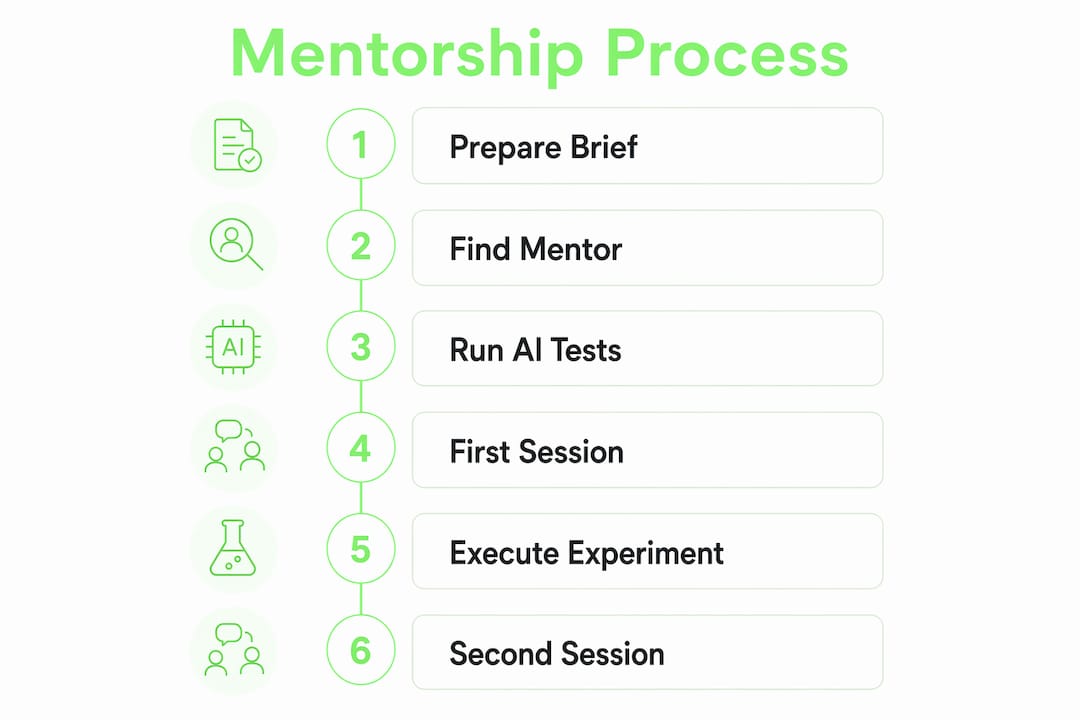
- Draft a one-page brief before every mentor session: list your core assumption, the experiment you ran, what you found, and what decision you’re facing.
- Run AI validation experiments using a tool like siift to generate hypotheses, stress-test your market sizing, and scaffold test designs before the session.
- Bring AI outputs to your mentor with assumptions visible. Don’t present AI results as conclusions — present them as structured hypotheses for the mentor to interrogate.
- Iterate based on mentor feedback. Update your brief, revise the hypothesis, and rerun the experiment with tighter parameters.
- Design a small customer test based on the refined hypothesis. Keep it cheap and fast: five customer conversations, a landing page, a prototype.
- Measure and document results in a format your mentor can review asynchronously between sessions.
- Repeat the loop. Each cycle should produce a clearer go-to-market signal or a faster kill decision.
Pro Tip: When sharing AI-generated outputs with a mentor, always surface the assumptions behind the output, not just the conclusion. A mentor’s most valuable contribution is often spotting the assumption you didn’t know you were making.
For AI-driven mentorship workflows, the brief is the connective tissue. It keeps both the AI session and the human session anchored to the same decision.

Your 30–60 day plan to activate mentorship
Week 1: Write your one-page brief. List your top three decisions, your core assumptions, and your 60-day success definition.
Week 2: Apply to SCORE or one other channel. Send two targeted outreach messages to potential mentors in your network using your brief as the hook.
Week 3: Run two AI validation experiments on your top hypothesis using siift or a comparable tool. Document findings.
Week 4: Hold mentor session #1. Share your brief and AI findings. Agree on one experiment to run before session #2.
Weeks 5–8: Execute the experiment, measure results, and bring documented outcomes to session #2. Adjust your strategy based on what you learned. Set the next 30-day milestone together.
The goal by day 60: at least one validated or invalidated assumption, one clearer strategic priority, and a mentor relationship with an established cadence.
Key Takeaways
Business mentorship works best when founders treat it as a judgment layer that sits above their AI validation workflow, not as a substitute for either hands-on testing or professional coaching.
| Point | Details |
|---|---|
| Mentorship is free to access | SCORE offers no-cost mentoring for the life of your business, available virtually or in person. |
| Match the problem to the role | Use mentors for early clarity; coaches for scaling bottlenecks; consultants for specific deliverables. |
| Preparation drives value | Arrive with your top three challenges and a 3–6 month success metric to maximize mentor engagement. |
| AI and mentors are complementary | Use AI tools to generate and test hypotheses, then bring structured findings to your mentor for judgment. |
| siift as a validation layer | siift helps founders encode mentor feedback into repeatable experiments and track progress toward product-market fit. |
The gap between mentorship and what founders actually do with it
Most founders who seek out a mentor want answers. What they actually need is better questions. That gap is where most mentorship relationships quietly fail — the founder arrives hoping for a playbook, the mentor offers a perspective, and nothing changes because the founder never built the habit of acting on it.
The founders who get the most from mentorship treat it like a forcing function, not a resource. They show up with a decision already half-made and use the session to stress-test it, not to generate options from scratch. That’s a fundamentally different posture, and it’s one that AI tools can actually help you build. When you’ve already run a validation experiment and documented your assumptions, you arrive at a mentor session with something to defend. That’s when the conversation gets interesting.
The advisory council model is underused for exactly the same reason. Founders default to one generalist mentor because it feels simpler, then wonder why the advice feels generic. Three specialists with defined domains will outperform one brilliant generalist almost every time, because the specificity of their experience matches the specificity of your problem.
siift gives your mentor feedback somewhere to go
Most mentor feedback evaporates between sessions. A great conversation, a sharp insight, and then… nothing. siift’s go-to-market planning tools give that feedback a structured home, converting mentor input into prioritized experiments with clear hypotheses, test designs, and measurable outcomes.
Where siift fits alongside human mentorship:
- One-click briefs: build the one-page brief you bring to every mentor session directly inside siift, grounded in your validation data.
- Experiment scaffolds: turn mentor feedback into a structured test plan with assumptions, success criteria, and a timeline.
- Progress tracking: maintain an auditable trail of hypotheses and results your mentor can review asynchronously.
siift complements your mentor. It does not replace one. Ready to close the loop between mentor insight and validated strategy? Start your idea validation on siift and bring your first results to your next mentor session.
Useful sources and next reads
- SCORE Business Mentoring via the SBA — free national mentor matching, all stages
- SCORE.org — workshops, templates, and one-on-one mentoring
- How Mentoring Works (SCORE) — the matching process explained
- Bank of America: What Is a Business Mentor — practical framing on mentor vs. consultant
- siift: Mentorship for Entrepreneurs — templates and guidance for structuring the relationship
- siift: What Is a Business Mentor? — mentor vs. coach vs. consultant, explained for founders
- Business coaching benefits for tech startups — external analysis on when coaching outperforms mentoring
FAQ
What is business mentorship, and how does it work?
Business mentorship is an ongoing, experience-based relationship where a seasoned operator helps a founder develop judgment, test strategy, and make better decisions. Sessions typically run 45–60 minutes and focus on the founder’s current challenges, not a fixed curriculum.
Is SCORE mentoring really free?
Yes. SCORE mentoring is always free, for the life of your business, and is available via email, phone, video, or in person across the United States.
How is a mentor different from a business coach?
A mentor shares experience-based perspective and judgment over the long term; a coach drives goal-specific accountability and operating discipline, typically when the founder has become the bottleneck to growth. Most founders benefit from both at different stages.
How do AI tools fit into a mentorship relationship?
AI tools like siift handle rapid hypothesis generation, market scanning, and experiment design. Founders bring those structured outputs to mentor sessions for human judgment and pattern recognition, creating a faster validation loop than either approach alone.
How long does it take to find a mentor through SCORE?
Matching through SCORE typically takes days to a few weeks, depending on your location and the specificity of your request. Preparing a clear one-paragraph summary of your business and challenge speeds the process significantly.