
TL;DR:
- Startups with mentorship outperform their peers in revenue, fundraising, and growth metrics.
- Mentorship provides crucial knowledge, emotional resilience, and long-term guidance beyond solo effort.
- Effective mentorship requires clear objectives, intentional relationships, and matching the right type to needs.
Startups that go through mentorship-enriched programs consistently outperform their peers on nearly every metric that matters: revenue growth, fundraising, team expansion, and long-term survival. Yet a stubborn myth persists in founder culture: that the best entrepreneurs figure it out alone, powering through on grit and instinct. The data tells a very different story. Accelerator programs with mentorship boost startup revenue, VC raising, and workforce expansion in ways that solo effort simply cannot replicate. This guide breaks down exactly how mentorship works, what forms it takes, and how you can build a strategy that accelerates your own founder journey.
Table of Contents
- Why mentorship matters in entrepreneurship
- Types of mentorship: Instrumental, psychological, and integrative
- Mentorship structures: Accelerators vs. angels and beyond
- Building your mentorship strategy: Best practices and pitfalls
- Perspective: The overlooked power of sustained, personalized mentorship
- Take the next step: Connect with mentorship and AI tools
- Frequently asked questions
Key Takeaways
| Point | Details |
|---|---|
| Mentorship accelerates success | Evidence shows businesses with mentors have higher revenue, funding, and team growth. |
| Choose the right mentorship type | Instrumental, psychological, and integrative mentorships each target different needs and stages. |
| Quality and fit matter most | Ongoing, personalized mentorship has more impact than short-term or generic programs. |
| Plan your mentorship strategy | Set clear goals, mix formal and informal support, and leverage both human and AI guidance. |
Why mentorship matters in entrepreneurship
Let’s be honest about something. The “self-made” founder narrative is mostly mythology. Behind almost every breakout startup, you’ll find a network of advisors, mentors, and experienced guides who helped the founders avoid catastrophic mistakes, sharpen their strategy, and open doors that would have otherwise stayed closed. Mentorship isn’t a nice-to-have. It’s a force multiplier.
The evidence is increasingly hard to ignore. Startups with mentorship report significantly higher revenues, more successful fundraising rounds, and faster workforce growth compared to those without structured guidance. These aren’t marginal gains. We’re talking about the kind of performance differences that separate companies that scale from companies that stall.
“The right mentor doesn’t just share knowledge. They compress your learning curve, validate your assumptions, and show you the patterns that only experience can reveal.”
What makes the numbers even more compelling is how deep mentorship’s impact runs. It’s not just about the business itself. Research confirms that employee wages rise 13.6% post-acceleration, and former startup employees are significantly more likely to receive managerial promotions later in their careers. Mentorship creates a ripple effect that extends well beyond the founding team.
Consider what this means practically. When you work with a mentor who has navigated a down funding round, pivoted a product in a saturated market, or built a team from two people to two hundred, you’re not just getting advice. You’re gaining access to lived experience that no business school course or YouTube video can fully replicate. That’s the real currency of mentorship.
Some common myths worth addressing directly:
- “I’ll figure it out as I go.” Most founders do learn by doing, but the cost of avoidable mistakes is enormous. Time, capital, and team morale are all at stake.
- “I don’t need help, I have a great idea.” Ideas are the starting point, not the finish line. Execution, market fit, and scaling require knowledge that mentors have already earned.
- “Mentors are only for early-stage founders.” Research on peer mentorship benefits shows that guidance creates value at every growth stage, from pre-revenue to Series B.
Understanding what a business mentor actually does versus what most founders imagine is an important first step. The best mentors challenge your thinking, not just validate it. With that foundation established, let’s explore the concrete forms this support can take.
Types of mentorship: Instrumental, psychological, and integrative
Not all mentorship looks the same. A founder struggling to understand unit economics needs something very different from a founder burning out after eighteen months of non-stop hustle. Research now categorizes mentorship into three distinct types, and understanding these distinctions helps you pursue the right support at the right time.
| Mentorship type | Primary focus | Best suited for | Key benefits |
|---|---|---|---|
| Instrumental | Skills, tactics, technical know-how | Founders needing execution help | Faster learning, fewer costly mistakes |
| Psychological | Emotional support, resilience, confidence | Founders facing burnout or self-doubt | Better mental health, sustained motivation |
| Integrative | Combines skills and emotional support | Founders at complex growth stages | Holistic development, higher productivity |
Instrumental mentorship is what most people picture when they think of a business mentor. This is the advisor who reviews your pitch deck, challenges your financial model, introduces you to their network, and helps you think through your go-to-market strategy. Instrumental mentors are often former operators or investors with domain-specific expertise. If you’re trying to figure out how to price your SaaS product or navigate a manufacturing partnership, this is the mentorship type you need most.
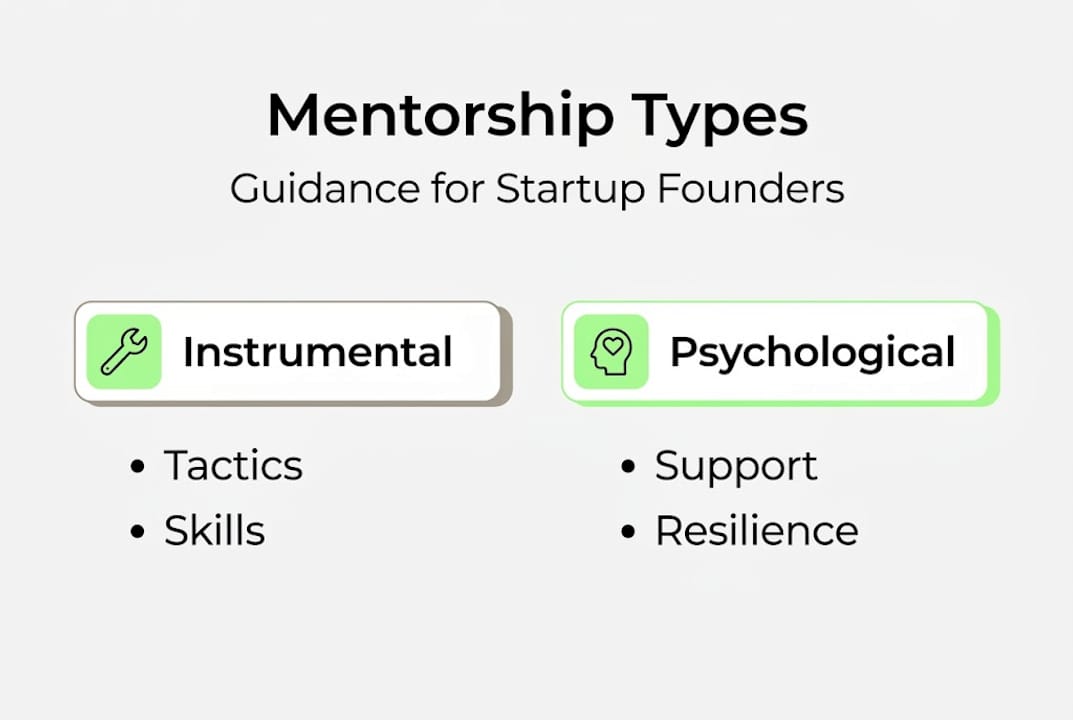
Psychological mentorship is less talked about, but arguably just as critical. Entrepreneurship is emotionally brutal. The isolation of founding a company, the weight of payroll, the fear of failure, these experiences create a psychological burden that erodes decision-making quality over time. Psychological mentors provide a safe space to process that pressure. They build your resilience and remind you that setbacks are part of the pattern, not evidence of personal failure.
Integrative mentorship combines both dimensions and represents the gold standard of guidance. An integrative mentor helps you sharpen your product strategy on Tuesday and also checks in on how you’re holding up emotionally on Thursday. This dual focus on productivity and well-being creates outcomes that neither type delivers alone.
Here’s where the comparison gets interesting for early-stage founders:
- Instrumental mentorship accelerates skill acquisition but can feel transactional if not paired with relational depth.
- Psychological mentorship builds the inner foundation required for long-term performance but may not address tactical gaps.
- Integrative mentorship is harder to find but delivers the most durable impact, especially when navigating pivots or market uncertainty.
Pro Tip: Before approaching a potential mentor, write down your three most pressing challenges. Are they tactical, emotional, or both? This exercise clarifies which mentorship type you actually need right now, and it signals to prospective mentors that you’re serious and self-aware.
Platforms and programs that understand this spectrum tend to deliver better outcomes. Exploring incubator vs. accelerator mentorship models can help you identify which structured program aligns with your current needs. And as AI mentor options grow more sophisticated, they’re beginning to fill instrumental gaps efficiently, freeing up human mentors for the deeper psychological and integrative work.
Mentorship structures: Accelerators vs. angels and beyond
Having understood the types of mentorship, let’s investigate how their delivery varies through accelerators, angel investors, and emerging channels. Because the where and how of mentorship matters enormously.
Accelerator programs like Y Combinator, Techstars, and their regional equivalents have become almost synonymous with startup mentorship. They offer structured cohort experiences, access to networks, and concentrated bursts of guidance over three to six months. The results at scale are genuinely impressive. Startups emerging from these programs regularly outperform non-accelerated peers on revenue and fundraising metrics. But structured doesn’t always mean optimal for every founder.
Here’s what the data reveals about the alternatives. Angel mentorship outperforms accelerator mentorship across several key metrics: funding raised, number of investment rounds, investor network growth, and headcount expansion. Why? Because angels typically have deeper, longer-term relationships with the founders they back. They’re not operating on a cohort calendar. They’re invested, literally and figuratively, in your specific outcome.
This doesn’t mean accelerators are inferior. It means the comparison demands nuance. Here’s a structured way to think about your options:
- Accelerator programs excel when you need rapid validation, community, and structured curriculum. The compressed timeline forces clarity and momentum.
- Angel mentors shine when you need relationship depth, patient capital, and someone who has navigated the exact domain challenges you’re facing.
- Incubators provide longer runway and lower-pressure environments, often better suited to deep-tech or science-driven ventures with longer development cycles.
- Peer networks offer horizontal mentorship where founders at similar stages share real-time learnings. These relationships are often undervalued but practically invaluable.
- AI-powered platforms are emerging as a new category entirely, providing on-demand, scalable guidance that complements human mentorship without replacing it.
Pro Tip: Don’t frame the choice as accelerator OR angel. The smartest founders stack mentorship sources deliberately. A peer network for day-to-day emotional support, an angel mentor for strategic depth, and an AI tool for rapid research and validation creates a resilient mentorship ecosystem.
If you’re actively seeking guidance, learning how to find mentors efficiently can save you months of trial and error. And if you’re evaluating formal program routes, reviewing the best startup accelerators worldwide helps you compare structures, industries, and outcomes before you commit.
The throughline in all of this? Mentorship structures are only as powerful as the match between the format and your specific needs. A cohort program built for B2B SaaS founders will likely frustrate a founder building a marketplace for local artisans. Context always wins.
Building your mentorship strategy: Best practices and pitfalls
With different mentorship options now clearly in view, it’s time to chart a pragmatic path for your own startup journey. Because knowing mentorship matters and actually building a mentorship strategy that works are two very different things.

Let’s start with what separates effective mentorship relationships from disappointing ones. Research from Psychology Today highlights that unstructured pairings and mismatched expectations are among the most common reasons mentorship fails. The solution isn’t to find a more impressive mentor. It’s to design the relationship with intention from the start.
Here are the essential steps to building a mentorship strategy that actually delivers:
- Define your objectives before you reach out. What specific outcomes do you want from mentorship in the next six months? Revenue targets? A funding round? Product-market fit? Clarity on your goals makes every mentorship conversation more productive and signals to mentors that you’re worth investing in.
- Mix formal and informal mentorship. Formal programs provide structure and accountability. Informal relationships, the advisor you grab coffee with quarterly, the founder Slack group you contribute to regularly, provide ongoing support and serendipitous connections that formal structures often miss.
- Embrace AI tools as a force multiplier. Platforms designed to guide founders through ideation and validation can accelerate your learning curve between mentor meetings. Use them to do your homework, not to replace the human relationship.
- Create a two-way value dynamic. The best mentorship relationships are genuinely mutual. Mentors gain from the relationship too: exposure to new markets, intellectual stimulation, and the satisfaction of contributing to someone else’s growth. Approach the relationship as a partnership, not a transaction.
- Build in regular check-ins and honest evaluation. Every quarter, ask yourself whether the mentorship is still serving your evolving needs. Founders who apply best practices from experienced operators treat mentorship like a living strategy: regularly reviewed and adjusted.
“The goal of mentorship is not dependency. It’s the accelerated development of your own judgment, until you become the mentor someone else desperately needs.”
Real stories illuminate this powerfully. Many of the startup success stories that capture public attention share a common subplot: a pivotal mentor relationship that reframed the founder’s understanding of their market, their customer, or themselves. These aren’t coincidences. They’re patterns.
One critical pitfall to actively avoid: seeking mentors who only validate your existing beliefs. The most uncomfortable mentorship conversations, the ones that challenge your assumptions and expose your blindspots, are often the most transformative. Cultivating curiosity as a core entrepreneurial skill is what keeps you open to that kind of productive friction.
And remember: mentorship works best when you show up prepared, coachable, and specific. Generic requests for “advice” waste everyone’s time. Concrete questions about real challenges create the conditions for genuine mentorship to happen.
Perspective: The overlooked power of sustained, personalized mentorship
Here’s an uncomfortable observation we’ve made from working with founders at all stages. Most entrepreneurs dramatically overvalue the one-time insight from a high-profile mentor and dramatically undervalue the ongoing, relationship-based guidance of someone who actually knows their business and their character.
A single coffee meeting with a celebrated investor might generate a great anecdote, but it rarely changes the trajectory of a startup. What does change trajectories? Consistent, personalized guidance from someone who watches you grow, corrects your course regularly, and adapts their advice to your specific situation over time. That’s the compounding effect most founders miss.
This becomes even more important as AI reshapes the startup landscape. AI mentors and tools can now deliver impressive instrumental guidance at scale, helping founders validate ideas, map markets, and stress-test strategies faster than ever before. But they can’t replicate the contextual intimacy of a mentor who has watched you navigate three pivots and knows exactly where your blindspots cluster. The logo on the accelerator’s website matters far less than the quality of the human relationship inside it.
Sustained mentorship is the real competitive advantage. Not the glamour of a famous name on your advisory board.
Take the next step: Connect with mentorship and AI tools
Ready to find mentorship and leverage smart tools for your journey? Here’s how you can start today. At siift, we’ve built the Intelligent Business Canvas specifically for founders who want a structured, evidence-backed path from idea to traction. Our agentic AI platform guides you step-by-step through ideation, validation, and go-to-market strategy, compressing the learning curve that mentorship alone can’t always cover. Think of it as your always-on strategic co-pilot that works between mentor sessions. To complement your AI toolkit, explore our guide to finding a mentor and connect with guidance that fits your actual stage, your actual market, and your actual goals.
Frequently asked questions
What type of mentorship has the biggest impact on startup growth?
Long-term, hands-on angel mentorship delivers the strongest impact on funding, growth, and expansion, with research confirming that angel mentorship outperforms accelerator programs across multiple growth metrics.
Do mentorship programs actually improve startup revenue?
Yes, startups with mentorship consistently report higher revenues, more successful fundraising, and greater team growth in global studies tracking accelerator and mentor program outcomes.
How can I find the right mentor for my business?
Identify your most pressing skill and emotional gaps first, then evaluate both formal programs and informal networks, and consider platforms that use AI and peer matching to connect you with contextually relevant guides.
What risks should I watch out for in mentorship?
Unstructured pairings and mismatched expectations are the most common failure modes, and research confirms that program design and mentor-mentee alignment are the variables that determine whether mentorship actually delivers results.
Can mentorship programs help with founder well-being?
Absolutely. Integrative mentorship that combines practical skills development with psychological support is shown to reduce stress, boost self-confidence, and improve overall productivity for entrepreneurs at all stages.