

TL;DR:
- Building online trust involves establishing credibility through visible social proof, technical signals, and brand consistency. A phased approach starting with reviews, case studies, and a secure, professional website sets a strong foundation for long-term reputation growth. Authenticity, consistency, and proactive reputation management are essential to convert skeptics into loyal customers.
Building trust online is the combination of credibility, authenticity, and visible social proof that converts skeptical strangers into paying customers. For entrepreneurs, freelancers, and small business owners, trust is not a soft metric. It is the deciding factor between a visitor who buys and one who bounces. The good news? You do not need a Fortune 500 budget to establish online credibility. You need a clear strategy, consistent execution, and the patience to let proof accumulate. This guide gives you exactly that, from the foundational signals that matter most to the long-term reputation practices that keep customers coming back.
What does building trust online actually require?
Online trust, in industry terms, falls under the broader practice of establishing online credibility, which combines technical signals, social proof, and brand consistency. First impressions form in under 50 milliseconds. That means your website either signals competence before a visitor reads a single word, or it quietly tells them to leave.
Here is what the foundation looks like in practice:
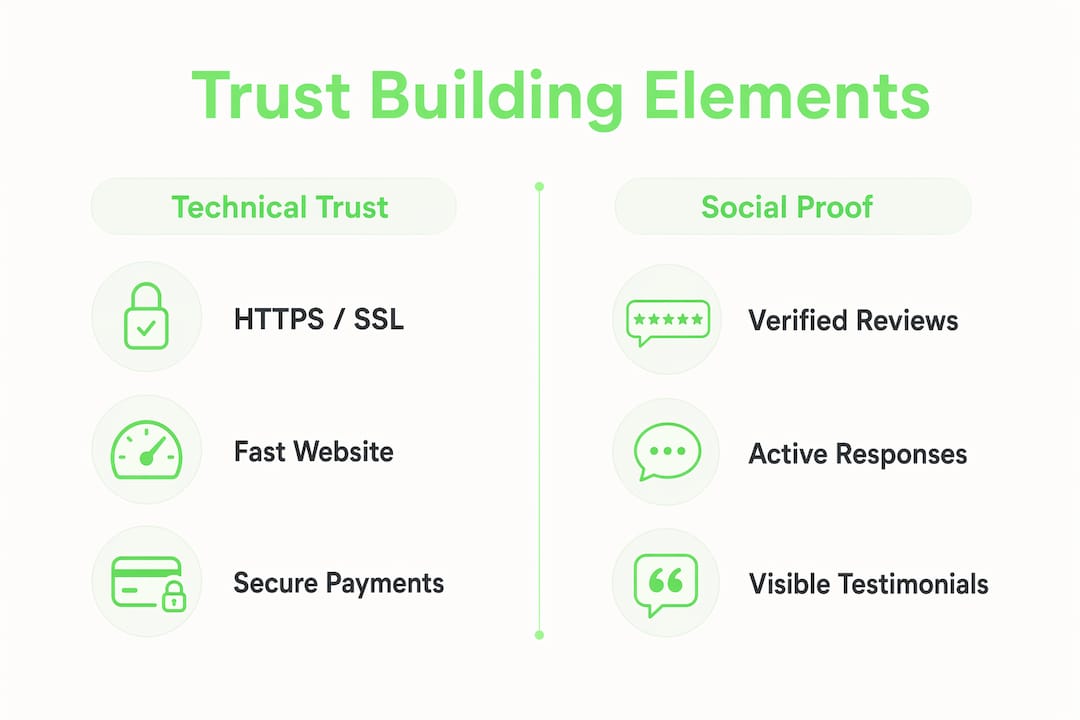
- HTTPS and SSL certificates. Visible security signals including HTTPS, clear contact details, and payment provider badges are non-negotiable trust markers. A browser warning that flags your site as “not secure” kills conversions before they start.
- Professional, clean design. Cluttered layouts, broken links, and inconsistent fonts all read as incompetence. Tools like Nestamedia Studios can help small teams build a polished digital presence without enterprise-level costs.
- Transparent contact information. A physical address, phone number, and responsive email address signal that a real person stands behind the business.
- Consistent branding across every touchpoint. Your LinkedIn profile, website, email signature, and social bios should look and sound like they belong to the same company.
For review management and social proof collection, platforms like Trustpilot, Google Business Profile, and Yelp are the standard starting points. For content publishing, tools like WordPress or Webflow give you full control over your narrative.
Pro Tip: Run your website through Google PageSpeed Insights and GTmetrix before anything else. A slow, insecure site destroys trust faster than any bad review.

| Foundation Element | Why It Matters |
|---|---|
| HTTPS / SSL certificate | Signals security and prevents browser warnings |
| Professional design | Communicates competence within 50 milliseconds |
| Transparent contact info | Confirms a real business exists behind the brand |
| Consistent branding | Reduces cognitive friction across all channels |
| Review platform presence | Provides third-party validation customers actively seek |
How do you build credibility and authenticity on digital channels?
Credibility is foundational to authority. Entrepreneurs must establish transparent, consistent actions before they can claim recognized expertise. Skipping that sequence is one of the most common mistakes founders make. They chase awards and press coverage before they have a single verified customer review.
Here is a practical sequence for building authentic credibility:
- Publish experience-led content. Focused, experience-led content creates deeper credibility signals than broad, superficial attempts. Write about problems you have actually solved, not topics you think will rank. Understanding your core audience before you publish a single post saves months of wasted effort.
- Collect third-party reviews and case studies. Testimonials with measurable results (“revenue increased 40% in 90 days”) outperform vague praise every time. Case studies on your website give prospects a reason to believe you before they ever speak to you.
- Use social media for genuine two-way conversation. Posting and ghosting is not a strategy. Respond to comments, ask questions, and share behind-the-scenes reality. Authenticity is not a brand value. It is a behavior.
- Earn media mentions in credible outlets. One high-authority media mention in Forbes or Harvard Business Review equals 100 generic blog posts in credibility value. Pitch your expertise to journalists, contribute guest articles, and pursue podcast appearances in your niche.
- Highlight specialist certifications and team credentials. Small businesses lacking deep technical expertise can boost credibility by featuring specialist team members or third-party certifications prominently.
“Credibility is not claimed. It is demonstrated, repeatedly, in public, over time.”
The Dual Brand Strategy is worth noting here. For solo founders and freelancers, your personal brand and your company brand reinforce each other. When your LinkedIn profile shows consistent expertise and your company website echoes that same voice, the combined signal is far stronger than either alone.
Which trust signals actually influence customer decisions?
Customers do not consciously audit your trust signals. They feel them. But the signals that drive that feeling are specific and measurable. AI evaluates six source types for credibility: third-party reviews, content presence, case studies, earned media, social platforms, and industry awards. Missing signals in multiple categories causes recommendation failure, both from AI tools and from human buyers doing their own research.
The most persuasive trust signals, ranked by customer impact:
- Recent, verified reviews. Recency matters. A five-star review from three years ago carries less weight than a four-star review from last month.
- Customer testimonials with specific outcomes. Numbers and names beat anonymous praise.
- Case studies. These are the long-form proof that you can actually deliver results.
- Industry awards and certifications. Third-party recognition signals that someone outside your company has validated your work.
- Media mentions. A logo wall showing Forbes, Inc., or TechCrunch coverage signals authority instantly.
Pro Tip: Place your strongest trust signal above the fold on your homepage. Most visitors never scroll past the first screen, so your best proof needs to be the first thing they see.
The comparison below shows how different proof types land with different buyer mindsets:
| Trust Signal | Best For | Buyer Mindset |
|---|---|---|
| Verified reviews | First-time visitors | “Is this business real?” |
| Case studies | Considered purchases | “Can they solve my problem?” |
| Media mentions | High-ticket services | “Are they a recognized authority?” |
| Certifications | Regulated industries | “Are they qualified?” |
| Payment badges | E-commerce checkout | “Is my payment safe?” |
Responding to negative reviews publicly and constructively is one of the most underrated trust signals available. It shows prospects that you take accountability seriously, which is exactly what they want to see before handing over money.
What are best practices for managing trust long-term?
Trust is not a one-time project. It is an ongoing practice. Effective online reputation management is proactive, involving monitoring brand mentions, responding quickly, and ensuring positive content dominates search results. Reactive reputation management, where you only act after a crisis, is expensive and slow.
A phased approach works best for resource-constrained founders:
- Months 1–6: Reviews and case studies first. A phased trust-building strategy that starts with reviews and case studies lays a solid foundation before expanding to content and social platforms. Ask every satisfied customer for a review. Document your first three client wins as case studies.
- Months 7–12: Content and earned media. Start publishing focused, experience-led articles. Pitch two or three media outlets per month. A single placement in a credible publication does more for your authority than a year of social posts.
- Year 2 and beyond: Social scaling and awards. Once your foundation is solid, pursue industry awards, speaking opportunities, and larger media placements. These amplify credibility that already exists. They cannot create it from scratch.
For ongoing monitoring, tools like Google Alerts, Mention, and Brand24 track what people say about your business across the web. Set up alerts for your brand name, your founder name, and your core product or service terms.
Consistency in messaging is the thread that holds all of this together. Your website copy, social bios, email templates, and sales conversations should tell the same story. Inconsistency reads as confusion at best and dishonesty at worst.
How do you avoid the most common trust-building mistakes?
Most trust-building failures are not dramatic. They are slow leaks. Here is where founders most often go wrong:
- Over-claiming without proof. Saying “we are the best in the industry” without a single review, case study, or credential to back it up actively damages credibility. Specificity beats superlatives every time.
- Neglecting technical basics. A site that loads in five seconds, throws security warnings, or breaks on mobile tells visitors everything they need to know. Fix the technical foundation before investing in content or ads.
- Ignoring negative feedback. Deleting or ignoring bad reviews signals defensiveness. Responding constructively and offering to resolve the issue signals maturity. Prospects read your responses as much as the original complaints.
- Inconsistent messaging across channels. If your website says you serve enterprise clients but your LinkedIn bio says you are a freelancer for startups, buyers get confused and move on.
- Expecting instant results. Trust accumulates like compound interest. The founders who win are the ones who show up consistently for 18 months, not the ones who sprint for six weeks and quit.
Pro Tip: Audit your digital presence from a stranger’s perspective once per quarter. Google your own name and business name, read your homepage as if you have never seen it, and ask a trusted peer what impression your LinkedIn profile gives. You will find gaps you have been blind to.
A content strategy aligned with SEO also reduces the risk of publishing content that never reaches the people you are trying to build trust with. Visibility and credibility are not the same thing, but you need both.
Key takeaways
Building trust online requires a layered, phased approach: start with technical credibility, add social proof, then scale with content and earned media.
| Point | Details |
|---|---|
| Foundation first | Secure your site with HTTPS, clean design, and transparent contact information before anything else. |
| Proof over claims | Verified reviews, case studies, and media mentions outperform any self-written marketing copy. |
| Phase your strategy | Focus on reviews and case studies in months 1–6, then layer in content and earned media. |
| ORM is proactive | Monitor brand mentions daily and respond to feedback quickly to stay ahead of reputation issues. |
| Consistency wins | Aligned messaging across every channel signals professionalism and builds cumulative trust. |
The uncomfortable truth about trust i had to learn the hard way
Here is what most trust-building guides will not tell you: the founders who struggle most are not the ones with bad products. They are the ones who believe that doing good work is enough. It is not. Trust is a communication problem as much as a quality problem.
I have watched talented freelancers lose clients to less-skilled competitors simply because the competitor had a cleaner website, more visible reviews, and a more consistent social presence. The market does not reward the best product. It rewards the most credible one.
The other thing I have learned is that authenticity is not a vibe. It is a discipline. Showing up consistently, responding to every review, publishing content that reflects genuine expertise, and admitting mistakes publicly when they happen. These are not feel-good practices. They are the specific behaviors that separate businesses with loyal customer bases from those stuck in a perpetual acquisition treadmill.
One mindset shift that changed everything for me: stop thinking about trust as something you build with customers and start thinking about it as something you build in public. Every piece of content, every review response, every media mention is a signal to the next thousand people who will Google you before they ever reach out. You are not just managing a relationship. You are building a record.
The online reputation management work you do today compounds over years. Start the clock now, not after you feel ready.
— Samim
How Siift helps you build a credible business from day one
Trust does not exist in a vacuum. It grows from a validated strategy, a clear value proposition, and a go-to-market plan that actually reaches the right people. Siift is built for exactly that moment when you are trying to turn a good idea into a business that customers believe in. The Siift New Business OS guides founders step by step through ideation, validation, and go-to-market, so you are not guessing at what your audience needs or what story to tell. When your strategy is grounded in real validation, your messaging becomes specific, your proof points become natural, and your credibility builds faster. Siift also takes a privacy-first approach to how it handles your data, which means the platform you use to build your business practices what it preaches.
FAQ
What is the fastest way to build trust online?
The fastest trust-building move is collecting verified reviews from real customers and displaying them prominently on your website. Combine that with HTTPS security and a professional design, and you cover the most critical signals immediately.
How long does building online credibility take?
A solid credibility foundation typically takes 6–12 months of consistent effort. A phased strategy focusing on reviews and case studies first, then content and media, produces the most durable results.
What is online reputation management?
Online reputation management (ORM) is the proactive practice of monitoring brand mentions, responding to reviews, and publishing positive content to control how your business appears in search results and on social platforms.
Do social media followers signal trust to customers?
Follower count matters far less than engagement quality and consistency. A small, responsive audience that interacts with your content signals more credibility than a large, silent one.
How does AI evaluate business credibility online?
AI tools assess credibility across six source types: third-party reviews, content presence, case studies, earned media, social platforms, and industry awards. Gaps in multiple categories reduce the likelihood of being recommended by AI-driven search tools.