

TL;DR:
- Content marketing is a strategic process that involves creating and distributing valuable content to attract a specific audience and generate business growth. Its effectiveness depends on having a documented strategy, selecting appropriate formats, and using AI tools to enhance planning, creation, and distribution. Most failures stem from neglecting patience, proper system-building, and connecting content efforts to clear business outcomes.
Content marketing is defined as the strategic creation and distribution of valuable, relevant content to attract a clearly defined audience and drive profitable business action. This is not blogging for fun or posting on social media to stay visible. The Content Marketing Institute describes it as a disciplined business approach, and the distinction matters enormously. When you treat content as a system rather than a side task, the returns compound. This guide breaks down content marketing explained in full, from the basics to AI-powered workflows, so you can build something that actually grows your business.
What is content marketing and why does it matter?
Content marketing is the opposite of interruption. Traditional advertising buys attention by cutting into someone’s experience. Content marketing replaces interruption with invitation, earning attention by solving real problems your audience already has. That shift from push to pull is what makes it so powerful for founders and early-stage marketers working with limited budgets.
The mechanics are straightforward. You create content that helps your audience at each stage of their decision process. They find it, trust you more because of it, and eventually buy from you. The relationship is built before the sale ever happens.
Here is what makes content marketing different from traditional advertising:
- Inbound vs. outbound: Content draws customers toward you. Ads interrupt them wherever they are.
- Long-term vs. short-term: A well-written article or video keeps generating traffic for years. A paid ad stops the moment you stop paying.
- Trust-building vs. attention-buying: Content proves your expertise. Ads assert it.
- Audience-owned vs. platform-owned: Your content library is an asset. Your ad spend is an expense.
The buyer journey matters here. Awareness-stage content (blog posts, social videos, podcasts) introduces your brand to people who do not know you yet. Consideration-stage content (case studies, comparison guides, webinars) helps prospects evaluate their options. Decision-stage content (testimonials, demos, free trials) closes the gap between interest and action. Mapping your content to these stages is the difference between publishing and marketing.
What are the core components of an effective content strategy?
Strategy is the word that separates content marketing from mere publishing. Without documented goals, content marketing is just a content calendar with no destination. The most common failure point for beginners is treating posts as isolated efforts rather than parts of a connected system.
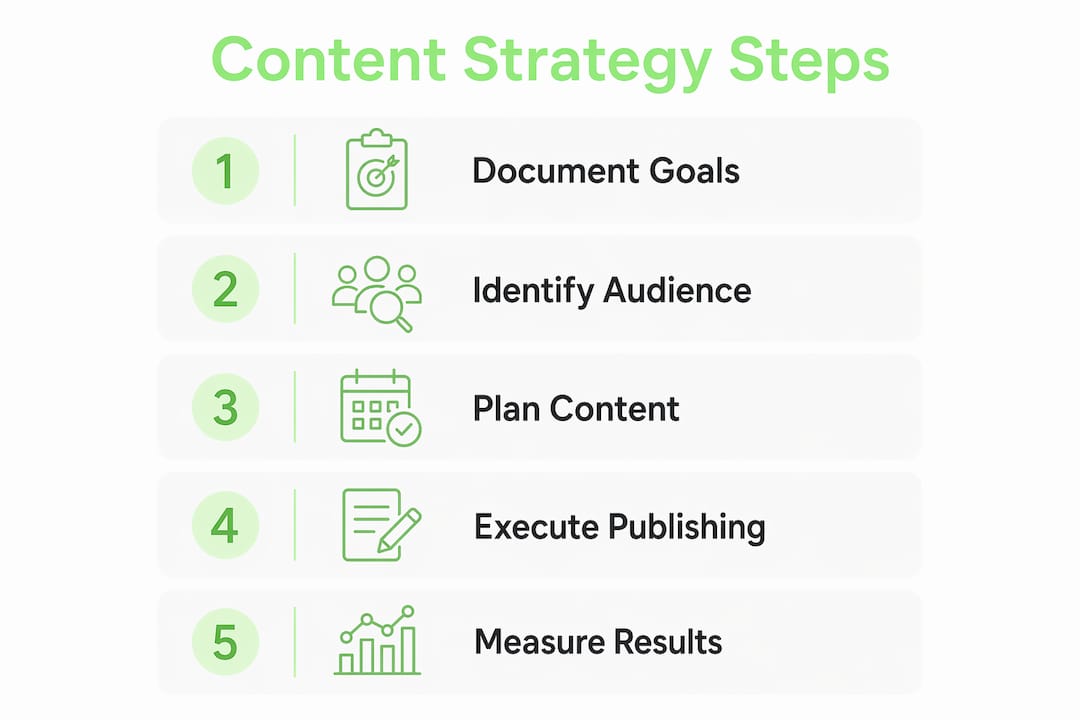
A documented content marketing strategy has five components:
- Clear business goals: What does success look like? More leads, lower customer acquisition cost, higher brand awareness? Define it before you write a single word.
- Audience insights: Who are you writing for, what do they search for, and what problems keep them up at night? Tools like SparkToro and Google Search Console surface this data.
- Content types and channels: Which formats fit your audience and your capacity? Blog posts, YouTube videos, LinkedIn articles, and email newsletters each serve different purposes.
- A distribution plan: Creating content without distributing it is like printing flyers and leaving them in your office. Decide how each piece reaches your audience before you publish it.
- Measurement criteria: Track metrics tied to business outcomes, not just page views. Conversion rates, email signups, and pipeline contribution tell you whether your content is working.
Companies with a documented strategy see 33% higher ROI than those without one. That gap is not a coincidence. Documentation forces clarity, and clarity drives better decisions at every step.
The “publishing trap” is real. Many founders start strong, produce content for a few weeks, then burn out because nothing seems to be working. The trap is volume without strategy. You publish more, measure nothing meaningful, and conclude that content marketing does not work. It does work. The system just has to be built first.
Pro Tip: Before you write your next piece of content, write down the one business outcome it is supposed to drive. If you cannot answer that in one sentence, you are not ready to publish it yet.
How do content formats perform across buyer journey stages?
Not all content formats are equal, and the data in 2026 is clear about which ones earn the best returns. Short-form video generates a 104% ROI, making it the highest-performing format by a significant margin. That number reflects the dominance of TikTok, Instagram Reels, and YouTube Shorts in capturing attention at the awareness stage.

SEO-optimized long-form articles remain in the top five ROI formats. They work differently from video. A 2,000-word article ranks in Google, answers specific questions, and builds topical authority over months and years. Video gets you discovered fast. Long-form keeps you discoverable forever.
| Format | Buyer Stage | ROI Level | Best Use |
|---|---|---|---|
| Short-form video | Awareness | Very High (104%) | Brand discovery, social reach |
| SEO long-form articles | Awareness, Consideration | High | Organic search, authority building |
| Case studies | Consideration, Decision | High | Trust, proof of results |
| Email newsletters | Consideration, Decision | High | Nurturing, retention |
| Webinars and podcasts | Consideration | Medium | Deep engagement, lead generation |
| Testimonials and demos | Decision | Medium | Conversion, closing |
Long-form content acts as a backbone asset, meaning one well-researched article or video script can be repurposed into a dozen smaller pieces. A 1,500-word blog post becomes five LinkedIn posts, three short-form videos, one email newsletter, and a Twitter thread. That multiplier effect is how small teams compete with larger marketing departments.
The practical implication is this: start with one long-form piece per month and repurpose it aggressively across channels. You build depth and breadth without doubling your workload.
Pro Tip: Use a content repurposing tracker, a simple spreadsheet works fine, to log every format you extract from each core piece. Most founders leave 80% of their content’s potential value on the table by publishing once and moving on.
What role does AI play in modern content marketing workflows?
AI is no longer optional in content marketing. 95% of B2B marketers now incorporate AI-powered tools in their content workflows. That figure signals a fundamental shift in how content gets planned, created, and distributed. Ignoring AI at this point is like ignoring email in 2005.
Here is where AI tools are making the biggest difference right now:
- Content planning and ideation: Tools like ChatGPT, Perplexity, and Claude generate topic clusters, keyword angles, and content briefs in minutes. What used to take a strategist a full day now takes an hour.
- First-draft generation: AI writes serviceable first drafts that humans refine. The quality of the output depends entirely on the quality of the prompt and the editor’s judgment.
- SEO optimization: Platforms like Surfer SEO and Clearscope analyze top-ranking content and tell you exactly what topics, questions, and terms to include.
- Distribution optimization: AI tools analyze engagement patterns and recommend the best times, formats, and channels for each piece of content.
- Performance analysis: Tools like HubSpot and Google Analytics 4 use machine learning to surface which content drives pipeline, not just traffic.
The risk with AI is losing your brand voice. AI generates generic content at scale, and generic content does not build trust. The founders and marketers who win with AI use it to handle the mechanical work while keeping human judgment in charge of strategy, tone, and positioning. For a deeper look at which tools are worth your time, the AI tools for entrepreneurs guide at Siift covers the most relevant options for early-stage teams.
A systems view connecting creation, distribution, and measurement is what makes AI integration effective rather than chaotic. Without that system, AI just accelerates the publishing trap.
Key takeaways
Effective content marketing requires a documented strategy, the right format mix, and a system that connects creation, distribution, and measurement to real business outcomes.
| Point | Details |
|---|---|
| Strategy before content | Document your goals and audience before publishing anything to avoid the publishing trap. |
| Documentation drives ROI | A written strategy produces 33% higher ROI than an undocumented approach. |
| Format selection matters | Short-form video leads ROI at 104%; long-form articles build lasting organic authority. |
| Repurpose every asset | One long-form piece should generate multiple formats to maximize reach and efficiency. |
| AI is standard, not optional | 95% of B2B marketers use AI tools; use them for speed while keeping human strategy in control. |
Why most content marketing fails before it starts
I have watched dozens of founders approach content marketing the same way. They get excited, publish a burst of posts in month one, see modest results, and quietly stop by month three. The content was fine. The system was missing.
The uncomfortable truth is that content marketing rewards patience and penalizes impatience. Most of the ROI from a well-built content program arrives six to twelve months after you start. That timeline terrifies founders who are used to the instant feedback loop of paid ads. But the founders who push through that period build something their competitors cannot easily replicate.
What I have found actually works is treating your content library like a product. You would not ship a product without a roadmap, user research, and success metrics. Apply the same discipline to content. Document your strategy. Set quarterly goals. Measure outcomes that connect to revenue, not just reach.
The other mistake I see constantly is chasing vanity metrics. Page views feel good. Shares feel good. But effective measurement focuses on business outcomes like conversion rates, pipeline contribution, and customer lifetime value. Those numbers tell you whether your content is building a business or just an audience.
One more thing: stop treating every piece of content as a standalone post. Your best articles, videos, and guides are assets. Repurpose them, update them, and link them together. A content library with internal structure compounds in value over time. A feed of disconnected posts does not.
— Samim
How Siift helps founders build smarter content systems
Building a content marketing strategy from scratch is one of the hardest things a first-time founder faces. You are simultaneously figuring out your product, your market, and your message. Siift is built for exactly that moment. As an agentic AI platform for entrepreneurs, Siift guides you through ideation, validation, and go-to-market planning in a structured, step-by-step way that generic AI tools simply cannot match. If you are ready to stop guessing and start building with clarity, start your strategy here and see how Siift accelerates your path to traction. For founders who want to go deeper on the AI tools shaping content workflows in 2026, the best AI tools for startup marketing guide is a strong next read.
FAQ
What is the simplest content marketing definition?
Content marketing is the strategic creation and distribution of valuable content to attract a defined audience and drive business growth. Unlike advertising, it earns attention by solving problems rather than buying it.
How much ROI does content marketing generate?
Content marketing yields an average of $7.65 per $1 spent when executed with a documented plan. Documented strategies produce 33% higher ROI than undocumented approaches.
What content format has the highest ROI in 2026?
Short-form video generates a 104% ROI, making it the top-performing format. SEO-optimized long-form articles remain in the top five and deliver compounding organic traffic over time.
How do beginners avoid the most common content marketing mistakes?
The biggest mistake is publishing without a documented strategy. Connect every piece of content to a specific buyer journey stage and a measurable business outcome before you create it.
How does AI fit into a content marketing strategy?
AI tools handle planning, drafting, SEO optimization, and distribution analysis. With 95% of B2B marketers now using AI in their workflows, the key is using AI for speed while keeping human judgment in charge of strategy and brand voice.