

The simplest high-leverage program is an always-on passive channel plus one recurring high-depth active channel, routed into weekly synthesis with a named owner. Do that before you add another survey. Method choice depends on where the customer is in their journey and how much decision depth you actually need. Teams that get this right treat surveys as one signal among several, not the whole system, and they close the loop every time.
TL;DR:
- Incorporate a continuous passive feedback channel alongside a recurring high-depth probe to create an efficient, high-leverage feedback loop.
- Focus on timely follow-ups and closing the loop by explaining to customers how their input leads to specific changes, preventing trust erosion.
- Use a mix of feedback methods: passive channels like tickets and reviews for ambient signals, plus scheduled interviews or conversational AI for deep insights.
- Ensure feedback is routed to the appropriate owner, with clear SLAs, to turn insights into action and avoid the common follow-through failure.
- Automate data collection and integration into a central system with identity resolution, consistent tagging, and regular synthesis to maintain scalable feedback processes.
Table of Contents
- What Is Customer Feedback Collection and Why Does It Matter?
- Which Feedback Collection Methods Should You Use?
- How Do You Run Each Feedback Method Well?
- How Do You Build a Feedback Program That Doesn’t Fizzle Out?
- What’s the Best Way to Analyze and Act on Feedback?
- What Systems Do You Need to Collect Feedback at Scale?
- How siift Turns Feedback Into Validated Strategy
- The Overlooked Problem With Most Feedback Programs
- Sources
- FAQ
What Is Customer Feedback Collection and Why Does It Matter?
Customer feedback collection is the practice of systematically gathering opinions, sentiment, and behavioral signals from customers so you can improve a product, service, or experience. That’s the plain definition. The part most teams miss is that collection is only step one of a four-stage loop: collect, analyze, act, and close the loop by telling customers what changed because of them.
Skip any stage and the whole system breaks. Collect without analyzing and you’ve built a comment graveyard. Analyze without acting and you’ve produced a report nobody reads. Act without closing the loop and customers assume you ignored them anyway, even when you didn’t.
The business case is not abstract. Retention improves when customers feel heard, churn drops when you fix the things people actually complain about, and your product roadmap gets sharper when it’s built on real friction points instead of internal guesses. Actioning feedback well is tied to meaningful revenue growth for companies that treat it as a growth lever rather than a support-ticket afterthought.
Here’s the uncomfortable stat: surveys remain the top method companies use to track satisfaction, but interaction analytics is catching up fast as a way to read sentiment without relying on click-through rates alone, with Metrigy data showing 59.2% of companies leaning on surveys versus 53.2% now using interaction analytics. That’s not a small gap closing. That’s a signal that survey fatigue is real and companies are compensating with passive listening.
The bigger problem isn’t collection volume. It’s follow-through. A meaningful share of organizations collect feedback but never act on it or close the loop — which means all that customer goodwill spent filling out your survey evaporates the moment nothing visibly changes.
The four-stage loop, in practice:
- Collect: passive and active channels running simultaneously, not one big annual survey.
- Analyze: quantitative trending plus qualitative theme coding, done on a fixed cadence.
- Act: prioritized fixes routed to a named owner with a deadline.
- Close the loop: tell the specific customers (or your whole base) what you changed and why.
Which Feedback Collection Methods Should You Use?
Every method trades reach for depth. Surveys reach thousands of people with shallow answers; interviews get you three people and the actual truth. The trick is knowing which end of that spectrum you need before you pick a tool.
Here’s how the major channels stack up:
| Method | Typical reach | Depth of insight | Best used for |
|---|---|---|---|
| Email surveys | High | Low to moderate | Broad satisfaction trends (NPS/CSAT) |
| In-app microsurveys | Moderate to high | Moderate | Contextual, moment-specific feedback |
| SMS pulses | Moderate | Low | Quick post-transaction checks |
| Customer interviews | Low | Very high | Root-cause discovery, roadmap decisions |
| Conversational AI interviews | Moderate | High | Scaling qualitative depth beyond what a small team can staff |
| Support ticket / chat mining | High (passive) | Moderate | Ongoing pain-point detection |
| Reviews | High (passive) | Moderate | Public sentiment, competitive positioning |
| Social listening | High (passive) | Low to moderate | Brand perception, emerging complaints |
| Feedback widgets | Moderate | Low | Low-friction, always-available capture |
Email surveys have response rates that vary depending on list warmth, in-app microsurveys often outperform because they ask while the experience is still fresh, and passive channels like ticket mining and reviews provide continuous signal with zero customer effort. Gathering feedback right after an interaction consistently produces more accurate sentiment than reaching out days or weeks later, because memory fades and emotion cools.
The baseline shape that works for most product teams: run a passive floor (tickets, reviews, in-app widgets) all the time, then layer in one high-depth active probe (interviews, conversational AI, or a quarterly deep-dive survey) on a fixed schedule. You get continuous ambient signal plus a periodic gut check that catches what passive data can’t explain.
Skip the temptation to run five active channels at once. Diversifying channels matters, but the winning pattern is fewer, better-timed touches rather than surveying customers into silence.
How Do You Run Each Feedback Method Well?
Knowing the methods is easy. Executing them without annoying your customers or collecting garbage data is where most teams stumble. Here’s the operational detail for each.
1. Surveys: NPS, CSAT, and CES
Keep it to one to three questions per send. NPS asks “How likely are you to recommend us?” on a 0 to 10 scale; CSAT asks “How satisfied were you with this interaction?”; CES asks “How easy was it to get this done?” Pick one metric per survey moment, not all three stacked together.
Timing matters more than wording. Send CSAT and CES immediately after a support interaction or transaction. Send NPS on a quarterly or biannual cadence to your active user base, not after every login. Response rates for cold email lists run low; warm, contextual sends do noticeably better, especially when the ask is one tap instead of a ten-field form.
2. In-product microsurveys
Place these at natural pause points: after a task completes, right before a subscription renews, or immediately following a feature’s first use. Don’t interrupt someone mid-task to ask how they feel about the task.
A/B test the timing itself, not just the wording. Try triggering the prompt immediately on completion versus a five-second delay, and watch which version gets more completions without more dismissals. One well-timed prompt beats three poorly timed ones.
3. SMS and email pulses
SMS works best as a single tap, one-question pulse (thumbs up or down) sent within minutes of a transaction. Email pulses can carry slightly more nuance but should never exceed three questions. Frequency caps matter here: no customer should get more than one pulse survey per interaction type per month, or you’ll train them to ignore you.
Incentives can lift response rates, but keep them modest, a small discount or loyalty credit works better than a sweepstakes entry, which can attract low-effort junk responses.
4. Interviews and moderated research
Recruit from recent, engaged customers, not your happiest superfans or your angriest churned accounts exclusively. A skewed sample gives you a skewed roadmap. Structure your guide around open-ended “why” and “walk me through” prompts rather than yes/no questions, and leave room to go off-script when someone says something unexpected.
The goal of an interview isn’t to confirm what you already believe. It’s to find the thing you didn’t know to ask about. For founders validating an early idea, structured customer development interviews turn loose conversations into testable hypotheses instead of anecdotes you nod along to.
5. Conversational AI interviews
These outperform static surveys when you need qualitative depth at a scale no human research team could staff. An AI interviewer can run dozens of moderated-style conversations in parallel, probe follow-up answers, and surface patterns a five-person team would take weeks to find manually.
The quality-control catch: review a sample of transcripts regularly to make sure the AI isn’t leading respondents toward expected answers or missing sarcasm and context. Treat it as a force multiplier for your research function, not a replacement for ever talking to a human yourself.
6. Passive mining: tickets, chat, and reviews
Tag every support ticket and chat transcript by topic and sentiment as it comes in, not in a quarterly batch. Automated categorization tools can flag recurring themes, but inferred sentiment needs human spot-checks. AI-inferred sentiment from transcripts is useful for scale, but it can misclassify sarcasm, mixed emotions, and industry-specific phrasing if nobody validates the output.
7. Social listening
Track brand mentions, product-specific complaints, and competitor comparisons across the platforms your customers actually use. The credibility check matters: weight verified customers and repeat mentions higher than one-off drive-by comments, and always cross-reference a viral complaint against your support ticket volume before treating it as a fire.
Pro Tip: Run your passive channels and your one active probe on completely separate calendars. Passive collection should never stop; active probes should have a defined start and end date so your team knows when synthesis is due.
How Do You Build a Feedback Program That Doesn’t Fizzle Out?
A one-off survey campaign is a project. A feedback program is infrastructure, and infrastructure needs cadence, sampling rules, and clear ownership or it collapses within two quarters.
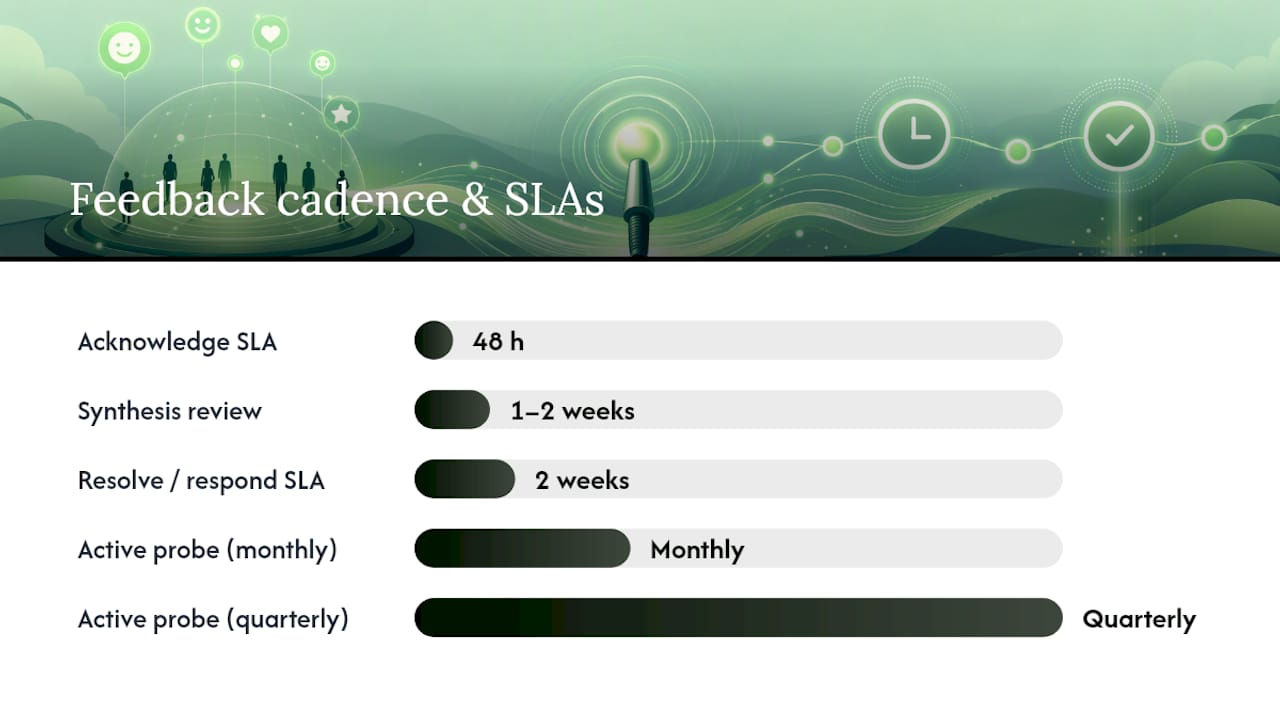
Cadence: Run your passive layer continuously and never turn it off. Schedule your active probe (interviews, conversational AI sessions, or deep-dive surveys) on a fixed rhythm, monthly for high-velocity products, quarterly for slower-moving B2B tools. Set a synthesis meeting every one to two weeks where someone actually reviews what came in, rather than letting it pile up until the quarterly business review.
Sampling: Randomize who gets surveyed within a recency window instead of always pinging your most vocal power users. If you can afford full-coverage outreach (every customer, every interaction) that’s ideal, but a random sample beats a convenience sample every time. Convenience sampling is how you end up building a roadmap for your five loudest customers instead of your actual base.
Incentives: Small, proportional rewards, a discount code or account credit, tend to lift response rates without distorting honesty. Avoid incentives large enough that people rush through just to claim the reward; that’s how you get low-quality data that looks complete.
Ownership and routing: Every piece of feedback needs a destination. Route bugs to engineering, pricing complaints to whoever owns monetization, feature requests to product. Set an SLA: acknowledge within 48 hours, resolve or respond with a plan within two weeks. Closing the loop, telling the customer what happened after they spoke up, is one of the most consistently cited best practices across major feedback guides, and it’s also the step most programs quietly drop.
- Continuous passive floor, never paused.
- One scheduled active probe on a fixed rhythm.
- Synthesis review every one to two weeks.
- Randomized sampling, not convenience sampling.
- Named owner and SLA for every feedback category.
- A closing-the-loop message sent every time, even if the answer is “not now.”
Pro Tip: Draft your “you said, we did” template before you launch the program, not after the first round of feedback comes in. Teams that write it in advance actually send it. Teams that plan to write it later usually don’t.
What’s the Best Way to Analyze and Act on Feedback?
Collection without synthesis is just a bigger inbox. The teams that turn feedback into product decisions run two parallel tracks: quantitative trending and qualitative theme coding, then merge them into one prioritized list.
Quantitative tracking: Trend NPS, CSAT, and CES over time, and always split by cohort (new versus tenured customers, plan tier, use case). A flat overall NPS can hide a sharp drop in one segment. Watch sample size before drawing conclusions. A ten-response swing in a small cohort is noise, not a trend.
Qualitative synthesis: Code open-text responses and interview transcripts into recurring themes, then pull two or three representative quotes per theme so the pattern doesn’t get flattened into a vague bullet point. Push past the surface complaint to the root cause. “The app is slow” might really mean “I don’t trust that my data saved.”
Inferred sentiment and interaction analytics: These extend your reach into interactions nobody explicitly rated, but they’re a complement, not a replacement for direct feedback. Spot-check a sample regularly against human judgment to catch systematic errors before they skew your roadmap.
Prioritization: Score each theme on frequency, business impact, and effort to fix. A high-frequency, high-impact, low-effort fix should always jump the queue ahead of a rare, low-impact request, no matter how loudly one customer asked for it.
More than half of companies now track feedback signal through interaction analytics rather than surveys alone, a sign that passive, always-on listening is becoming standard alongside traditional surveying.
- Trend scores by cohort, never as one blended number.
- Pair every theme with two or three real quotes.
- Score frequency × impact × effort before prioritizing.
- Spot-check inferred sentiment against human judgment.
- Measure loop-closing effectiveness by tracking follow-up response rates and churn shifts in the segment you addressed.
That last metric is the one most teams skip. If you fixed something and told customers, did the complaint volume actually drop? If you can’t answer that, you’re not closing the loop, you’re just sending emails.
What Systems Do You Need to Collect Feedback at Scale?
Feedback data is only useful if it lands somewhere your team can actually see it next to everything else you know about a customer. That means connecting your survey tool, in-product event tracking, support platform, CRM, and analytics into something closer to one data flow than five disconnected spreadsheets.
The essential connections:
- Survey and microsurvey tools feeding into your central customer record.
- In-product event data tagged with the same customer ID as support and survey responses.
- Support platform tickets tagged and routed automatically by topic.
- CRM fields updated with sentiment and feedback history per account.
- A data warehouse or central repository where synthesis actually happens.
The capabilities that make or break this: identity resolution so the same customer’s survey response, support ticket, and product usage all link to one profile; deduplication so one loud customer doesn’t skew your theme counts; consistent timestamping so you can tell what happened before or after a fix shipped; and automated synthesis that flags recurring themes without a human manually re-reading everything each week.
Automating the collection and routing workflow removes a lot of the manual tagging that causes teams to fall behind on synthesis. Most integrations run on webhooks for real-time triggers (a new ticket fires a Slack alert) or batch ETL for less time-sensitive syncing (nightly survey response dumps into your warehouse). Test the pipeline the same way you’d test any product feature: send a dummy response through end to end and confirm it lands correctly before you trust it with real customer data.
On privacy: strip or mask personally identifiable information before broad internal sharing, set clear retention windows so feedback data doesn’t sit indefinitely, and get explicit consent for anything you plan to quote publicly. This is operational hygiene, not legal advice, but skipping it is how you end up with a data mess nobody wants to own.
How siift Turns Feedback Into Validated Strategy
Founders don’t have a research team. They have a notes app full of half-remembered customer calls and a gut feeling they’re afraid to trust. siift’s New Business OS exists to close that gap, guiding you step by step from a raw customer quote to a prioritized, testable hypothesis instead of leaving that translation work to intuition.
Here’s what that looks like in practice:
- Turning scattered interview notes into structured, ranked hypotheses instead of a messy doc nobody revisits.
- Cross-checking early-customer signal against market data so you’re not validating a niche of one.
- Flagging when your feedback sample is too small or too skewed to support the roadmap decision you’re about to make.
If you’re still deciding whether an idea deserves the next three months of your life, siift’s startup idea validation tools are built for exactly that filtering work, minus the guesswork.
The Overlooked Problem With Most Feedback Programs
Most teams don’t have a collection problem. They have a follow-through problem dressed up as a tooling problem. The research backs this up plainly: companies collect plenty, and a meaningfully smaller share of them ever close the loop. Buying another survey tool doesn’t fix that. Assigning an owner and a deadline does.
The conventional advice, “survey more, survey often”, is backwards for most product teams. Survey fatigue is real, response quality drops when you over-ask, and the fix isn’t more surveys, it’s better-timed ones layered on top of passive channels you’re probably already sitting on and ignoring: your support tickets, your reviews, your churn interviews.
If you take one thing from this: stop optimizing your survey questions before you’ve built the routing and ownership system that turns answers into action. A perfectly worded NPS follow-up question routed to nobody is worse than a clumsy one that reaches an engineer with a deadline. Fix the pipe before you polish the tap.
— Samim Safaei
Sources
FAQ
What Is the Best Method for Customer Feedback Collection?
There’s no single best method. The strongest programs combine a continuous passive channel (support tickets, reviews) with one scheduled high-depth active channel (interviews or conversational AI), synthesized on a regular cadence.
How Often Should You Collect Customer Feedback?
Passive channels should run continuously with no pause. Active probes like interviews or deep-dive surveys work best on a fixed schedule, monthly for fast-moving products, quarterly for slower B2B cycles.
What’s a Good Survey Response Rate?
Response rates vary widely by channel and list warmth; in-app microsurveys asked in context tend to outperform cold email sends because customers respond while the experience is still fresh.
How Do You Avoid Survey Fatigue?
Cap surveys at one to three questions, limit how often any one customer gets asked, and time the ask to a natural pause point instead of interrupting an active task.
What Does “Closing the Loop” Mean in Feedback Collection?
It means telling customers what changed because of their input, whether through a direct follow-up message or a public “you said, we did” update. Skipping this step is one of the most common reasons feedback programs lose customer trust.