

Product-market fit means your product is being pulled by a specific customer group — the clearest test is whether at least 40% of your active users would be “very disappointed” if it disappeared. If you’re not there yet, the move isn’t to hire more or spend more on ads. It’s to measure, learn, and iterate until the market starts pulling you forward.
Before you read another word, run this three-signal diagnostic right now:
- The Sean Ellis check. Survey your most engaged users: “How would you feel if you could no longer use this product?” If at least 40% answer “very disappointed,” you’re in PMF territory. Below that threshold? You have real work to do.
- Week-4 retention. Pull your cohort data. Are users who signed up a month ago still completing your core workflow? Flat or rising retention after the first month is one of the strongest signals of genuine fit.
- Organic referral share. What percentage of new signups came from word of mouth, not paid channels? A rising organic referral rate means customers are doing your marketing for you — which is exactly what fit looks like in practice.
If two of those three signals are weak, pause any growth spending. The 42% of startups that fail because they never served a validated market need almost always kept spending through weak signals instead of stopping to fix them.
Table of Contents
- What product-market fit really means (and why it matters more than your product)
- Concrete signals and metrics that tell you where you stand
- How to measure PMF this week: surveys, cohorts, and analytics
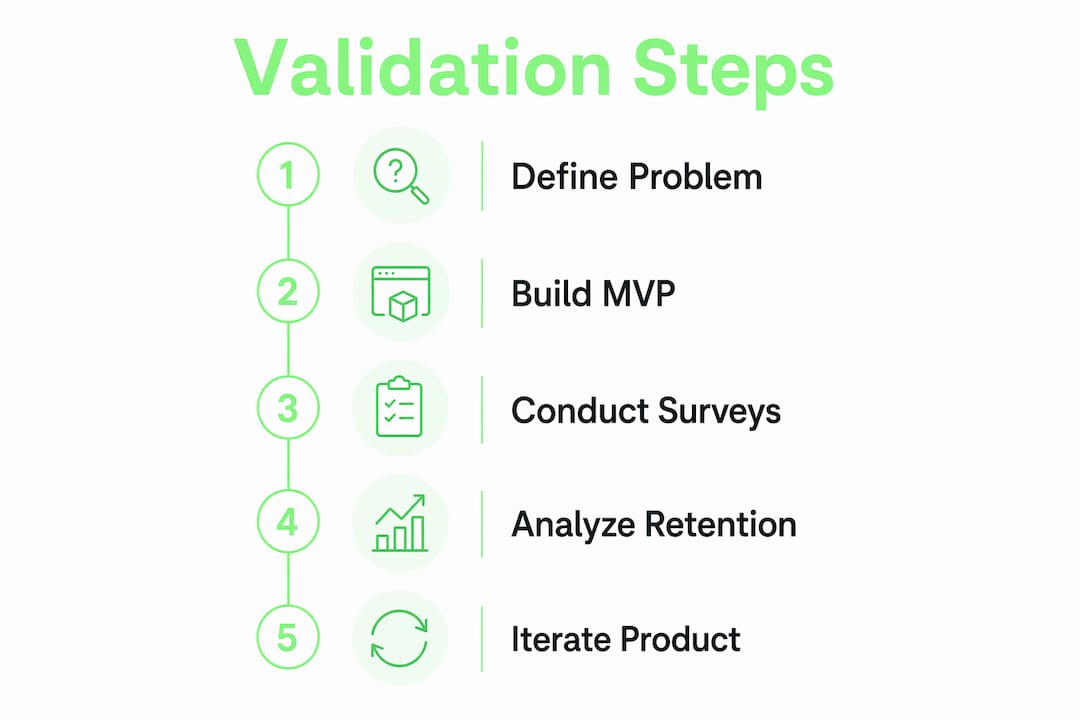
- A four-stage roadmap from idea to validated fit
- Real examples of how PMF was found (and almost missed)
- Common founder mistakes that kill product-market fit before it starts
- What it realistically costs and how long it takes to find fit
- What to do right after you’ve earned product-market fit
- How siift maps to the PMF process and accelerates your validation
- Key Takeaways
- The part most PMF guides won’t tell you
- siift helps you find fit before you run out of runway
- Useful sources
- FAQ
What product-market fit really means (and why it matters more than your product)
The phrase was coined by Andy Rachleff, co-founder of Benchmark Capital, who adapted it from Steve Blank’s customer development work. Marc Andreessen popularized it in a 2007 blog post, defining it simply as “being in a good market with a product that can satisfy that market.” Sean Ellis later made it measurable with his “very disappointed” survey question. Three different framings, one shared conviction: the market matters more than the product.

PMF is not a binary event you either have or don’t. Y Combinator describes it as a spectrum — a degree of fit that needs to be high enough to sustain growth, and that requires continuous reassessment as markets shift and competitors emerge. A startup can have weak fit in one customer segment and strong fit in a narrower one. The work is finding where the pull is strongest.
Why does this matter beyond a feel-good milestone? Because fit changes everything downstream. Unit economics improve when customers stay and refer others. Sales cycles shorten when the value proposition resonates without heavy explanation. Fundraising dynamics shift when investors can see proven demand rather than a pitch deck hypothesis. Word of mouth compounds. Retention stabilizes your revenue model. Without fit, every dollar you spend on growth is accelerating a leaky bucket.
“When a great team meets a lousy market, market wins. When a great team meets a great market, something special happens.” — Andy Rachleff, via Andreessen Horowitz
That quote should be pinned above every founder’s desk. The instinct to perfect the product before testing the market is almost universal — and almost always wrong.
Concrete signals and metrics that tell you where you stand
The Sean Ellis 40% rule
The Sean Ellis test asks one question: “How would you feel if you could no longer use this product?” with four answer options ranging from “very disappointed” to “not disappointed.” The benchmark: if at least 40% select “very disappointed,” that’s a strong indicator of fit. Below that, you’re likely still searching.
Apply it correctly or the data misleads you. Survey only users who have experienced the core value of your product — not trial signups who never activated, not people who signed up recently. Timing matters: send the survey after users have completed your core workflow at least twice. And watch your sample size: aim for at least 40–50 responses for direction, 100+ for confidence.
A compact PMF dashboard
Track these three numbers together — they give you a complete picture without drowning in data:
- % “very disappointed” (Sean Ellis score): target at least 40%
- Week-4 cohort retention: the share of users still active 28 days after their first core-workflow completion
- Organic referral share: new signups attributable to word of mouth, not paid acquisition
Beyond those three, watch for supporting signals:
- NPS trending upward over successive cohorts
- Shortening sales cycle: deals closing faster without extra persuasion
- LTV:CAC ratio improving as retention rises and acquisition costs stabilize
- Conversion from free/trial to paid increasing without pricing changes
- Inbound support requests that reveal love, not just bugs (“Can you add X?” beats “Why is Y broken?”)
| Metric | Weak Signal | Strong Signal |
|---|---|---|
| Sean Ellis score | Below 40% | 40%+ |
| Week-4 retention | Below 20% | Above 40% |
| Organic referral share | Below 10% | Above 30% |
| LTV:CAC | Below 1x | Above 3x |
| Sales cycle trend | Lengthening | Shortening |
Benchmarks are directional, not gospel. A B2B SaaS tool serving enterprise buyers will have different retention curves than a consumer app. Use the table as a compass, not a verdict.
How to measure PMF this week: surveys, cohorts, and analytics
Step 1: Set up the Sean Ellis survey
The core question is fixed. What you add around it matters. A solid survey sequence looks like this:
- “How would you feel if you could no longer use [product]?” (the Ellis question)
- “What type of person do you think would benefit most from [product]?”
- “What is the main benefit you receive from [product]?”
- “How could we improve [product] for you?”
Questions 2 through 4 are gold. They tell you who your real customer is (often different from who you thought), what value they actually receive (often different from what you built for), and where the gap is. Send this to users who have completed your core workflow at least twice, using Typeform, Google Forms, or a lightweight in-app tool like Sprig.
Pro Tip: Don’t survey your whole user list. Segment for “activated” users only — people who reached your product’s core value moment. Surveying unactivated users inflates your “not disappointed” responses and makes your score look worse than it is.
Step 2: Build a cohort retention test
Pick a cohort start event (signup, first core action, first paid transaction) and track weekly active usage for 8 weeks. Tools like Mixpanel, Amplitude, or even a well-structured Google Sheets export from your database will work at early stage. You’re looking for a retention curve that flattens rather than drops to zero — a flat curve, even at 20–30%, means some users have found genuine value.
Step 3: Instrument your core value moment
Before you can measure retention, you need to define and track the event that represents your product delivering its core promise. For a project management tool, that might be “first task completed by a collaborator.” For a payments product, “first successful transaction.” Name it, instrument it in your analytics, and make it the anchor of every cohort you run.

Step 4: Run 20–30 discovery interviews before building more
This is the most underused measurement tool in early-stage startups. One-on-one problem interviews — before you write more code — surface whether the problem you’re solving is urgent enough to pay for. If you can’t schedule 20 calls with people in your target segment, that’s a signal in itself: the market may not be as accessible or motivated as you assumed.
A four-stage roadmap from idea to validated fit
Stage 1: Problem discovery
Goal: Confirm the problem is real, urgent, and underserved before writing significant code.
- Run a set of one-on-one customer discovery interviews with your target segment
- Document the exact language customers use to describe the problem (this becomes your messaging)
- Identify the top 3 competing alternatives they use today and why those fall short
- Decision gate: Can you find 20 people who describe the same painful problem unprompted? If not, narrow or pivot the hypothesis.
Stage 2: MVP validation
Goal: Ship the smallest possible version that delivers the core value and test whether users return.
- Build only the feature(s) that address the core problem — nothing else
- Recruit 10–20 target users manually; do not rely on paid acquisition yet
- Instrument your core value moment and track week-2 and week-4 retention
- Decision gate: Are a meaningful share of users returning to complete the core workflow by week 4? If not, the value hypothesis needs work.
Stage 3: Product iteration
Goal: Improve fit by narrowing the ICP, sharpening the value proposition, or changing the core workflow.
- Run the Sean Ellis survey on activated users; target at least 40–50 responses for direction, 100+ for confidence
- Analyze the “what is the main benefit” responses to find the real job-to-be-done
- Run structured A/B experiments on onboarding, messaging, and core feature flows
- Decision gate: Is your Ellis score trending toward 40%? Is week-4 retention rising cohort over cohort?
Stage 4: Validation at scale
Goal: Confirm fit holds across a larger, more diverse sample before investing in growth.
- Expand to 100+ survey responses and confirm at least 40% answer “very disappointed”
- Test one repeatable acquisition channel (SEO, outbound, community) and measure CAC
- Verify that LTV:CAC is trending above 3x before scaling spend
- Decision gate: All three dashboard metrics (Ellis score, week-4 retention, organic referral share) in the strong-signal range? You’re ready to scale.
Pro Tip: Keep your team tiny during stages 1–3. Y Combinator’s guidance is explicit: operate like a focused, lean unit and minimize burn until the market is pulling you. Hiring a sales team before you have repeatable fit is one of the fastest ways to burn runway on the wrong hypothesis.
Real examples of how PMF was found (and almost missed)
These aren’t fairy tales — they’re mechanics. What changed, what moved, and what the lesson is.
Slack
Slack started as an internal communication tool built for a gaming company called Glitch. The game failed. But the team noticed their own internal tool had become indispensable to how they worked. They pivoted the entire product around that internal tool, narrowed the ICP to small tech teams, and found that the “very disappointed” signal was overwhelming among early adopters.
- Before: A feature of a failing game, used by one team
- Test: Opened the tool to a handful of other companies; measured daily active usage and organic sharing
- Signal: Teams were adding colleagues without being asked; organic growth outpaced anything they could have bought
- Lesson: The product that finds fit is often not the one you set out to build. Stay close to where users are actually getting value.
Instagram launched as Burbn, a location check-in app with photo-sharing as a secondary feature. Usage data told a different story: people were ignoring check-ins and using the photo filters obsessively. The founders stripped everything except photos, filters, and sharing.
- Before: A cluttered app with low engagement on its core feature
- Test: Removed all features except the one users kept returning to
- Signal: Retention spiked immediately; organic sharing drove viral growth
- Lesson: Retention data is more honest than your roadmap. If users keep coming back for one thing, that one thing is your product.
The pattern both share
Narrow the ICP, strip the product to the core value moment, and let retention data guide the decision. Neither team scaled marketing before the signal was clear. Both iterated through pivots rather than treating their original idea as sacred.
Common founder mistakes that kill product-market fit before it starts
Most PMF failures aren’t about bad products. They’re about bad timing and bad signals. Here’s what to watch for:
Red flags that you’re scaling too early:
- Hiring a sales team or growth marketer before week-4 retention is above 30%
- Running paid acquisition with a falling or flat retention curve
- Celebrating user acquisition numbers while ignoring churn
- Raising a seed round and immediately expanding the feature set
False positives that fool founders:
- A spike in signups from a press mention that doesn’t convert to retained users
- High engagement in the first week that drops to near-zero by week 4
- Positive feedback from friends, family, or early fans who aren’t your real ICP
- A single enterprise customer who represents 80% of your revenue (concentration risk, not fit)
Concrete fixes:
- Narrow your ICP to the 20% of users who are most engaged and most vocal — build for them, not the average user
- Use sales-driven validation before building: can you close a deal before the feature exists?
- Run a “stop-gap” experiment: remove a feature and see if users complain loudly. Silence is a signal.
- Treat your NPS not as a vanity metric but as a leading indicator — track it cohort by cohort, not as an aggregate
How to read false negatives: Sometimes fit is real but the signal is weak because you’re surveying the wrong users. If your Ellis score is below 40% but a specific segment scores above 40%, you may have fit in a narrower ICP than you’re currently targeting. Segment your survey results by user type, company size, or use case before concluding you don’t have fit.
What it realistically costs and how long it takes to find fit
There’s no universal timeline, and anyone who gives you one without context is guessing. That said, here are honest ranges by business model:
Typical timelines:
- B2B SaaS (SMB-focused): 12–18 months from first customer to validated fit, assuming weekly iteration cycles
- B2B SaaS (enterprise): 18–36 months, given longer sales cycles and slower feedback loops
- Consumer app: 6–18 months, with faster feedback but higher churn risk and noisier signals
- Marketplace: 18–30 months, because you’re solving a chicken-and-egg problem on two sides simultaneously
Lean validation budget (US market):
- Customer discovery (tools, incentives, travel): $1,000–$5,000
- MVP development (no-code or minimal engineering): $5,000–$30,000
- Analytics instrumentation (Mixpanel, Amplitude free tiers, or Segment): $0–$500/month
- Survey tooling (Typeform, Sprig): $0–$200/month
- Total lean validation runway: $50,000–$150,000 over 12 months for a two-person team
Rules of thumb:
- Keep your team at two to three people until you hit the Stage 4 decision gate
- Maintain at least 12 months of runway at all times during the search phase; 18 months is safer
- Do not hire for functions that exist to scale a working model (growth, sales ops, customer success) until the model is proven
- Every dollar spent on paid acquisition before fit is a dollar that could have funded five more discovery interviews
What to do right after you’ve earned product-market fit
Fit is not a finish line. It’s a starting gun for a different, harder race. The instinct to immediately hire and spend is understandable — and dangerous.
Scale checklist (do these in order):
- Identify your one repeatable acquisition channel before investing in a second
- Confirm CAC payback period is under 18 months for SaaS (shorter for consumer)
- Document your onboarding flow so a new hire can replicate your activation rate
- Set up cohort LTV tracking before you expand pricing or packaging
- Build a gross retention dashboard — churn is the first thing that breaks at scale
Metrics to monitor as you grow:
- CAC payback period: how many months of revenue to recover acquisition cost
- Cohort LTV curves: are later cohorts performing as well as early ones?
- Gross retention: the share of revenue retained before expansion; below 85% in SaaS is a warning sign
- NPS by cohort: fit can erode as you expand to new segments; track it segment by segment
Staged investment approach:
- Stage 1 post-fit: double down on the one channel that’s working; don’t diversify yet
- Stage 2: hire one dedicated growth or sales person and measure their output against your pre-hire baseline
- Stage 3: once CAC payback is confirmed and retention is stable, raise and scale
Achieving fit also changes your fundraising position significantly. Investors respond to demonstrated demand differently than they respond to projections. Come to those conversations with your three-metric dashboard, your cohort curves, and your organic referral data — that’s the story that moves term sheets.
How siift maps to the PMF process and accelerates your validation
siift’s New Business OS is built specifically for the search phase — the messy, iterative work between idea and fit that most tools ignore entirely. Here’s how its features map to the roadmap above:
| PMF Stage | Task | How siift helps |
|---|---|---|
| Problem discovery | Customer interview planning and synthesis | Guided discovery workflows with structured interview frameworks |
| MVP validation | Value hypothesis testing and ICP definition | AI-guided ICP narrowing and hypothesis stress-testing |
| Product iteration | Survey design and experiment tracking | Built-in validation sprint templates and experiment logs |
| Validation at scale | Go-to-market strategy and channel testing | Go-to-market planning workflows tied to your validated ICP |
A typical siift validation sprint looks like this:
- A founder enters their idea and target customer hypothesis into siift’s guided workflow
- siift surfaces the key assumptions to test and generates a prioritized discovery interview guide
- The founder runs 15–20 interviews, logs findings inside siift, and the platform synthesizes patterns across responses
- siift flags which assumptions are validated, which are weak, and recommends the next experiment
- The founder moves to MVP design with a clear, evidence-backed value hypothesis rather than a gut feeling
What siift does not do: it’s not an accounting tool, a legal service, an HR platform, or a back-office solution. It’s purpose-built for the idea-to-fit journey — validation, strategy, and go-to-market planning. If you need payroll or contracts, look elsewhere. If you need to find your market before you burn your runway, siift is built for that.
Key Takeaways
Product-market fit is a measurable, iterative process — not a lucky accident — and the founders who find it fastest are the ones who measure pull signals early and pivot their hypothesis before they scale.
| Point | Details |
|---|---|
| Use the three-metric dashboard | Track Sean Ellis score (at least 40% target), week-4 retention, and organic referral share together. |
| Survey only activated users | Surveying unactivated users inflates “not disappointed” responses; aim for at least 40–50 responses for direction, 100+ for confidence. |
| Stay lean until Stage 4 | Keep the team small and maintain sufficient runway during the search phase. |
| Scale one channel first | After fit, confirm one repeatable acquisition channel and CAC payback under 18 months before investing in a second. |
| siift accelerates the search | siift’s guided validation workflows map directly to discovery, hypothesis testing, and go-to-market planning for early-stage founders. |
The part most PMF guides won’t tell you
There’s a quiet anxiety that runs through every early-stage founder’s week: “Am I building the right thing, or am I just busy?” Most PMF content answers that question with frameworks. What it rarely says out loud is that the framework is not the hard part. The hard part is being willing to hear the market say “not yet” and respond with curiosity instead of defensiveness.
Here’s the contrarian note worth sitting with: most founders choose their product before they choose their market, and then spend 18 months trying to find a market that fits the product they already love. The research is consistent on this — market selection matters more than execution at the early stage. A great team in the wrong market loses. A mediocre team in a burning market often wins. That’s not a comfortable truth, but it’s a useful one.
The other thing guides understate: messaging is part of the product. If you can’t explain your value in the exact language your customer uses to describe their problem, the market won’t pull. You can have the right product and the wrong words and still look like you don’t have fit. The “what is the main benefit” question in the Sean Ellis survey isn’t a nice-to-have — it’s where your marketing copy comes from.
Measure love, not clicks. A thousand signups who never return tell you nothing useful. Twenty users who would genuinely miss your product tell you everything. Start there, stay there until the signal is clear, and then scale with confidence.
siift helps you find fit before you run out of runway
Most founders spend their first year building features nobody asked for. siift’s startup idea validation platform gives you a structured, AI-guided path from raw idea to validated go-to-market strategy — without the guesswork of figuring out what to test next.
You get guided discovery interview frameworks, hypothesis stress-testing, experiment tracking, and go-to-market planning workflows, all in one place. siift is built for the validation and strategy phase of the founder’s journey. It does not do accounting, legal, HR, or back-office work — it does the one thing that matters most before you scale: helping you confirm that a real market wants what you’re building.
If you’re ready to run a proper validation sprint instead of hoping the next feature is the one that clicks, start your validation workflow on siift today.
Useful sources
These are the primary sources and further reads worth bookmarking. Each one earns its place:
-
Andreessen Horowitz — 12 Things About Product-Market Fit: The most cited practitioner essay on PMF. Andy Rachleff’s market-first framing is the foundation of the definition section and the roadmap’s Stage 1 logic.
-
Y Combinator — The Real Product-Market Fit: YC’s own take on why PMF is a spectrum and why lean team discipline matters during the search. Directly supports the roadmap and timeline sections.
-
Stripe — What Is Product-Market Fit and What Startups Need to Know: A clear, founder-facing explainer that covers how fit changes fundraising dynamics. Useful for the post-PMF section.
-
EntrepreneurBytes — How to Find Product-Market Fit: The most practical breakdown of the Sean Ellis 40% rule, including survey design and interpretation. Essential companion to the measurement section.
-
ScoreApp — How to Achieve Product-Market Fit: Covers sample-size guidance for the Ellis survey and common measurement errors. Directly supports the “how to measure” section.
-
First Round Review — Customer Discovery Best Practices: The go-to resource for discovery interview design and the 20–30 interview rule. Supports Stage 1 of the roadmap.
-
Wikipedia — Product-Market Fit: A useful historical overview of how the concept evolved and which companies found fit through pivots. Good background for the examples section.
-
CB Insights — Startup Failure Reasons: The source for the 42% failure-from-no-market-need statistic. Grounds the urgency argument in the opening section.
-
BabyLoveRaise — Venture Capital Terms Every Startup Founder Must Know: A practical primer on VC vocabulary for founders preparing to fundraise after reaching fit. Useful companion to the post-PMF section.
FAQ
What is the 40% rule for product-market fit?
The 40% rule, developed by Sean Ellis, states that if at least 40% of your surveyed active users say they’d be “very disappointed” without your product, you’re likely in PMF territory. Survey only users who have completed your core workflow, and aim for at least 40–50 responses for direction, 100+ for confidence.
What are the four stages of product-market fit?
A practical four-stage model runs from problem discovery (validating the problem is real and urgent) through MVP validation, product iteration, and validation at scale. Each stage has a specific decision gate — you move forward only when the retention and survey signals clear the threshold for that stage.
What is a real example of product-market fit?
Slack is a clear example: the team discovered fit accidentally when their internal communication tool for a failing game company proved indispensable to other small teams. They stripped the product down to that core tool, narrowed the ICP, and found organic growth outpacing anything they could have paid for.
How difficult is it to reach product-market fit?
Genuinely hard — and slower than most founders expect. B2B SaaS startups typically take 12–18 months to reach validated fit, while marketplace models can take 18–30 months. The difficulty isn’t technical; it’s the discipline to keep iterating on the hypothesis instead of scaling before the signals are clear.
Can siift help me find product-market fit faster?
siift’s guided validation workflows are built specifically for the discovery-to-fit phase: structured interview frameworks, hypothesis stress-testing, and experiment tracking in one platform. It accelerates the search by keeping founders focused on the right questions at each stage, rather than building features before the market hypothesis is confirmed.