

TL;DR:
Founder-market fit measures how well a founder’s background, expertise, and network align with a specific market. It is the most critical early signal investors use, especially at pre-seed and seed stages, before any product-market fit metrics exist.
Founder-market-fit is defined as the degree of alignment between a founder’s unique background, domain expertise, and lived experience with the specific market problem they are solving. It is the earliest and most predictive signal investors use at pre-seed and seed stages, often outweighing product-market fit entirely when writing the first check. Think of it as the answer to one deceptively simple question: why are you the right person to solve this problem? Get that answer right, and everything else, including fundraising, product iteration, and customer acquisition, gets meaningfully easier. Miss it, and you are building on sand.
What is founder-market-fit and why does it matter?
Founder-market-fit is the foundational, predictive metric for early startup success. It captures whether a founder has the domain knowledge, network access, and personal conviction to navigate a market’s real complexity before a product even exists. Investors at the pre-seed and seed stages use it as their primary filter because product-market fit metrics like retention and churn simply do not exist yet at that stage.
The stakes are real. Building a startup typically spans a 7–10 year cycle, and investors need confidence that a founder will persist through the inevitable pivots, setbacks, and market shifts along the way. A founder with deep market alignment is far more likely to survive that cycle than one who simply has a clever idea. Entrepreneurial fit is not a soft concept. It is a structural advantage.
For first-time founders without a brand name or track record, this alignment becomes even more critical. Customers immediately recognize the problem when a founder with genuine market fit explains it. That instant recognition is a signal worth more than any pitch deck slide.
What are the core dimensions and signs of strong founder-market fit?
Strong founder-market fit shows up across three core dimensions: domain knowledge, network depth, and personal conviction. Each one is observable, testable, and directly relevant to how fast you can move in a market.

Domain knowledge means you have lived the problem. You have worked in the industry, experienced the pain firsthand, or spent years studying it obsessively. This creates insights that outsiders simply cannot replicate quickly. A mediocre product led by a founder with deep market insight will outperform a superior product from an outsider. That is not a motivational quote. It is a structural reality of how markets work.
Network depth means you can name and reach 30 key industry players within a week. Investors actually test this directly during evaluation. Failing this test signals a structural weakness in your ability to acquire early customers and build distribution. Your network is not just a nice-to-have. It is your first go-to-market channel.
Personal conviction means you are solving this problem regardless of whether it becomes a billion-dollar company. Founders who are personally invested in the outcome persist through the hard pivots. Those who are not tend to quit when the first version fails.
The fastest diagnostic tool is the conversation test. If you can explain your problem to a stranger and they nod within two minutes, your fit is strong. If you need more than two minutes to get them to understand, fit is likely insufficient. That two-minute threshold is a real signal, not a metaphor.
Dimension | Strong signal | Weak signal |
|---|---|---|
Domain knowledge | Lived the problem firsthand | Researched it from the outside |
Network depth | Can reach 30 key players in a week | Needs introductions to find anyone |
Personal conviction | Solving it regardless of outcome | Motivated primarily by market size |
Conversation test | Customer nods within two minutes | Requires extended explanation |
Pro Tip: Ask yourself: if this startup never raised a dollar of VC funding, would you still build it? If the answer is no, your conviction signal is weak and investors will sense it.
How does founder-market fit differ from product-market fit?
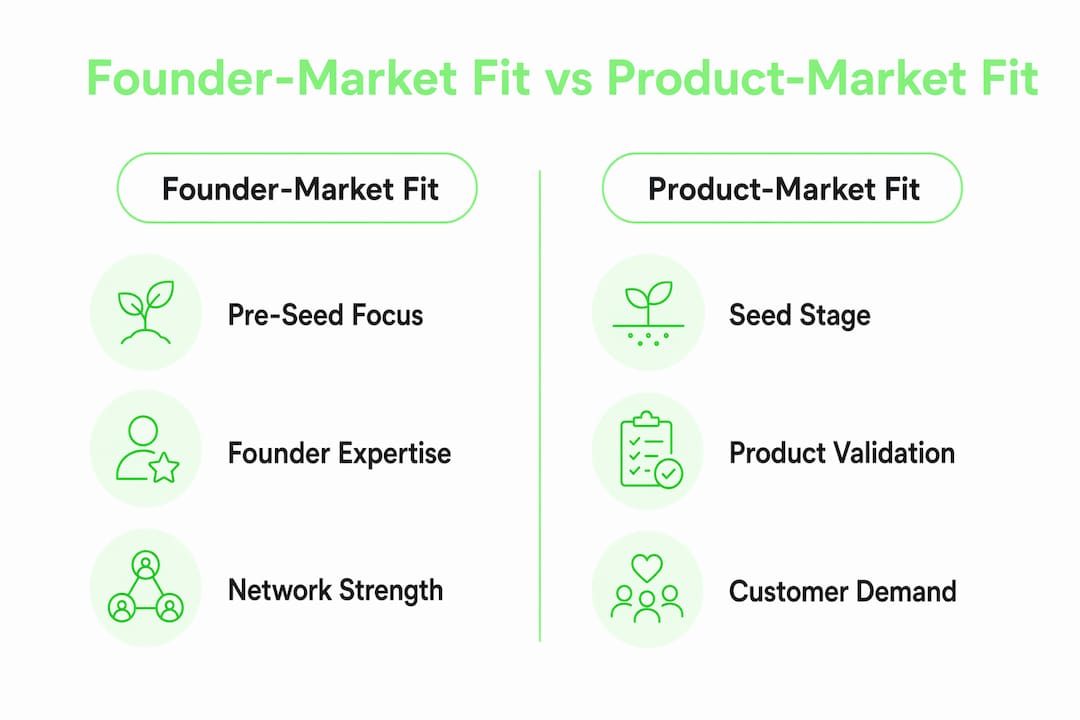
These two concepts are frequently confused, and that confusion costs founders real time and money. Founder-market fit is assessed by a founder’s background and domain expertise before a product exists. Product-market fit is a measured state determined by retention, churn, and revenue after a product is in market. They operate at completely different stages of the startup lifecycle.
Founder-market fit comes first. It predicts who will find product-market fit faster and more reliably. Think of it as the soil quality before you plant. Product-market fit is whether the crop actually grows. You need good soil before worrying about the harvest.
At the pre-seed and seed stages, investors are betting on the founder’s ability to find product-market alignment, not on a product that already has it. By Series A, the conversation shifts. Investors at that stage want to see retention curves and revenue growth. The two fits are sequential, not interchangeable.
Here is why the distinction matters practically. A founder with strong entrepreneurial fit can pivot the product repeatedly without losing their edge. They understand the market deeply enough to recognize when a solution is wrong while keeping the problem framing intact. A founder without that fit tends to pivot both the problem and the solution simultaneously, which is a recipe for losing direction entirely.
Factor | Founder-market fit | Product-market fit |
|---|---|---|
When it matters | Pre-seed and seed stages | Series A and beyond |
How it is measured | Founder background, network, domain expertise | Retention, churn, revenue, NPS |
What it predicts | Founder’s ability to navigate and persist | Product’s resonance with paying customers |
Primary audience | Early-stage investors | Growth-stage investors and operators |
How do you validate and improve your founder-market fit?
Validation does not require a big budget or months of research. A focused 14-day sprint costing under $200 including 15–20 deep customer interviews is the gold standard for early-stage validation. The key is focusing on past behavior and real pain, not hypothetical interest.
Here is a practical sequence for founders to assess and strengthen their market alignment:
Run the conversation test. Explain your problem to 10 people in your target market. Count how long it takes for them to nod. Under two minutes is a green light. Over two minutes means you need to sharpen your problem framing or reconsider your fit.
Score your problem validation. After each customer interview, rate the problem’s severity on a scale of 1–10 based on how urgently the customer described it. Kill the idea if scores fall below 6/10 consistently. Iterate if the problem scores well but the solution framing is weak. Those are two very different situations requiring two very different responses.
Test willingness to pay, not interest. Ask customers to pre-pay or sign a letter of intent, not just join a waitlist. Landing page sign-ups only test messaging resonance, not actual demand. True market demand shows up as deposits or signed pre-orders.
Run the network depth test. List 30 key industry players you can reach within a week. If you struggle to name them, your network depth is a gap that needs active work before you pitch investors.
Diagnose problem vs. solution framing. If customers understand the problem but reject your solution, that is a product iteration challenge. If customers do not recognize the problem at all, that is a fundamental fit issue requiring a harder pivot or a stop decision.
Pro Tip: The most common mistake founders make is treating a waitlist as proof of demand. A thousand email sign-ups with zero pre-orders is a marketing test, not a business validation. Require skin in the game from your earliest prospects.
For a structured approach to these steps, Siift’s startup validation guide walks founders through each stage with clear decision triggers.
How does founder-market fit influence fundraising and resilience?
Investors do not just read pitch decks. They assess whether a founder has the structural advantages to win in a specific market. Founder-market fit is nearly impossible to fake and serves as the essential anchor for navigating pivots and industry nuances. That is exactly why experienced investors prioritize it over early product metrics.
Here is what strong founder-market fit signals to a pre-seed or seed investor:
Reduced customer acquisition risk. A founder with deep network access can land the first 10 customers without a marketing budget. That is a concrete, testable advantage.
Faster product iteration. Domain expertise means fewer wrong turns. The founder already knows which assumptions are likely wrong and which are worth testing first.
Higher pivot resilience. When the first version fails (and it usually does), a founder with genuine market alignment can reframe the solution without losing their grip on the problem.
Lower execution risk. Investors are betting on a 7–10 year cycle. A founder who is personally invested in the problem is far less likely to walk away when things get hard.
“The best founders are not just smart. They are the right person for this specific problem at this specific moment.”
Founder-led market strategy also compounds over time. The deeper your market knowledge, the faster you can spot emerging customer needs, competitive gaps, and distribution opportunities that outsiders miss entirely. That compounding advantage is what separates founders who find product-market alignment quickly from those who spend years searching for it.
Key takeaways
Founder-market fit is the single most predictive early-stage signal because it determines whether a founder can survive the full startup building cycle and find product-market alignment faster than the competition.
Point | Details |
|---|---|
Fit comes before product | Investors evaluate founder-market fit at pre-seed before any product metrics exist. |
Three core dimensions | Domain knowledge, network depth, and personal conviction define strong entrepreneurial fit. |
Conversation test is your fastest diagnostic | If customers do not nod within two minutes, your problem framing or fit needs work. |
Validate with willingness to pay | Pre-orders and deposits confirm real demand; email sign-ups only confirm messaging. |
Fit predicts fundraising success | Founders with deep market alignment reduce investor risk and attract capital earlier. |
Why I think most founders get this backwards
Here is the uncomfortable truth I keep seeing: most aspiring founders spend months perfecting a product before they have spent even two weeks validating whether they are the right person to build it. They treat founder-market fit as a checkbox on a pitch deck rather than the foundational question it actually is.
I have watched founders with genuinely brilliant products fail because they were fundamentally outsiders in their chosen market. They did not have the network to get early customers. They did not have the domain knowledge to know which customer feedback to act on and which to ignore. And when the first version flopped, they did not have the personal conviction to push through the pivot. The product was not the problem. The fit was.
The founders who move fastest are not always the ones with the best ideas. They are the ones who understand their market so deeply that they can iterate with confidence rather than anxiety. That confidence is not arrogance. It is earned through lived experience, honest self-assessment, and rigorous validation. The good news is that fit can be built. You can deepen your domain knowledge, expand your network, and sharpen your problem framing. But you have to be honest about where you are starting from. Founders who skip that honesty tend to find out the hard way, usually after spending two years and significant capital on a problem they were never the right person to solve.
— Samim
How Siift helps founders validate their fit and ideas faster
Validating founder-market fit and product-market alignment does not have to be a solo, expensive, or slow process. Siift is an agentic AI platform built specifically for founders who want to move from idea to validated strategy without the guesswork or the noise. It guides you step by step through ideation, problem validation, customer interview frameworks, and go-to-market planning, all in one place. Siift filters out the biases and blind spots that trip up even experienced founders, so you spend less time spinning and more time building with clarity. If you are serious about getting your startup validation right from day one, Siift gives you the structure and intelligence to do it efficiently.
FAQ
What is founder-market fit in simple terms?
Founder-market fit is the alignment between a founder’s unique background, expertise, and network with the specific market problem they are solving. It is the primary signal investors use at pre-seed and seed stages to evaluate whether a founder can succeed.
How is founder-market fit different from product-market fit?
Founder-market fit is assessed before a product exists, based on the founder’s domain expertise and network. Product-market fit is measured after launch using retention, churn, and revenue data.
How do I know if I have strong founder-market fit?
Run the conversation test: explain your problem to target customers and see if they nod within two minutes. Also test your network depth by listing 30 key industry players you can reach within a week.
Can founder-market fit be built, or is it something you either have or not?
Founder-market fit can be strengthened through deliberate network building, deep domain learning, and honest self-assessment. It is not purely innate, but gaps must be identified and addressed before fundraising.
Why do investors prioritize founder-market fit over early product metrics?
At pre-seed and seed stages, there are no meaningful product metrics yet. Investors are betting on the founder’s ability to find product-market alignment over a typical 7–10 year building cycle, making founder fit the most reliable predictor available.