

TL;DR:
Competitive analysis helps founders understand rival strengths, weaknesses, and strategies to shape market position. Regular, structured evaluation using tiered competitors and visual frameworks reveals market gaps and opportunities. It guides better decisions in positioning, product development, pricing, and marketing strategies.
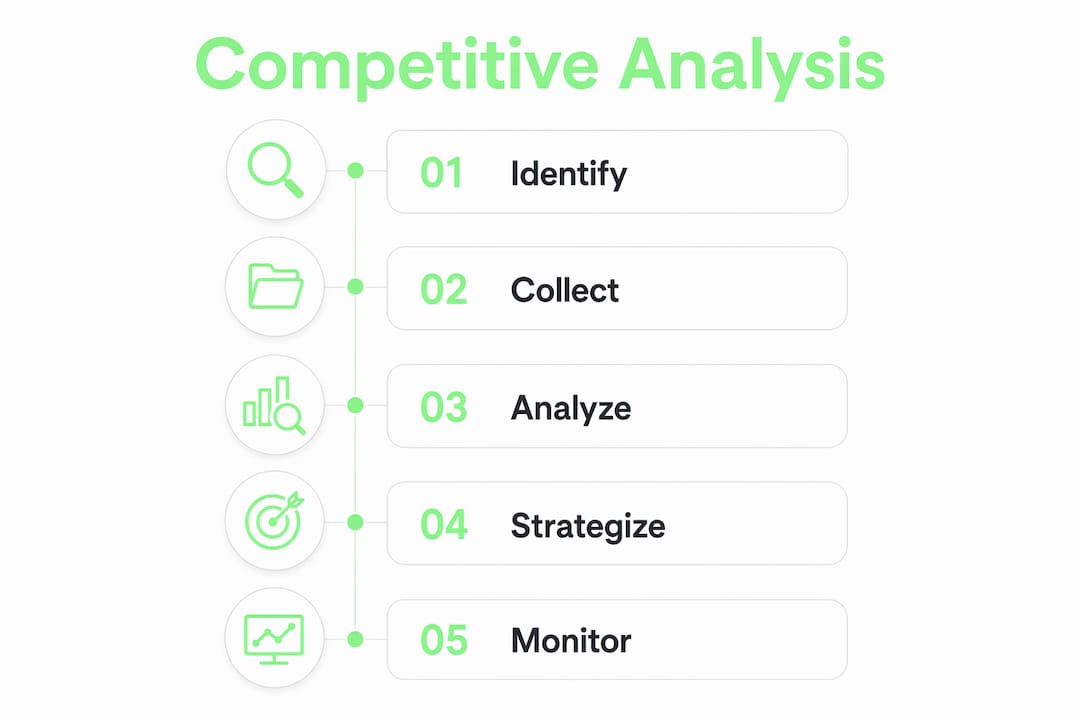
Competitive analysis is a structured process of gathering and interpreting data about your rivals’ strengths, weaknesses, strategies, and market positions to make smarter business decisions. Founders who know how to analyze competitors don’t just react to the market. They shape it. Organizations that conduct regular competitive analysis achieve 2.5x higher market leadership and 73% better decision-making than those that skip it. They also hit 40% faster time-to-market and 56% higher win rates. Those aren’t marginal gains. That’s the difference between a business that scales and one that stalls. The standard approach follows four steps: identify competitors, gather intelligence, compare with structured frameworks, and turn insights into action.
How to analyze competitors: start by identifying who they really are

Most founders list three or four names and call it a day. That’s a blind spot waiting to bite you. Segmenting competitors into tiers prevents being blindsided and broadens your competitive awareness in ways a flat list never will.
The three tiers worth tracking are:
Direct competitors: Businesses solving the same problem for the same customer with a similar solution. These are your most visible rivals.
Indirect competitors: Businesses solving the same problem with a different approach. A founder using spreadsheets to manage finances is an indirect competitor to accounting software.
Substitute competitors: Products or behaviors that replace your category entirely. Customers who “do nothing” or build their own solution fall here.
A fourth category is worth adding: aspirational competitors. These are the market leaders you’re not yet competing with directly, but whose playbooks contain lessons you can apply right now. Studying how they position, price, and communicate reveals what the market rewards at scale.
Practical ways to discover competitors include mining your own sales conversations (ask prospects who else they considered), scanning Google search results for your core use case, browsing app marketplaces, and reading industry analyst reports. Customer reviews on third-party platforms often name alternatives directly.
Pro Tip: Build a simple competitor tier map before you start collecting data. Assign each rival to a tier. This forces you to think structurally and stops you from over-indexing on the loudest names in your space while missing the quiet disruptors.
What data should you actually collect?
Data collection is where most founders either go too shallow or drown in spreadsheets. The fix is discipline. Limiting collection to five core assets per competitor keeps analysis focused and prevents the paralysis that comes from chasing every data point.
The five assets that matter most are:
Data Type | What to Look For |
|---|---|
Homepage copy | Core value proposition, target audience signals, and primary call to action |
Pricing page | Tiers, price anchors, free trial availability, and what each tier includes |
Customer reviews | Recurring complaints, praised features, and unmet needs mentioned repeatedly |
Case studies | Industries served, outcomes claimed, and customer profiles featured |
Content samples | Topics covered, tone, depth, and SEO keywords being targeted |
Create a dedicated research folder per competitor, one folder per rival, containing these five documents. This structure keeps your intelligence organized and makes comparison fast when you need it. Quality beats quantity every time. Five well-sourced documents per competitor outperform fifty half-read tabs.
Pro Tip: Set a two-hour time limit per competitor during your first research pass. Constraints force prioritization. You’ll capture the 80% that matters and avoid the rabbit hole of diminishing returns.
What frameworks turn raw data into real insight?
Raw data is just noise until a framework gives it structure. The SBA recommends SWOT analysis and Porter’s Five Forces as foundational tools for understanding market share, strengths, weaknesses, and entry barriers. Both remain relevant in 2026, and both work best when combined with visual mapping.
Here is how the core frameworks compare:
Framework | Best Used For | Output |
|---|---|---|
SWOT analysis | Assessing a single competitor’s position | Four-quadrant strengths and weaknesses map |
Porter’s Five Forces | Understanding industry-level competitive pressure | Threat and opportunity scoring by force |
Capability assessment | Comparing feature or service depth across rivals | Scored matrix by capability category |
2x2 positioning grid | Visualizing market clusters and open spaces | Visual map of competitor positioning |
The 2x2 positioning grid deserves special attention. Plot competitors on two axes that matter to your buyers, such as price versus complexity or market focus versus breadth. Clusters reveal where competition is fierce. Empty quadrants reveal where opportunity lives. That empty space is your strategic opening.
Competitive analysis also now requires tracking metrics that didn’t exist three years ago. AI search visibility and AI-driven traffic are critical new metrics that augment traditional SEO evaluation. If your competitors appear in AI-generated answers on platforms like Perplexity or ChatGPT and you don’t, that’s a distribution gap worth closing. You can test your own AI search presence with an AI search visibility test to see where you stand relative to rivals.
The goal of all this analysis is not to catalog what competitors do. It’s to find strategic gaps in the market: underserved segments, feature voids, messaging whitespace, and channel gaps that represent real opportunities. Avoid head-to-head battles where rivals are entrenched. Target the needs they’re ignoring. For a deeper look at classic frameworks tailored to founders, the SWOT analysis guide from Siift walks through each step with practical examples.
How do you turn competitor insights into business strategy?
Analysis without action is just expensive research. The translation from insight to strategy follows a clear sequence:
Update your positioning. If your 2x2 grid shows three competitors clustered around “enterprise and complex,” and you serve small businesses, make that contrast explicit in your messaging. Own the space they’re ignoring.
Build a product roadmap input. Customer reviews of competitors are a gold mine. Recurring complaints about a rival’s onboarding, pricing opacity, or missing features are your product team’s next sprint backlog.
Create sales battlecards. A one-page summary per competitor, covering their strengths, weaknesses, and how you compare on the dimensions buyers care about, gives your sales conversations structure and confidence.
Adjust pricing. If a competitor raised prices and reviews show customer frustration, that’s a window. If they’re undercutting you on a tier you don’t need to defend, let it go and compete on value elsewhere.
Refresh regularly, not obsessively. Successful founders refresh SWOT analyses per competitor regularly with updated information rather than repeating full research cycles. Spending about 15 minutes per competitor each cycle balances thoroughness and efficiency.
The most common pitfall is overcollecting data without a decision attached to it. Every piece of intelligence you gather should answer a specific question: Where should we focus? What should we build? How should we price? If a data point doesn’t answer one of those questions, it doesn’t belong in your analysis. For more on applying these insights to win in your market, the Siift article on handling competition as an entrepreneur covers the mindset and mechanics in depth.
Key Takeaways
Competitive analysis is most effective when it is structured, tiered, and cyclical, not a one-time research sprint.
Point | Details |
|---|---|
Tier your competitors | Segment rivals into direct, indirect, and substitute tiers to avoid blind spots. |
Limit data collection | Track five core assets per competitor to stay focused and avoid analysis paralysis. |
Use visual frameworks | Plot competitors on a 2x2 grid to find market clusters and open strategic spaces. |
Track AI visibility | Monitor AI search presence as a new competitive metric alongside traditional SEO. |
Refresh, don’t restart | Spend 15 minutes per competitor per cycle updating SWOT rather than repeating full research. |
The thing most founders get wrong about competitor research
Here’s what I’ve seen repeatedly working with early-stage founders: they analyze the competitors they already know and stop there. The direct rivals get all the attention. The indirect ones, the substitutes, the “do nothing” option, get ignored entirely. And then a product from an adjacent category eats their lunch.
The more useful mindset is to treat competitor analysis as a map of customer behavior, not a list of company names. When you ask “who else is competing for my customer’s attention, budget, and trust,” the list gets longer and more interesting. A founder building a project management tool for freelancers isn’t just competing with other project management tools. They’re competing with email, with spreadsheets, with the freelancer’s habit of keeping everything in their head.
The second mistake I see is using analysis to justify existing decisions rather than challenge them. Founders collect data that confirms their positioning and ignore the signals that suggest they’re in a crowded space. The 2x2 grid is useful precisely because it forces you to place yourself on the map honestly, not aspirationally.
My honest take: the founders who get the most from competitive analysis are the ones who treat it as a learning practice, not a quarterly report. They stay curious. They read competitor reviews the way a novelist reads other novels, looking for what works, what doesn’t, and what hasn’t been written yet. That’s where the real competitive advantage lives.
— Samim
Siift makes competitive intelligence work for founders
Competitive analysis is one of the highest-leverage activities a founder can do. It’s also one of the easiest to let slide when you’re heads-down building. Siift’s New Business OS is built specifically for entrepreneurs who need to move fast without missing the strategic picture. Siift guides you through competitor identification, market gap analysis, and positioning as part of a step-by-step validation process, so you’re not piecing it together from scratch. If you want to build a business with clarity about where you stand and where the real opportunities are, start with Siift and see how structured intelligence changes the way you make decisions.
FAQ
What is competitive analysis?
Competitive analysis is the process of identifying rivals and evaluating their strengths, weaknesses, strategies, and market positions to inform your own business decisions.
How often should I update my competitor research?
Refresh your SWOT analysis per competitor regularly rather than repeating full research cycles. Spending about 15 minutes per competitor each cycle keeps your intelligence current without consuming your calendar.
What are the best frameworks for analyzing competitors?
SWOT analysis, Porter’s Five Forces, capability assessment matrices, and 2x2 positioning grids are the most effective frameworks. The SBA recommends SWOT and Porter’s Five Forces as starting points for small business owners.
How do I find competitors I don’t know about yet?
Mine your sales conversations for names prospects mention, search Google for your core use case, browse app marketplaces, and read third-party customer reviews. Indirect and substitute competitors often surface through customer behavior rather than direct research.
Why does AI search visibility matter for competitor analysis?
AI-driven traffic is now a meaningful discovery channel. If competitors appear in AI-generated answers and you don’t, that’s a distribution gap. Tracking AI search presence alongside traditional SEO gives you a complete picture of competitive reach in 2026.